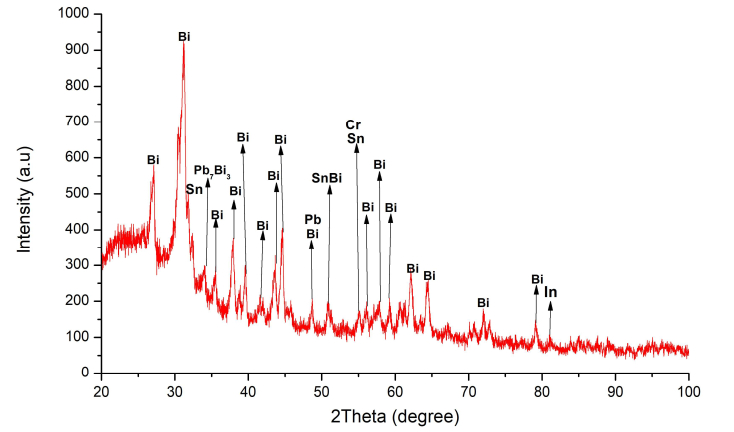
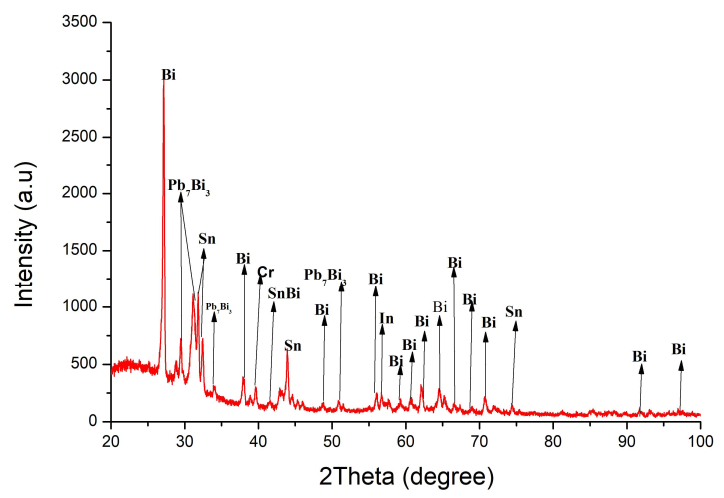
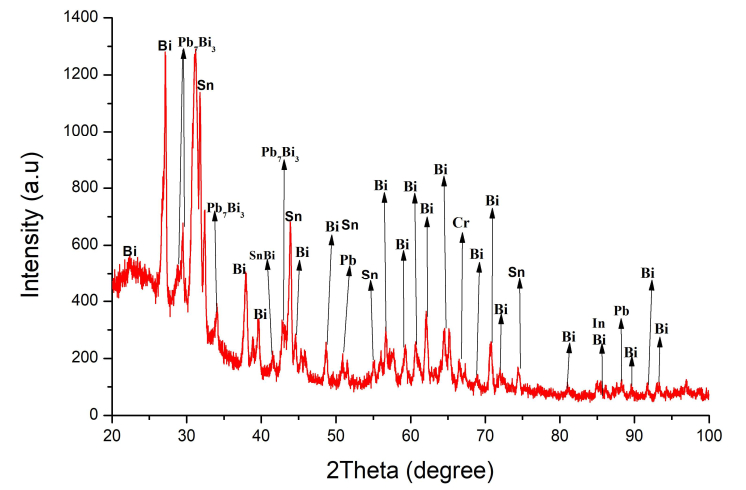
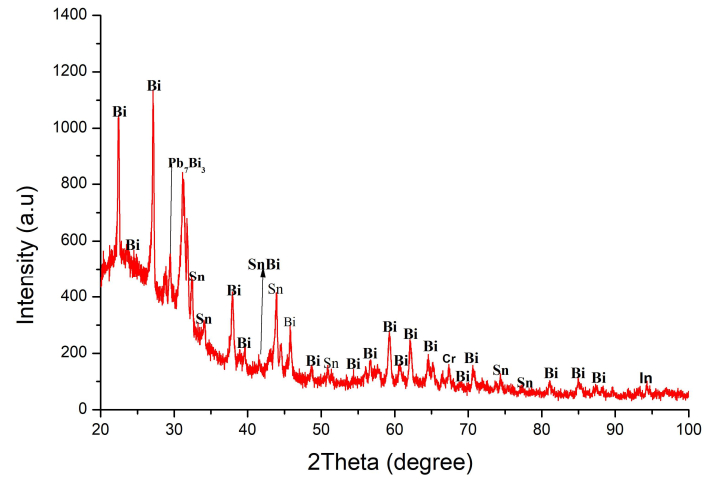
This study systematically investigated the thermal, mechanical, and structural properties of a bismuth-based (Bi-Pb-Sn-Cr-In) pentacrystalline structure solder matrix doped with nano-alumina powders to evaluate its characteristics at various nano-alumina loadings (0.5–1.5 wt%). Four well-designed nano-Al2O3 production alloys, differing only in nano-Al2O3 content, were synthesized and then investigated through X-ray diffraction, thermal/electrical transport tests, and elastic-hardness mapping methods to evaluate the effectiveness of the reinforcement. The results indicate that the presence of Al2O3 optimized the crystalline lattice of the alloy and effectively enhanced its mechanical properties, especially nano-Al2O3 at 1 wt%, which acted as a structural refiner, leading to the finest crystal domains and to the maximum Vickers microhardness value of 19.05 kg/mm2. Thermal management of Al2O3 agglomerate improves thermal stability and mechanical strength by increasing the alloy's melting temperature and pasty range. The specified 1 wt% nano-Al2O3 reinforcement loading provides enhanced mechanical robustness, thermal endurance, and electrical conductivity, with outcomes such as extended operational lifespans, lower failure rates, and long-term reliability in electronic packaging systems.
Citation: Abbas Al-Bawee, Feryal Dawood, Ahmed Alrubaiy. Effect of alumina nanoparticles on the microstructure, mechanical, and thermal properties of penta bismuth-tin-based solder alloys[J]. AIMS Materials Science, 2026, 13(1): 63-79. doi: 10.3934/matersci.2026004
This study systematically investigated the thermal, mechanical, and structural properties of a bismuth-based (Bi-Pb-Sn-Cr-In) pentacrystalline structure solder matrix doped with nano-alumina powders to evaluate its characteristics at various nano-alumina loadings (0.5–1.5 wt%). Four well-designed nano-Al2O3 production alloys, differing only in nano-Al2O3 content, were synthesized and then investigated through X-ray diffraction, thermal/electrical transport tests, and elastic-hardness mapping methods to evaluate the effectiveness of the reinforcement. The results indicate that the presence of Al2O3 optimized the crystalline lattice of the alloy and effectively enhanced its mechanical properties, especially nano-Al2O3 at 1 wt%, which acted as a structural refiner, leading to the finest crystal domains and to the maximum Vickers microhardness value of 19.05 kg/mm2. Thermal management of Al2O3 agglomerate improves thermal stability and mechanical strength by increasing the alloy's melting temperature and pasty range. The specified 1 wt% nano-Al2O3 reinforcement loading provides enhanced mechanical robustness, thermal endurance, and electrical conductivity, with outcomes such as extended operational lifespans, lower failure rates, and long-term reliability in electronic packaging systems.

| [1] |
Dawood F, Al-Bawee AT, Alrubaiy AAAG (2025) Microstructural and thermal property modifications of Sn-43Bi solder alloys via selective alloying with Se, In, Zn, and Al. Adv Sci Technol-Res 19: 273–284. https://doi.org/10.12913/22998624/205223 doi: 10.12913/22998624/205223

|
| [2] |
Al Katawy AA, Alrubaiy AAA, Jomah AJS (2024) Enhancing mechanical properties of low alloy steel through novel molten Bi-Ga austempering. DJES 17: 173–181. https://doi.org/10.24237/djes.2024.17212 doi: 10.24237/djes.2024.17212
|
| [3] |
Singh A, Durairaj R (2020) Study on hardness and shear strength with microstructure properties of Sn52Bi/Cu + 1% Al2O3 nanoparticles. IOP Conf Ser Mater Sci Eng 834: 012075. https://doi.org/10.1088/1757-899X/834/1/012075 doi: 10.1088/1757-899X/834/1/012075
|
| [4] |
Al-sorory H, Gumaan MS, Shalaby RM (2023) Effect of Al2O3 nanoparticle addition on the microstructure, mechanical, thermal, and electrical properties of melt-spun SAC355 lead-free solder for electronic packaging. J Mater Eng Perform 32: 8600–8611. https://doi.org/10.1007/s11665-022-07752-x doi: 10.1007/s11665-022-07752-x
|
| [5] |
Yang W, Li J, Li Y, et al. (2019) Effect of aluminum addition on the microstructure and properties of non-eutectic Sn-20Bi solder alloys. Materials 12: 1194. https://doi.org/10.3390/ma12071194 doi: 10.3390/ma12071194
|
| [6] |
Amares S, Ervina Efzan MN, Durairaj R, et al. (2017) Influence of nano-3% Al2O3 on the properties of low temperature Sn-58Bi (SB) lead-free solder alloy. IOP Conf Ser Mater Sci Eng 205: 012002. https://doi.org/10.1088/1757-899X/205/1/012002 doi: 10.1088/1757-899X/205/1/012002
|
| [7] |
Tan CY, Salleh MAAM (2019) The effect of aluminium addition on the microstructure of lead-free solder alloys: A short review. IOP Conf Ser Mater Sci Eng 701: 012026. https://doi.org/10.1088/1757-899X/701/1/012026 doi: 10.1088/1757-899X/701/1/012026
|
| [8] |
Yang F, Zhang L, Liu Z, et al. (2016) Properties and microstructures of Sn-Bi-X lead-free solders. Adv Mater Sci Eng 2016: 9265195. https://doi.org/10.1155/2016/9265195 doi: 10.1155/2016/9265195
|
| [9] |
Kang H, Rajendran SH, Jung JP (2021) Low melting temperature Sn-Bi solder: Effect of alloying and nanoparticle addition on the microstructural, thermal, interfacial bonding, and mechanical characteristics. Metals 11: 364. https://doi.org/10.3390/met11020364 doi: 10.3390/met11020364
|
| [10] |
Li S, Wang X, Liu Z, et al. (2020) Research status of evolution of microstructure and properties of sn-based lead-free composite solder alloys. J Nanomater 2020: 8843166. https://doi.org/10.1155/2020/8843166 doi: 10.1155/2020/8843166
|
| [11] |
Akbar N (2019) To investigate the thermal and mechanical properties of bismuth-doped SAC solder. Int J Res Appl Sci Eng Technol 7: 37–47. https://doi.org/10.22214/ijraset.2019.8006 doi: 10.22214/ijraset.2019.8006
|
| [12] |
Yang T, Chen Y, You K, et al. (2022) Effect of Bi, Sb, and Ti on microstructure and mechanical properties of SAC105 alloys. Materials 15: 4727. https://doi.org/10.3390/ma15144727 doi: 10.3390/ma15144727
|
| [13] |
Li C, Yan Y, Gao T, et al. (2020) The microstructure, thermal, and mechanical properties of Sn-3.0Ag-0.5Cu-xSb high-temperature lead-free solder. Materials 13: 4443. https://doi.org/10.3390/ma13194443 doi: 10.3390/ma13194443
|
| [14] |
Chen W, Kong J, Chen WJ (2011) Effect of rare earth Ce on the microstructure, physical properties and thermal stability of a new lead-free solder. J Min Metall Sect B 47: 11–21. https://doi.org/10.2298/JMMB1101011C doi: 10.2298/JMMB1101011C
|
| [15] |
Sayyadi R, Naffakh-Moosavy H (2019) The role of intermetallic compounds in controlling the microstructural, physical and mechanical properties of Cu-[Sn-Ag-Cu-Bi]-Cu solder joints. Sci Rep 9: 8389. https://doi.org/10.1038/s41598-019-44758-3 doi: 10.1038/s41598-019-44758-3
|
| [16] |
Yang C, Zhou S, Lin S, et al. (2019) A computational thermodynamics-assisted development of Sn-Bi-In-Ga quaternary alloys as low-temperature Pb-free solders. Materials 12: 631. https://doi.org/10.3390/ma12040631 doi: 10.3390/ma12040631
|
| [17] |
Yakymovych A, Mudry S, Shtablavyi I, et al. (2016) Effect of nano Co reinforcements on the structure of the Sn-3.0Ag-0.5Cu solder in liquid and after reflow solid states. Mater Chem Phys 181: 470–475. https://doi.org/10.1016/j.matchemphys.2016.06.083 doi: 10.1016/j.matchemphys.2016.06.083
|
| [18] |
Said RM, Saud N, Nasir NM, et al. (2019) Enhanced thermal and microstructure properties of Sn-1.0Ag-0.7Cu based lead-free solder with titanium oxide addition. IOP Conf Ser Mater Sci Eng 701: 012046. https://doi.org/10.1088/1757-899X/701/1/012046 doi: 10.1088/1757-899X/701/1/012046
|
| [19] |
Fathy N, Hafez KM, Abdulaziz F, et al. (2025) Development of hypoeutectic SnBi alloy solder reinforced with WO3 nanoparticles for connecting Cu substrates via thermal bonding. Sci Rep 15: 6849. https://doi.org/10.1038/s41598-025-89729-z doi: 10.1038/s41598-025-89729-z
|
| [20] |
Yang W, Yang Z, Fu Y, et al. (2020) Effect of graphene nanosheet addition on the wettability and mechanical properties of Sn-20Bi-xGNS/Cu solder joints. Materials 13: 3968. https://doi.org/10.3390/ma13183968 doi: 10.3390/ma13183968
|
| [21] |
Nawi SA, Mohamed MT, Rajab MA, et al. (2024) Enhancing the performance of hybrid composites through the addition of zinc oxide and carbon fibers. DJES 17: 112–119. https://doi.org/10.24237/djes.2024.17208 doi: 10.24237/djes.2024.17208
|
| [22] |
Liu Y, Tu KN (2020) Low melting point solders based on Sn, Bi, and In elements. Mater Today Adv 8: 100115. https://doi.org/10.1016/j.mtadv.2020.100115 doi: 10.1016/j.mtadv.2020.100115
|
| [23] |
Pu L, Liu Y, Yang Y, et al. (2020) Effect of adding Ag to the medium entropy SnBiIn alloy on intermetallic compound formation. Mater Lett 272: 127891. https://doi.org/10.1016/j.matlet.2020.127891 doi: 10.1016/j.matlet.2020.127891
|
| [24] |
Dadvand A, Boukani NH, Dawoodian M (2018) Numerical simulation of the melting of a NePCM due to a heated thin plate with different positions in a square enclosure. Therm Sci Eng Prog 7: 248–266. https://doi.org/10.1016/j.tsep.2018.06.013 doi: 10.1016/j.tsep.2018.06.013
|
| [25] |
Al-Rubaiy AAAG, Al Katawy AA, Azawy AK, et al. (2025) Enhancing the thermal and acoustic performance of phenolic polymeric aggregate concrete. ARFMTS 129: 104–114. https://doi.org/10.37934/arfmts.129.2.104114 doi: 10.37934/arfmts.129.2.104114
|
| [26] |
Mohamed MT, Helal RA, Nawi SA, et al. (2023) Identifying regularities of high temperature on constant and variable fatigue life of AA7075-Al2O3 nanocomposite fabricated by stir casting method. East-Eur J Enterp Technol 2: 35–41. https://doi.org/10.15587/1729-4061.2023.276835 doi: 10.15587/1729-4061.2023.276835
|
| [27] |
Algailani HM, Al-Nassar SI, Mahmoud AK, et al. (2024) Study the wear characteristics for Ni‐ZrO2 and Ni‐Al2O3 nanocomposite coatings produced by electroless deposition technique. Mater Des Process Commun 2024: 4907211. https://doi.org/10.1155/2024/4907211 doi: 10.1155/2024/4907211
|
Figures(12) / Tables(5)

Abbas Al-Bawee, Feryal Dawood, Ahmed Alrubaiy. Effect of alumina nanoparticles on the microstructure, mechanical, and thermal properties of penta bismuth-tin-based solder alloys[J]. AIMS Materials Science, 2026, 13(1): 63-79. doi: 10.3934/matersci.2026004





 DownLoad: