We studied finite-horizon cooperative packing with heterogeneous linear dynamics, convex local constraints, quadratic costs, and reverse-convex pairwise disk clearance. Nonlinear disk indicators give an exact consensus lifting; fixed contact halfspaces give a convex inner approximation. For a specified synchronous local/copy multiplier iteration, a weighted distance to a saddle of the fixed-halfspace problem decreases and bounds the multipliers. A retained-edge dual procedure implements the joint weighted copy projection using neighbor exchanges, with convergence even when contact rows are redundant. A feasible normal-refresh outer iteration has original-disk Karush–Kuhn–Tucker cluster points under an explicit uniform strict-point condition, allowing active local input and corridor bounds. Separately, a jammed antipodal polygon is a strict saddle in a reduced position model. Its fixed-point statement requires coincident historical copies and specified multipliers; its stale-normal estimate is local. Using five shared feasible starts, we compared the implemented normal-refresh method with external nonlinear solvers using the same original-disk feasibility, stationarity, complementarity, and multiplier-sign thresholds. The proposed method and two released SciPy solvers passed this screen on all starts; an additional independent ALADIN reference was reported by variant, including unsuccessful runs. The results distinguish surrogate convergence, original-problem stationarity, and constrained saddle behavior.
Citation: Zhonghui Xue, Yu Chen. Consensus multiplier methods for heterogeneous reverse-convex programs[J]. Journal of Industrial and Management Optimization, 2026, 22(12): 6908-6935. doi: 10.3934/jimo.2026230
We studied finite-horizon cooperative packing with heterogeneous linear dynamics, convex local constraints, quadratic costs, and reverse-convex pairwise disk clearance. Nonlinear disk indicators give an exact consensus lifting; fixed contact halfspaces give a convex inner approximation. For a specified synchronous local/copy multiplier iteration, a weighted distance to a saddle of the fixed-halfspace problem decreases and bounds the multipliers. A retained-edge dual procedure implements the joint weighted copy projection using neighbor exchanges, with convergence even when contact rows are redundant. A feasible normal-refresh outer iteration has original-disk Karush–Kuhn–Tucker cluster points under an explicit uniform strict-point condition, allowing active local input and corridor bounds. Separately, a jammed antipodal polygon is a strict saddle in a reduced position model. Its fixed-point statement requires coincident historical copies and specified multipliers; its stale-normal estimate is local. Using five shared feasible starts, we compared the implemented normal-refresh method with external nonlinear solvers using the same original-disk feasibility, stationarity, complementarity, and multiplier-sign thresholds. The proposed method and two released SciPy solvers passed this screen on all starts; an additional independent ALADIN reference was reported by variant, including unsuccessful runs. The results distinguish surrogate convergence, original-problem stationarity, and constrained saddle behavior.

| [1] |
Z. Pan, K. Wu, BC-ADMM: A parallel decoupled non-convex constrained optimizer for robot applications, Int. J. Rob. Res., 2026, Advance online publication. https://doi.org/10.1177/02783649261458408 |
| [2] |
D. Q. Mayne, J. B. Rawlings, C. V. Rao, P. O. M. Scokaert, Constrained model predictive control: Stability and optimality, Automatica, 36 (2000), 789–814. https://doi.org/10.1016/s0005-1098(99)00214-9 doi: 10.1016/s0005-1098(99)00214-9
|
| [3] |
I. Karamouzas, N. Sohre, R. Narain, S. J. Guy, Implicit crowds: Optimization integrator for robust crowd simulation, ACM Trans. Graph., 36 (2017), 136. https://doi.org/10.1145/3072959.3073705 doi: 10.1145/3072959.3073705
|
| [4] |
B. Zhou, F. Gao, L. Wang, C. Liu, S. Shen, Robust and efficient quadrotor trajectory generation for fast autonomous flight, IEEE Robot. Autom. Lett., 4 (2019), 3529–3536. https://doi.org/10.1109/lra.2019.2927938 doi: 10.1109/lra.2019.2927938
|
| [5] |
S. Boyd, N. Parikh, E. Chu, B. Peleato, J. Eckstein, Distributed optimization and statistical learning via the alternating direction method of multipliers, Found. Trends Mach. Learn., 3 (2011), 1–122. https://doi.org/10.1561/2200000016 doi: 10.1561/2200000016
|
| [6] |
R. T. Rockafellar, Augmented Lagrangians and applications of the proximal point algorithm in convex programming, Math. Oper. Res., 1 (1976), 97–116. https://doi.org/10.1287/moor.1.2.97 doi: 10.1287/moor.1.2.97
|
| [7] |
Y. Yang, X. Guan, Q.-S. Jia, L. Yu, B. Xu, C. J. Spanos, A survey of ADMM variants for distributed optimization: Problems, algorithms and features, arXiv: 2208.03700, 2022. https://doi.org/10.48550/arXiv.2208.03700 |
| [8] |
O. Shorinwa, T. Halsted, J. Yu, M. Schwager, Distributed optimization methods for multi-robot systems: Part 2—a survey, IEEE Robot. Autom. Mag., 31 (2024), 154–169. https://doi.org/10.1109/mra.2024.3352852 doi: 10.1109/mra.2024.3352852
|
| [9] |
M. Hong, Z.-Q. Luo, M. Razaviyayn, Convergence analysis of alternating direction method of multipliers for a family of nonconvex problems, SIAM J. Optim., 26 (2016), 337–364. https://doi.org/10.1137/140990309 doi: 10.1137/140990309
|
| [10] |
Y. Wang, W. Yin, J. Zeng, Global convergence of ADMM in nonconvex nonsmooth optimization, J. Sci. Comput., 78 (2019), 29–63. https://doi.org/10.1007/s10915-018-0757-z doi: 10.1007/s10915-018-0757-z
|
| [11] |
B. Jiang, T. Lin, S. Ma, S. Zhang, Structured nonconvex and nonsmooth optimization: Algorithms and iteration complexity analysis, Comput. Optim. Appl., 72 (2019), 115–157. https://doi.org/10.1007/s10589-018-0034-y doi: 10.1007/s10589-018-0034-y
|
| [12] |
A. Themelis, P. Patrinos, Douglas–Rachford splitting and ADMM for nonconvex optimization: Tight convergence results, SIAM J. Optim., 30 (2020), 149–181. https://doi.org/10.1137/18m1163993 doi: 10.1137/18m1163993
|
| [13] |
G. Li, T. K. Pong, Global convergence of splitting methods for nonconvex composite optimization, SIAM J. Optim., 25 (2015), 2434–2460. https://doi.org/10.1137/140998135 doi: 10.1137/140998135
|
| [14] |
T.-H. Chang, M. Hong, W.-C. Liao, X. Wang, Asynchronous distributed ADMM for large-scale optimization—part Ⅰ: Algorithm and convergence analysis, IEEE Trans. Signal Process., 64 (2016), 3118–3130. https://doi.org/10.1109/tsp.2016.2537271 doi: 10.1109/tsp.2016.2537271
|
| [15] |
M. Hong, A distributed, asynchronous and incremental algorithm for nonconvex optimization: An ADMM approach, IEEE Trans. Control Netw. Syst., 5 (2018), 935–945. https://doi.org/10.1109/tcns.2017.2657460 doi: 10.1109/tcns.2017.2657460
|
| [16] |
S. Kumar, R. Jain, K. Rajawat, Asynchronous optimization over heterogeneous networks via consensus ADMM, IEEE Trans. Signal Inf. Process. Netw., 3 (2017), 114–129. https://doi.org/10.1109/tsipn.2016.2593896 doi: 10.1109/tsipn.2016.2593896
|
| [17] |
B. Mafakheri, J. H. Manton, I. Shames, An asynchronous decentralised optimisation algorithm for nonconvex problems, arXiv: 2507.22311, 2025. https://doi.org/10.48550/arXiv.2507.22311 |
| [18] |
G. Carnevale, N. Bastianello, G. Notarstefano, R. Carli, ADMM-tracking gradient for distributed optimization over asynchronous and unreliable networks, IEEE Trans. Autom. Control, 70 (2025), 5160–5175. https://doi.org/10.1109/tac.2025.3539454 doi: 10.1109/tac.2025.3539454
|
| [19] |
X. Zhang, J. Ma, Z. Cheng, S. Huang, C. W. de Silva, T. H. Lee, Improved hierarchical ADMM for nonconvex cooperative distributed model predictive control, arXiv: 2011.00463, 2020. https://doi.org/10.48550/arXiv.2011.00463 |
| [20] |
K. Sun, X. A. Sun, A two-level distributed algorithm for nonconvex constrained optimization, Comput. Optim. Appl., 84 (2023), 609–649. https://doi.org/10.1007/s10589-022-00433-4 doi: 10.1007/s10589-022-00433-4
|
| [21] |
J. Nocedal, S. J. Wright, Numerical Optimization, 2nd edition, Springer, 2006. Available from: https://doi.org/10.1007/978-0-387-40065-5. |
| [22] |
J. D. Lee, M. Simchowitz, M. I. Jordan, B. Recht, Gradient descent only converges to minimizers, In: 29th Annual Conference on Learning Theory, vol. 49 of Proceedings of Machine Learning Research. PMLR, 2016, 1246–1257. Available from: https://proceedings.mlr.press/v49/lee16.html. |
| [23] |
J. D. Lee, I. Panageas, G. Piliouras, M. Simchowitz, M. I. Jordan, B. Recht, First-order methods almost always avoid strict saddle points, Math. Program., 176 (2019), 311–337. https://doi.org/10.1007/s10107-019-01374-3 doi: 10.1007/s10107-019-01374-3
|
| [24] |
H. Attouch, J. Bolte, B. F. Svaiter, Convergence of descent methods for semi-algebraic and tame problems: Proximal algorithms, forward–backward splitting, and regularized Gauss–Seidel methods, Math. Program., 137 (2013), 91–129. https://doi.org/10.1007/s10107-011-0484-9 doi: 10.1007/s10107-011-0484-9
|
| [25] |
J. Bolte, S. Sabach, M. Teboulle, Proximal alternating linearized minimization for nonconvex and nonsmooth problems, Math. Program., 146 (2014), 459–494. https://doi.org/10.1007/s10107-013-0701-9 doi: 10.1007/s10107-013-0701-9
|
| [26] |
B. Houska, J. Frasch, M. Diehl, An augmented Lagrangian based algorithm for distributed nonconvex optimization, SIAM J. Optim., 26 (2016), 1101–1127. https://doi.org/10.1137/140975991 doi: 10.1137/140975991
|
| [27] |
W. Deng, W. Yin, On the global and linear convergence of the generalized alternating direction method of multipliers, J. Sci. Comput., 66 (2016), 889–916. https://doi.org/10.1007/s10915-015-0048-x doi: 10.1007/s10915-015-0048-x
|
| [28] |
D. P. Bertsekas, J. N. Tsitsiklis, Parallel and Distributed Computation: Numerical Methods, Athena Scientific, 2015. Available from: http://www.athenasc.com/pdcbook.html. |
| [29] |
J. Guo, G. Hug, O. Tonguz, Asynchronous ADMM for distributed non-convex optimization in power systems, arXiv: 1710.08938, 2017. https://doi.org/10.48550/arXiv.1710.08938 |
| [30] |
M. Mesbahi, M. Egerstedt, Graph Theoretic Methods in Multiagent Networks, Princeton University Press, 2010. https://doi.org/10.1515/9781400835355 |
| [31] |
A. Nedić, J. Liu, Distributed optimization for control, Annu. Rev. Control Robot. Auton. Syst., 1 (2018), 77–103. https://doi.org/10.1146/annurev-control-060117-105131 doi: 10.1146/annurev-control-060117-105131
|
| [32] |
C. Hildreth, A quadratic programming procedure, Naval Res. Logist. Q., 4 (1957), 79–85. https://doi.org/10.1002/nav.3800040113 doi: 10.1002/nav.3800040113
|
| [33] |
R. L. Dykstra, An algorithm for restricted least squares regression, J. Am. Stat. Assoc., 78 (1983), 837–842. https://doi.org/10.1080/01621459.1983.10477029 doi: 10.1080/01621459.1983.10477029
|
| [34] |
R. J. Tibshirani, Dykstra's algorithm, ADMM, and coordinate descent: Connections, insights, and extensions, arXiv: 1705.04768, 2017. https://doi.org/10.48550/arXiv.1705.04768 |
| [35] |
B. R. Marks, G. P. Wright, Technical note—a general inner approximation algorithm for nonconvex mathematical programs, Oper. Res., 26 (1978), 681–683. https://doi.org/10.1287/opre.26.4.681 doi: 10.1287/opre.26.4.681
|
| [36] |
G. Scutari, F. Facchinei, L. Lampariello, Parallel and distributed methods for constrained nonconvex optimization—part Ⅰ: Theory, IEEE Trans. Signal Process., 65 (2017), 1929–1944. https://doi.org/10.1109/tsp.2016.2637317 doi: 10.1109/tsp.2016.2637317
|
| [37] |
D. Kraft, A Software Package for Sequential Quadratic Programming, Technical Report DFVLR-FB 88-28, DFVLR German Aerospace Center, 1988. |
| [38] |
R. H. Byrd, M. E. Hribar, J. Nocedal, An interior point algorithm for large-scale nonlinear programming, SIAM J. Optim., 9 (1999), 877–900. https://doi.org/10.1137/s1052623497325107 doi: 10.1137/s1052623497325107
|
| [39] |
P. Virtanen, R. Gommers, T. E. Oliphant, M. Haberland, T. Reddy, D. Cournapeau, et al., SciPy 1.0: Fundamental algorithms for scientific computing in Python, Nat. Methods, 17 (2020), 261–272. https://doi.org/10.1038/s41592-019-0686-2 doi: 10.1038/s41592-019-0686-2
|
| [40] |
A. Engelmann, Y. Jiang, H. Benner, R. Ou, B. Houska, T. Faulwasser, ALADIN-$\alpha$—an open-source MATLAB toolbox for distributed non-convex optimization, Optim. Control Appl. Methods, 43 (2022), 4–22. https://doi.org/10.1002/oca.2811 doi: 10.1002/oca.2811
|
 jimo-22-12-230-s001.pdf |
 |
Figures(4) / Tables(3)
Zhonghui Xue, Yu Chen. Consensus multiplier methods for heterogeneous reverse-convex programs[J]. Journal of Industrial and Management Optimization, 2026, 22(12): 6908-6935. doi: 10.3934/jimo.2026230

Scope of the analysis. The delayed-copy statements concern reduced contact geometry. The convergence statements refer to the explicitly specified inner and outer iterations
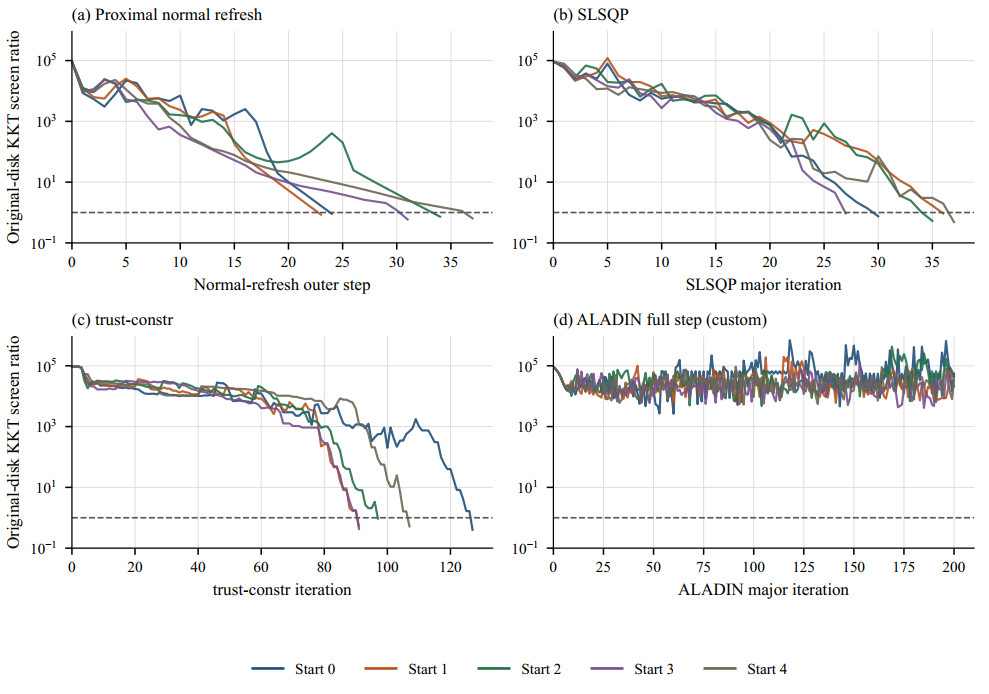
Common original-disk KKT screen along the saved trajectories. The displayed ratio combines physical feasibility, raw stationarity, and raw complementarity using the thresholds in (7.3); success requires the ratio at most one. Each panel uses that method's native iteration axis. The axes are not a common measure of computational work
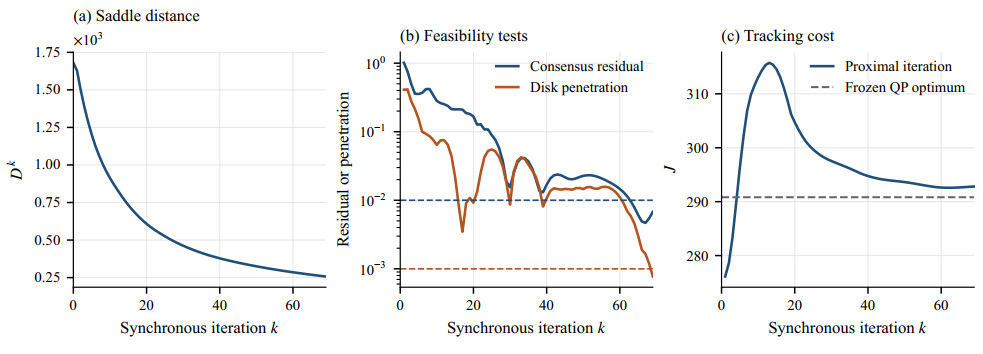
Fixed-halfspace synchronous proximal run, seed $ 0 $. (a) Distance to the saddle of that same frozen problem, including $ D^0 $. (b) Consensus residual and disk penetration. (c) Tracking cost and the frozen-QP reference value. This is a distance-inequality diagnostic, separate from the common original-disk KKT benchmark
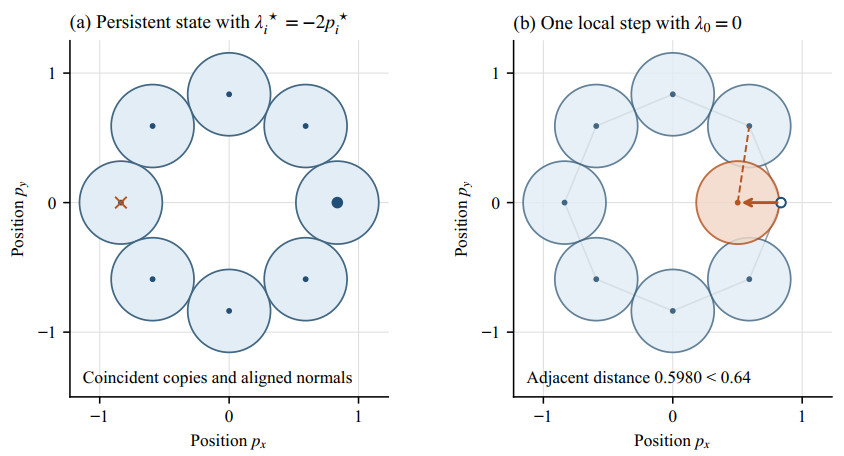
Exact reduced-position illustration of Theorem 6.21, with $ M = 8 $, $ d = 0.64 $, and $ \alpha = 1 $. (a) Coincident history and $ \lambda_i^\star = -2p_i^\star $ give a fixed point. (b) One awake endpoint with $ \lambda_i = 0 $ and $ \rho_i+\gamma_i = 4 $ has a radial factor $ \kappa_i = 0.6 $ and an adjacent distance of $ 0.5980 < d $. The panels use distinct multiplier states



 DownLoad: