In this study, we investigated dual outsourcing strategies for multi-component products on a competitive equipment manufacturing platform comprising an original equipment manufacturer (OEM), a competing contract manufacturer (CM), and a component supplier. A game-theoretic model was developed to compare four combinations of in-house and outsourced production and procurement. The results showed that the OEM's production and procurement decisions are interdependent: Procurement outsourcing is possible only when production is outsourced. When the one-time investment cost of establishing a production line is low, the OEM chooses in-house production and procurement; when the cost is high, it outsources production, while its procurement decision depends on relative market potential. For sensitivity analyses, we examined how the investment cost, relative market potential, and quantity discount level affected the OEM's production and procurement outsourcing preferences and the CM's preferences over the OEM's strategies. A distinctive finding was that, conditional on the OEM retaining procurement authority, its willingness to produce in-house is jointly affected by relative market potential and the quantity-discount level and does not exhibit a uniform monotonic response to either factor considered separately. We further identified the conditions for win-win outcomes and found that their probability decreases as the quantity discount level increases. These findings provide guidance for coordinating cooperation and competition on manufacturing platforms.
Citation: Jinzhou He, Xiaojuan Li. Research on dual outsourcing strategies for multi-component products in a competitive equipment manufacturing platform[J]. Journal of Industrial and Management Optimization, 2026, 22(12): 6503-6538. doi: 10.3934/jimo.2026218
In this study, we investigated dual outsourcing strategies for multi-component products on a competitive equipment manufacturing platform comprising an original equipment manufacturer (OEM), a competing contract manufacturer (CM), and a component supplier. A game-theoretic model was developed to compare four combinations of in-house and outsourced production and procurement. The results showed that the OEM's production and procurement decisions are interdependent: Procurement outsourcing is possible only when production is outsourced. When the one-time investment cost of establishing a production line is low, the OEM chooses in-house production and procurement; when the cost is high, it outsources production, while its procurement decision depends on relative market potential. For sensitivity analyses, we examined how the investment cost, relative market potential, and quantity discount level affected the OEM's production and procurement outsourcing preferences and the CM's preferences over the OEM's strategies. A distinctive finding was that, conditional on the OEM retaining procurement authority, its willingness to produce in-house is jointly affected by relative market potential and the quantity-discount level and does not exhibit a uniform monotonic response to either factor considered separately. We further identified the conditions for win-win outcomes and found that their probability decreases as the quantity discount level increases. These findings provide guidance for coordinating cooperation and competition on manufacturing platforms.

| [1] |
L. Li, J. Han, C. Chen, S. Liu, H. Ding, Overview of the development of ground unmanned equipment, Automobile Applied Technology, 50 (2025), 156-162. https://doi.org/10.16638/j.cnki.1671-7988.2025.013.029 doi: 10.16638/j.cnki.1671-7988.2025.013.029
|
| [2] |
Y. Tian, C. Zhao, Research on software-defined weapon equipment technology, Science and Technology & Innovation, 13 (2024), 110-112. https://doi.org/10.15913/j.cnki.kjycx.2024.13.029 doi: 10.15913/j.cnki.kjycx.2024.13.029
|
| [3] |
G. P. Cachon, P. T. Harker, Competition and outsourcing with scale economies, Manage. Sci., 48 (2002), 1314-1333. https://doi.org/10.1287/mnsc.48.10.1314.271 doi: 10.1287/mnsc.48.10.1314.271
|
| [4] |
Y. Jin, J. K. Ryan, Price and service competition in an outsourced supply chain, Prod. Oper. Manag., 21 (2012), 331-344. https://doi.org/10.1111/j.1937-5956.2011.01247.x doi: 10.1111/j.1937-5956.2011.01247.x
|
| [5] |
A. Nagurney, D. Li, L. S. Nagurney, Pharmaceutical supply chain networks with outsourcing under price and quality competition, Int. Trans. Oper. Res., 20 (2013), 859-888. https://doi.org/10.1111/itor.12031 doi: 10.1111/itor.12031
|
| [6] |
S. Benjaafar, E. Elahi, K. L. Donohue, Outsourcing via service competition, Manage. Sci., 53 (2007), 241-259. https://doi.org/10.1287/mnsc.1060.0612 doi: 10.1287/mnsc.1060.0612
|
| [7] |
S. H. Bae, C. S. Yoo, J. Sarkis, Outsourcing with quality competition: Insights from a three-stage game-theoretic model, Int. J. Prod. Res., 48 (2010), 327-342. https://doi.org/10.1080/00207540903174882 doi: 10.1080/00207540903174882
|
| [8] |
A. Arya, B. Mittendorf, D. E. M. Sappington, Outsourcing, vertical integration, and price vs. quantity competition, Int. J. Ind. Organ., 26 (2008), 1-16. https://doi.org/10.1016/j.ijindorg.2006.10.006 doi: 10.1016/j.ijindorg.2006.10.006
|
| [9] |
D. Ni, K. W. Li, X. Tang, Production costs, scope economies, and multi-client outsourcing under quantity competition, Int. J. Prod. Econ., 121 (2009), 130-140. https://doi.org/10.1016/j.ijpe.2009.04.018 doi: 10.1016/j.ijpe.2009.04.018
|
| [10] |
X. Meng, Z. Yao, J. Nie, Y. Zhao, Make or buy? It is the question: A study in the presence of carbon tax, Int. J. Prod. Econ., 195 (2018), 328-337. https://doi.org/10.1016/j.ijpe.2017.10.029 doi: 10.1016/j.ijpe.2017.10.029
|
| [11] |
J. Amaral, C. A. Billington, A. A. Tsay, Safeguarding the promise of production outsourcing, Interfaces, 36 (2006), 220-233. https://doi.org/10.1287/inte.1060.0210 doi: 10.1287/inte.1060.0210
|
| [12] |
K. Chen, T. Xiao, Outsourcing strategy and production disruption of supply chain with demand and capacity allocation uncertainties, Int. J. Prod. Econ., 170 (2015), 243-257. https://doi.org/10.1016/j.ijpe.2015.09.028 doi: 10.1016/j.ijpe.2015.09.028
|
| [13] |
X. Wang, X. Liu, S. Zhang, The impact of subsidies on wind farms under uncertainty: A real options approach, Omega, 144 (2026), 103592. https://doi.org/10.1016/j.omega.2026.103592 doi: 10.1016/j.omega.2026.103592
|
| [14] |
X. Wang, X. Liu, S. Zhang, Operational and expansion strategies of wind farms under uncertainty: The impact of credit risk and production flexibility, IEEE Trans. Eng. Manag., 73 (2026), 1512-1527. https://doi.org/10.1109/TEM.2026.3656529 doi: 10.1109/TEM.2026.3656529
|
| [15] |
X. Zhu, Outsourcing management under various demand information sharing scenarios, Ann. Oper. Res., 257 (2017), 449-467. https://doi.org/10.1007/s10479-015-1944-z doi: 10.1007/s10479-015-1944-z
|
| [16] |
J. Chen, L. Liang, F. Yang, Cooperative quality investment in outsourcing, Int. J. Prod. Econ., 162 (2015), 174-191. https://doi.org/10.1016/j.ijpe.2015.01.019 doi: 10.1016/j.ijpe.2015.01.019
|
| [17] |
Y. Wang, B. Niu, P. Guo, The comparison of two vertical outsourcing structures under push and pull contracts, Prod. Oper. Manag., 23 (2014), 610-625. https://doi.org/10.1111/poms.12025 doi: 10.1111/poms.12025
|
| [18] |
A. A. Tsay, N. Agrawal, Channel conflict and coordination in the e-commerce age, Prod. Oper. Manag., 13 (2004), 93-110. https://doi.org/10.1111/j.1937-5956.2004.tb00147.x doi: 10.1111/j.1937-5956.2004.tb00147.x
|
| [19] |
Q. Li, B. Li, P. Chen, P. Hou, Dual-channel supply chain decisions under asymmetric information with a risk-averse retailer, Ann. Oper. Res., 257 (2017), 423-447. https://doi.org/10.1007/s10479-015-1852-2 doi: 10.1007/s10479-015-1852-2
|
| [20] |
S. X. Zhu, Analysis of dual sourcing strategies under supply disruptions, Int. J. Prod. Econ., 170 (2015), 191-203. https://doi.org/10.1016/j.ijpe.2015.09.019 doi: 10.1016/j.ijpe.2015.09.019
|
| [21] |
V. Gupta, B. He, S. P. Sethi, Contingent sourcing under supply disruption and competition, Int. J. Prod. Res., 53 (2015), 3006-3027. https://doi.org/10.1080/00207543.2014.965351 doi: 10.1080/00207543.2014.965351
|
| [22] |
N. Zeng, Dual sourcing decisions with supply risk and capacity constraint, Management Review, 33 (2021), 294-305. https://doi.org/10.14120/j.cnki.cn11-5057/f.20201223.001 doi: 10.14120/j.cnki.cn11-5057/f.20201223.001
|
| [23] |
C. P. Chen, Z. X. Chen, Research on transnational dual-source procurement strategy with suppliers' different supply lead-time, IFAC-PapersOnLine, 52 (2019), 2038-2043. https://doi.org/10.1016/j.ifacol.2019.11.505 doi: 10.1016/j.ifacol.2019.11.505
|
| [24] |
P. L. Meena, S. P. Sarmah, Multiple sourcing under supplier failure risk and quantity discount: A genetic algorithm approach, Transp. Res. Part E Logist. Transp. Rev., 50 (2013), 84-97. https://doi.org/10.1016/j.tre.2012.10.001 doi: 10.1016/j.tre.2012.10.001
|
| [25] |
T. Sawik, Optimization of cost and service level in the presence of supply chain disruption risks: Single vs. multiple sourcing, Comput. Oper. Res., 51 (2014), 11-20. https://doi.org/10.1016/j.cor.2014.04.006 doi: 10.1016/j.cor.2014.04.006
|
| [26] |
N. Freeman, J. Mittenthal, B. Keskin, S. Melouk, Sourcing strategies for a capacitated firm subject to supply and demand uncertainty, Omega, 77 (2018), 127-142. https://doi.org/10.1016/j.omega.2017.06.004 doi: 10.1016/j.omega.2017.06.004
|
| [27] |
J. Cai, M. Zhong, J. Shang, W. Huang, Coordinating VMI supply chain under yield uncertainty: Option contract, subsidy contract, and replenishment tactic, Int. J. Prod. Econ., 185 (2017), 196-210. https://doi.org/10.1016/j.ijpe.2016.12.032 doi: 10.1016/j.ijpe.2016.12.032
|
| [28] |
X. Wang, Y. Zhang, S. Zhang, Dynamic order allocation in a duopoly hybrid workforce of competition: A machine learning approach, Eur. J. Oper. Res., 315 (2024), 668-690. https://doi.org/10.1016/j.ejor.2023.12.026 doi: 10.1016/j.ejor.2023.12.026
|
| [29] |
H. Yang, J. Chen, Y. Xia, S. Liu, A study on outsourcing strategies for manufacturers considering multi-component products, Journal of Henan University of Science and Technology (Social Science), 42 (2024), 62-68. https://doi.org/10.15926/j.cnki.hkdsk.2024.06.011 doi: 10.15926/j.cnki.hkdsk.2024.06.011
|
| [30] |
L. Xie, X. Li, C. Yin, Q. Meng, P. Hou, Sourcing strategies for mixed-component products considering the risk of external procurement and consumer information perception, Int. Trans. Oper. Res., 34 (2027) 1412-1454. https://doi.org/10.1111/itor.70091 doi: 10.1111/itor.70091
|
| [31] |
X. Wang, Y. Li, S. Zhang, The interplay between green product production and advertising investment under green reputation, IEEE Trans. Eng. Manag., 72 (2025), 2680-2699. https://doi.org/10.1109/TEM.2025.3582257 doi: 10.1109/TEM.2025.3582257
|
| [32] |
T. Wang, K. Fu, J. Xu, OEM's manufacturing and procurement outsourcing strategy with competition, Journal of Management Sciences in China, 27 (2024), 28-45. https://doi.org/10.19920/j.cnki.jmsc.2024.01.003 doi: 10.19920/j.cnki.jmsc.2024.01.003
|
| [33] |
X. Wang, Y. Zhang, S. Zhang, Dynamic advertising, pricing, and the optimal elongation timing of the supply chain, Int. J. Prod. Res., 2025, 1-22. https://doi.org/10.1080/00207543.2025.2553833 10.1080/00207543.2025.2553833 |
| [34] |
P. Mao, X. Li, M. Mao, Sourcing strategy of competitive supply chains considering carbon tax and consumer's carbon sensitivity, China Transportation Review, 45 (2023), 116-123. https://doi.org/10.20164/j.cnki.cn11-1197/u.2023.08.020 doi: 10.20164/j.cnki.cn11-1197/u.2023.08.020
|
| [35] |
L. Liu, L. Zhao, Module-based service provision strategies under the environment of servitization, Journal of Industrial Engineering and Engineering Management, 37 (2023), 144-152. https://doi.org/10.13587/j.cnki.jieem.2023.04.012 doi: 10.13587/j.cnki.jieem.2023.04.012
|
| [36] |
P. Keskinocak, S. Savaşaneril, Collaborative procurement among competing buyers, Nav. Res. Logist., 55 (2008), 516-540. https://doi.org/10.1002/nav.20305 doi: 10.1002/nav.20305
|
| [37] |
R. R. Chen, P. Roma, Group buying of competing retailers, Prod. Oper. Manag., 20 (2011), 181-197. https://doi.org/10.1111/j.1937-5956.2010.01173.x doi: 10.1111/j.1937-5956.2010.01173.x
|
| [38] |
N. Singh, X. Vives, Price and quantity competition in a differentiated duopoly, RAND J. Econ., 15 (1984), 546-554. |
| [39] |
A. Arya, B. Mittendorf, D. H. Yoon, Friction in related-party trade when a rival is also a customer, Manage. Sci., 54 (2008), 1850-1860. https://doi.org/10.1287/mnsc.1080.0906 doi: 10.1287/mnsc.1080.0906
|
 jimo-22-12-218-s001.pdf |
 |
Figures(19)
Jinzhou He, Xiaojuan Li. Research on dual outsourcing strategies for multi-component products in a competitive equipment manufacturing platform[J]. Journal of Industrial and Management Optimization, 2026, 22(12): 6503-6538. doi: 10.3934/jimo.2026218

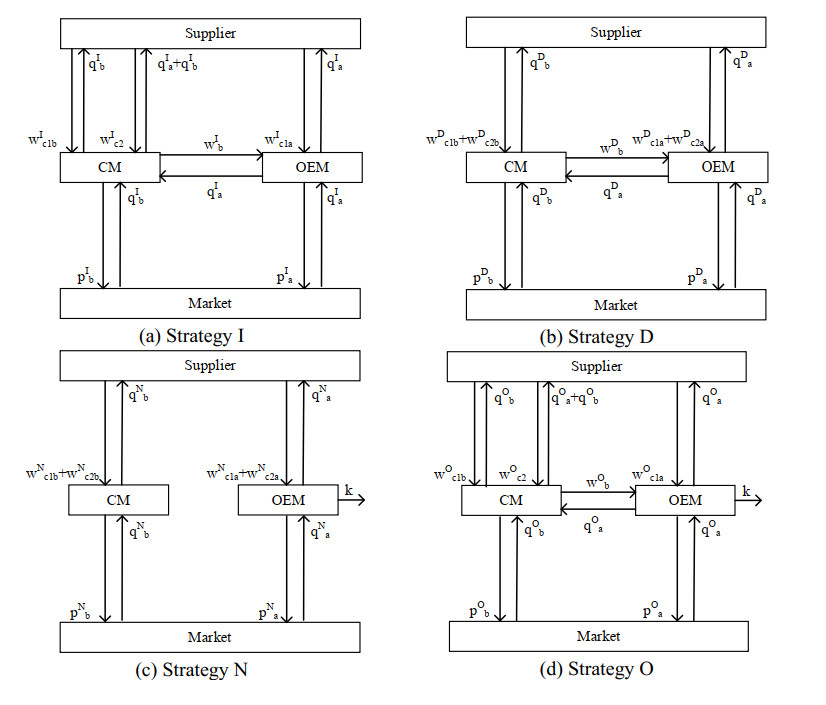
Supply chain structures
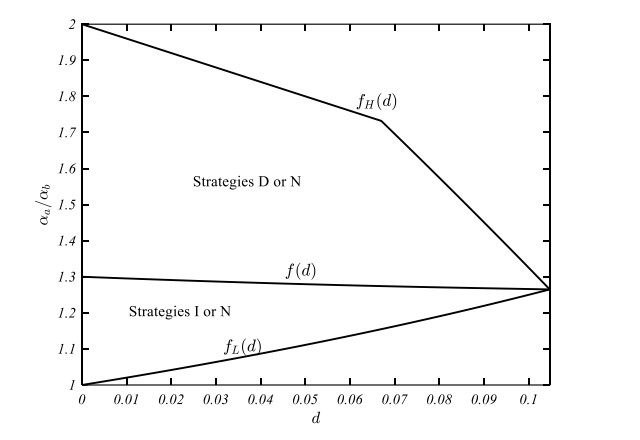
Outsourcing strategy decisions
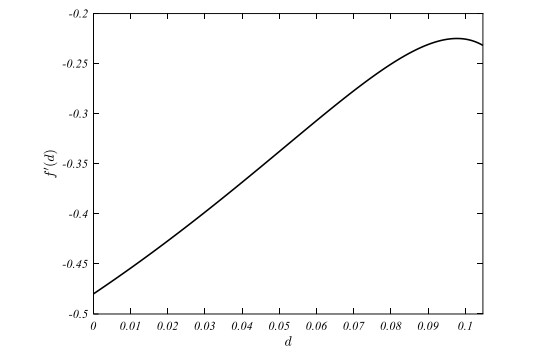
Plot of $ f'(d) $
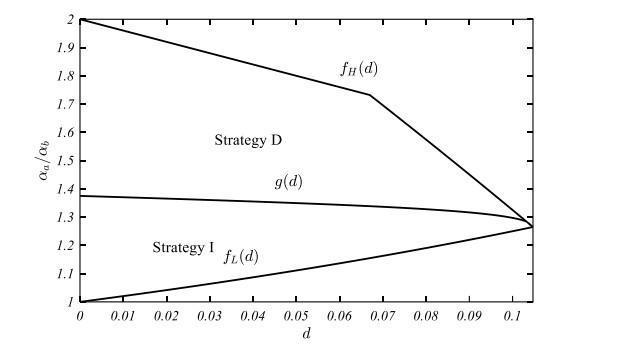
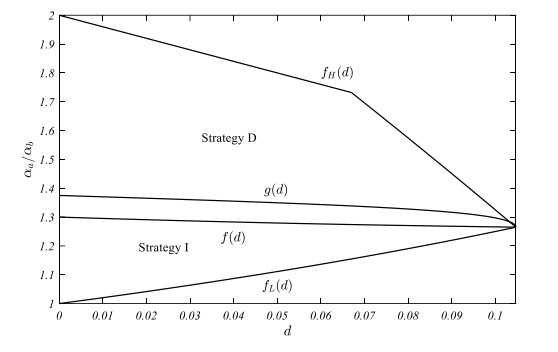
CM's preferences over outsourcing strategies
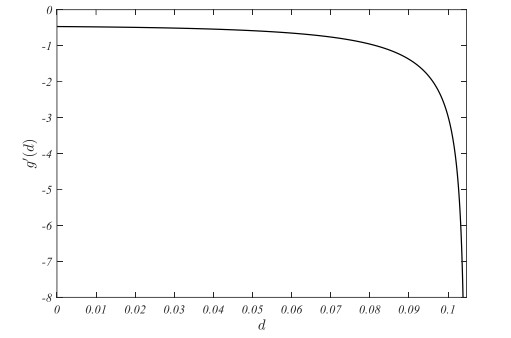
Plot of $ g'\left(d \right) $
Win-win strategies
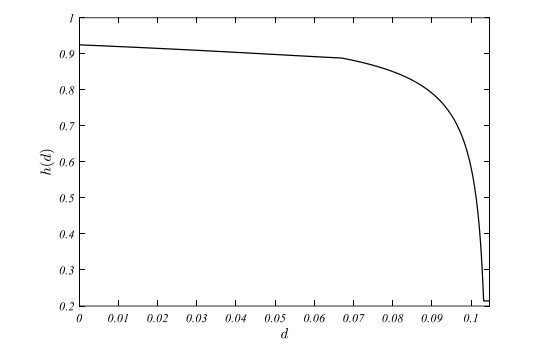
Variation in the likelihood of a win-win outcome
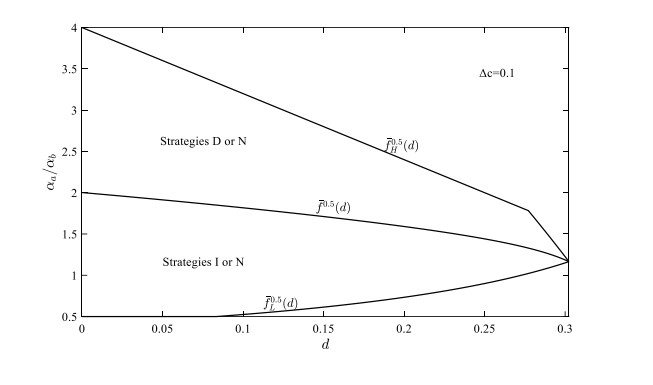
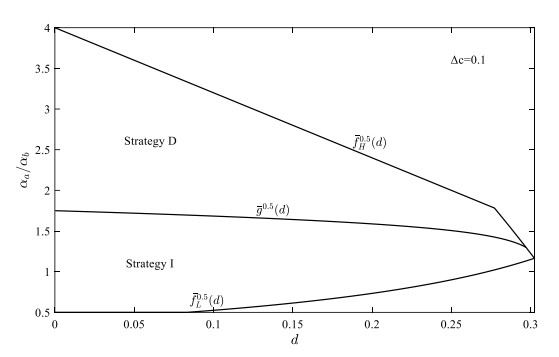
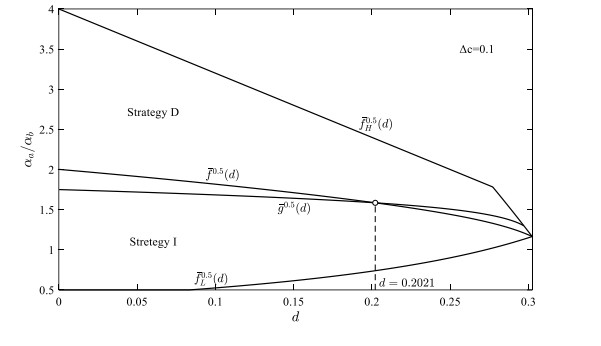
OEM's outsourcing strategy decision when $ \Delta c = 0.1 $ and $ \gamma = 0.5 $
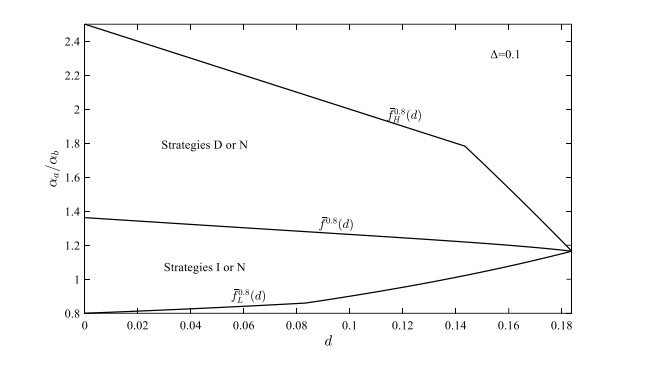
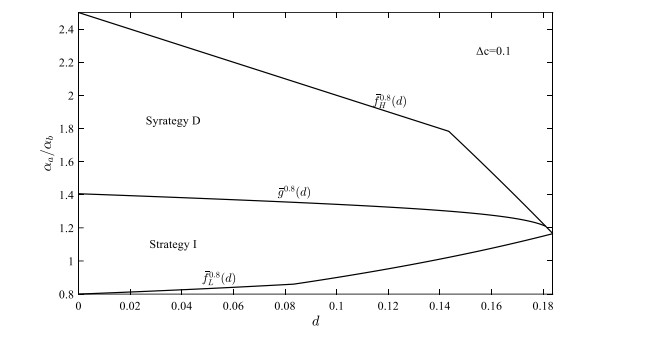
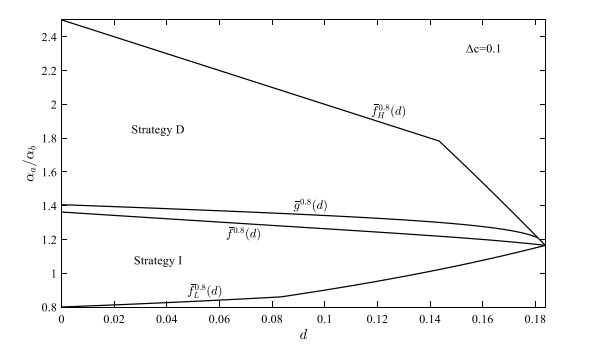
OEM's outsourcing strategy decision when $ \Delta c = 0.1 $ and $ \gamma = 0.8 $
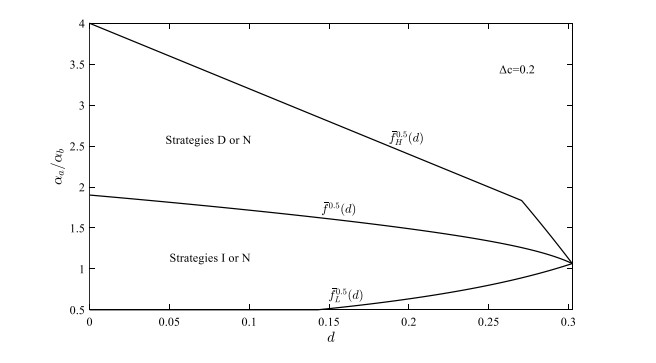
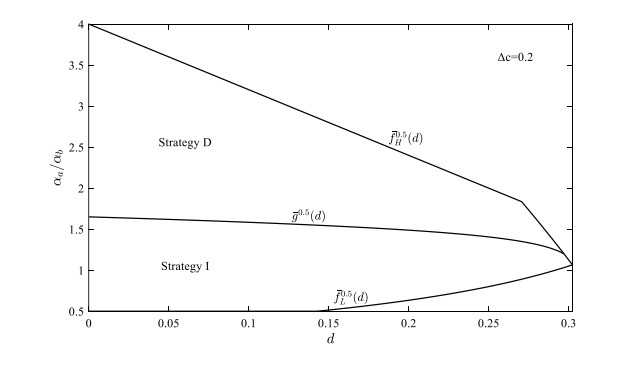
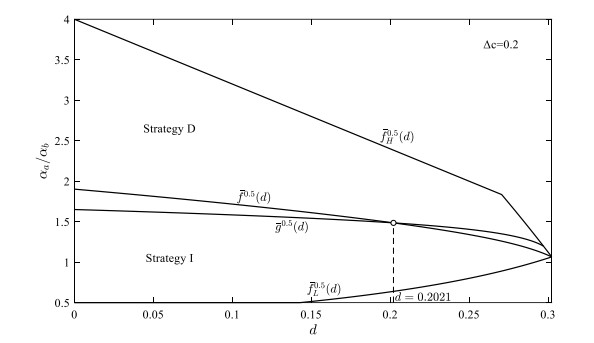
OEM's outsourcing strategy decision when $ \Delta c = 0.2 $ and $ \gamma = 0.5 $
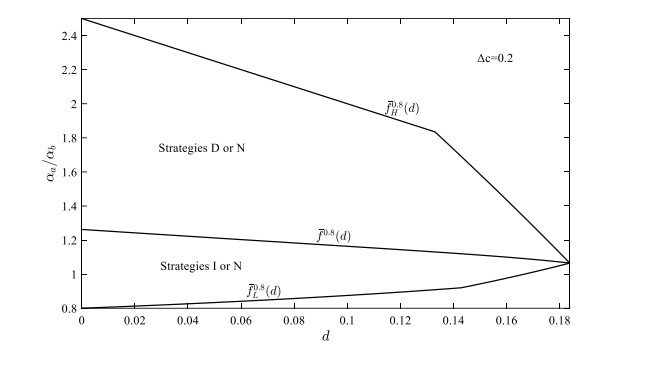
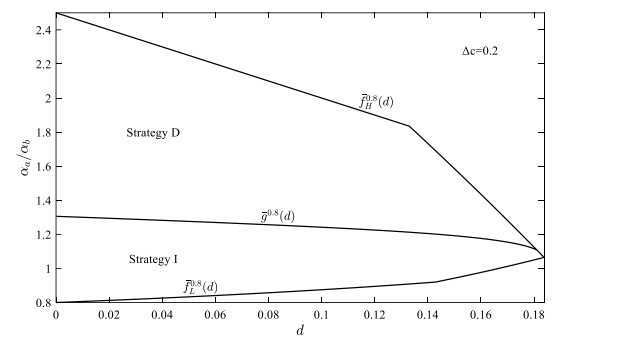
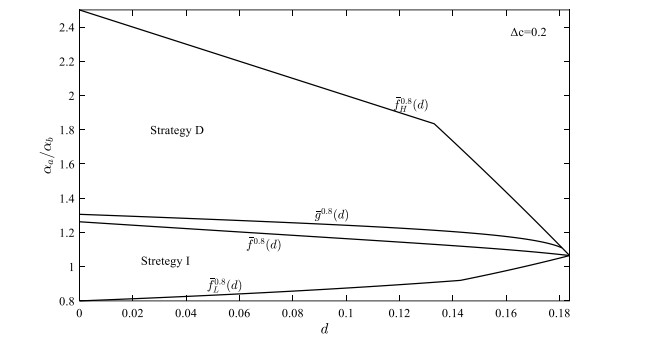
OEM's outsourcing strategy decision when $ \Delta c = 0.2 $ and $ \gamma = 0.8 $
Contract manufacturer's strategy preference when $ \Delta c = 0.1 $ and $ \gamma = 0.5 $
Contract manufacturer's strategy preference when $ \Delta c = 0.1 $ and $ \gamma = 0.8 $
Contract manufacturer's strategy preference when $ \Delta c = 0.2 $ and $ \gamma = 0.5 $
Contract manufacturer's strategy preference when $ \Delta c = 0.2 $ and $ \gamma = 0.8 $
Win-win strategy when $ \Delta c = 0.1 $ and $ \gamma = 0.5 $
Win-win strategy when $ \Delta c = 0.1 $ and $ \gamma = 0.8 $
Win-win strategy when $ \Delta c = 0.2 $ and $ \gamma = 0.5 $
Win-win strategy when $ \Delta c = 0.2 $ and $ \gamma = 0.8 $



 DownLoad: