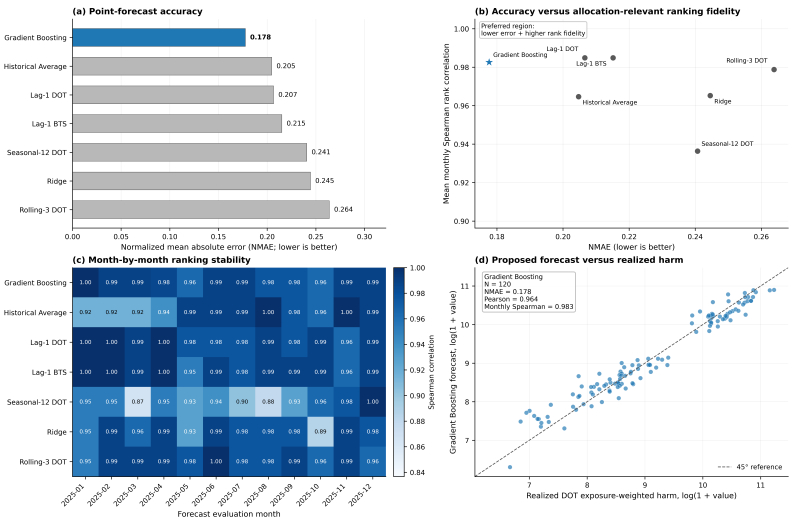
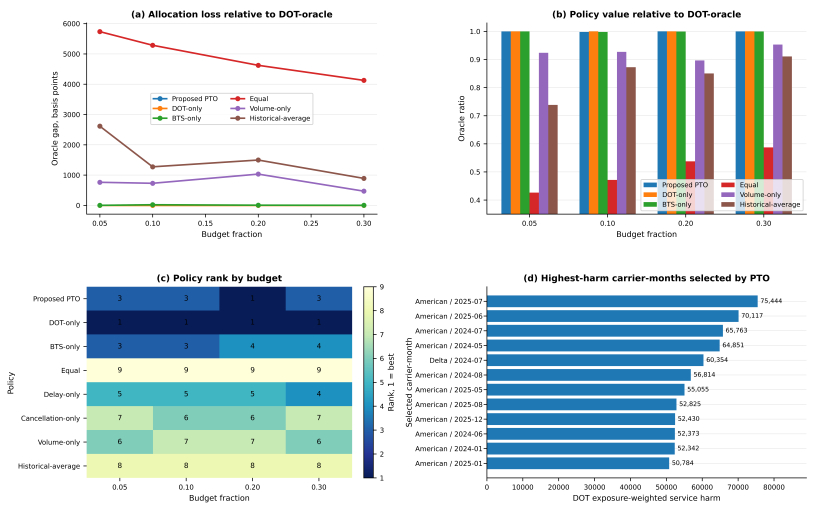
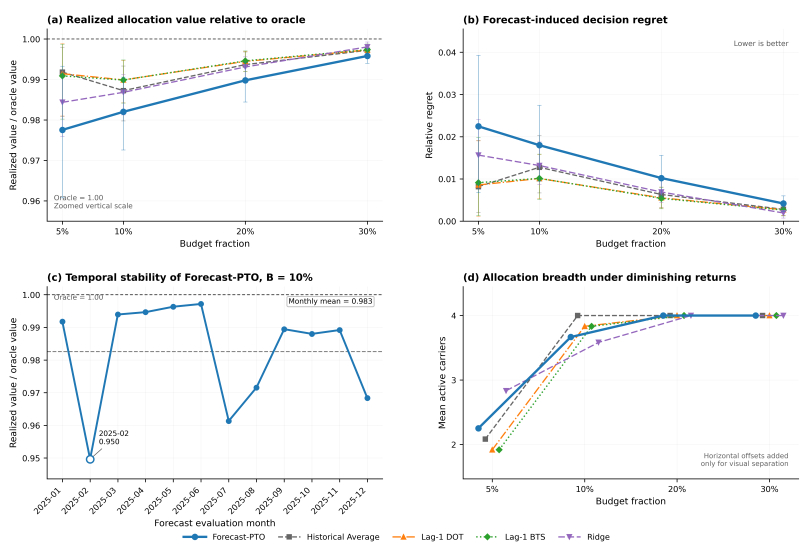
Airline disruption prediction has operational value only when it improves resource-allocation decisions made before realized service outcomes are known. We develop an auditable forecast-to-optimization framework that separates service-quality measurement, ex-ante forecasting, constrained allocation, and ex-post evaluation. The service-harm construction uses a mutually exclusive decomposition so that cancellations are not counted both in the non-on-time component and again through the cancellation penalty. Bureau of Transportation Statistics flight-level records and U.S. Department of Transportation published measures are treated as linked reporting layers of the same operating system and are used for reconstruction-consistency diagnostics, not independent-source validation. On a locked 2025 carrier-month panel, the leakage-controlled forecast-based predict-then-optimize (Forecast-PTO) policy retains 97.95%–99.60% of hindsight-oracle value across budget fractions of 5%–30%. The main decision conclusion remains stable under heterogeneous relative costs and capacities, alternative response-curvature assumptions, and a finer carrier-airport-month analysis. An uncertainty-aware robust extension shows that protection against forecast disagreement can carry an ex-post decision cost rather than automatically improving realized value. The framework therefore distinguishes measurement consistency, forecast value, optimization value, and causal intervention effects not identified by observational service data.
Citation: Jinho Cha, Eun-Young Kwon. Data-driven optimization for airline service quality improvement under delay and cancellation risk[J]. Journal of Industrial and Management Optimization, 2026, 22(10): 5507-5556. doi: 10.3934/jimo.2026188
Airline disruption prediction has operational value only when it improves resource-allocation decisions made before realized service outcomes are known. We develop an auditable forecast-to-optimization framework that separates service-quality measurement, ex-ante forecasting, constrained allocation, and ex-post evaluation. The service-harm construction uses a mutually exclusive decomposition so that cancellations are not counted both in the non-on-time component and again through the cancellation penalty. Bureau of Transportation Statistics flight-level records and U.S. Department of Transportation published measures are treated as linked reporting layers of the same operating system and are used for reconstruction-consistency diagnostics, not independent-source validation. On a locked 2025 carrier-month panel, the leakage-controlled forecast-based predict-then-optimize (Forecast-PTO) policy retains 97.95%–99.60% of hindsight-oracle value across budget fractions of 5%–30%. The main decision conclusion remains stable under heterogeneous relative costs and capacities, alternative response-curvature assumptions, and a finer carrier-airport-month analysis. An uncertainty-aware robust extension shows that protection against forecast disagreement can carry an ex-post decision cost rather than automatically improving realized value. The framework therefore distinguishes measurement consistency, forecast value, optimization value, and causal intervention effects not identified by observational service data.

| [1] |
C. Barnhart, P. Belobaba, A. R. Odoni, Applications of operations research in the air transport industry, Transp. Sci., 37 (2003), 368–391. https://doi.org/10.1287/trsc.37.4.368.23276 doi: 10.1287/trsc.37.4.368.23276

|
| [2] |
R. Britto, M. Dresner, A. Voltes, The impact of flight delays on passenger demand and societal welfare, Transp. Res. Part E Logist. Transp. Rev., 48 (2012), 460–469. https://doi.org/10.1016/j.tre.2011.10.009 doi: 10.1016/j.tre.2011.10.009
|
| [3] |
S. AhmadBeygi, A. Cohn, Y. Guan, P. Belobaba, Analysis of the potential for delay propagation in passenger airline networks, J. Air Transp. Manag., 14 (2008), 221–236. https://doi.org/10.1016/j.jairtraman.2008.04.010 doi: 10.1016/j.jairtraman.2008.04.010
|
| [4] |
P. Fleurquin, J. J. Ramasco, V. M. Eguíluz, Systemic delay propagation in the US airport network, Sci. Rep., 3 (2013), 1159. https://doi.org/10.1038/srep01159 doi: 10.1038/srep01159
|
| [5] |
C. Li, J. Mao, L. Li, J. Wu, L. Zhang, J. Zhu, Z. Pan, Flight delay propagation modeling: Data, methods, and future opportunities, Transp. Res. Part E Logist. Transp. Rev., 185 (2024), 103525. https://doi.org/10.1016/j.tre.2024.103525 doi: 10.1016/j.tre.2024.103525
|
| [6] |
N. A. Ribeiro, J. Tay, W. Ng, S. Birolini, Delay predictive analytics for airport capacity management, Transp. Res. Part C Emerg. Technol., 171 (2025), 104947. https://doi.org/10.1016/j.trc.2024.104947 doi: 10.1016/j.trc.2024.104947
|
| [7] |
F. Cao, T. Tang, Y. Gao, O. Michler, M. Schultz, Predicting flight arrival times with deep learning: A strategy for minimizing potential conflicts in gate assignment, Transp. Res. Part C Emerg. Technol., 169 (2024), 104866. https://doi.org/10.1016/j.trc.2024.104866 doi: 10.1016/j.trc.2024.104866
|
| [8] |
Y. Pang, P. Zhao, J. Hu, Y. Liu, Machine learning-enhanced aircraft landing scheduling under uncertainties, Transp. Res. Part C Emerg. Technol., 158 (2024), 104444. https://doi.org/10.1016/j.trc.2023.104444 doi: 10.1016/j.trc.2023.104444
|
| [9] |
J. M. Rosenberger, E. L. Johnson, G. L. Nemhauser, Rerouting aircraft for airline recovery, Transp. Sci., 37 (2003), 408–421. https://doi.org/10.1287/trsc.37.4.408.23271 doi: 10.1287/trsc.37.4.408.23271
|
| [10] |
J. D. Petersen, G. Sölveling, J.-P. Clarke, E. L. Johnson, S. Shebalov, An optimization approach to airline integrated recovery, Transp. Sci., 46 (2012), 482–500. https://doi.org/10.1287/trsc.1120.0414 doi: 10.1287/trsc.1120.0414
|
| [11] | B. Tan, Z. Liang, C. Y. Chung, H. Dong, X. Yin, S. K. Rayeem, J. Zhu, Uncertainty-Aware Approaches Toward Managing Hydrogen-Powered Vehicles and Renewable Energy Units in Microgrid–Transportation Networks, IEEE Trans. Transp. Electrif., (2026), In press. https://doi.org/10.1109/TTE.2026.3712731 |
| [12] | A. Sternberg, J. Soares, D. Carvalho, E. Ogasawara, A Review on flight delay prediction, arXiv preprint, arXiv: 1703.06118, 2017. https://doi.org/10.48550/arXiv.1703.06118 |
| [13] |
L. Carvalho, A. Sternberg, L. Maia Gonçalves, A. B. Cruz, J. A. Soares, D. Brandão, et al., , On the relevance of data science for flight delay research: A systematic review, Transp. Rev., 41 (2021), 499–528. https://doi.org/10.1080/01441647.2020.1861123 doi: 10.1080/01441647.2020.1861123
|
| [14] |
E. Esmaeilzadeh, S. Mokhtarimousavi, Machine learning approach for flight departure delay prediction and analysis, Transp. Res. Rec., 2674 (2020), 145–159. https://doi.org/10.1177/0361198120930014 doi: 10.1177/0361198120930014
|
| [15] |
W. A. Khan, H.-L. Ma, S.-H. Chung, X. Wen, Hierarchical integrated machine learning model for predicting flight departure delays and duration in series, Transp. Res. Part C Emerg. Technol., 129 (2021), 103225. https://doi.org/10.1016/j.trc.2021.103225 doi: 10.1016/j.trc.2021.103225
|
| [16] |
Q. Li, X. Guan, J. Liu, A CNN-LSTM framework for flight delay prediction, Expert Syst. Appl., 227 (2023), 120287. https://doi.org/10.1016/j.eswa.2023.120287 doi: 10.1016/j.eswa.2023.120287
|
| [17] |
M. Mamdouh, M. Ezzat, H. Hefny, Improving flight delays prediction by developing attention-based bidirectional LSTM network, Expert Syst. Appl., 238 (2024), 121747. https://doi.org/10.1016/j.eswa.2023.121747 doi: 10.1016/j.eswa.2023.121747
|
| [18] |
C. Li, X. Qi, Y. Yang, Z. Zeng, L. Zhang, J. Mao, FAST-CA: Fusion-based Adaptive Spatial–Temporal Learning with Coupled Attention for airport network delay propagation prediction, Inf. Fusion, 107 (2024), 102326. https://doi.org/10.1016/j.inffus.2024.102326 doi: 10.1016/j.inffus.2024.102326
|
| [19] |
X. Shen, J. Chen, R. Yan, A spatial-temporal model for network-wide flight delay prediction based on federated learning, Appl. Soft Comput., 154 (2024), 111380. https://doi.org/10.1016/j.asoc.2024.111380 doi: 10.1016/j.asoc.2024.111380
|
| [20] |
J. Pineda-Jaramillo, C. Munoz, R. Mesa-Arango, C. Gonzalez-Calderon, A. Lange, Integrating multiple data sources for improved flight delay prediction using explainable machine learning, Res. Transp. Bus. Manag., 56 (2024), 101161. https://doi.org/10.1016/j.rtbm.2024.101161 doi: 10.1016/j.rtbm.2024.101161
|
| [21] |
Y. Su, K. Xie, H. Wang, Z. Liang, W. A. Chaovalitwongse, P. M. Pardalos, Airline disruption management: A review of models and solution methods, Engineering, 7 (2021), 435–447. https://doi.org/10.1016/j.eng.2020.08.021 doi: 10.1016/j.eng.2020.08.021
|
| [22] |
Y. Hu, S. Wang, S. Zhang, Z. Li, Review of optimization problems, models and methods for airline disruption management from 2010 to 2024, Digit. Transp. Saf., 3 (2024), 246–263. https://doi.org/10.48130/dts-0024-0022 doi: 10.48130/dts-0024-0022
|
| [23] |
L. Cadarso, V. Vaze, Passenger-Centric Integrated Airline Schedule and Aircraft Recovery, Transp. Sci., 57 (2023), 813–837. https://doi.org/10.1287/trsc.2022.1174 doi: 10.1287/trsc.2022.1174
|
| [24] |
Q. Zhang, S.-H. Chung, H.-L. Ma, X. Sun, Robust aircraft maintenance routing with heterogeneous aircraft maintenance tasks, Transp. Res. Part C Emerg. Technol., 160 (2024), 104518. https://doi.org/10.1016/j.trc.2024.104518 doi: 10.1016/j.trc.2024.104518
|
| [25] |
S. Birolini, A. Jacquillat, Day-ahead aircraft routing with data-driven primary delay predictions, Eur. J. Oper. Res., 310 (2023), 379–396. https://doi.org/10.1016/j.ejor.2023.02.035 doi: 10.1016/j.ejor.2023.02.035
|
| [26] |
Y. Xu, Z. Shen, Z. Liu, X. Sun, Machine learning assisted dynamic copy generation approach for integrated aircraft and passenger recovery problem, Transp. Res. Part C Emerg. Technol., 178 (2025), 105208. https://doi.org/10.1016/j.trc.2025.105208 doi: 10.1016/j.trc.2025.105208
|
| [27] |
N. Rashedi, N. Sankey, V. Vaze, K. Wei, A machine learning approach for solution space reduction in aircraft disruption recovery, Eur. J. Oper. Res., 323 (2025), 297–308. https://doi.org/10.1016/j.ejor.2024.11.025 doi: 10.1016/j.ejor.2024.11.025
|
| [28] |
A. E. Hızır, C. Barnhart, V. Vaze, Large-scale airline crew recovery using mixed-integer optimization and supervised machine learning, Transp. Sci., 60 (2026), 177–196. https://doi.org/10.1287/trsc.2025.0105 doi: 10.1287/trsc.2025.0105
|
| [29] |
A. V. M. Oliveira, B. F. Oliveira, M. D. Vassallo, Airport service quality perception and flight delays: Examining the influence of psychosituational latent traits of respondents in passenger satisfaction surveys, Res. Transp. Econ., 102 (2023), 101371. https://doi.org/10.1016/j.retrec.2023.101371 doi: 10.1016/j.retrec.2023.101371
|
| [30] | U.S. Department of Transportation, Air Travel Consumer Reports, Office of Aviation Consumer Protection, 2026. Available from: https://www.transportation.gov/individuals/aviation-consumer-protection/air-travel-consumer-reports. |
| [31] |
D. Bertsimas, N. Kallus, From predictive to prescriptive analytics, Manag. Sci., 66 (2020), 1025–1044. https://doi.org/10.1287/mnsc.2018.3253 doi: 10.1287/mnsc.2018.3253
|
| [32] |
A. N. Elmachtoub, P. Grigas, Smart "Predict, then Optimize", Manag. Sci., 68 (2022), 9–26. https://doi.org/10.1287/mnsc.2020.3922 doi: 10.1287/mnsc.2020.3922
|
| [33] |
B. Wilder, B. Dilkina, M. Tambe, Melding the data-decisions pipeline: Decision-focused learning for combinatorial optimization, Proc. AAAI Conf. Artif. Intell., 33 (2019), 1658–1665. https://doi.org/10.1609/aaai.v33i01.33011658 doi: 10.1609/aaai.v33i01.33011658
|
| [34] |
N. Ho-Nguyen, F. Kılınç-Karzan, Risk guarantees for end-to-end prediction and optimization processes, Manag. Sci., 68 (2022), 8680–8698. https://doi.org/10.1287/mnsc.2022.4321 doi: 10.1287/mnsc.2022.4321
|
| [35] |
O. El Balghiti, A. N. Elmachtoub, P. Grigas, A. Tewari, Generalization bounds in the predict-then-optimize framework, Math. Oper. Res., 48 (2023), 2043–2065. https://doi.org/10.1287/moor.2022.1330 doi: 10.1287/moor.2022.1330
|
| [36] |
S. Lan, J.-P. Clarke, C. Barnhart, Planning for robust airline operations: Optimizing aircraft routings and flight departure times to minimize passenger disruptions, Transp. Sci., 40 (2006), 15–28. https://doi.org/10.1287/trsc.1050.0134 doi: 10.1287/trsc.1050.0134
|
| [37] |
C. Song, X. Ma, C. Ardizzone, J. Zhuang, The adverse impact of flight delays on passenger satisfaction: An innovative prediction model utilizing wide & deep learning, J. Air Transp. Manag., 114 (2024), 102511. https://doi.org/10.1016/j.jairtraman.2023.102511 doi: 10.1016/j.jairtraman.2023.102511
|
| [38] | U.S. Bureau of Transportation Statistics, Marketing Carrier On-Time Performance Data, Beginning January 2018, TranStats Airline On-Time Performance Data, U.S. Department of Transportation, 2026. Available from: https://www.transtats.bts.gov/Tables.asp?QO_VQ=EFD. |
 jimo-22-10-188-s001.pdf |
 |
Figures(8) / Tables(8)
Jinho Cha, Eun-Young Kwon. Data-driven optimization for airline service quality improvement under delay and cancellation risk[J]. Journal of Industrial and Management Optimization, 2026, 22(10): 5507-5556. doi: 10.3934/jimo.2026188




 DownLoad: