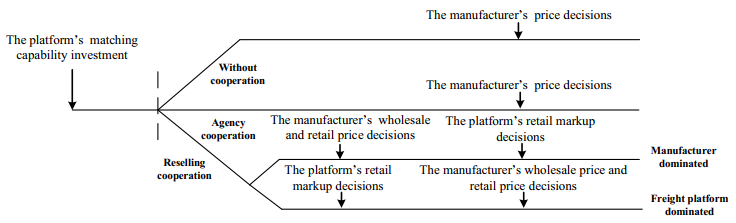
Promoting new energy commercial vehicle (NECV) adoption in freight transportation remains challenging, as a sluggish freight market dampens logistics service providers' (LSPs) willingness to invest and exacerbates overcapacity pressure on manufacturers. While online freight platforms (OFPs) can enhance vehicle utilization and stimulate demand, how manufacturers and platforms should cooperate to effectively promote NECVs remains unclear. This study developed a stylized game-theoretic supply chain model comprising a manufacturer, an OFP, and LSPs to examine strategic sales cooperation. We analyzed three settings—no cooperation, agency cooperation, and reselling cooperation—under manufacturer-led and platform-led power structures. The results showed that cooperation does not universally improve outcomes. The manufacturer generally prefers the reselling mode, whereas the OFP's preference depends on competitive intensity and unit freight service revenue, potentially leading to a prisoner's dilemma. Compared with the agency mode, the reselling mode better aligns incentives and can enhance market expansion but may intensify channel competition. Moreover, power structure plays a critical role: when the platform controls sufficient freight demand, a platform-led structure more effectively incentivizes service improvement and market expansion; otherwise, a manufacturer-led structure helps restrain opportunistic platform behavior. From an environmental perspective, although reselling improves utilization-phase benefits, it does not necessarily enhance lifecycle sustainability unless production-phase emissions are substantially reduced. These insights provide strategic guidance for promoting NECVs and integrating freight and vehicle sales.
Citation: Xu Jing, Wang Nengmin, Wei Bin, Jiang Bin. Aligning freight services and vehicle sales: Strategic cooperation for new energy commercial vehicle adoption[J]. Journal of Industrial and Management Optimization, 2026, 22(7): 3188-3218. doi: 10.3934/jimo.2026117
Promoting new energy commercial vehicle (NECV) adoption in freight transportation remains challenging, as a sluggish freight market dampens logistics service providers' (LSPs) willingness to invest and exacerbates overcapacity pressure on manufacturers. While online freight platforms (OFPs) can enhance vehicle utilization and stimulate demand, how manufacturers and platforms should cooperate to effectively promote NECVs remains unclear. This study developed a stylized game-theoretic supply chain model comprising a manufacturer, an OFP, and LSPs to examine strategic sales cooperation. We analyzed three settings—no cooperation, agency cooperation, and reselling cooperation—under manufacturer-led and platform-led power structures. The results showed that cooperation does not universally improve outcomes. The manufacturer generally prefers the reselling mode, whereas the OFP's preference depends on competitive intensity and unit freight service revenue, potentially leading to a prisoner's dilemma. Compared with the agency mode, the reselling mode better aligns incentives and can enhance market expansion but may intensify channel competition. Moreover, power structure plays a critical role: when the platform controls sufficient freight demand, a platform-led structure more effectively incentivizes service improvement and market expansion; otherwise, a manufacturer-led structure helps restrain opportunistic platform behavior. From an environmental perspective, although reselling improves utilization-phase benefits, it does not necessarily enhance lifecycle sustainability unless production-phase emissions are substantially reduced. These insights provide strategic guidance for promoting NECVs and integrating freight and vehicle sales.

| [1] | L. Xue, D. Liu, Decarbonizing China's road transport sector: Strategies toward carbon neutrality, 2022. https://doi.org/10.46830/wrirpt.21.00145 |
| [2] |
Y. Gao, M. Leng, Y. Zhang, L. Liang, Incentivizing the adoption of electric vehicles in city logistics: Pricing, driving range, and usage decisions under time window policies, Int. J. Prod. Econ., 245 (2022), 108406. https://doi.org/10.1016/j.ijpe.2021.108406 doi: 10.1016/j.ijpe.2021.108406

|
| [3] |
H. Liao, S. Peng, L. Li, Y. Zhu, The role of governmental policy in game between traditional fuel and new energy vehicles, Comput. Ind. Eng., 169 (2022), 108292. https://doi.org/10.1016/j.cie.2022.108292 doi: 10.1016/j.cie.2022.108292
|
| [4] |
S. K. Nkesah, Making road freight transport more Sustainable: Insights from a systematic literature review, Transp. Res. Interdiscip. Perspect., 22 (2023), 100967. https://doi.org/10.1016/j.trip.2023.100967 doi: 10.1016/j.trip.2023.100967
|
| [5] | A. Ashraf, Tesla cybertruck inventory swells despite discounts, falling short of elon musk's vision. Available from: https://www.benzinga.com/tech/25/02/44037023/tesla-cybertruck-inventory-swells-despite-discounts-falling-short-of-elon-musks-vision, 2025, Accessed: 2026-06-02. |
| [6] | Y. Zhang, The dynamic market landscape of new energy commercial vehicles in China. Available from: https://interactanalysis.com/insight/the-dynamic-market-landscape-of-new-energy-commercial-vehicles-in-china, 2025, Accessed: 2026-06-02. |
| [7] |
Z. Yan, H. Ding, L. Chen, The analyzing the role of electric vehicles in urban logistics: A case of China, Front. Environ. Sci., 11 (2023), 1128079. https://doi.org/10.3389/fenvs.2023.1128079 doi: 10.3389/fenvs.2023.1128079
|
| [8] |
C. Yang, J. Bian, X. Guo, W. Jiang, Logistics outsourcing strategy with online freight platforms, Omega, 125 (2024), 103042. https://doi.org/10.1016/j.omega.2024.103042 doi: 10.1016/j.omega.2024.103042
|
| [9] |
Z. Zhou, X. Wan, Does the sharing economy technology disrupt incumbents? Exploring the influences of mobile digital freight matching platforms on road freight logistics firms, Prod. Oper. Manag., 31 (2022), 117–137. https://doi.org/10.1111/poms.13491 doi: 10.1111/poms.13491
|
| [10] | Ctinsa, Report says: Chinese truck drivers' monthly net income is 12,000 yuan! Higher income through freight platforms. Available from: https://ctinsa.com/industry-news/1292, 2024, Accessed: 2026-06-02. |
| [11] |
J. Yan, G. Wang, S. Chen, H. Zhang, J. Qian, Y. Mao, Harnessing freight platforms to promote the penetration of long-haul heavy-duty hydrogen fuel-cell trucks, Energy, 254 (2022), 124225. https://doi.org/10.1016/j.energy.2022.124225 doi: 10.1016/j.energy.2022.124225
|
| [12] |
R. Mao, H. Chen, H. Shen, Cooperation strategies with third-party platform: E-tailer and manufacturer perspectives, Nav. Res. Logist. 70 (2023), 878–896. https://doi.org/10.1002/nav.22136 doi: 10.1002/nav.22136
|
| [13] |
Y. Shen, S. P. Willems, Y. Dai, Channel selection and contracting in the presence of a retail platform, Prod. Oper. Manag. 28 (2019), 1173–1185. https://doi.org/10.1111/poms.12977 doi: 10.1111/poms.12977
|
| [14] |
J. Li, Y. Zheng, B. Dai, J. Yu, Implications of matching and pricing strategies for multiple-delivery-points service in a freight O2O platform, Transp. Res. Part E Logist. Transp. Rev., 136 (2020), 101871. https://doi.org/10.1016/j.tre.2020.101871 doi: 10.1016/j.tre.2020.101871
|
| [15] |
X. Chen, X. Wang, D. Zhang, M. Yang, Selling models for platforms under service-sensitive demand, Omega, 115 (2023), 102794. https://doi.org/10.1016/j.omega.2022.102794 doi: 10.1016/j.omega.2022.102794
|
| [16] |
J. Xia, W. Niu, Adding clicks to bricks: An analysis of supplier encroachment under service spillovers, Electron. Commer. Res. Appl., 37 (2019), 100876. https://doi.org/10.1016/j.elerap.2019.100876 doi: 10.1016/j.elerap.2019.100876
|
| [17] |
A. Y. Ha, S. Tong, Y. Wang, Channel structures of online retail platforms, Manuf. Serv. Oper. Manag., 24 (2021), 1547–1561. https://doi.org/10.1287/msom.2021.1011 doi: 10.1287/msom.2021.1011
|
| [18] |
M. Gu, D. Liu, S. Kumar, Navigating platform-led affiliate marketing: Implications for content creation and platform profitability, Inf. Syst. Res., 36 (2024), 410–432. https://doi.org/10.1287/isre.2022.0620 doi: 10.1287/isre.2022.0620
|
| [19] |
W. Huang, W. Zhou, F. Luo, Coopetition between B2C e-commerce companies: price competition and logistics service cooperation, J. Syst. Sci. Syst. Eng. , 29 (2020), 730–749. https://doi.org/10.1007/s11518-020-5474-0 doi: 10.1007/s11518-020-5474-0
|
| [20] |
Y. Zhang, M. Huang, L. Tian, D. Jin, G. Cai, Build or join a sharing platform? The choice of manufacturer's sharing mode, Int. J. Prod. Econ. , 231 (2021), 107811. https://doi.org/10.1016/j.ijpe.2020.107811 doi: 10.1016/j.ijpe.2020.107811
|
| [21] |
V. Abhishek, K. Jerath, Z. J. Zhang, Agency selling or reselling? Channel structures in electronic retailing, Manag. Sci., 62 (2016) 2259–2280. https://doi.org/10.1287/mnsc.2015.2230 doi: 10.1287/mnsc.2015.2230
|
| [22] |
D. Guo, Z. P. Fan, M. Sun, B2C car-sharing services: Sharing mode selection and value-added service investment, Transp. Res. Part E Logist. Transp. Rev., 165 (2022), 102836. https://doi.org/10.1016/j.tre.2022.102836 doi: 10.1016/j.tre.2022.102836
|
| [23] |
Y. Sun, Q. Zhu, X. Li, Electric vehicle adoption in logistics supply chain, Int. J. Prod. Res., 64 (2026), 2158–2177. https://doi.org/10.1080/00207543.2025.2575082 doi: 10.1080/00207543.2025.2575082
|
| [24] |
A. Jenn, J. H. Lee, S. Hardman, G. Tal, An in-depth examination of electric vehicle incentives: Consumer heterogeneity and changing response over time, Transp. Res. Part Policy Pract., 132 (2020), 97–109. https://doi.org/10.1016/j.tra.2019.11.004 doi: 10.1016/j.tra.2019.11.004
|
| [25] |
Y. Zhang, Y. Jiang, W. Rui, R. G. Thompson, Analyzing truck fleets' acceptance of alternative fuel freight vehicles in China, Renew. Energy, 134 (2019), 1148–1155. https://doi.org/10.1016/j.renene.2018.09.016 doi: 10.1016/j.renene.2018.09.016
|
| [26] |
S. Henrik, N. Emil, Who are the early adopters of alternative fuel technology? A study of Swedish road freight companies, Transp. Res. Part Policy Pract. , 186 (2024), 104132. https://doi.org/10.1016/j.tra.2024.104132 doi: 10.1016/j.tra.2024.104132
|
| [27] |
V. Cantillo, J. Amaya, I. Serrano, V. Cantillo-García, J. Galván, Influencing factors of trucking companies willingness to shift to alternative fuel vehicles, Transp. Res. Part E Logist. Transp. Rev. , 163 (2022), 102753. https://doi.org/10.1016/j.tre.2022.102753 doi: 10.1016/j.tre.2022.102753
|
| [28] |
M. Scorrano, R. Danielis, M. Giansoldati, Electric light commercial vehicles for a cleaner urban goods distribution. Are they cost competitive?, Res. Transp. Econ. , 85 (2021), 101022. https://doi.org/10.1016/j.retrec.2020.101022 doi: 10.1016/j.retrec.2020.101022
|
| [29] |
M. Schiffer, P. Klein, G. Laporte, G. Walther, Integrated planning for electric commercial vehicle fleets: A case study for retail mid-haul logistics networks, Eur. J. Oper. Res. , 291 (2020), 944–960. https://doi.org/10.1016/j.ejor.2020.09.054 doi: 10.1016/j.ejor.2020.09.054
|
| [30] |
J. Winkelmann, S. Spinler, T. Neukirchen, Green transport fleet renewal using approximate dynamic programming: A case study in German heavy-duty road transportation, Transp. Res. Part E Logist. Transp. Rev. , 186 (2024), 103547. https://doi.org/10.1016/j.tre.2024.103547 doi: 10.1016/j.tre.2024.103547
|
| [31] |
D. C. Jang, B. Kim, S. Y. Lee, A two-sided market platform analysis for the electric vehicle adoption: Firm strategies and policy design, Transp. Res. Part Transp. Environ. , 62 (2018), 646–658. https://doi.org/10.1016/j.trd.2018.02.002 doi: 10.1016/j.trd.2018.02.002
|
| [32] |
Z. Li, C. Zhang, H. Xu, R. Lyu, The optimal vehicle product line strategy considering product information disclosure under government carbon regulation, Omega, 119 (2023), 102887. https://doi.org/10.1016/j.omega.2023.102887 doi: 10.1016/j.omega.2023.102887
|
| [33] |
N. Yu, M. Zhao, H. Zhou, Z. Jiao, Optimal new energy credits strategy for fuel vehicle manufacturers considering government subsidy, J. Ind. Manag. Optim. , 21 (2025), 4304–4330. https://doi.org/10.3934/jimo.2025054 doi: 10.3934/jimo.2025054
|
| [34] |
Z. P. Fan, S. Huang, X. Wang, The vertical cooperation and pricing strategies of electric vehicle supply chain under brand competition, Comput. Ind. Eng. , 152 (2021), 106968. https://doi.org/10.1016/j.cie.2020.106968 doi: 10.1016/j.cie.2020.106968
|
| [35] |
S. Hu, S. Shu, Z. Chen, Y. Shao, X. Na, C. Xie, et al., Sustainable impact analysis of freight pooling strategies on city crowdsourcing logistics platform, Transp. Res. Part Transp. Environ., 130 (2024), 104167. https://doi.org/10.1016/j.trd.2024.104167 doi: 10.1016/j.trd.2024.104167
|
| [36] |
Y. Wu, J. Huang, X. Chen, The information value of logistics platforms in a freight matching market, Eur. J. Oper. Res. , 312 (2024), 227–239. https://doi.org/10.1016/j.ejor.2023.06.043 doi: 10.1016/j.ejor.2023.06.043
|
| [37] |
Y. Xu, L. Ling, J. Wu, S. Xu, On-demand ride-hailing platforms under green mobility: Pricing strategies and government regulation, Transp. Res. Part E Logist. Transp. Rev., 189 (2024), 103650. https://doi.org/10.1016/j.tre.2024.103650 doi: 10.1016/j.tre.2024.103650
|
| [38] |
Q. Zhang, Y. Liu, Promoting electric vehicle adoption in ride-hailing platforms: To control or subsidize? Comput. Ind. Eng. , 191 (2024), 110146. https://doi.org/10.1016/j.cie.2024.110146 doi: 10.1016/j.cie.2024.110146
|
| [39] |
H. Song, R. Wang, Y. Tang, Competition or cooperation: Strategy analysis for a social commerce platform, Eur. J. Oper. Res. , 318 (2024), 560–574. https://doi.org/10.1016/j.ejor.2024.05.014 doi: 10.1016/j.ejor.2024.05.014
|
| [40] |
X. Xu, X. Chen, J. Hou, T. C. E. Cheng, Y. Yu, L. Zhou, Should live streaming be adopted for agricultural supply chain considering platform's quality improvement and blockchain support?, Transp. Res. Part E Logist. Transp. Rev. , 195 (2025), 103950. https://doi.org/10.1016/j.tre.2024.103950 doi: 10.1016/j.tre.2024.103950
|
| [41] |
B. Mantin, H. Krishnan, T. Dhar, The strategic role of third-party marketplaces in retailing, Prod. Oper. Manag. , 23 (2014), 1937–1949. https://doi.org/10.1111/poms.12203 doi: 10.1111/poms.12203
|
| [42] |
L. Xia, K. Li, N. Zhao, H. Fu, B. Liu, Strategic promotion decisions of competing mobile application suppliers in Stackelberg game context, Expert Syst. Appl. , 244 (2024), 123037. https://doi.org/10.1016/j.eswa.2023.123037 doi: 10.1016/j.eswa.2023.123037
|
| [43] |
D. Chen, Y. W. Zhou, X. Lin, Q. Lin, W. Fu, Interplay between online intermediaries' information sharing and manufacturers' selling format selection, J. Ind. Manag. Optim. , 19 (2023), 6664–6687. https://doi.org/10.3934/jimo.2022233 doi: 10.3934/jimo.2022233
|
| [44] |
Y. Yan, R. Zhao, Z. Liu, Strategic introduction of the marketplace channel under spillovers from online to offline sales, Eur. J. Oper. Res. , 267 (2018), 65–77. https://doi.org/10.1016/j.ejor.2017.11.011 doi: 10.1016/j.ejor.2017.11.011
|
| [45] |
W. K. Chiang, D. Chhajed, J. D. Hess, Direct marketing, indirect profits: A strategic analysis of dual-channel supply-chain design, Manag. Sci. , 49 (2003), 1–20. https://doi.org/10.1287/mnsc.49.1.1.12749 doi: 10.1287/mnsc.49.1.1.12749
|
| [46] |
K. Matsui, When should a manufacturer set its direct price and wholesale price in dual-channel supply chains? Eur. J. Oper. Res. , 258 (2017), 501–511. https://doi.org/10.1016/j.ejor.2016.08.048 doi: 10.1016/j.ejor.2016.08.048
|
| [47] |
A. A. Tsay, N. Agrawal, Channel conflict and coordination in the E‐Commerce age, Prod. Oper. Manag. , 13 (2004), 93–110. https://doi.org/10.1111/j.1937-5956.2004.tb00147.x doi: 10.1111/j.1937-5956.2004.tb00147.x
|
| [48] |
S. Zheng, Y. Yu, Manufacturer encroachment with equal pricing strategy, Transp. Res. Part E Logist. Transp. Rev. , 152 (2021), 102346. https://doi.org/10.1016/j.tre.2021.102346 doi: 10.1016/j.tre.2021.102346
|
| [49] |
G. Martín-Herrán, S. P. Sigué, Is multichannel retail marketing integration a panacea? J. Oper. Res. Soc. , 76 (2024), 1630–1648. https://doi.org/10.1080/01605682.2024.2430337 doi: 10.1080/01605682.2024.2430337
|
| [50] |
L. Wei, S. Zheng, S. Du, B. Zhang, Agency selling or reselling: The role of cause marketing, Eur. J. Oper. Res. , 320 (2025), 343–357. https://doi.org/10.1016/j.ejor.2024.07.034 doi: 10.1016/j.ejor.2024.07.034
|
| [51] |
S. Huang, Y. Peng, J. Xu, Supply chain channel configuration with power imbalance and spillovers under platform retailing, Int. J. Prod. Econ. , 281 (2025), 109522. https://doi.org/10.1016/j.ijpe.2025.109522 doi: 10.1016/j.ijpe.2025.109522
|
| [52] |
F. Tao, Y. Zhou, J. Bian, K. K. Lai, Agency selling or reselling? Channel selection of green products with consumer environmental awareness, Int. J. Logist. Res. Appl. , 27 (2024), 326–345. https://doi.org/10.1080/13675567.2022.2114436 doi: 10.1080/13675567.2022.2114436
|
| [53] |
T. Lu, Y. J. Chen, J. C. Fransoo, C. Y. Lee, Shipping to heterogeneous customers with competing carriers, Manuf. Serv. Oper. Manag., 22 (2020), 851–867. https://doi.org/10.1287/msom.2019.0776 doi: 10.1287/msom.2019.0776
|
| [54] |
S. Zheng, Y. E. Ge, X. Fu, Capacity sharing within a shipping alliance: Firm optimization and welfare analysis, Marit. Policy Manag., 51 (2024), 206–225. https://doi.org/10.1080/03088839.2022.2120215 doi: 10.1080/03088839.2022.2120215
|
| [55] |
X. Sun, T. M. Choi, S. Luo, Logistics capacity balancing platforms in the sharing economy: when will simple rules be optimal? IEEE Trans. Syst. Man Cybern. Syst., 52 (2022), 2637–2650. https://doi.org/10.1109/TSMC.2020.3048837 doi: 10.1109/TSMC.2020.3048837
|
| [56] |
Y. Gui, D. Tan, Z. Liu, F. Dong, Worry not rareness but disparity: Impact of fairness concerns on platforms' pricing and matching decision in competitive two-sided markets, Expert Syst. Appl. , 238 (2024), 121683. https://doi.org/10.1016/j.eswa.2023.121683 doi: 10.1016/j.eswa.2023.121683
|
| [57] |
Y. Li, M. Chu, X. Bai, To fight or not? product introduction and channel selection in the presence of a platform's private label, Transp. Res. Part E Logist. Transp. Rev., 181 (2024), 103373. https://doi.org/10.1016/j.tre.2023.103373 doi: 10.1016/j.tre.2023.103373
|
| [58] |
X. Lyu, T. Xiao, J. Li, Evolution of direct network effects: A perspective of market thickness of an online freight platform, Electron. Mark. , 34 (2024), 7. https://doi.org/10.1007/s12525-024-00691-6 doi: 10.1007/s12525-024-00691-6
|
| [59] |
T. Y. Wang, Z. S. Chen, K. Govindan, K. S. Chin, Manufacturer's selling mode choice in a platform-oriented dual channel supply chain, Expert Syst. Appl. , 198 (2022), 116842. https://doi.org/10.1016/j.eswa.2022.116842 doi: 10.1016/j.eswa.2022.116842
|
| [60] |
L. Cheng, M. Li, C. Tan, P. Huang, M. Zhang, R. Sun, Computational game-theoretic models for adaptive urban energy systems: a comprehensive review of algorithms, strategies, and engineering applications, Arch. Comput. Methods Eng., 33 (2026), 2037–2114. https://doi.org/10.1007/s11831-025-10364-y doi: 10.1007/s11831-025-10364-y
|
| [61] |
K. Wang, L. Cheng, M. Yin, K. Zhang, R. Wang, M. Zhang, et al., Evolutionary game theory in energy storage systems: A systematic review of collaborative decision-making, operational strategies, and coordination mechanisms for renewable energy integration, Sustainability, 17 (2025), 7400. https://doi.org/10.3390/su17167400 doi: 10.3390/su17167400
|
 jimo-22-07-117-s001.pdf |
 |
Figures(11) / Tables(4)
Xu Jing, Wang Nengmin, Wei Bin, Jiang Bin. Aligning freight services and vehicle sales: Strategic cooperation for new energy commercial vehicle adoption[J]. Journal of Industrial and Management Optimization, 2026, 22(7): 3188-3218. doi: 10.3934/jimo.2026117




 DownLoad: