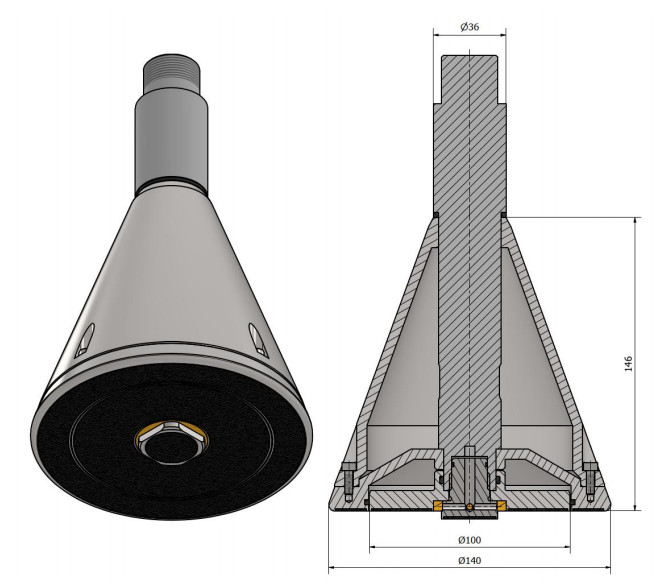
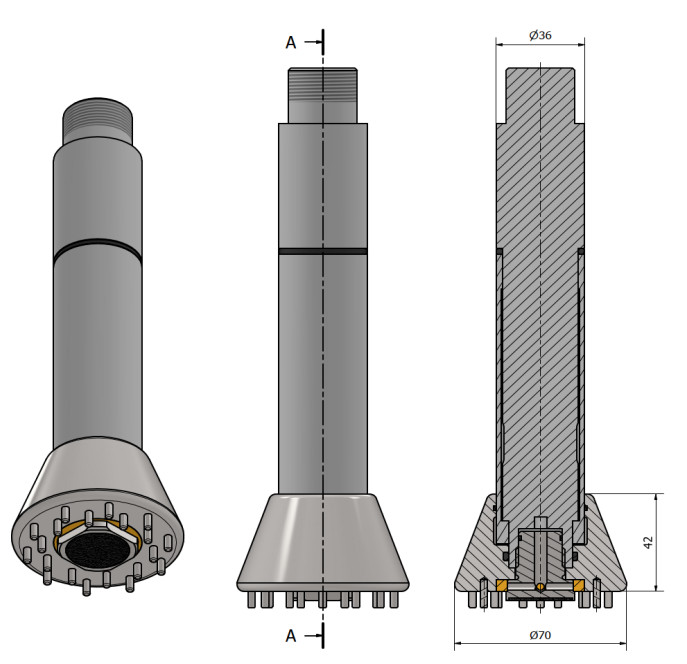
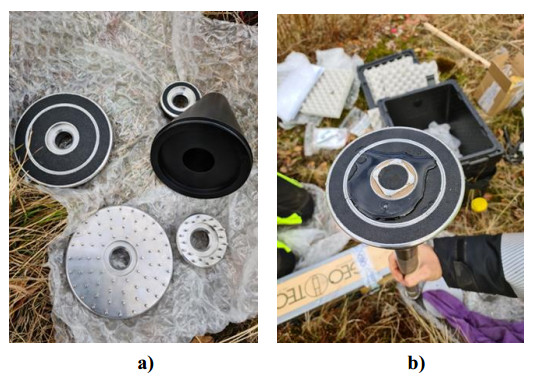
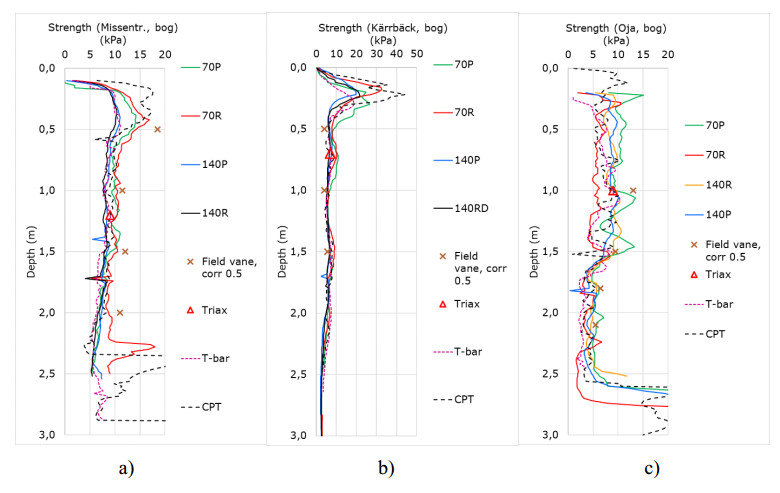
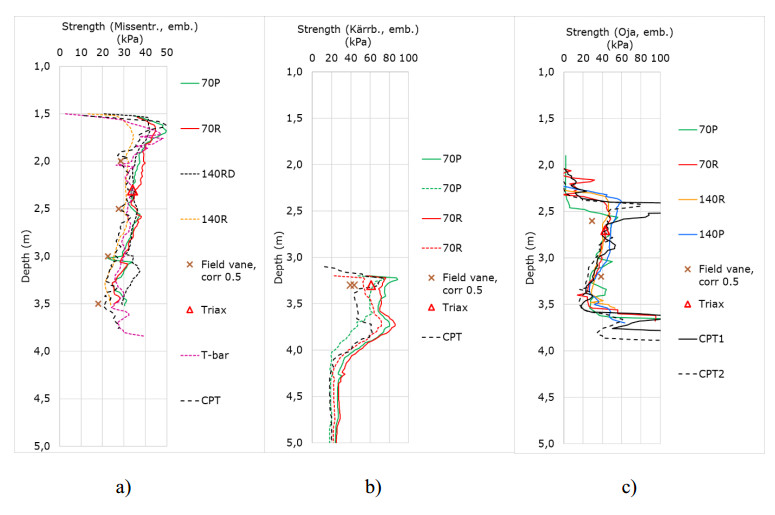
In this article, a new probe and method, CiPPT (Circular Probe Penetration Test), is presented, which was developed for sounding and strength determination in peat. The probe is an inverted cone where the horizontal end surface is pushed down into the peat during sounding. The probe is connected to the same equipment used for cone penetration testing, with the cone replaced by an inverted cone. A larger CiPPT, 140 mm diameter for research purposes, and a smaller CiPPT, 70 mm diameter for production purposes, have been developed and tested, both with either pins on the end surface or a rough end surface. Additionally, a variant of the CiPPT 140 mm diameter called double-CiPPT with an inner and outer plate has been developed to study the effect of fiber tensile strength on sounding resistance. The functionality of the double-CiPPT were verified, and the CiPPT variants were tested at three field test sites with low- and medium- humified peat. To evaluate strength, the results from the CiPPT were calibrated against triaxial compression tests. Comparisons were made with other in situ methods. Moreover, peat that was loaded and compressed over a long period below railway embankments and peat not loaded and not compressed in bogs were investigated.
Citation: Bo Vesterberg, Mattias Andersson, Fredrik Burman, David Rudebeck, Martin Holmén. CiPPT—A new in situ method for sounding and strength determination in peat[J]. AIMS Geosciences, 2025, 11(3): 558-576. doi: 10.3934/geosci.2025024
In this article, a new probe and method, CiPPT (Circular Probe Penetration Test), is presented, which was developed for sounding and strength determination in peat. The probe is an inverted cone where the horizontal end surface is pushed down into the peat during sounding. The probe is connected to the same equipment used for cone penetration testing, with the cone replaced by an inverted cone. A larger CiPPT, 140 mm diameter for research purposes, and a smaller CiPPT, 70 mm diameter for production purposes, have been developed and tested, both with either pins on the end surface or a rough end surface. Additionally, a variant of the CiPPT 140 mm diameter called double-CiPPT with an inner and outer plate has been developed to study the effect of fiber tensile strength on sounding resistance. The functionality of the double-CiPPT were verified, and the CiPPT variants were tested at three field test sites with low- and medium- humified peat. To evaluate strength, the results from the CiPPT were calibrated against triaxial compression tests. Comparisons were made with other in situ methods. Moreover, peat that was loaded and compressed over a long period below railway embankments and peat not loaded and not compressed in bogs were investigated.

| [1] | Carlsten P, Lindahl A (1999) Torvs geotekniska egenskaper. Sammanställning av erfarenheter från laboratorieförsök på torv. Swedish Geotechnical Institute, Linköping. In Swedish. |
| [2] |
Boylan N, Long M, Mathijssen FAJM (2011) In situ strength characterisation of peat and organic soil using full-flow penetrometers. Can Geotech J 48: 1085–1099. https://doi.org/10.1139/T11-023 doi: 10.1139/T11-023

|
| [3] | Landva AO (2007) Characterization of Escuminac peat and construction on peatland. 2nd International Workshop on Characterisation and Engineering Properties of Natural Soils, Singapore. |
| [4] |
O'Kelly BC (2017) Measurement, interpretation and recommended use of laboratory strength properties of fibrous peat. Geotech Res 4: 136–171. https://doi.org/10.1680/jgere.17.00006 doi: 10.1680/jgere.17.00006
|
| [5] | Hendry MT (2011) The Geomechanical Behaviour of Peat Foundations Below Rail-track Structures. Dissertation. PhD Thesis, University of Saskatchewan. |
| [6] |
Hendry MT, Sharma JS, Martin CD, et al. (2012) Effect of fiber content and structure on anisotropic elastic stiffness and shear strength of peat. Can Geotech J 49: 403–415. https://doi.org/10.1139/t2012-003 doi: 10.1139/t2012-003
|
| [7] | Vesterberg B, Rudebeck D, Burman F, et al. (2020) Torv—deformationer och brottmekanismer i modellförsök, Ny utrustning och metodik för blockprovtagning och modellförsök. SGI Publikation 49, Swedish Geotechnical Institute, Linköping. In Swedish. |
| [8] | Vesterberg B, Andersson M, Rudebeck D, et al. (2025) Torvs hållfasthet och stabilitet för bankar på torv, Torvs egenskaper under och vid sidan om bank, Swedish Geotechnical Institute, SGI, Linköping. In Swedish. |
| [9] | von Post L, Granlund E (1926) Södra Sveriges torvtillgångar I. Sveriges geologiska undersökning. Stockholm, 1–127. In Swedish. |
| [10] | Carlsten P (1988) Torv—geotekniska egenskaper och byggmetoder, Swedish Geotechnical Institute, Linköping. In Swedish. |
| [11] |
Muraro S, Jommi C (2021) Experimental determination of the shear strength of peat from standard undrained triaxial tests: correcting for the effects of end restraint. Géotechnique 71: 76–87. https://doi.org/10.1680/jgeot.18.P.346 doi: 10.1680/jgeot.18.P.346
|
| [12] | Zwanenburg C (2022) Personal communication. Deltares, Netherlands. |
Figures(14)

Bo Vesterberg, Mattias Andersson, Fredrik Burman, David Rudebeck, Martin Holmén. CiPPT—A new in situ method for sounding and strength determination in peat[J]. AIMS Geosciences, 2025, 11(3): 558-576. doi: 10.3934/geosci.2025024





 DownLoad: