Recently, the orthogonal subspace exploration (OSE) method has been introduced for matrix completion, explicitly embedding subspace information to accelerate convergence and improve accuracy. However, because the self-expression matrix in the OSE method inherits both the low-rank property and the full dimension of the original incomplete matrix, it suffers from severe parameter redundancy. This not only restricts further improvement in convergence accuracy but also leads to high computational cost due to required matrix inversion and eigenvalue decomposition. To address these limitations, this paper proposes an improved orthogonal subspace exploration method with bilinear factorization (IOSEBF). The key idea is to impose the orthogonal subspace constraint on a small coefficient matrix obtained via bilinear factorization, rather than on the original high-dimensional incomplete matrix. This strategy significantly reduces both parameter redundancy and computational cost. Experimental results demonstrate that the proposed IOSEBF method is much more accurate than state-of-the-art methods and is hundreds of times faster.
Citation: Qing Liu, Lin Ye, Bin Jiang, XianCun Zhou. An improved orthogonal subspace exploration method with bilinear factorization for fast matrix completion[J]. Electronic Research Archive, 2027, 35(1): 164-185. doi: 10.3934/era.2027006
Recently, the orthogonal subspace exploration (OSE) method has been introduced for matrix completion, explicitly embedding subspace information to accelerate convergence and improve accuracy. However, because the self-expression matrix in the OSE method inherits both the low-rank property and the full dimension of the original incomplete matrix, it suffers from severe parameter redundancy. This not only restricts further improvement in convergence accuracy but also leads to high computational cost due to required matrix inversion and eigenvalue decomposition. To address these limitations, this paper proposes an improved orthogonal subspace exploration method with bilinear factorization (IOSEBF). The key idea is to impose the orthogonal subspace constraint on a small coefficient matrix obtained via bilinear factorization, rather than on the original high-dimensional incomplete matrix. This strategy significantly reduces both parameter redundancy and computational cost. Experimental results demonstrate that the proposed IOSEBF method is much more accurate than state-of-the-art methods and is hundreds of times faster.

| [1] |
Y. Wang, W. Li, J. E. Fowler, G. Vivone, Robust matrix completion with deterministic sampling via convex optimization, IEEE Trans. Pattern Anal. Mach. Intell. , 48 (2026), 6771-6785. https://doi.org/10.1109/TPAMI.2026.3659200 doi: 10.1109/TPAMI.2026.3659200
|
| [2] |
M. C. Tsakiris, Low-rank matrix completion theory via Plücker coordinates, IEEE Trans. Pattern Anal. Mach. Intell. , 45 (2023), 10084-10099. https://doi.org/10.1109/TPAMI.2023.3250325 doi: 10.1109/TPAMI.2023.3250325
|
| [3] |
X. Li, H. Zhang, R. Zhang, Matrix completion via non-convex relaxation and adaptive correlation learning, IEEE Trans. Pattern Anal. Mach. Intell. , 45 (2023), 1981-1991. https://doi.org/10.1109/TPAMI.2022.3157083 doi: 10.1109/TPAMI.2022.3157083
|
| [4] |
H. Cai, L. Huang, P. Li, D. Needell, Matrix completion with cross-concentrated sampling: Bridging uniform sampling and CUR sampling, IEEE Trans. Pattern Anal. Mach. Intell. , 45 (2023), 10100-10113. https://doi.org/10.1109/TPAMI.2023.3261185 doi: 10.1109/TPAMI.2023.3261185
|
| [5] |
Z. Y. Wang, X. P. Li, H. C. So, A. M. Zoubir, Adaptive rank-one matrix completion using sum of outer products, IEEE Trans. Circuits Syst. Video Technol. , 33 (2023), 4868-4880. https://doi.org/10.1109/TCSVT.2023.3250651 doi: 10.1109/TCSVT.2023.3250651
|
| [6] |
J. Miao, K. I. Kou, Color image recovery using low-rank quaternion matrix completion algorithm, IEEE Trans. Image Process. , 31 (2022), 190-201. https://doi.org/10.1109/TIP.2021.3128321 doi: 10.1109/TIP.2021.3128321
|
| [7] |
Q. Liu, Z. Lai, Z. Zhou, F. Kuang, Z. Jin, A truncated nuclear norm regularization method based on weighted residual error for matrix completion, IEEE Trans. Image Process. , 25 (2016), 316-330. https://doi.org/10.1109/TIP.2015.2503238 doi: 10.1109/TIP.2015.2503238
|
| [8] |
A. Eamaz, F. Yeganegi, M. Soltanalian, Matrix completion from one-bit dither samples, IEEE Trans. Signal Process. , 74 (2026), 1616-1630. https://doi.org/10.1109/TSP.2024.3445289 doi: 10.1109/TSP.2024.3445289
|
| [9] |
Y. Li, X. Sun, Euclidean distance matrix completion via asymmetric projected gradient descent, IEEE Trans. Signal Process. , 74 (2026), 355-371. https://doi.org/10.1109/TSP.2025.3650509 doi: 10.1109/TSP.2025.3650509
|
| [10] |
H. Shu, J. Li, Y. Jin, H. Wang, Guaranteed multidimensional time series prediction via deterministic tensor completion theory, IEEE Trans. Signal Process. , 73 (2025), 4638-4653. https://doi.org/10.1109/TSP.2025.3632844 doi: 10.1109/TSP.2025.3632844
|
| [11] |
Z. Wang, L. He, J. Miao, L. J. Deng, J. Liu, Low-rank reduced biquaternion matrix completion with application to color image inpainting, Pattern Recognit. , 180 (2026), 114021. https://doi.org/10.1016/j.patcog.2026.114021 doi: 10.1016/j.patcog.2026.114021
|
| [12] |
X. Jin, J. Miao, Q. Wang, G. Geng, K. Huang, Sparse matrix factorization with L2, 1 norm for matrix completion, Pattern Recognit. , 127 (2022), 108655. https://doi.org/10.1016/j.patcog.2022.108655 doi: 10.1016/j.patcog.2022.108655
|
| [13] |
Z. Li, F. Nie, R. Wang, X. Li, Robust rank-one matrix completion with rank estimation, Pattern Recognit. , 142 (2023), 109637. https://doi.org/10.1016/j.patcog.2023.109637 doi: 10.1016/j.patcog.2023.109637
|
| [14] |
R. Han, S. Liao, S. Fu, X. Wang, Transformed sparsity-boosted low-rank model for image inpainting with non-convex γ-norm regularization and non-local prior, Opt. Laser Technol. , 181 (2025), 111865. https://doi.org/10.1016/j.optlastec.2024.111865 doi: 10.1016/j.optlastec.2024.111865
|
| [15] |
K. Wang, B. Li, M. Xu, D. Ding, Q. Zheng, G. Tian, et al., MCLRP: Enhanced prediction of anticancer drug response through low-rank matrix completion and transcriptomic profiling, BMC Biol. , 24 (2026), 4. https://doi.org/10.1186/s12915-025-02457-8 doi: 10.1186/s12915-025-02457-8
|
| [16] |
H. Shu, H. Wang, J. Peng, D. Meng, Low-rank tensor completion with 3-D spatiotemporal transform for traffic data imputation, IEEE Trans. Intell. Transp. Syst. , 25 (2024), 18673-18687. https://doi.org/10.1109/TITS.2024.3422214 doi: 10.1109/TITS.2024.3422214
|
| [17] |
M. Fazel, Matrix Rank Minimization with Applications, Ph. D thesis, Stanford University, 2002. https://faculty.washington.edu/mfazel/thesis-final.pdf |
| [18] |
J. Cai, E. Candès, Z. Shen, A singular value thresholding method for matrix completion, SIAM J. Optim. , 20 (2010), 1956-1982. https://doi.org/10.1137/080738970 doi: 10.1137/080738970
|
| [19] |
K. C. Toh, S. Yun, An accelerated proximal gradient algorithm for nuclear norm regularized linear least squares problems, Pacific J. Optim. , 6 (2010), 615-640. |
| [20] |
P. Jain, R. Meka, I. S. Dhillon, Guaranteed rank minimization via singular value projection, in Advances in Neural Information Processing Systems 23 (NIPS 2010), (2010), 1-9. |
| [21] |
Z. Wen, W. Yin, Y. Zhang, Solving a low-rank factorization model for matrix completion by a nonlinear successive over-relaxation, Math. Program. Comput. , 4 (2012), 333-361. https://doi.org/10.1007/s12532-012-0044-1 doi: 10.1007/s12532-012-0044-1
|
| [22] |
Y. Liu, L. Jiao, F. Shang, A fast tri-factorization method for low-rank matrix recovery and completion, Pattern Recognit. , 46 (2013), 163-173. https://doi.org/10.1016/j.patcog.2012.07.003 doi: 10.1016/j.patcog.2012.07.003
|
| [23] |
Y. Liu, L. Jiao, F. Shang, F. Yin, F. Liu, An efficient matrix bi-factorization alternative optimization method for low-rank matrix recovery and completion, Neural Netw. , 48 (2013), 8-18. https://doi.org/10.1016/j.neunet.2013.06.013 doi: 10.1016/j.neunet.2013.06.013
|
| [24] |
M. Yang, Y. Li, J. Wang, Feature and nuclear norm minimization for matrix completion, IEEE Trans. Knowl. Data Eng. , 34 (2022), 2190-2199. https://doi.org/10.1109/TKDE.2020.3005978 doi: 10.1109/TKDE.2020.3005978
|
| [25] |
G. Chang, W. Zhang, L. Zhang, Matrix completion with incomplete side information via orthogonal complement projection, in Proceedings of the 42nd International Conference on Machine Learning (ICML), (2025), 7393-7416. |
| [26] |
A. Agarwal, J. Choi, M. Yuan, Robust matrix estimation with side information, preprint, arXiv: 2603.24833. |
| [27] |
H. Zhang, Z. Jiao, X. Li, Orthogonal subspace exploration for matrix completion, Pattern Recognit. , 153 (2024), 110456. https://doi.org/10.1016/j.patcog.2024.110456 doi: 10.1016/j.patcog.2024.110456
|
| [28] |
W. Qu, X. Xiu, H. Chen, L. Kong, A survey on high-dimensional subspace clustering, Mathematics, 11 (2023), 436. https://doi.org/10.3390/math11020436 doi: 10.3390/math11020436
|
| [29] |
Z. Xing, W. Zhao, Clustering structure identification with ordering graph, Knowl. -Based Syst. , 343 (2026), 115999. https://doi.org/10.1016/j.knosys.2026.115999 doi: 10.1016/j.knosys.2026.115999
|
| [30] |
Z. Xing, W. Zhao, Block-diagonal structure learning for subspace clustering, Expert Syst. Appl. , 285 (2025), 127767. https://doi.org/10.1016/j.eswa.2025.127767 doi: 10.1016/j.eswa.2025.127767
|
| [31] |
Z. Xing, W. Zhao, Block-diagonal guided DBSCAN clustering, IEEE Trans. Knowl. Data Eng. , 36 (2024), 5709-5722. https://doi.org/10.1109/TKDE.2024.3401075 doi: 10.1109/TKDE.2024.3401075
|
| [32] |
Y. H. Nazari, A. Tajaddini, F. S. Movahed, F. Alonso-Fernandez, P. Tiwari, Robust oblique projection and weighted NMF for hyperspectral unmixing, Pattern Recognit. , 170 (2026), 112029. https://doi.org/10.1016/j.patcog.2025.112029 doi: 10.1016/j.patcog.2025.112029
|
| [33] |
Y. Yan, D. Cheng, J. E. Feng, H. Li, J. Yue, Survey on applications of algebraic state space theory of logical systems to finite state machines, Sci. China Inf. Sci. , 66 (2023), 111201. https://doi.org/10.1007/s11432-022-3538-4 doi: 10.1007/s11432-022-3538-4
|
| [34] |
Z. Wang, X. P. Li, H. C. So, Robust matrix completion based on factorization and truncated-quadratic loss function, IEEE Trans. Circuits Syst. Video Technol. , 33 (2023), 1521-1534. https://doi.org/10.1109/TCSVT.2022.3214583 doi: 10.1109/TCSVT.2022.3214583
|
Figures(6) / Tables(4)
Qing Liu, Lin Ye, Bin Jiang, XianCun Zhou. An improved orthogonal subspace exploration method with bilinear factorization for fast matrix completion[J]. Electronic Research Archive, 2027, 35(1): 164-185. doi: 10.3934/era.2027006

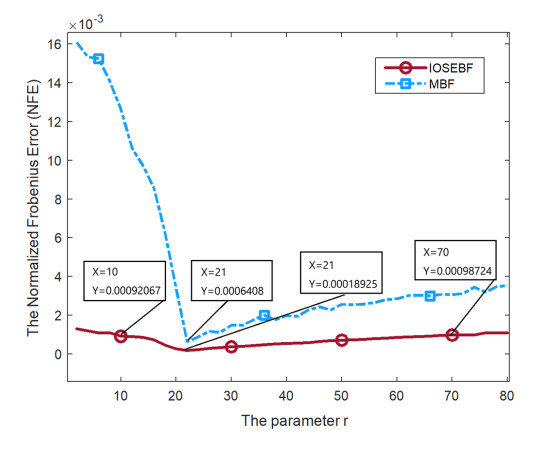
The effect of r on IOSEBF. The size of D is 200 × 200, the true rank is 20 and the noise level σ = 0. IOSEBF is tested with λ fixed at 100 and μ at 6000, while r ranges from 1 to 80
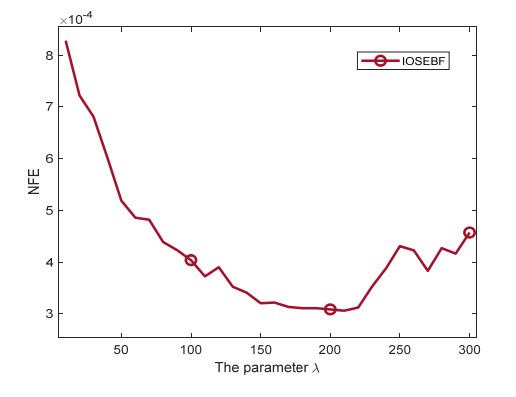
The effect of λ on IOSEBF with r = 30 and μ = 6000. IOSEBF is tested by letting the parameter λ increase from 10 to 300 with a step size equal to 10
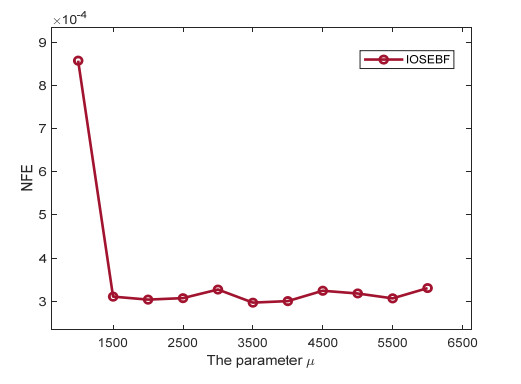
The effect of μ on IOSEBF with r = 30 and λ = 200. IOSEBF is tested by letting the parameter μ increase from 100 to 6000 with a step size equal to 500
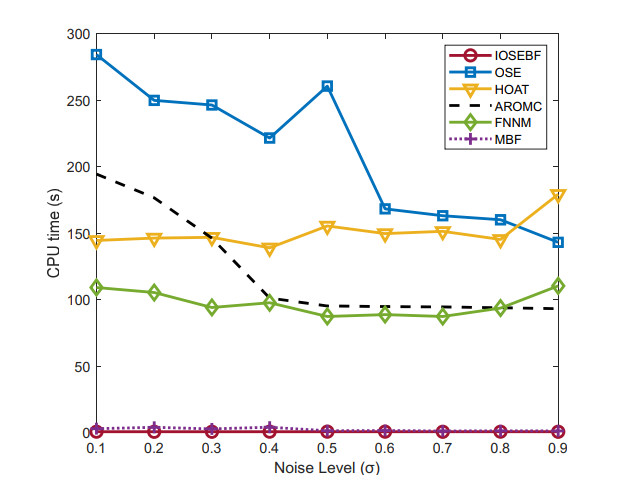
CPU time of IOSEBF and the other five compared methods. The noise level of the tested incomplete matrices increases from 0.1 to 0.9 with a step size of 0.1
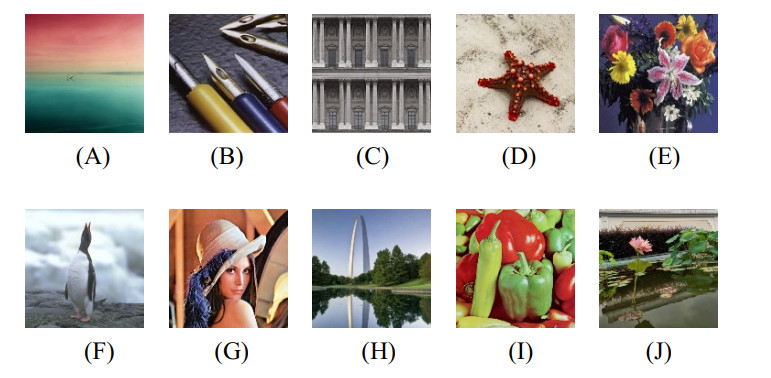
The original color images used for matrix completion. Each image is of size $ 1024\times 1024 $ pixels
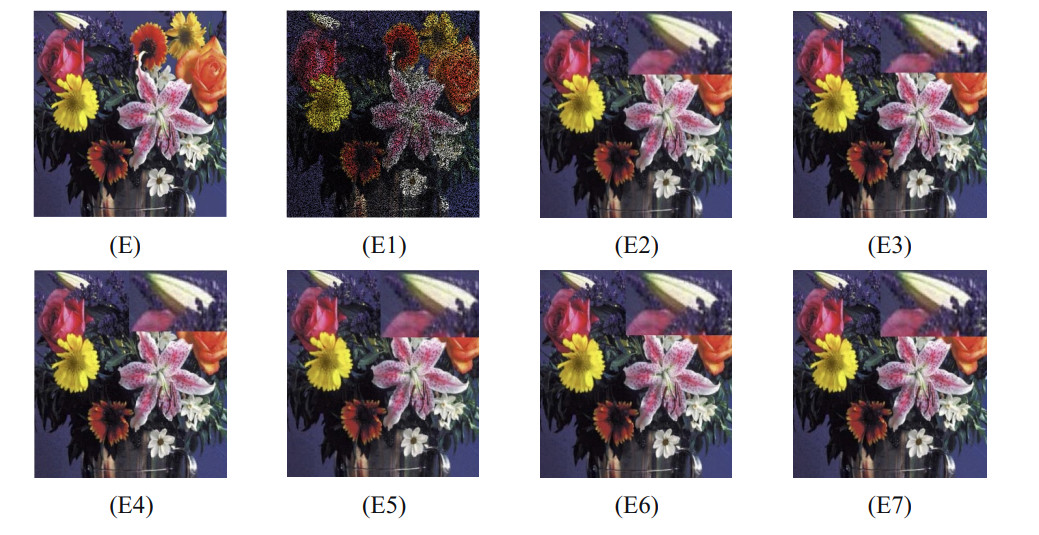
The recovery results of IOSEBF and other compared methods. (E) The original image. (E1) The incomplete image. (E2) FNNM, PSNR = 33.87. (E3) HOAT, PSNR = 33.58. (E4) AROMC, PSNR = 33.45. (E5) MBF, PSNR = 32.26. (E6) OSE, PSNR = 34.67. (E7) IOSEBF, PSNR = 36.17




 DownLoad: