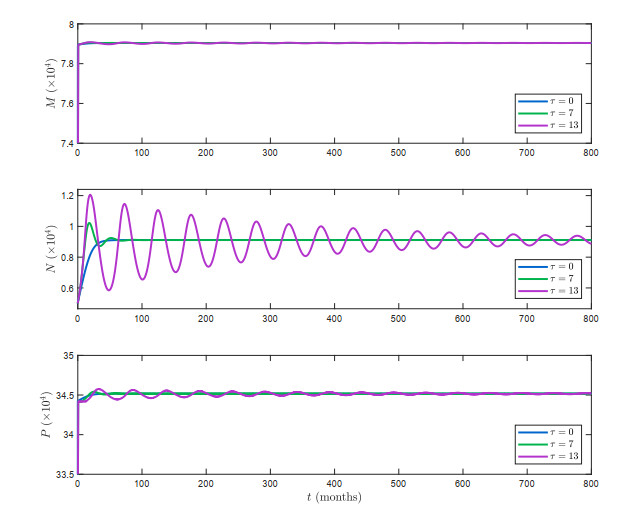
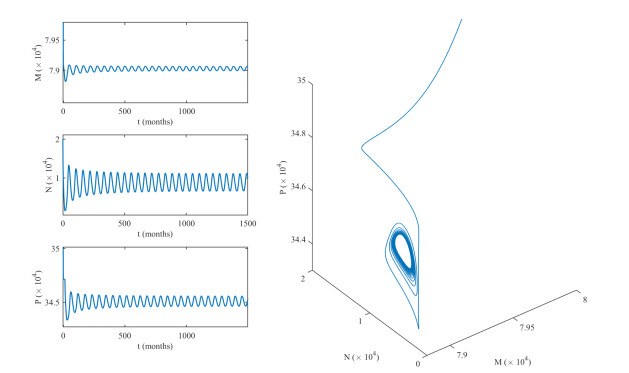
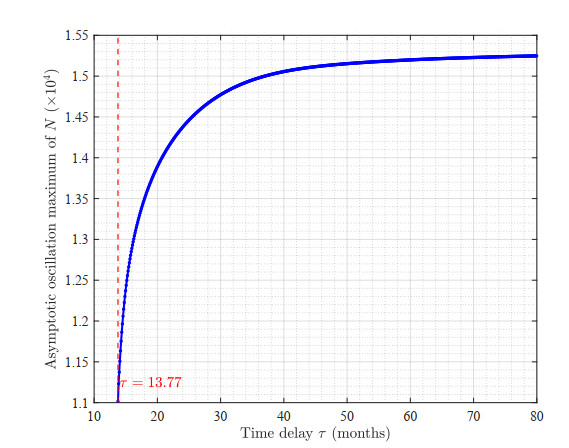
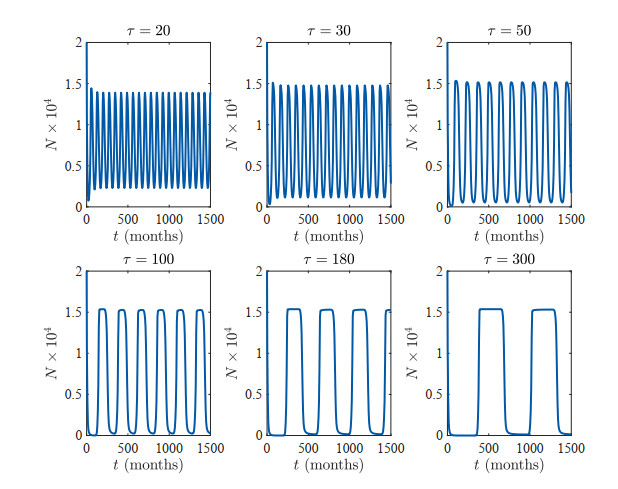
Pine wilt disease represents a devastating forest pest with severe ecological risks. Biological control based on the natural enemy Dastarcus helophoroides has become a core management strategy. Most existing dynamical models mainly focus on a single time delay or the effects of natural enemies, and studies comprehensively incorporating the coupled interplay of temperature, interspecific relationships, and time delay are still limited. Motivated by this situation, we establish a three-dimensional model of delayed differential equations, which captures the tripartite interaction among pine wood nematodes, Monochamus alternatus, and Dastarcus helophoroides. The model combines logistic population growth, Holling type Ⅱ functional response, and the Brière type Ⅱ nonlinear temperature-dependent developmental function, and introduces parasitic time delay to reflect temperature-driven regulation of development and reproduction across all three species. Analytically, we prove the existence of positive equilibria and derive criteria for the local asymptotic stability of the model. Taking the parasitic time delay as the bifurcation parameter, we obtain the critical time delay threshold and the transversality condition for Hopf bifurcation. The multiple time scales method is applied to derive the normal form of Hopf bifurcation, which further determines the stability and bifurcation direction of the periodic orbits. Numerically, we perform systematic simulations to examine how key parameters shape the model's dynamical behavior. Simulation results indicate that as the time delay increases, attracting periodic solutions emerge under the tested parameter values and initial histories. The ecological insights and biological control implications derived from this work are model-based hypotheses that may serve as a reference for further studies on pine wilt disease.
Citation: Kejia Wang, Yuting Ding, Yanan Zheng. Dynamical analysis of a delayed pine wilt disease model under temperature conditions[J]. Electronic Research Archive, 2026, 34(12): 8943-8976. doi: 10.3934/era.2026376
Pine wilt disease represents a devastating forest pest with severe ecological risks. Biological control based on the natural enemy Dastarcus helophoroides has become a core management strategy. Most existing dynamical models mainly focus on a single time delay or the effects of natural enemies, and studies comprehensively incorporating the coupled interplay of temperature, interspecific relationships, and time delay are still limited. Motivated by this situation, we establish a three-dimensional model of delayed differential equations, which captures the tripartite interaction among pine wood nematodes, Monochamus alternatus, and Dastarcus helophoroides. The model combines logistic population growth, Holling type Ⅱ functional response, and the Brière type Ⅱ nonlinear temperature-dependent developmental function, and introduces parasitic time delay to reflect temperature-driven regulation of development and reproduction across all three species. Analytically, we prove the existence of positive equilibria and derive criteria for the local asymptotic stability of the model. Taking the parasitic time delay as the bifurcation parameter, we obtain the critical time delay threshold and the transversality condition for Hopf bifurcation. The multiple time scales method is applied to derive the normal form of Hopf bifurcation, which further determines the stability and bifurcation direction of the periodic orbits. Numerically, we perform systematic simulations to examine how key parameters shape the model's dynamical behavior. Simulation results indicate that as the time delay increases, attracting periodic solutions emerge under the tested parameter values and initial histories. The ecological insights and biological control implications derived from this work are model-based hypotheses that may serve as a reference for further studies on pine wilt disease.

| [1] |
M. Li, H. Li, X. Ding, L. Wang, X. Wang, F. Chen, The detection of pine wilt disease: a literature review, Int. J. Mol. Sci., 23 (2022), 10797. https://doi.org/10.3390/ijms231810797 doi: 10.3390/ijms231810797

|
| [2] | National Forestry and Grassland Administration, Announcement of the National Forestry and Grassland Administration (No. 4, 2025): Pine Wilt Disease Epidemic Area in 2025, 25 Feb. 2025. Available from: https://www.forestry.gov.cn/search/612541. Accessed: 5 Mar. 2025. |
| [3] |
X. Z. Wang, Y. F. Cao, L. F. Wang, C. G. Piao, C. L. Li, Current status of pine wilt disease and its control status, J. Environ. Entomol., 40 (2018), 256–267. https://doi.org/10.3969/j.issn.1674-0858.2018.02.3 doi: 10.3969/j.issn.1674-0858.2018.02.3
|
| [4] |
Y. Zhang, Y. Wang, Analysis on the onset characteristics and scientific prevention and control technologies of pine wilt disease, World Trop. Agric., 47 (2026), 129–131. https://doi.org/10.12008/j.issn.1009-1726.2026.01.042 doi: 10.12008/j.issn.1009-1726.2026.01.042
|
| [5] |
J. Li, Y. T. Ding, Stability analysis of a pine wood nematode prevention and control model with delay, Int. J. Biomath., 18 (2025), 151–188. https://doi.org/10.1142/S1793524524500128 doi: 10.1142/S1793524524500128
|
| [6] |
Y. D. Liu, Y. J. Sun, F. Wang, L. J. Wang, X. Chen, B. Zhang, et al., Nematicidal effects of Juniperus chinensis leaf extracts on the pine wood nematode (Bursaphelenchus xylophilus), J. Plant Dis. Prot., 133 (2026), 17. https://doi.org/10.1007/s41348-025-01188-w doi: 10.1007/s41348-025-01188-w
|
| [7] |
Z. Q. Yang, X. Y. Wang, Y. N. Zhang, C. N. Situ, F. Y. Fu, Control effect of the pine wood nematode disease transmitted by Monochamus alternatus through releasing the parasitoid Dastarcus helophoroides (Fairmaire) and using bait-trees, Chin. J. Biol. Control, 28 (2012), 490–495. https://doi.org/10.3969/j.issn.2095-039X.2012.04.008 doi: 10.3969/j.issn.2095-039X.2012.04.008
|
| [8] |
Y. S. Chen, J. Y. Zhou, X. H. Xiao, Z. D. Luo, X. W. Peng, Population dynamics and spatial distribution pattern of Dastarcus helophoroides larvae in forest stands, J. Environ. Entomol., 45 (2023), 688–694. https://doi.org/10.3969/j.issn.1674-0858.2023.03.15 doi: 10.3969/j.issn.1674-0858.2023.03.15
|
| [9] |
H. Lee, J. K. Jung, Y. Nam, S. H. Koh, Temperature-dependent oviposition models for Monochamus saltuarius (Coleoptera: Cerambycidae), Insects, 15 (2024), 597. https://doi.org/10.3390/insects15080597 doi: 10.3390/insects15080597
|
| [10] |
S. Jikumaru, K. Togashi, Temperature effects on the transmission of Bursaphelenchus xylophilus (Nemata: Aphelenchoididae) by Monochamus alternatus (Coleoptera: Cerambycidae), J. Nematol., 32 (2000), 110–116. https://doi.org/10.21307/jofnem-2000-32-1-110 doi: 10.21307/jofnem-2000-32-1-110
|
| [11] |
Q. D. Hou, J. X. Li, L. Cheng, L. L. Ren, Y. Q. Luo, Cryptobiosis enables pine wood nematode resistance to low-temperature stress, Forests, 16 (2025), 910. https://doi.org/10.3390/f16060910 doi: 10.3390/f16060910
|
| [12] |
Y. C. Hou, Y. T. Ding, Bifurcation analysis of pine wilt disease model with both memory-based diffusion and nonlocal effect, Nonlinear Dyn., 112 (2024), 10723–10738. https://doi.org/10.1007/s11071-024-09598-5 doi: 10.1007/s11071-024-09598-5
|
| [13] |
A. Yoshimura, K. Kawasaki, F. Takasu, K. Togashi, K. Futai, N. Shigesada, Modeling the spread of pine wilt disease caused by nematodes with pine sawyers as vector, Ecology, 80 (1999), 1691–1702. https://doi.org/10.1890/0012-9658(1999)080[1691:MSOPWD]2.0.CO;2 doi: 10.1890/0012-9658(1999)080[1691:MSOPWD]2.0.CO;2
|
| [14] |
F. Takasu, N. Yamamoto, K. Kawasaki, K. Togashi, Y. Kishi, N. Shigesada, Modeling the expansion of an introduced tree disease, Biol. Invasions, 2 (2000), 141–150. https://doi.org/10.1023/A:1010048725497 doi: 10.1023/A:1010048725497
|
| [15] |
J. F. Brière, P. Pracros, A. Y. Le Roux, J. S. Pierre, A novel rate model of temperature-dependent development for arthropods, Environ. Entomol., 28 (1999), 22–29. https://doi.org/10.1093/ee/28.1.22 doi: 10.1093/ee/28.1.22
|
| [16] |
M. Cruz-Loya, E. A. Mordecai, V. M. Savage, A flexible model for thermal performance curves, Ecology, 107 (2026), e70251. https://doi.org/10.1002/ecy.70251 doi: 10.1002/ecy.70251
|
| [17] |
J. Jin, B. K. Quinn, P. Shi, The modified Briere equation and its applications, Plants, 11 (2022), 1769. https://doi.org/10.3390/plants11131769 doi: 10.3390/plants11131769
|
| [18] | Hunan Provincial Forestry Department, Release of Natural Enemies of Monochamus alternatus for Pine Wilt Disease Control in Hunan Forest Areas, 2 Dec. 2020. Available from: https://lyj.hunan.gov.cn/lyj/tslm_71206/lykp/syjs/202012/t20201202_13974052.html. Accessed: 7 Jul. 2026. |
| [19] | W. M. Li, Y. P. Wu, Effective accumulated temperature measurement of Monochamus alternatus, Shaanxi J. Agric. Sci., 61 (2015), 4. |
| [20] |
Y. Z. Li, Z. Q. Yang, M. L. Li, Study on the relationship between temperature and the growth and procreation of Dastarcus helophoroides Fairmaire, J. Northwest A & F Univ. Nat. Sci. Ed., 37 (2009), 125–129. https://doi.org/10.13207/j.cnki.jnwafu.2009.02.016 doi: 10.13207/j.cnki.jnwafu.2009.02.016
|
| [21] |
Y. J. Zhou, C. D. Lu, H. Y. Shen, Y. Liang, Z. H. Chen, J. H. Zhong, et al., Adaptation and physiological response of Dastarcus helophoroides (Fairmaire) to high temperature stress, Chin. J. Biol. Control, 37 (2021), 1179–1188. https://doi.org/10.16409/j.cnki.2095-039x.2021.05.013 doi: 10.16409/j.cnki.2095-039x.2021.05.013
|
| [22] | Hubei Provincial Forestry Pest Control Information Network, Release of Natural Enemies of Monochamus alternatus in Shishou City: "Control Insects with Insects", 8 Aug. 2023. Available from: https://lyj.hubei.gov.cn/slfzw/xwzz/sndt/202308/t20230808_4786992.shtml. Accessed: 5 Jul. 2026. |
| [23] |
J. Wang, F. Y. Fu, C. N. Situ, Parasitism of Dastarcus helophoroides on Monochamus alternatus, For. Pest Dis., 29 (2010), 38–39. https://doi.org/10.3969/j.issn.1671-0886.2010.04.011 doi: 10.3969/j.issn.1671-0886.2010.04.011
|
| [24] |
C. X. Ying, X. Q. Wu, T. Y. Wen, Y. Zhang, Population reproduction of Bursaphelenchus xylophilus and Bursaphelenchus mucronatus with different virulence response to temperature, J. Environ. Entomol., 45 (2023), 433–441. https://doi.org/10.3969/j.issn.1674-0858.2023.02.15 doi: 10.3969/j.issn.1674-0858.2023.02.15
|
| [25] |
Y. S. Chen, S. K. Chen, H. P. Yu, Z. D. Luo, X. P. Liu, Effects of low temperature treatment on storage and hatchability of eggs of Dastarcus helophoroides, J. Henan Agric. Sci., 47 (2018), 73–77. https://doi.org/10.15933/j.cnki.1004-3268.2018.01.013 doi: 10.15933/j.cnki.1004-3268.2018.01.013
|
| [26] |
P. Wei, Y. Li, W. Zhang, M. Gao, Z. Liu, X. Zhang, Factors affecting the ratio of female to male of pinewood nematodes Bursaphelenchus xylophilus (Steiner & Buhrer) Nickle, Forests, 12 (2021), 763. https://doi.org/10.3390/f12060763 doi: 10.3390/f12060763
|
| [27] |
G. N. Zheng, X. H. Yang, Z. S. Dong, M. L. Wei, X. L. Zheng, Review of reproductive behavior of Monochamus alternatus and its influencing factors, Guangxi For. Sci., 51 (2022), 128–135. https://doi.org/10.19692/j.issn.1006-1126.20220120 doi: 10.19692/j.issn.1006-1126.20220120
|
| [28] | Y. L. Pan, Q. Liu, G. D. Peng, Y. S. Chen, J. Li, Y. Cao, et al., Seasonal phenology and population dynamics of Japanese pine sawyer Monochamus alternatus Hope (Coleoptera:Cerambycidae) in different regions of Jiangxi, For. Res., 36 (2023), 70–78. |
| [29] | Y. Jiang, Study on Reproductive Biology of Dastarcus helophoroides, an Important Natural Enemy of Monochamus alternatus, Master's thesis, Northeast Forestry University, Harbin, China, 2012. |
| [30] |
Y. Wang, J. Chen, F. M. Chen, Q. Zhou, L. F. Zhou, S. H. Sun, Transmission of Bursaphelenchus xylophilus (Nematoda: Aphelenchoididae) through feeding activity of Monochamus alternatus (Coleoptera: Cerambycidae), J. Nanjing For. Univ. Nat. Sci. Ed., 43 (2019), 1–10. https://doi.org/10.3969/j.issn.1000-2006.201903001 doi: 10.3969/j.issn.1000-2006.201903001
|
Figures(11) / Tables(2)
Kejia Wang, Yuting Ding, Yanan Zheng. Dynamical analysis of a delayed pine wilt disease model under temperature conditions[J]. Electronic Research Archive, 2026, 34(12): 8943-8976. doi: 10.3934/era.2026376





 DownLoad: