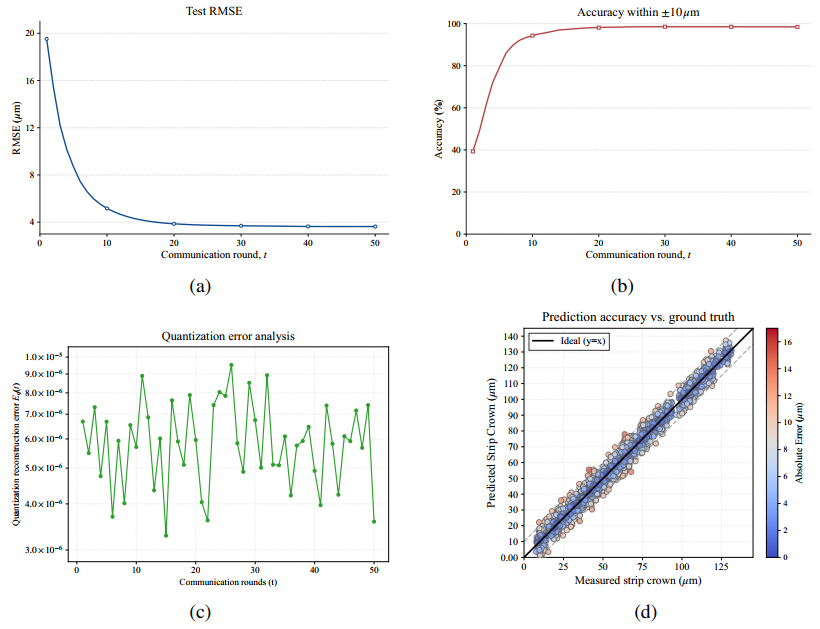
To address the vulnerability of output-layer gradient leakage during the distributed training of hot-rolled steel strip-crown prediction across multiple steel mills, this paper proposes a privacy-preserving split-layer federated learning scheme based on multi-client functional encryption. The proposed scheme keeps the input layer parameters at local clients, where they are updated using local data but are neither uploaded nor aggregated. Only the output layer gradients are encrypted and aggregated to update the shared output layer parameters. Leveraging the inner-product property of multiclient functional encryption alongside a capacity-aware, fixed client partitioning strategy, the secure aggregation of output layer gradients is achieved entirely within the ciphertext domain. Theoretical analysis derives a conditional stationarity bound for the shared output layer optimization phase under fixed local input layer parameters and quantization error. Furthermore, a reduction-based security analysis establishes single-round and multi-round ciphertext indistinguishability under the condition that all authorized fixed-subset outputs are identical between the compared inputs in every communication round. Under the honest-but-curious aggregation server and external eavesdropper threat models, this result provides confidentiality beyond the information revealed by these authorized outputs. Experimental results demonstrate that the proposed secure aggregation framework based on multi-client functional encryption achieves a root mean square error of 3.6290 µm for strip-crown prediction. This result confirms the feasibility of applying privacy-preserving gradient aggregation to this industrial prediction task.
Citation: Yadong Wang, Nuerken Saireke, Jimin Wang. Privacy-preserving gradient scheme for hot-rolled steel based on functional encryption[J]. Electronic Research Archive, 2026, 34(12): 8896-8916. doi: 10.3934/era.2026374
To address the vulnerability of output-layer gradient leakage during the distributed training of hot-rolled steel strip-crown prediction across multiple steel mills, this paper proposes a privacy-preserving split-layer federated learning scheme based on multi-client functional encryption. The proposed scheme keeps the input layer parameters at local clients, where they are updated using local data but are neither uploaded nor aggregated. Only the output layer gradients are encrypted and aggregated to update the shared output layer parameters. Leveraging the inner-product property of multiclient functional encryption alongside a capacity-aware, fixed client partitioning strategy, the secure aggregation of output layer gradients is achieved entirely within the ciphertext domain. Theoretical analysis derives a conditional stationarity bound for the shared output layer optimization phase under fixed local input layer parameters and quantization error. Furthermore, a reduction-based security analysis establishes single-round and multi-round ciphertext indistinguishability under the condition that all authorized fixed-subset outputs are identical between the compared inputs in every communication round. Under the honest-but-curious aggregation server and external eavesdropper threat models, this result provides confidentiality beyond the information revealed by these authorized outputs. Experimental results demonstrate that the proposed secure aggregation framework based on multi-client functional encryption achieves a root mean square error of 3.6290 µm for strip-crown prediction. This result confirms the feasibility of applying privacy-preserving gradient aggregation to this industrial prediction task.

| [1] | D. Matlock, J. Speer, Third generation of AHSS: Microstructure design concepts, in Microstructure and Texture in Steels, (2009), 185–205. https://doi.org/10.1007/978-1-84882-454-6_11 |
| [2] |
K. Muszka, D. Dziedzic, L. Madej, J. Majta, P. D. Hodgson, E. J. Palmiere, The development of ultrafine-grained hot rolling products using advanced thermomechanical processing, Mater. Sci. Eng. A, 610 (2014), 290–296. https://doi.org/10.1016/j.msea.2014.05.051 doi: 10.1016/j.msea.2014.05.051

|
| [3] |
T. Cheng, G. Chen, Prediction of mechanical properties of hot-rolled strip steel based on PCA-GBDT method, J. Phys. Conf. Ser., 1774 (2021), 012002. https://doi.org/10.1088/1742-6596/1774/1/012002 doi: 10.1088/1742-6596/1774/1/012002
|
| [4] |
Y. Liu, X. Wang, J. Sun, G. Liu, H. Li, Y. Ji, Strip thickness and profile-flatness prediction in tandem hot rolling process using mechanism model-guided machine learning, Steel Res. Int., 94 (2023), 2200447. https://doi.org/10.1002/srin.202200447 doi: 10.1002/srin.202200447
|
| [5] |
L. Song, D. Xu, X. Wang, Q. Yang, Y. Ji, Application of machine learning to predict and diagnose for hot-rolled strip crown, Int. J. Adv. Manuf. Technol., 120 (2022), 881–890. https://doi.org/10.1007/s00170-022-08825-w doi: 10.1007/s00170-022-08825-w
|
| [6] |
C. M. Sellars, Computer modelling of hot-working processes, Mater. Sci. Technol., 1 (1985), 325–332. https://doi.org/10.1179/mst.1985.1.4.325 doi: 10.1179/mst.1985.1.4.325
|
| [7] |
P. D. Hodgson, R. K. Gibbs, A mathematical model to predict the mechanical properties of hot rolled C-Mn and microalloyed steels, ISIJ Int., 32 (1992), 1329–1338. https://doi.org/10.2355/isijinternational.32.1329 doi: 10.2355/isijinternational.32.1329
|
| [8] |
P. D. Hodgson, L. X. Kong, C. H. J. Davies, The prediction of the hot strength in steels with an integrated phenomenological and artificial neural network model, J. Mater. Process. Technol., 87 (1999), 131–138. https://doi.org/10.1016/S0924-0136(98)00344-6 doi: 10.1016/S0924-0136(98)00344-6
|
| [9] | C. L. Mo, Q. Li, D. Z. Li, F. Feng, Z. D. Zhan, Prediction of the properties of hot rolling strip by using regression and neural network, Acta Metall. Sin., 39 (2003), 1110–1114. |
| [10] |
X. Li, Q. Jiang, X. Zhou, G. Cao, G. Wang, Z. Liu, Machine learning complex interactions among recovery, precipitation, and recrystallization for Nb micro-alloyed steels, Met. Mater. Int., 30 (2024), 167–181. https://doi.org/10.1007/s12540-023-01493-9. doi: 10.1007/s12540-023-01493-9
|
| [11] |
S. X. Zhao, S. C. Liu, Y. S. Jiang, B. Zhao, Y. L. Lv, J. Zhang, et al., Industrial foundation models (IFMs) for intelligent manufacturing: A systematic review, J. Manuf. Syst., 82 (2025), 420–448. https://doi.org/10.1016/j.jmsy.2025.06.011 doi: 10.1016/j.jmsy.2025.06.011
|
| [12] |
F. Roters, A. Aslam, Y. Bai, M. Büschelberger, K. Bulert, A. Butz, et al., Stahldigital: ontology-based workflows for the steel industry, Adv. Eng. Mater., 27 (2025), 2402148. https://doi.org/10.1002/adem.202402148 doi: 10.1002/adem.202402148
|
| [13] | T. Liu, J. Xia, G. Chen, J. H. Park, Synthesis of noisy sampled-data networked control systems under deception attacks: Direct current motor applications, IEEE Internet Things J., 2026 (2026). https://doi.org/10.1109/JIOT.2026.3680502 |
| [14] | Y. Fu, Z. Zhang, G. Zeng, X. Ren, Attack for range-only localization systems: A learning-based robust optimization approach, IEEE Internet Things J., 2026 (2026). https://doi.org/10.1109/JIOT.2026.3698447 |
| [15] |
Z. Wang, J. Yang, Z. Liu, W. Ning, A two-layer deception attack detection framework for UAV, IEEE Internet Things J., 13 (2026), 27228–27236. https://doi.org/10.1109/JIOT.2026.3679816 doi: 10.1109/JIOT.2026.3679816
|
| [16] |
N. Haim, G. Vardi, G. Yehudai, O. Shamir, M. Irani, Reconstructing training data from trained neural networks, Adv. Neural Inf. Process. Syst., 35 (2022), 22911–22924. https://doi.org/10.52202/068431-1665 doi: 10.52202/068431-1665
|
| [17] | A. Viand, P. Jattke, A. Hithnawi, SoK: Fully homomorphic encryption compilers, in Proceedings of the 2021 IEEE Symposium on Security and Privacy (SP), San Francisco, CA, USA, (2021), 1092–1108. https://doi.org/10.1109/SP40001.2021.00068 |
| [18] |
K. Wei, J. Li, M. Ding, C. Ma, H. H. Yang, F. Farokhi, et al., Federated learning with differential privacy: Algorithms and performance analysis, IEEE Trans. Inf. Forensics Secur., 15 (2020), 3454–3469. https://doi.org/10.1109/TIFS.2020.2988575 doi: 10.1109/TIFS.2020.2988575
|
| [19] | B. Knott, S. Venkataraman, A. Hannun, S. Sengupta, M. Ibrahim, L. van der Maaten, Crypten: Secure multi-party computation meets machine learning, Adv. Neural Inf. Process. Syst., 34 (2021), 4961–4973. |
| [20] |
X. Zhang, Y. Luo, T. Li, A review of research on secure aggregation for federated learning, Future Internet, 17 (2025), 308. https://doi.org/10.3390/fi17070308 doi: 10.3390/fi17070308
|
| [21] | R. Zhang, J. Han, L. Chen, Flexible threshold multi-client functional encryption for inner product in federated learning, preprint, arXiv: 2510.15367. https://doi.org/10.48550/arXiv.2510.15367 |
| [22] | J. Chotard, E. Dufour-Sans, R. Gay, D. H. Phan, D. Pointcheval, Decentralized multi-client functional encryption for inner product, in International Conference on the Theory and Application of Cryptology and Information Security, (2018), 703–732. https://doi.org/10.1007/978-3-030-03329-3_24 |
| [23] | M. Abdalla, F. Benhamouda, R. Gay, From single-input to multi-client inner-product functional encryption, in International Conference on the Theory and Application of Cryptology and Information Security, (2019), 552–582. https://doi.org/10.1007/978-3-030-34618-8_19 |
| [24] |
L. Bottou, F. E. Curtis, J. Nocedal, Optimization methods for large-scale machine learning, SIAM Rev., 60 (2018), 223–311. https://doi.org/10.1137/16M1080173 doi: 10.1137/16M1080173
|
| [25] | G. H. Hardy, J. E. Littlewood, G. Pólya, Inequalities, Cambridge University Press, Cambridge, 1952. |
| [26] |
G. Li, D. Gong, X. Lu, D. Zhang, Ensemble learning based methods for crown prediction of hot-rolled strip, ISIJ Int., 61 (2021), 1603–1613. https://doi.org/10.2355/isijinternational.ISIJINT-2020-639 doi: 10.2355/isijinternational.ISIJINT-2020-639
|
| [27] | J. Wang, J. Ke, J. Guo, Y. Zhao, Recursive binary identification with differential privacy and data tampering attacks, preprint, arXiv: 2601.07608. https://doi.org/10.48550/arXiv.2601.07608 |
| [28] | L. Guo, J. Wang, Y. Zhao, J. F. Zhang, State estimation with protecting exogenous inputs via Cramér-Rao lower bound approach, preprint, arXiv: 2410.08756v2. https://doi.org/10.1007/s11432-024-5021-y |
Figures(2) / Tables(6)
Yadong Wang, Nuerken Saireke, Jimin Wang. Privacy-preserving gradient scheme for hot-rolled steel based on functional encryption[J]. Electronic Research Archive, 2026, 34(12): 8896-8916. doi: 10.3934/era.2026374





 DownLoad: