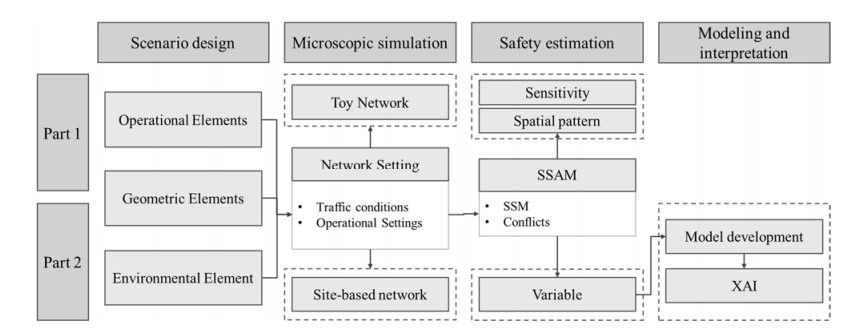
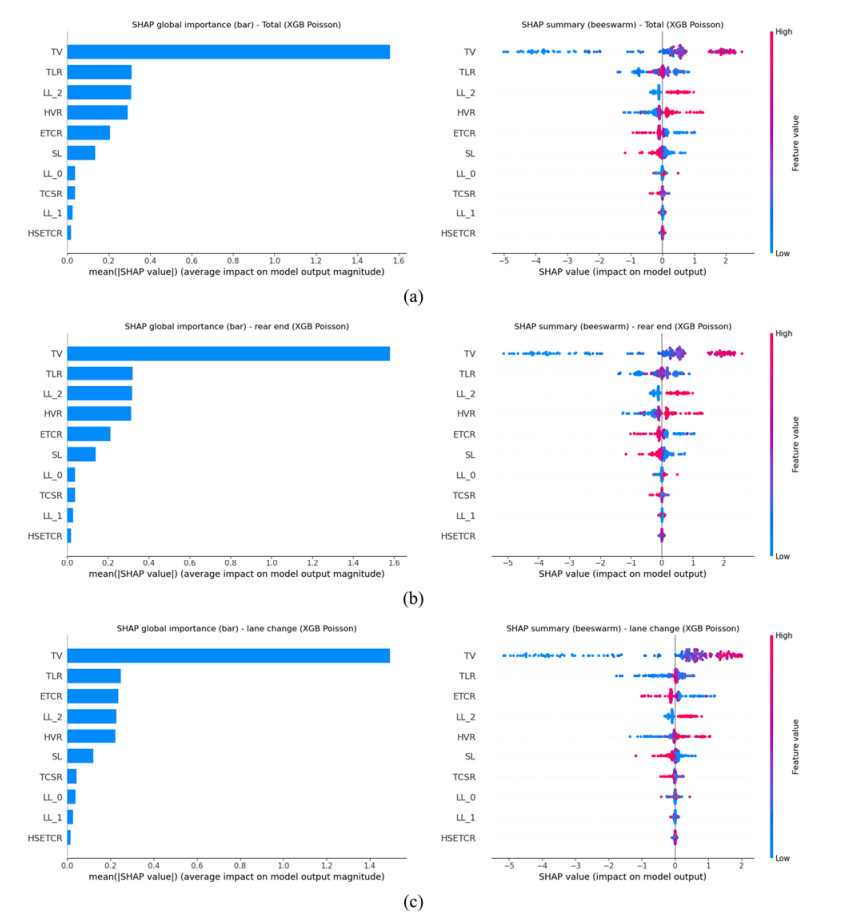
The rapid expansion of expressway open-toll plazas, where high-speed electronic toll collection lanes operate alongside slower manual and single-lane toll lanes, has introduced complex crash risks that are difficult to capture using traditional crash-frequency models alone. Sparse crash records, heterogeneous operating conditions, and evolving tolling configurations call for data-driven approaches that integrate simulation, surrogate safety metrics, and computational learning. This study aims to perform a comprehensive risk assessment of open-toll plaza configurations by combining surrogate safety measure (SSM) estimations with computational learning (CL)-based accident prediction models. First, a broad set of geometric and operational scenarios is generated by systematically varying lane layout, toll-lane composition, merging length, speed limit, traffic volume, and heavy-vehicle share. For each scenario, microscopic traffic simulations are conducted, and SSMs—including time to collision (TTC), post-encroachment time (PET), and conflict counts—are extracted to quantify instantaneous interaction risk at the vehicle level. These SSMs serve both as comparative safety indicators and as target outputs for subsequent CL models. Next, the CL model is trained to predict conflict frequencies from design and traffic features, while a complementary parametric count model is estimated for benchmarking. To enhance interpretability, eXplainable AI (XAI) attribution techniques are used to decompose the CL predictions into feature-level contributions, revealing nonlinear and interaction effects associated with high-risk operating regimes. The results highlight the dominant influence of traffic volume and toll lane ratio on conflict occurrence. By integrating SSM-based simulation outputs with CL and XAI, the proposed approach provides quantitative and interpretable evidence that supports safer design and operation of expressway open-toll plazas within next-generation data-driven transportation systems.
Citation: Hojae Kim, Juneyoung Park, Cheol Oh, Chris Lee. Comprehensive risk assessment on expressway open-toll Plaza with computational learning-based accident predictions and surrogate safety measure estimations[J]. Electronic Research Archive, 2026, 34(5): 3050-3078. doi: 10.3934/era.2026138
The rapid expansion of expressway open-toll plazas, where high-speed electronic toll collection lanes operate alongside slower manual and single-lane toll lanes, has introduced complex crash risks that are difficult to capture using traditional crash-frequency models alone. Sparse crash records, heterogeneous operating conditions, and evolving tolling configurations call for data-driven approaches that integrate simulation, surrogate safety metrics, and computational learning. This study aims to perform a comprehensive risk assessment of open-toll plaza configurations by combining surrogate safety measure (SSM) estimations with computational learning (CL)-based accident prediction models. First, a broad set of geometric and operational scenarios is generated by systematically varying lane layout, toll-lane composition, merging length, speed limit, traffic volume, and heavy-vehicle share. For each scenario, microscopic traffic simulations are conducted, and SSMs—including time to collision (TTC), post-encroachment time (PET), and conflict counts—are extracted to quantify instantaneous interaction risk at the vehicle level. These SSMs serve both as comparative safety indicators and as target outputs for subsequent CL models. Next, the CL model is trained to predict conflict frequencies from design and traffic features, while a complementary parametric count model is estimated for benchmarking. To enhance interpretability, eXplainable AI (XAI) attribution techniques are used to decompose the CL predictions into feature-level contributions, revealing nonlinear and interaction effects associated with high-risk operating regimes. The results highlight the dominant influence of traffic volume and toll lane ratio on conflict occurrence. By integrating SSM-based simulation outputs with CL and XAI, the proposed approach provides quantitative and interpretable evidence that supports safer design and operation of expressway open-toll plazas within next-generation data-driven transportation systems.

| [1] |
J. Weng, R. Wang, M. Wang, J. Rong, Fuel consumption and vehicle emission models for evaluating environmental impacts of the ETC system, Sustainability, 7 (2015), 8935-8950. https://doi.org/10.3390/su7078934 doi: 10.3390/su7078934

|
| [2] | A. Eilbert, A. Mittelman, A. M. Chouinard, M. Glaze, C. Ho, Estimating Emission Benefits of Electronic Open-Road Tolling Conversion Projects, John A. Volpe National Transportation Systems Center, Report No. 1174898, 2022. Available from: https://rosap.ntl.bts.gov/view/dot/64625. |
| [3] |
N. Alemazkoor, M. Burris, Examining potential travel time savings benefits due to toll rates that vary by lane, J. Transp. Technol., 4 (2014), 267-286. https://doi.org/10.4236/jtts.2014.43024 doi: 10.4236/jtts.2014.43024
|
| [4] | M. Abuzwidah, M. Abdel-Aty, Crash risk analysis of different designs of toll plazas, Saf. Sci., 107 (2018), 77-84. https://doi.org/10.1016/j.ssci.2018.02.024 |
| [5] | M. Abuzwidah, M. Abdel-Aty, Safety assessment of the conversion of toll plazas to all-electronic toll collection system, Accid. Anal. Prev., 80 (2015), 153-161. https://doi.org/10.1016/j.aap.2015.03.039 |
| [6] |
M. Saad, M. Abdel-Aty, J. Lee, Analysis of driving behavior at expressway toll plazas, Transp. Res. Part F Traffic Psychol. Behav., 61 (2019), 163-177. https://doi.org/10.1016/j.trf.2017.12.008 doi: 10.1016/j.trf.2017.12.008
|
| [7] |
D. Lord, F. Mannering, The statistical analysis of crash-frequency data: A review and assessment of methodological alternatives, Transp. Res. Part A Policy Pract., 44 (2010), 291-305. https://doi.org/10.1016/j.tra.2010.02.001 doi: 10.1016/j.tra.2010.02.001
|
| [8] |
D. Gettman, L. Head, Surrogate safety measures from traffic simulation models, Transp. Res. Rec. , 1840 (2003), 104-115. https://doi.org/10.3141/1840-12 doi: 10.3141/1840-12
|
| [9] | D. Gettman, L. Pu, T. Sayed, S. G. Shelby, Surrogate Safety Assessment Model and Validation: Final Report, Turner-Fairbank Highway Res. Cent., Report No. FHWA-HRT-08-051, 2008. Available from: https://rosap.ntl.bts.gov/view/dot/39210. |
| [10] |
Y. Fei, K. Long, L. Xing, X. Pei, X. Li, L. Yao, Safety performance analysis of toll plaza diverging area based on an improved simulation platform for weak-constraint driving behaviors, Accid. Anal. Prev. , 220 (2025), 108177. https://doi.org/10.1016/j.aap.2025.108177 doi: 10.1016/j.aap.2025.108177
|
| [11] |
O. Lares, H. Zhen, J. J. Yang, Feature group tabular transformer: A novel approach to traffic crash modeling and causality analysis, Appl. Comput. Intell. , 5 (2025), 29-56. https://doi.org/10.3934/aci.2025003 doi: 10.3934/aci.2025003
|
| [12] |
J. H. Friedman, Greedy function approximation: A gradient boosting machine, Ann. Stat., 29 (2001), 1189-1232. https://doi.org/10.1214/aos/1013203451 doi: 10.1214/aos/1013203451
|
| [13] |
L. Xing, J. He, M. Abdel-Aty, Y. Wu, J. Yuan, Time-varying analysis of traffic conflicts at the upstream approach of toll plaza, Accid. Anal. Prev. , 141 (2020), 105539. https://doi.org/10.1016/j.aap.2020.105539 doi: 10.1016/j.aap.2020.105539
|
| [14] |
L. Xing, M. Abdel-Aty, Q. Cai, Comparison of different models for evaluating vehicle collision risks at upstream diverging area of toll plaza, Accid. Anal. Prev. , 135 (2019), 105343. https://doi.org/10.1016/j.aap.2019.105343 doi: 10.1016/j.aap.2019.105343
|
| [15] |
W. Xiang, C. Wang, X. Li, Q. Xue, X. Liu, Optimizing guidance signage system to improve drivers' lane-changing behavior at the expressway toll plaza, Transp. Res. Part F Traffic Psychol. Behav., 90 (2022), 382-396. https://doi.org/10.1016/j.trf.2022.09.008 doi: 10.1016/j.trf.2022.09.008
|
| [16] |
S. M. Lundberg, G. Erion, H. Chen, A. DeGrave, J. M. Prutkin, B. Nair, et al., From local explanations to global understanding with explainable AI for trees, Nat. Mach. Intell., 2 (2020), 56-67. https://doi.org/10.1038/s42256-019-0138-9 doi: 10.1038/s42256-019-0138-9
|
| [17] |
A. B. Parsa, A. Movahedi, H. Taghipour, S. Derrible, A. Mohammadian, Toward safer highways: Application of XGBoost and SHAP for real-time accident detection and feature analysis, Accid. Anal. Prev., 136 (2020), 105405. https://doi.org/10.1016/j.aap.2019.105405 doi: 10.1016/j.aap.2019.105405
|
| [18] |
H. Al-Mahamid, D. Al-Nabulsi, A. Torok, Developing safety performance functions incorporating pavement roughness using Poisson regression and machine learning models on Jordan's Desert Highway, Transp. Res. Interdiscip. Perspect., 34 (2025), 101659. https://doi.org/10.1016/j.trip.2025.101659 doi: 10.1016/j.trip.2025.101659
|
| [19] |
Y. Ma, J. Zhang, J. Lu, S. Chen, G. Xing, R. Feng, Prediction and analysis of likelihood of freeway crash occurrence considering risky driving behavior, Accid. Anal. Prev., 192 (2023), 107244. https://doi.org/10.1016/j.aap.2023.107244 doi: 10.1016/j.aap.2023.107244
|
| [20] |
W. Wang, Y. Yang, X. Yang, V. V. Gayah, Y. Wang, J. Tang, et al., A negative binomial Lindley approach considering spatiotemporal effects for modeling traffic crash frequency with excess zeros, Accid. Anal. Prev., 207 (2024), 107741. https://doi.org/10.1016/j.aap.2024.107741 doi: 10.1016/j.aap.2024.107741
|
| [21] |
C. Wang, N. Stamatiadis, Surrogate safety measure for simulation-based conflict study, Transp. Res. Rec. , 2386 (2013), 72-80. https://doi.org/10.3141/2386-09 doi: 10.3141/2386-09
|
| [22] |
M. Essa, T. Sayed, Simulated traffic conflicts: Do they accurately represent field-measured conflicts, Transp. Res. Rec. , 2514 (2015), 48-57. https://doi.org/10.3141/2514-06 doi: 10.3141/2514-06
|
| [23] | Korea Expressway Corporation, Design Guidelines for Toll Plaza Areas Considering On-Site Toll Collection Lanes, 2019. Available from: https://www.codil.or.kr/viewDtlCostSave.do?gubun = costsave&pMetaCode=EDGCODA00606. |
| [24] | Transportation Research Board, Highway Capacity Manual, 2000. Available from: https://onlinepubs.trb.org/onlinepubs/trnews/rpo/rpo.trn129.pdf. |
| [25] |
S. Kim, The toll plaza optimization problem: Design, operations, and strategies, Transp. Res. Part E Logist. Transp. Rev. , 45 (2009), 125-137. https://doi.org/10.1016/j.tre.2008.03.004 doi: 10.1016/j.tre.2008.03.004
|
| [26] |
H. T. Abdelwahab, Traffic micro-simulation model for design and operational analysis of barrier toll stations, Ain Shams Eng. J. , 8 (2017), 507-513. https://doi.org/10.1016/j.asej.2016.05.010 doi: 10.1016/j.asej.2016.05.010
|
| [27] |
H. U. Ahmed, Y. Huang, P. Lu, A review of car-following models and modeling tools for human and autonomous-ready driving behaviors in micro-simulation, Smart Cities, 4 (2021), 314-335. https://doi.org/10.3390/smartcities4010019 doi: 10.3390/smartcities4010019
|
| [28] |
A. Dijkstra, P. Marchesini, F. Bijleveld, V. Kars, H. Drolenga, M. Van Maarseveen, Do calculated conflicts in microsimulation model predict number of crashes, Transp. Res. Rec. , 2147 (2010), 105-112. https://doi.org/10.3141/2147-13 doi: 10.3141/2147-13
|
| [29] |
C. Caliendo, M. Guida, Microsimulation approach for predicting crashes at unsignalized intersections using traffic conflicts, J. Transp. Eng. , 138 (2012), 1453-1467. https://doi.org/10.1061/(ASCE)TE.1943-5436.0000473 doi: 10.1061/(ASCE)TE.1943-5436.0000473
|
| [30] |
L. Xing, D. Zou, Y. Fei, K. Long, J. Wang, Safety evaluation of toll plaza diverging area considering different vehicles' toll collection types, Appl. Sci. , 13 (2023), 9005. https://doi.org/10.3390/app13159005 doi: 10.3390/app13159005
|
| [31] |
K. El-Basyouny, T. Sayed, Safety performance functions using traffic conflicts, Saf. Sci. , 51 (2013), 160-164. https://doi.org/10.1016/j.ssci.2012.04.015 doi: 10.1016/j.ssci.2012.04.015
|
| [32] |
L. Xing, J. He, M. Abdel-Aty, Q. Cai, Y. Li, O. Zheng, Examining traffic conflicts of up stream toll plaza area using vehicles' trajectory data, Accid. Anal. Prev. , 125 (2019), 174-187. https://doi.org/10.1016/j.aap.2019.01.034 doi: 10.1016/j.aap.2019.01.034
|
| [33] |
F. Huang, P. Liu, H. Yu, W. Wang, Identifying if VISSIM simulation model and SSAM provide reasonable estimates for field measured traffic conflicts at signalized intersections, Accid. Anal. Prev., 50 (2013), 1014-1024. https://doi.org/10.1016/j.aap.2012.08.018 doi: 10.1016/j.aap.2012.08.018
|
| [34] |
P. Song, N. N. Sze, O. Zheng, M. Abdel-Aty, Addressing unobserved heterogeneity at road user level for the analysis of conflict risk at tunnel toll plaza: A correlated grouped random parameters logit approach with heterogeneity in means, Anal. Methods Accid. Res. , 36 (2022), 100243. https://doi.org/10.1016/j.amar.2022.100243 doi: 10.1016/j.amar.2022.100243
|
| [35] |
M. Abuzwidah, M. Abdel-Aty, M. Ahmed, Safety evaluation of hybrid main-line toll plazas, Transp. Res. Rec. , 2435 (2014), 53-60. https://doi.org/10.3141/2435-07 doi: 10.3141/2435-07
|
| [36] |
F. Zahedieh, C. Lee, Impacts of a toll information sign and toll lane configuration on queue length and collision risk at a toll plaza with a high percentage of heavy vehicles, Vehicles, 6 (2024), 1249-1267. https://doi.org/10.3390/vehicles6030059 doi: 10.3390/vehicles6030059
|
| [37] |
Y. He, J. Xia, Comprehensive evaluation on traffic safety of mixed traffic flow in a freeway merging area using cloud model, Symmetry, 17 (2025), 855. https://doi.org/10.3390/sym17060855 doi: 10.3390/sym17060855
|
| [38] |
S. Son, K. Kwon, J. Park, M. Abdel-Aty, Applying an improved calibration method in the safety evaluation framework for the open tolling system, Transportmetrica A Transport Sci. , 21 (2025), 2270759. https://doi.org/10.1080/23249935.2023.2270759 doi: 10.1080/23249935.2023.2270759
|
| [39] |
N. Park, J. Park, C. Lee, Conditional generative adversarial network-based roadway crash risk prediction considering heterogeneity with dynamic data, J. Safety Res. , 92 (2025), 217-229. https://doi.org/10.1016/j.jsr.2024.12.001 doi: 10.1016/j.jsr.2024.12.001
|
| [40] |
J. Park, J. Park, C. Oh, J. Jeong, S. Lee, Risk driving indicator-based safety performance estimation by various aggregation level using hard braking event data, Sustainability, 18 (2026), 1914. https://doi.org/10.3390/su18041914 doi: 10.3390/su18041914
|
Figures(3) / Tables(9)
Hojae Kim, Juneyoung Park, Cheol Oh, Chris Lee. Comprehensive risk assessment on expressway open-toll Plaza with computational learning-based accident predictions and surrogate safety measure estimations[J]. Electronic Research Archive, 2026, 34(5): 3050-3078. doi: 10.3934/era.2026138





 DownLoad: