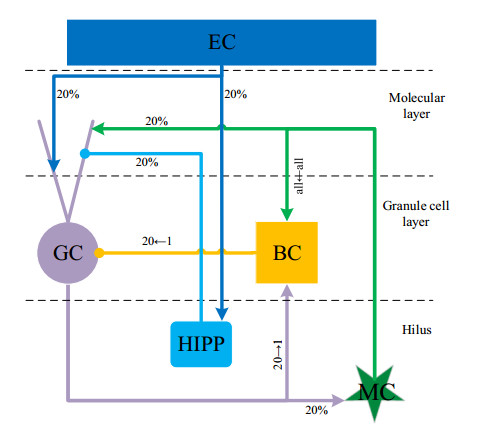
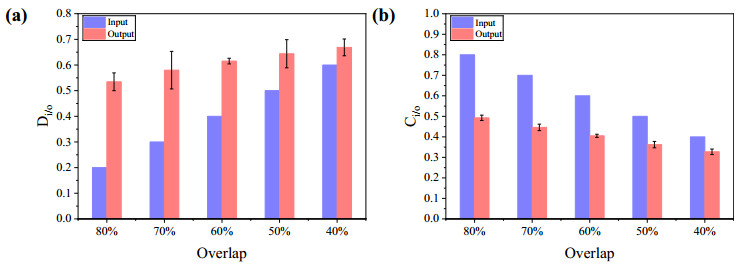
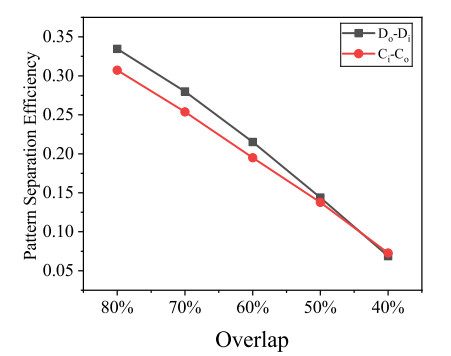
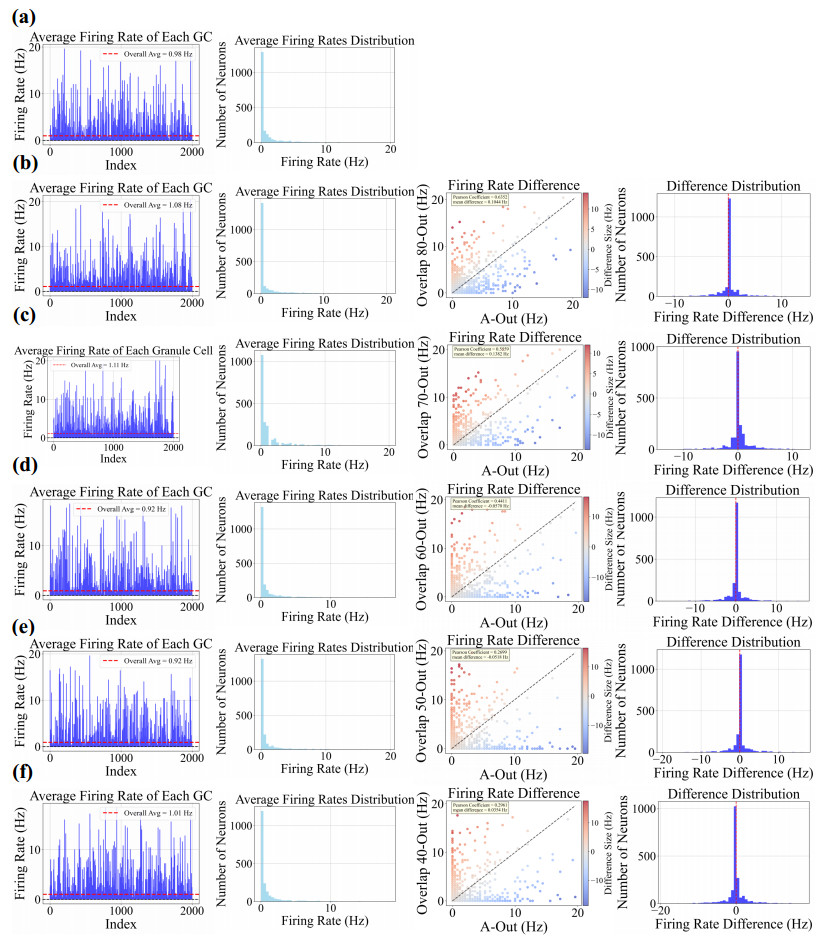
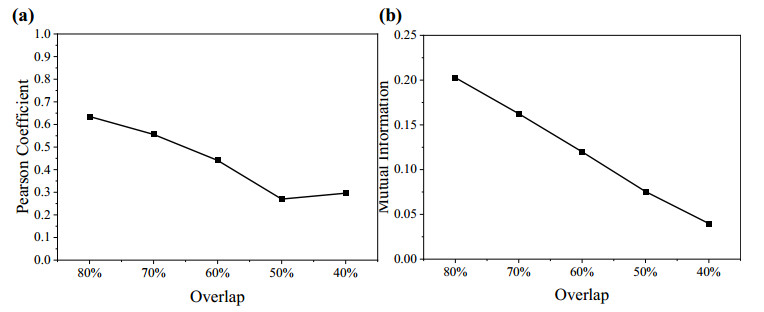
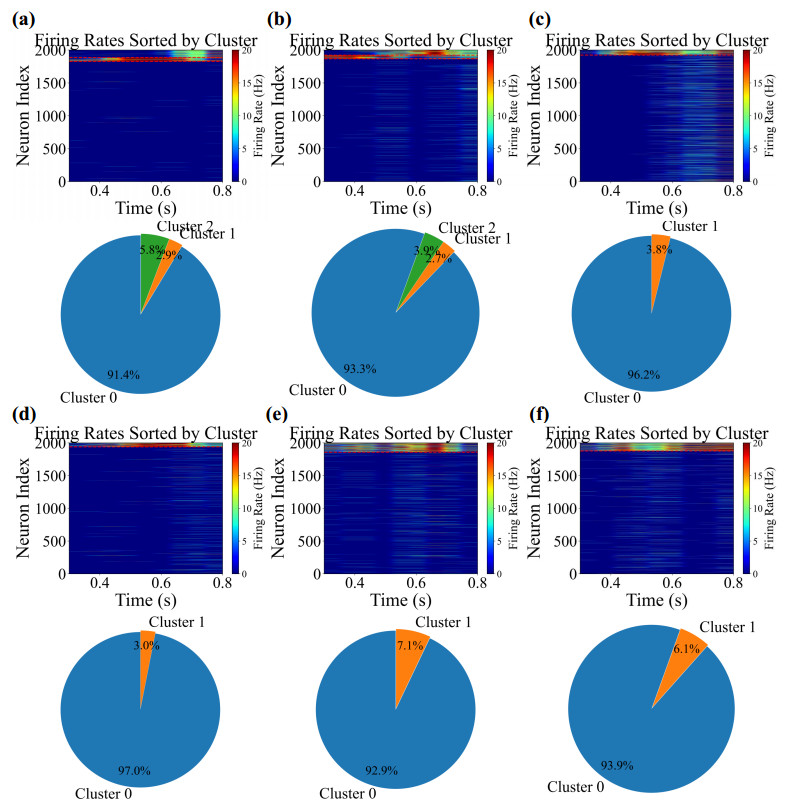
The ability to discriminate highly similar memories depends critically on pattern separation mediated by the dentate gyrus (DG). Although intrinsic neural mechanisms have been extensively studied, the influence of external input patterns on this process is often overlooked. Here, we established a biologically plausible DG model, subjected it to input pattern pairs with varying degrees of overlap, and examined the firing properties of granule cells (GCs) as output patterns. Based on the analysis of population coding, we observed that as the overlap between input pairs decreased, both the separation distance and orthogonalization level increased, indicating enhanced separation performance. Subsequently, from the perspective of rate coding, we computed the mean firing rate of individual GC to paired inputs and statistically analyzed the distributions of mean firing rates and their pairwise differences across GCs. Our results showed that these firing rate metrics unaffected by variations in input overlap. However, the Pearson correlation coefficient and mutual information between GC ensembles were significantly influenced, with both measures decreasing as input overlap is reduced. We also found that high-overlap inputs ($ > 70\% $) induced substantial firing rate variability in individual GC, which predominantly manifested as rate remapping. Furthermore, clustering analysis based on time-windowed firing rates demonstrated that pattern separation does not alter the structural characteristics of GCs, with similar cluster configurations emerging across different input overlap conditions. Together, these findings provided a detailed characterization of GC firing properties during pattern separation.
Citation: Huimin Bai, Kai Yang. Encoding scheme-dependent effects of input pattern pairs on pattern separation in the dentate gyrus neuronal network[J]. Electronic Research Archive, 2025, 33(10): 6476-6492. doi: 10.3934/era.2025285
The ability to discriminate highly similar memories depends critically on pattern separation mediated by the dentate gyrus (DG). Although intrinsic neural mechanisms have been extensively studied, the influence of external input patterns on this process is often overlooked. Here, we established a biologically plausible DG model, subjected it to input pattern pairs with varying degrees of overlap, and examined the firing properties of granule cells (GCs) as output patterns. Based on the analysis of population coding, we observed that as the overlap between input pairs decreased, both the separation distance and orthogonalization level increased, indicating enhanced separation performance. Subsequently, from the perspective of rate coding, we computed the mean firing rate of individual GC to paired inputs and statistically analyzed the distributions of mean firing rates and their pairwise differences across GCs. Our results showed that these firing rate metrics unaffected by variations in input overlap. However, the Pearson correlation coefficient and mutual information between GC ensembles were significantly influenced, with both measures decreasing as input overlap is reduced. We also found that high-overlap inputs ($ > 70\% $) induced substantial firing rate variability in individual GC, which predominantly manifested as rate remapping. Furthermore, clustering analysis based on time-windowed firing rates demonstrated that pattern separation does not alter the structural characteristics of GCs, with similar cluster configurations emerging across different input overlap conditions. Together, these findings provided a detailed characterization of GC firing properties during pattern separation.

| [1] |
H. Eichenbaum, A cortical-hippocampal system for declarative memory, Nat. Rev. Neurosci., 1 (2000), 41–50. https://doi.org/10.1038/35036213 doi: 10.1038/35036213

|
| [2] |
B. Schmidt, D. F. Marrone, E. J. Markus, Disambiguating the similar: The dentate gyrus and pattern separation, Behav. Brain Res., 226 (2012), 56–65. https://doi.org/10.1016/j.bbr.2011.08.039 doi: 10.1016/j.bbr.2011.08.039
|
| [3] |
N. Rebola, M. Carta, C. Mulle, Operation and plasticity of hippocampal CA3 circuits: implications for memory encoding, Nat. Rev. Neurosci., 18 (2017), 208–220. https://doi.org/10.1038/nrn.2017.10 doi: 10.1038/nrn.2017.10
|
| [4] |
S. Y. Kim, W. Lim, Effect of adult-born immature granule cells on pattern separation in the hippocampal dentate gyrus, Cognit. Neurodyn., 18 (2024), 2077–2093. https://doi.org/10.1007/s11571-023-09985-5 doi: 10.1007/s11571-023-09985-5
|
| [5] |
A. Treves, E. T. Rolls, Computational analysis of the role of the hippocampus in memory, Hippocampus, 4 (1994), 374–391. https://doi.org/10.1002/hipo.450040319 doi: 10.1002/hipo.450040319
|
| [6] |
E. T. Rolls, R. P. Kesner, A computational theory of hippocampal function, and empirical tests of the theory, Prog. Neurobiol., 79 (2006), 1–48. https://doi.org/10.1016/j.pneurobio.2006.04.005 doi: 10.1016/j.pneurobio.2006.04.005
|
| [7] |
R. P. Kesner, E. T. Rolls, A computational theory of hippocampal function, and tests of the theory: New developments, Neurosci. Biobehav. Rev., 48 (2015), 92–147. https://doi.org/10.1016/j.neubiorev.2014.11.009 doi: 10.1016/j.neubiorev.2014.11.009
|
| [8] | W. Deng, J. B. Aimone, F. H. Gage, New neurons and new memories: how does adult hippocampal neurogenesis affect learning and memory? Nat. Rev. Neurosci., 11 (2010), 339–350. https://doi.org/10.1038/nrn2822 |
| [9] |
M. A. Yassa, C. E. L. Stark, Pattern separation in the hippocampus, Trends Neurosci., 34 (2011), 515–525. https://doi.org/10.1016/j.tins.2011.06.006 doi: 10.1016/j.tins.2011.06.006
|
| [10] |
J. J. Knierim, J. P. Neunuebel, Tracking the flow of hippocampal computation: Pattern separation, pattern completion, and attractor dynamics, Neurobiol. Learn. Mem., 129 (2016), 38–49. https://doi.org/10.1016/j.nlm.2015.10.008 doi: 10.1016/j.nlm.2015.10.008
|
| [11] |
T. Hainmueller, M. Bartos, Dentate gyrus circuits for encoding, retrieval and discrimination of episodic memories, Nat. Rev. Neurosci., 21 (2020), 153–168. https://doi.org/10.1038/s41583-019-0260-z doi: 10.1038/s41583-019-0260-z
|
| [12] |
Y. Senzai, Function of local circuits in the hippocampal dentate gyrus-CA3 system, Neurosci. Res., 140 (2019), 43–52. https://doi.org/10.1016/j.neures.2018.11.003 doi: 10.1016/j.neures.2018.11.003
|
| [13] |
K. Nakazawa, Dentate mossy cell and pattern separation, Neuron, 93 (2017), 465–467. https://doi.org/10.1016/j.neuron.2017.01.021 doi: 10.1016/j.neuron.2017.01.021
|
| [14] |
D. F. Marrone, A. A. Adams, E. Satvat, Increased pattern separation in the aged fascia dentata, Neurobiol. Aging, 32 (2011), 2317.e23–2317.e32. https://doi.org/10.1016/j.neurobiolaging.2010.03.021 doi: 10.1016/j.neurobiolaging.2010.03.021
|
| [15] |
S. Chavlis, P. C. Petrantonakis, P. Poirazi, Dendrites of dentate gyrus granule cells contribute to pattern separation by controlling sparsity, Hippocampus, 27 (2017), 89–110. https://doi.org/10.1002/hipo.22675 doi: 10.1002/hipo.22675
|
| [16] |
P. C. Petrantonakis, P. Poirazi, Dentate gyrus circuitry features improve performance of sparse approximation algorithms, PLoS One, 10 (2015), e0117023. https://doi.org/10.1371/journal.pone.0117023 doi: 10.1371/journal.pone.0117023
|
| [17] |
K. Yang, X. Sun, S. Zhu, The heterogeneous population of granule cells contributes to pattern separation of the dentate gyrus neural network, Nonlinear Dyn., 112 (2024), 13465–13481. https://doi.org/10.1007/s11071-024-09730-5 doi: 10.1007/s11071-024-09730-5
|
| [18] |
D. J. Willshaw, P. Dayan, R. G. M. Morris, Memory, modelling and marr: a commentary on Marr (1971) 'simple memory: a theory of archicortex', Phil. Trans. R. Soc. B, 370 (2015), 20140383. https://doi.org/10.1098/rstb.2014.0383 doi: 10.1098/rstb.2014.0383
|
| [19] |
A. D. Madar, L. A. Ewell, M. V. Jones, Pattern separation of spiketrains in hippocampal neurons, Sci. Rep., 9 (2019), 5282. https://doi.org/10.1038/s41598-019-41503-8 doi: 10.1038/s41598-019-41503-8
|
| [20] |
F. Faghihi, A. A. Moustafa, Impaired neurogenesis of the dentate gyrus is associated with pattern separation deficits: A computational study, J. Integr. Neurosci., 15 (2016), 277–293. https://doi.org/10.1142/S0219635216500175 doi: 10.1142/S0219635216500175
|
| [21] |
S. J. Guzman, A. Schlögl, C. Espinoza, X. Zhang, B. A. Suter, P. Jonas, How connectivity rules and synaptic properties shape the efficacy of pattern separation in the entorhinal cortex–dentate gyrus–CA3 network, Nat. Comput. Sci., 1 (2021), 830–842. https://doi.org/10.1038/s43588-021-00157-1 doi: 10.1038/s43588-021-00157-1
|
| [22] |
C. E. Myers, H. E. Scharfman, A role for hilar cells in pattern separation in the dentate gyrus: A computational approach, Hippocampus, 19 (2009), 321–337. https://doi.org/10.1002/hipo.20516 doi: 10.1002/hipo.20516
|
| [23] |
C. E. Myers, H. E. Scharfman, Pattern separation in the dentate gyrus: A role for the CA3 backprojection, Hippocampus, 21 (2011), 1190–1215. https://doi.org/10.1002/hipo.20828 doi: 10.1002/hipo.20828
|
| [24] |
C. E. Myers, K. Bermudez-Hernandez, H. E. Scharfman, The influence of ectopic migration of granule cells into the hilus on dentate gyrus-CA3 function, PLoS One, 8 (2013), e68208. https://doi.org/10.1371/journal.pone.0068208 doi: 10.1371/journal.pone.0068208
|
| [25] |
A. Hummos, C. C. Franklin, S. S. Nair, Intrinsic mechanisms stabilize encoding and retrieval circuits differentially in a hippocampal network model, Hippocampus, 24 (2014), 1430–1448. https://doi.org/10.1002/hipo.22324 doi: 10.1002/hipo.22324
|
| [26] |
R. Coultrip, R. Granger, G. Lynch, A cortical model of winner-take-all competition via lateral inhibition, Neural Networks, 5 (1992), 47–54. https://doi.org/10.1016/S0893-6080(05)80006-1 doi: 10.1016/S0893-6080(05)80006-1
|
| [27] |
M. J. West, L. Slomianka, H. J. G. Gundersen, Unbiased stereological estimation of the total number of neurons in the subdivisions of the rat hippocampus using the optical fractionator, Anat. Rec., 231 (1991), 482–497. https://doi.org/10.1002/ar.1092310411 doi: 10.1002/ar.1092310411
|
| [28] |
P. S. Buckmaster, A. L. Jongen-Rêlo, Highly specific neuron loss preserves lateral inhibitory circuits in the dentate gyrus of kainate-induced epileptic rats, J. Neurosci., 19 (1999), 9519–9529. https://doi.org/10.1523/JNEUROSCI.19-21-09519.1999 doi: 10.1523/JNEUROSCI.19-21-09519.1999
|
| [29] |
D. G. Amaral, N. Ishizuka, B. Claiborne, Chapter neurons, numbers and the hippocampal network, Prog. Brain Res., 83 (1990), 1–11. https://doi.org/10.1016/S0079-6123(08)61237-6 doi: 10.1016/S0079-6123(08)61237-6
|
| [30] | B. McNaughton, C. Barnes, S. Mizumori, E. Green, P. Sharp, Contribution of granule cells to spatial representations in hippocampal circuits: A puzzle, in Kindling and Synaptic Plasticity: The Legacy of Graham Goddar, Springer-Verlag, Boston, 110 (1991), 123. |
| [31] |
T. Hafting, M. Fyhn, S. Molden, M. Moser, E. Moser, Microstructure of a spatial map in the entorhinal cortex, Nature, 436 (2005), 801–806. https://doi.org/10.1038/nature03721 doi: 10.1038/nature03721
|
| [32] |
R. Brette, W. Gerstner, Adaptive exponential integrate-and-fire model as an effective description of neuronal activity, J. Neurophysiol., 94 (2005), 3637–3642. https://doi.org/10.1152/jn.00686.2005 doi: 10.1152/jn.00686.2005
|
| [33] | A. Roth, M. Van Rossum, Modeling synapses, in Computational Modeling Methods for Neuroscientists, (2009), 139–160. https://doi.org/10.7551/mitpress/9780262013277.003.0007 |
| [34] |
J. Geiger, J. Lubke, A. Roth, M. Frotscher, P. Jonas, Submillisecond AMPA receptor-mediated signaling at a principal neuron-interneuron synapse, Neuron, 18 (1997), 1009–1023. https://doi.org/10.1016/S0896-6273(00)80339-6 doi: 10.1016/S0896-6273(00)80339-6
|
| [35] |
C. Schmidt-Hieber, J. Bischofberger, Fast sodium channel gating supports localized and efficient axonal action potential initiation, J. Neurosci., 30 (2010), 10233–10242. https://doi.org/10.1523/JNEUROSCI.6335-09.2010 doi: 10.1523/JNEUROSCI.6335-09.2010
|
| [36] |
R. Krueppel, S. Remy, H. Beck, Dendritic integration in hippocampal dentate granule cells, Neuron, 71 (2011), 512–528. https://doi.org/10.1016/j.neuron.2011.05.043 doi: 10.1016/j.neuron.2011.05.043
|
| [37] |
P. H. Chiang, P. Y. Wu, T. W. Kuo, Y. C. Liu, C. F. Chan, T. C. Chien, et al., Gaba is depolarizing in hippocampal dentate granule cells of the adolescent and adult rats, J. Neurosci., 32 (2012), 62–67. https://doi.org/10.1523/JNEUROSCI.3393-11.2012 doi: 10.1523/JNEUROSCI.3393-11.2012
|
| [38] |
P. J. Rousseeuw, Silhouettes: A graphical aid to the interpretation and validation of cluster analysis, J. Comput. Appl. Math., 20 (1987), 53–65. https://doi.org/10.1016/0377-0427(87)90125-7 doi: 10.1016/0377-0427(87)90125-7
|
Figures(8) / Tables(1)
Huimin Bai, Kai Yang. Encoding scheme-dependent effects of input pattern pairs on pattern separation in the dentate gyrus neuronal network[J]. Electronic Research Archive, 2025, 33(10): 6476-6492. doi: 10.3934/era.2025285





 DownLoad: