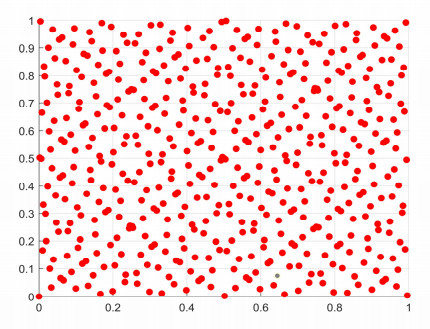
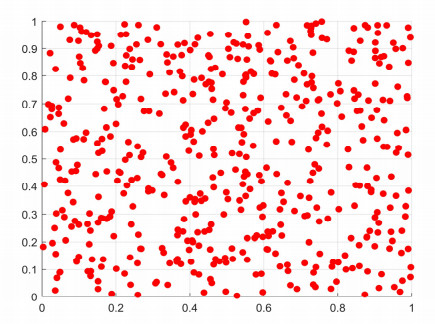
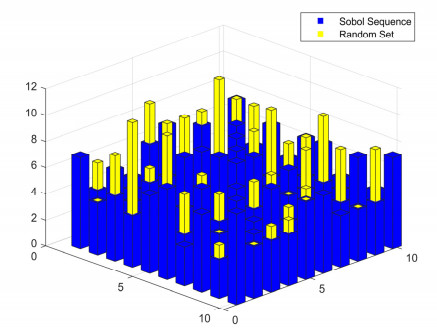
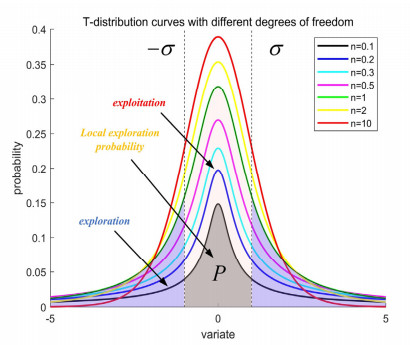
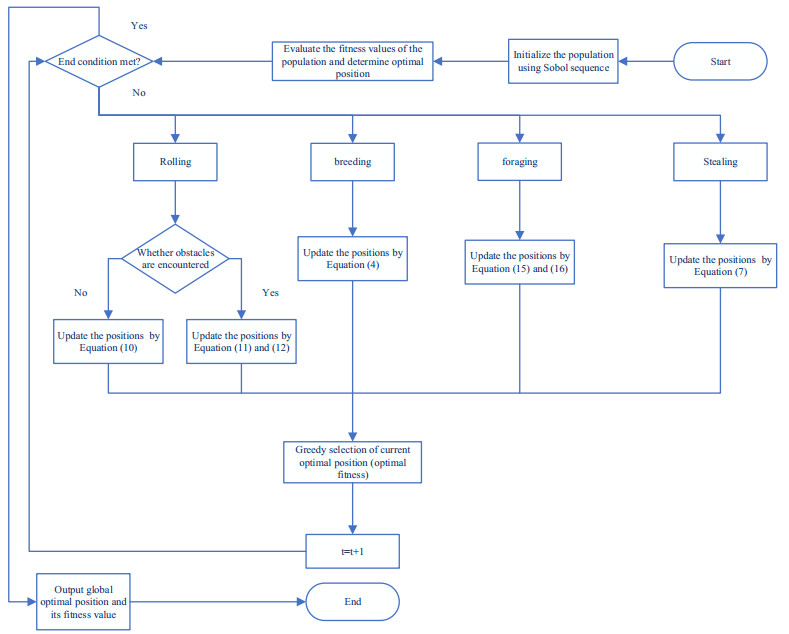
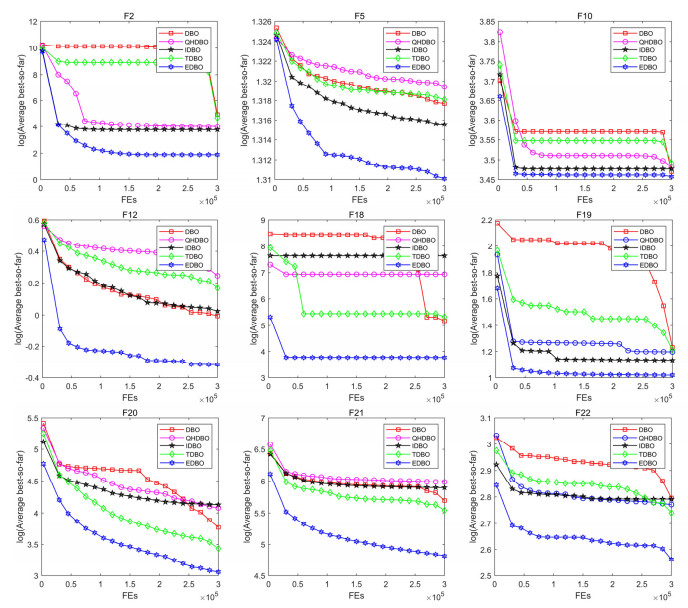
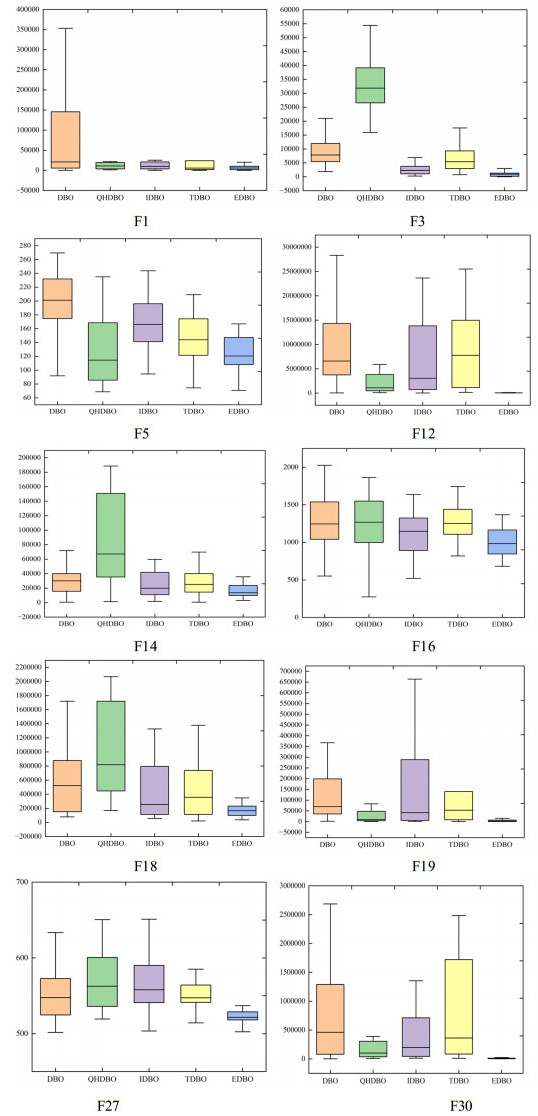
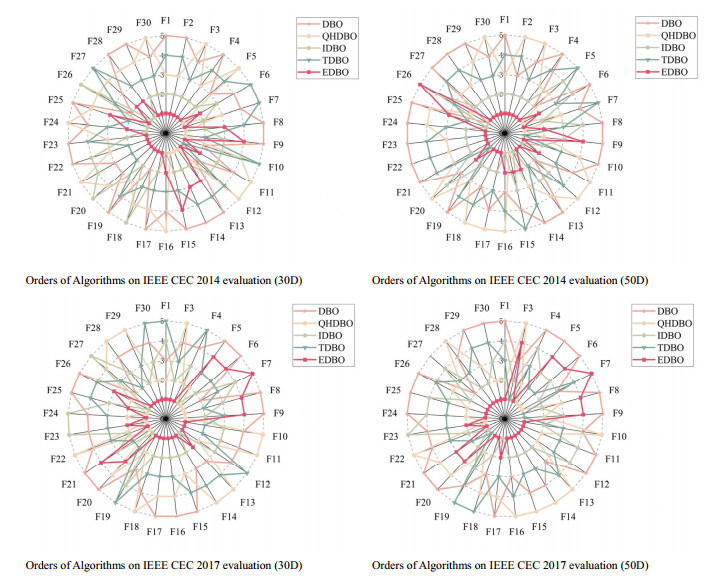
Dung beetle optimization (DBO) algorithm is a population-based metaheuristic that excels in optimization tasks, demonstrating strong performance in finding high-quality solutions. However, when addressing complex optimization problems, the algorithm also suffers from issues such as low population diversity, a tendency to fall into local optima, and suboptimal convergence speed. To address these challenges, this paper proposed an enhanced dung beetle optimization (EDBO) algorithm. The core improvements included the use of the Sobol sequence for better population initialization and the introduction of a mutation mechanism based on probability ratios and random angles to enhance the global exploration ability and convergence accuracy of the algorithm. Furthermore, the convergence factor has been modified to ensure that the algorithm emphasizes global search in the early stages, while focusing on local exploitation in the later stages. Additionally, an adaptive T-distribution mutation method has been constructed to increase the algorithm's probability of escaping from local optima. To validate the performance of the enhanced dung beetle optimization, the algorithm has been tested on the CEC2014 and CEC2017 benchmark functions. The experimental results demonstrated that EDBO outclassed both the original DBO and other advanced optimization algorithms in terms of overall performance. Finally, the effectiveness of EDBO in solving real-world problems is verified through its application in the three-dimensional (3D) path planning of unmanned aerial vehicles. In the most challenging task scenarios, the EDBO algorithm successfully identified feasible paths. Compared with five benchmark algorithms, it achieved an average reduction in the overall cost of 17.1%, 9.5%, 22.9%, 14.5%, and 18.6%, respectively. These results further demonstrated the significant superiority and practical value of the EDBO algorithm in addressing the unmanned aerial vehicles (UAVs) path planning problem.
Citation: Kaike Tu, Jiatang Cheng. Enhanced dung beetle optimization algorithm and its application in 3D UAV path planning[J]. Electronic Research Archive, 2025, 33(4): 2618-2667. doi: 10.3934/era.2025117
Dung beetle optimization (DBO) algorithm is a population-based metaheuristic that excels in optimization tasks, demonstrating strong performance in finding high-quality solutions. However, when addressing complex optimization problems, the algorithm also suffers from issues such as low population diversity, a tendency to fall into local optima, and suboptimal convergence speed. To address these challenges, this paper proposed an enhanced dung beetle optimization (EDBO) algorithm. The core improvements included the use of the Sobol sequence for better population initialization and the introduction of a mutation mechanism based on probability ratios and random angles to enhance the global exploration ability and convergence accuracy of the algorithm. Furthermore, the convergence factor has been modified to ensure that the algorithm emphasizes global search in the early stages, while focusing on local exploitation in the later stages. Additionally, an adaptive T-distribution mutation method has been constructed to increase the algorithm's probability of escaping from local optima. To validate the performance of the enhanced dung beetle optimization, the algorithm has been tested on the CEC2014 and CEC2017 benchmark functions. The experimental results demonstrated that EDBO outclassed both the original DBO and other advanced optimization algorithms in terms of overall performance. Finally, the effectiveness of EDBO in solving real-world problems is verified through its application in the three-dimensional (3D) path planning of unmanned aerial vehicles. In the most challenging task scenarios, the EDBO algorithm successfully identified feasible paths. Compared with five benchmark algorithms, it achieved an average reduction in the overall cost of 17.1%, 9.5%, 22.9%, 14.5%, and 18.6%, respectively. These results further demonstrated the significant superiority and practical value of the EDBO algorithm in addressing the unmanned aerial vehicles (UAVs) path planning problem.

| [1] |
F. Li, H. Xu, F. Qiu, Modified artificial rabbits optimization combined with bottlenose dolphin optimizer in feature selection of network intrusion detection, Electron. Res. Arch., 32 (2024), 1770–1880. https://doi.org/10.3934/era.2024081 doi: 10.3934/era.2024081

|
| [2] |
B. A. Berg, Locating global minima in optimization problems by a random-cost approach, Nature, 361 (1993), 708–710. https://doi.org/10.1038/361708a0 doi: 10.1038/361708a0
|
| [3] |
M. Kmich, I. Harrade, H. Karmouni, M. Sayyouri, S. S. Askar, M. Abouhawwash, Image registration using the arithmetic optimization algorithm for robotic visual servoing, Int. J. Comput. Intell. Syst., 18 (2025), 1. https://doi.org/10.1007/s44196-024-00612-7 doi: 10.1007/s44196-024-00612-7
|
| [4] |
M. A. Tahiri, H. Karmouni, A. Bencherqui, A. Daoui, M. Sayyouri, H. Qjidaa, et al., New color image encryption using hybrid optimization algorithm and Krawtchouk fractional transformations, Visual Comput., 39 (2023), 6395–6420. https://doi.org/10.1007/s00371-022-02736-3 doi: 10.1007/s00371-022-02736-3
|
| [5] | M. Kmich, H. Karmouni, I. Harrade, M. J. Ouazzani, H. Qjidaa, M. Sayyouri, Improved intensity-based image registration via archimedes optimization algorithm, in 2024 International Conference on Intelligent Systems and Computer Vision (ISCV), (2024), 1–5. https://doi.org/10.1109/ISCV60512.2024.10620082 |
| [6] |
Y. Zhang, Z. Wang, H. Wang, F. Blaabjerg, Artificial intelligence-aided thermal model considering cross-coupling effects, IEEE Trans. Power Electron., 35 (2020), 9998–10002. https://doi.org/10.1109/TPEL.2020.2980240 doi: 10.1109/TPEL.2020.2980240
|
| [7] |
H. Karmouni, M. Chouiekh, S. Motahhir, H. Qjidaa, M. O. Jamil, M. Sayyouri, Optimization and implementation of a photovoltaic pumping system using the sine-cosine algorithm, Eng. Appl. Artif. Intell., 114 (2022), 105104. https://doi.org/10.1016/j.engappai.2022.105104 doi: 10.1016/j.engappai.2022.105104
|
| [8] |
S. Wang, S. Li, H. Yu, A power generation accumulation-based adaptive chaotic differential evolution algorithm for wind turbine placement problems, Electron. Res. Arch., 32 (2024), 4659–4683. https://doi.org/10.3934/era.2024212 doi: 10.3934/era.2024212
|
| [9] |
A. Bencherqui, M. A. Tahiri, H. Karmouni, M. Alfidi, Y. El Afou, H. Qjidaa, et al., Chaos-enhanced archimede algorithm for global optimization of real-world engineering problems and signal feature extraction, Processes, 12 (2024), 406. https://doi.org/10.3390/pr12020406 doi: 10.3390/pr12020406
|
| [10] | R. Zhang, X. Li, H. Ren, Y. Ding, Y. Meng, Q. Xia, UAV Flight path planning based on multi-strategy improved white sharks optimization, IEEE Access, 11 (2023). https://doi.org/88462-88475.10.1109/ACCESS.2023.3304708 |
| [11] |
J. Luo, B. Shi, A hybrid whale optimization algorithm based on modified differential evolution for global optimization problems, Appl. Intell., 49 (2019), 1982–2000. https://doi.org/10.1007/s10489-018-1362-4 doi: 10.1007/s10489-018-1362-4
|
| [12] | Z. Wei, W. Gao, G. Li, Q. Zhang, A penalty-based differential evolution for multimodal optimization, IEEE Trans. Cybern., 52 (2021). https://doi.org/6024-6033.10.1109/TCYB.2021.3117359 |
| [13] |
A. E. Ezugwu, A. K. Shukla, R. Nath, A. A. Akinyelu, J. O. Agushaka, H. Chiroma, et al., Metaheuristics: A comprehensive overview and classification along with bibliometric analysis, Artif. Intell. Rev., 54 (2021), 4237–4316. https://doi.org/10.1007/s10462-020-09952-0 doi: 10.1007/s10462-020-09952-0
|
| [14] |
J. H. Holland, Genetic algorithms and the optimal allocation of trials, SIAM J. Comput., 2 (1973), 88–105. https://doi.org/10.1137/0202009 doi: 10.1137/0202009
|
| [15] | J. Kennedy, R. Eberhart, Particle swarm optimization, in Proceedings of ICNN'95-International Conference on Neural Networks, 4 (1995), 1942–1948. https://doi.org/10.1109/ICNN.1995.488968 |
| [16] |
M. Dorigo, V. Maniezzo, A. Colorni, Ant system: Optimization by a colony of cooperating agents, IEEE Trans. Syst. Man Cybern. Part B, 26 (1996), 29–41. https://doi.org/10.1109/3477.484436 doi: 10.1109/3477.484436
|
| [17] |
R. Storn, K. Price, Differential evolution-a simple and efficient heuristic for global optimization over continuous spaces, J. Global Optim., 11 (1997), 341–359. https://doi.org/10.1023/A:1008202821328 doi: 10.1023/A:1008202821328
|
| [18] |
R. Rajabioun, Cuckoo optimization algorithm, Appl. Soft Comput., 11 (2011), 5508–5518. https://doi.org/10.1016/j.asoc.2011.05.008 doi: 10.1016/j.asoc.2011.05.008
|
| [19] |
M. K. Marichelvam, T. Prabaharan, X. S. Yang, A discrete firefly algorithm for the multi-objective hybrid flowshop scheduling problems, IEEE Trans. Evol. Comput., 18 (2014), 301–305. https://doi.org/10.1109/TEVC.2013.2240304 doi: 10.1109/TEVC.2013.2240304
|
| [20] |
S. Mirjalili, S. M. Mirjalili, A. Lewis, Grey wolf optimizer, Adv. Eng. Software, 69 (2014), 46–61. https://doi.org/10.1016/j.advengsoft.2013.12.007 doi: 10.1016/j.advengsoft.2013.12.007
|
| [21] |
J. Cheng, Q. Lin, Y. Xiong, Sine cosine algorithm with peer learning for global numerical optimization, Eng. Optim., 2024 (2024), 1–18. https://doi.org/10.1080/0305215X.2024.2340054 doi: 10.1080/0305215X.2024.2340054
|
| [22] |
A. Askarzadeh, A novel metaheuristic method for solving constrained engineering optimization problems: Crow search algorithm, Comput. Struct., 169 (2016), 1–12. https://doi.org/10.1016/j.compstruc.2016.03.001 doi: 10.1016/j.compstruc.2016.03.001
|
| [23] |
M. Seyedali, L. Andrew, The whale optimization algorithm, Adv. Eng. Software, 95 (2016), 51–67. https://doi.org/10.1016/j.advengsoft.2016.01.008 doi: 10.1016/j.advengsoft.2016.01.008
|
| [24] |
J. Xue, B. Shen, A novel swarm intelligence optimization approach: Sparrow search algorithm, Syst. Sci. Control Eng., 8 (2020), 22–34. https://doi.org/10.1080/21642583.2019.1708830 doi: 10.1080/21642583.2019.1708830
|
| [25] |
J. Xue, B. Shen, Dung beetle optimizer: A new meta-heuristic algorithm for global optimization, J. Supercomput., 79 (2023), 7305–7336. https://doi.org/10.1007/s11227-022-04959-6 doi: 10.1007/s11227-022-04959-6
|
| [26] |
B. Zheng, Y. Chen, C. Wang, A. A. Heidari, L. Liu, H. Chen, The moss growth optimization (MGO): Concepts and performance, J. Comput. Design Eng., 11 (2024), 184–221. https://doi.org/10.1093/jcde/qwae080 doi: 10.1093/jcde/qwae080
|
| [27] |
D. H. Wolpert, W. G. Macready, No free lunch theorems for optimization, IEEE Trans. Evol. Computat., 1 (1997), 67–82. https://doi.org/10.1109/4235.585893 doi: 10.1109/4235.585893
|
| [28] |
J. Xu, Z. Han, L. Yin, Z. Yan, Y. Yu, G. Ma, Multi-strategy-based artificial bee colony algorithm for AUV path planning with angle constraints, Ocean Eng., 312 (2024), 119155. https://doi.org/10.1016/j.oceaneng.2024.119155 doi: 10.1016/j.oceaneng.2024.119155
|
| [29] |
I. Attiya, M. Abd Elaziz, L. Abualigah, T. N. Nguyen, A. A. El-Latif, An improved hybrid swarm intelligence for scheduling IoT application tasks in the cloud, IEEE Trans. Ind. Inf., 18 (2022), 6264–6272. https://doi.org/10.1109/TII.2022.3148288 doi: 10.1109/TII.2022.3148288
|
| [30] |
Y. Shen, C. Zhang, F. S. Gharehchopogh, S. Mirjalili, An improved whale optimization algorithm based on multi-population evolution for global optimization and engineering design problems, Exp. Syst. Appl., 215 (2023), 119296. https://doi, org/10.1016/j.eswa.2022.119269 doi: 10.1016/j.eswa.2022.119269
|
| [31] |
F. Zhu, G. Li, H. Tang, Y. Li, X. Lv, X. Wang, Dung beetle optimization algorithm based on quantum computing and multi-strategy fusion for solving engineering problems, Exp. Syst. Appl., 236 (2024), 121219. https://doi.org/10.1016/j.eswa.2023.121219 doi: 10.1016/j.eswa.2023.121219
|
| [32] |
J. He, L. Fu, Robot path planning based on improved dung beetle optimizer algorithm, J. Braz. Soc. Mech. Sci. Eng., 46 (2024), 235. https://doi.org/10.1007/s40430-024-04768-3 doi: 10.1007/s40430-024-04768-3
|
| [33] |
Z. Wang, L. Huang, S. Yang, D. Li, D. He, S. Chan, A quasi-oppositional learning of updating quantum state and Q-learning based on the dung beetle algorithm for global optimization, Alexandria Eng. J., 81 (2023), 469–488. https://doi.org/10.1016/j.aej.2023.09.042 doi: 10.1016/j.aej.2023.09.042
|
| [34] |
Q. Li, H. Shi, W. Zhao, C. Ma, Enhanced dung beetle optimization algorithm for practical engineering optimization, Mathematics, 12 (2024), 1084. https://doi.org/10.3390/math12071084 doi: 10.3390/math12071084
|
| [35] | M. Bukumira, M. Zivkovic, M. Antonijevic, L. Jovanovic, N. Bacanin, T. Zivkovic, The extreme gradient boosting method optimized by hybridized sine cosine metaheuristics for ship vessel classification, in International Conference on Advances in Data-driven Computing and Intelligent Systems, (2023), 255–270. https://doi.org/10.1007/978-981-99-9524-0_20 |
| [36] | B. Radomirovic, L. Jovanovic, C. Stoean, M. Zivkovic, A. Njegus, N. Bacanin, Solar flare classification using modified metaheuristic optimized xgboost, in 2023 25th International Symposium on Symbolic and Numeric Algorithms for Scientific Computing (SYNASC), (2023), 287–292. https://doi.org/10.1109/SYNASC61333.2023.00049 |
| [37] |
C. Lopez-Franco, D. Diaz, J. Hernandez-Barragan, N. Arana-Daniel, M. Lopez-Franco, A metaheuristic optimization approach for trajectory tracking of robot manipulators, Mathematics, 10 (2022), 1051. https://doi.org/10.3390/math10071051 doi: 10.3390/math10071051
|
| [38] |
A. Bencherqui, M. A. Tahiri, H. Karmouni, M. Alfidi, S. Motahhir, M. Abouhawwash, et al., Optimal algorithm for color medical encryption and compression images based on DNA coding and a hyperchaotic system in the moments, Eng. Sci. Technol. Int. J., 50 (2024), 101612. https://doi.org/10.1016/j.jestch.2023.101612 doi: 10.1016/j.jestch.2023.101612
|
| [39] |
M. Kmich, N. El Ghouate, A. Bencharqui, H. Karmouni, M. Sayyouri, S. S. Askar, et al., Chaotic Puma optimizer algorithm for controlling wheeled mobile robots, Eng. Sci. Technol. Int. J., 63 (2025), 101982. https://doi.org/10.1016/j.jestch.2025.101982 doi: 10.1016/j.jestch.2025.101982
|
| [40] |
H. Karmouni, M. A. Tahiri, I. Dagal, H. Amakdouf, M. O. Jamil, H. Qjidaa, et al., Secure and optimized satellite image sharing based on chaotic eπ map and Racah moments, Exp. Syst. Appl., 236 (2024), 121247. https://doi.org/10.1016/j.eswa.2023.121247 doi: 10.1016/j.eswa.2023.121247
|
| [41] |
N. El Ghouate, A. Bencherqui, H. Mansouri, A. E. Maloufy, M. A. Tahiri, H. Karmouni, et al., Improving the Kepler optimization algorithm with chaotic maps: Comprehensive performance evaluation and engineering applications, Artif. Intell. Rev., 57 (2024), 313. https://doi.org/10.1007/s10462-024-10857-5 doi: 10.1007/s10462-024-10857-5
|
| [42] | Y. Lu, X. Lu, G. Yang, X. Xiong, Robust zero-watermarking algorithm for multi-medical images based on FFST-Schur and Tent mapping, Biomed. Signal Process. Control, 96 (2024) 106557. https://doi.org/10.1016/j.bspc.2024.106557 |
| [43] |
M. Ye, H. Zhou, H. Yang, B. Hu, X. Wang, Multi-strategy improved dung beetle optimization algorithm and its applications, Biomimetics, 9 (2024), 291. https://doi.org/10.3390/biomimetics9050291 doi: 10.3390/biomimetics9050291
|
| [44] |
M. Zhang, D. Long, T. Qin, J. Yang, A chaotic hybrid butterfly optimization algorithm with particle swarm optimization for high-dimensional optimization problems, Symmetry, 12 (2020), 1800. https://doi.org/10.3390/sym12111800 doi: 10.3390/sym12111800
|
| [45] |
S. Mirjalili, A. Lewis, Adaptive gbest-guided gravitational search algorithm, Neural Comput. Appl., 25 (2014), 1569–1584. https://doi.org/10.1007/s00521-014-1640-y doi: 10.1007/s00521-014-1640-y
|
| [46] |
W. C. Wong, C. Y. Chung, K. W. Chan, H. Chen, Quasi-Monte Carlo based probabilistic small signal stability analysis for power systems with plug-in electric vehicle and wind power integration, IEEE Trans. Power Syst., 28 (2013), 3335–3343. https://doi.org/10.1109/TPWRS.2013.2254505 doi: 10.1109/TPWRS.2013.2254505
|
| [47] |
C. Xu, Y. Mao, H. Chen, H. Tao, F. Liu, Skew t distribution-based nonlinear filter with asymmetric measurement noise using variational Bayesian inference, Comput. Model. Eng. Sci., 131 (2022), 349–364. https://doi.org/10.32604/cmes.2021.019027 doi: 10.32604/cmes.2021.019027
|
| [48] | H. Zhang, Q. Huang, L. Ma, Z. Zhang, Sparrow search algorithm with adaptive t distribution for multi-objective low-carbon multimodal transportation planning problem with fuzzy demand and fuzzy time, Exp. Syst. Appl., 238 (2024) 122042. https://doi.org/10.1016/j.eswa.2023.122042 |
| [49] | J. Liang, B. Qu, P. N. Suganthan, Problem definitions and evaluation criteria for the CEC 2014 special session and competition on single objective real-parameter numerical optimization, Technical Report 201311, Computational Intelligence Laboratory, Zhengzhou University, Zhengzhou China and Technical Report, Nanyang Technological University: Singapore, 2013. |
| [50] | G. Wu, R. Mallipeddi, P. Suganthan, Problem definitions and evaluation criteria for the CEC 2017 competition and special session on constrained single objective real-parameter optimization, Nanyang Technol. Univ. Singapore Tech. Rep, 2016 (2016), 1–18. |
| [51] |
S. Arora, S. Singh, Butterfly optimization algorithm: a novel approach for global optimization, Soft Comput., 23 (2019), 715–734. https://doi.org/10.1007/s00500-018-3102-4 doi: 10.1007/s00500-018-3102-4
|
| [52] |
S. Zhao, T. Zhang, S. Ma, M. Chen, Dandelion optimizer: A nature-inspired metaheuristic algorithm for engineering applications, Eng. Appl. Artif. Intell., 114 (2022), 105075. https://doi.org/10.1016/j.engappai.2022.105075 doi: 10.1016/j.engappai.2022.105075
|
| [53] |
L. Abualigah, A. Diabat, S. Mirjalili, M. Abd Elaziz, A. H. Gandomi, The arithmetic optimization algorithm, Comput. Methods Appl. Mech. Eng., 376 (2021), 113609. https://doi.org/10.1016/j.cma.2020.113609 doi: 10.1016/j.cma.2020.113609
|
| [54] |
E. Rashedi, H. Nezamabadi-Pour, S. Saryazdi, GSA: A gravitational search algorithm, Inf. Sci., 179 (2009), 2232–2248. https://doi.org/10.1016/j.ins.2009.03.004 doi: 10.1016/j.ins.2009.03.004
|
| [55] |
A. A. Heidari, S. Mirjalili, H. Faris, I. Aljarah, M. Mafarja, H. Chen, Harris Hawks optimization: Algorithm and applications, Future Generation Comput. Syst., 97 (2019), 849–872. https://doi.org/10.1016/j.future.2019.02.028 doi: 10.1016/j.future.2019.02.028
|
| [56] |
E. Singh, N. Pillay, A study of ant-based pheromone spaces for generation constructive hyper-heuristics, Swarm Evol. Comput., 72 (2022), 101095. https://doi.org/10.1016/j.swevo.2022.101095 doi: 10.1016/j.swevo.2022.101095
|
| [57] |
B. Li, P. Afkhami, R. Khayamim, Z. Elmi, R. Moses, J. Sobanjo, et al., A holistic optimization-based approach for sustainable selection of level crossings for closure with safety, economic, and environmental considerations, Reliab. Eng. Syst. Safety, 249 (2024), 110197. https://doi.org/10.1016/j.ress.2024.110197 doi: 10.1016/j.ress.2024.110197
|
| [58] |
M. A. Dulebenets, An adaptive Polyploid memetic algorithm for scheduling trucks at a cross-docking terminal, Inf. Sci., 565 (2021), 390–421. https://doi.org/10.1016/j.ins.2021.02.039 doi: 10.1016/j.ins.2021.02.039
|
| [59] |
M. Chen, J. Xu, W. Zhang, Z. Li, A new customer-oriented multi-task scheduling model for cloud manufacturing considering available periods of services using an improved hyper-heuristic algorithm, Exp. Syst. Appl., 269 (2025), 126419. https://doi.org/10.1016/j.eswa.2025.126419 doi: 10.1016/j.eswa.2025.126419
|
Figures(13) / Tables(10)
Kaike Tu, Jiatang Cheng. Enhanced dung beetle optimization algorithm and its application in 3D UAV path planning[J]. Electronic Research Archive, 2025, 33(4): 2618-2667. doi: 10.3934/era.2025117





 DownLoad: