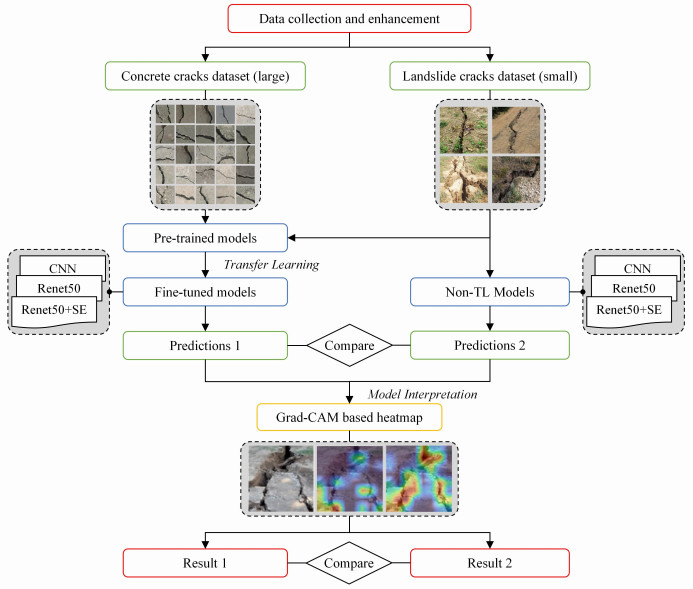
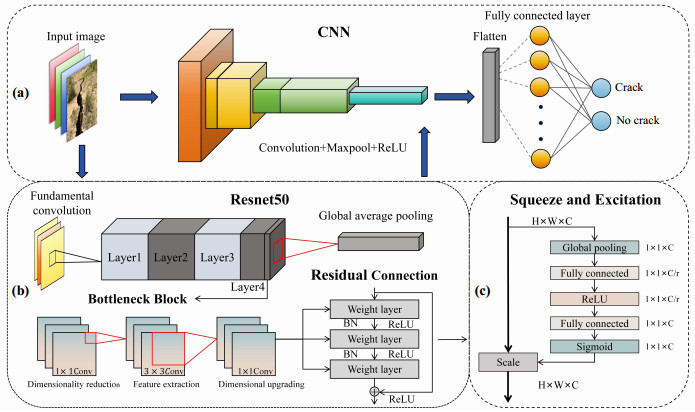
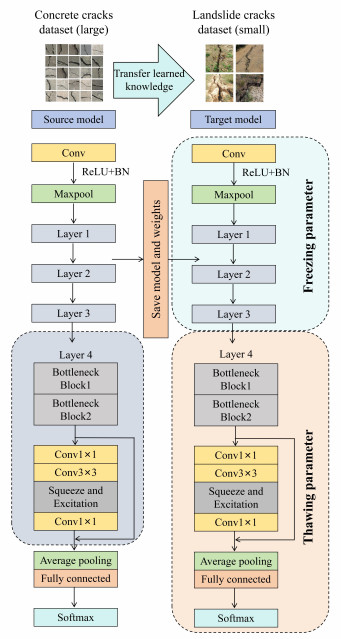
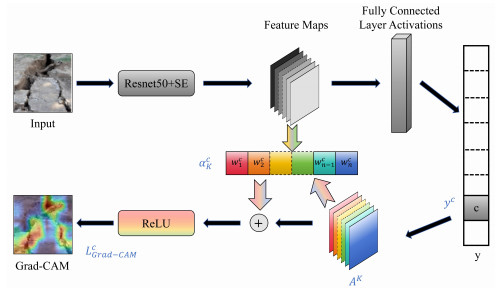
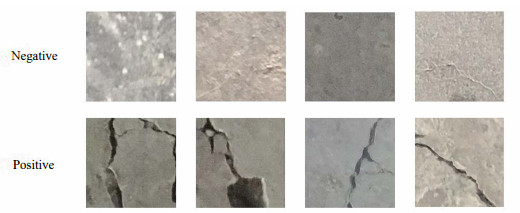
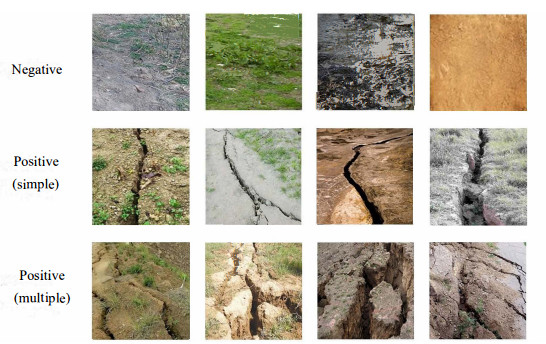
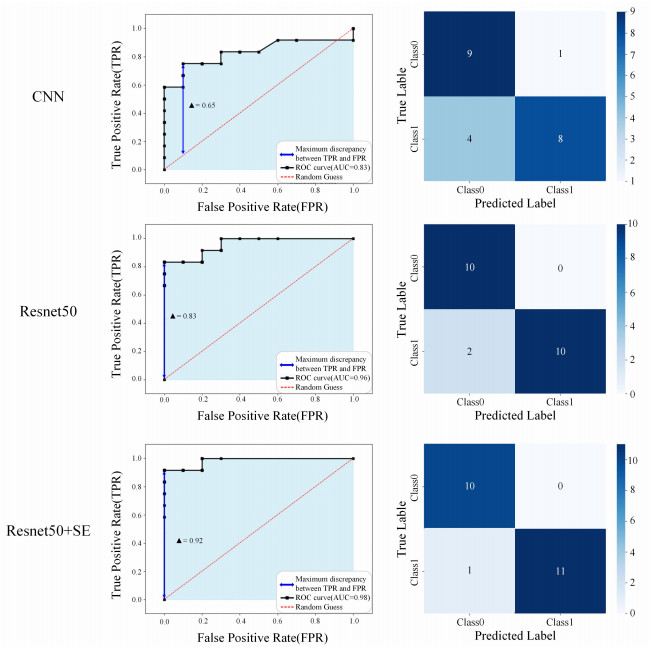
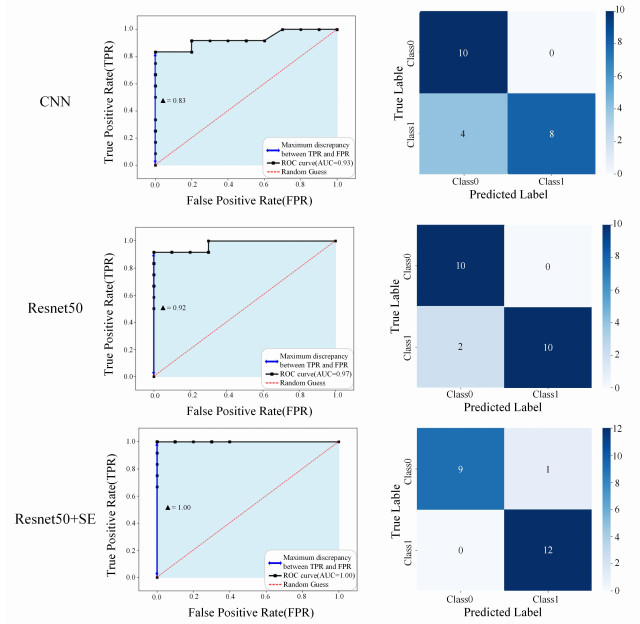
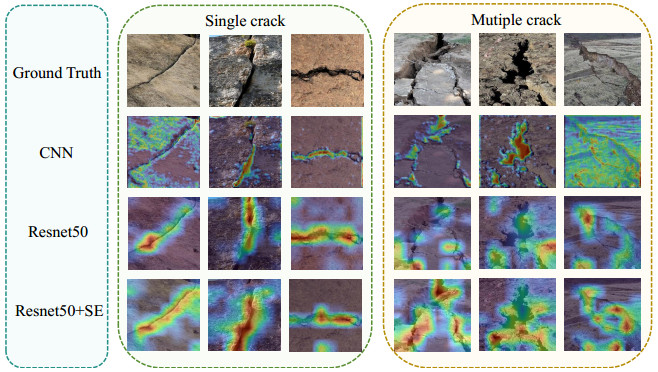
Landslide crack identification is crucial for risk management and mitigation, yet challenges like limited data and the lack of model interpretability hinder progress. This study proposes a deep learning-based solution for classifying landslide cracks using the ResNet50 architecture integrated with a squeeze-and-excitation (SE) attention mechanism, the transfer learning (TL) strategy, and a model interpretability approach. We introduced the SE module to enhance the model's ability to capture subtle crack features, and, in the TL framework, we first pretrained the model on a large concrete crack dataset to learn general crack characteristics, then fine-tuned it on a landslide crack dataset. To further improve interpretability, we applied gradient-weighted class activation mapping (Grad-CAM) to visualize the areas of the image most influential to the model's decisions. Our results demonstrated that ResNet50+SE outperforms both the standard convolutional neural network (CNN) and residual network with 50 layers (ResNet50), particularly in recall and F1 score, highlighting its superior ability to detect challenging cracks and improve overall landslide crack identification accuracy. Additionally, TL boosts performance, even with the limited availability of landslide crack data. Grad-CAM heatmaps provide valuable insights into the model's focus and decision-making, enhancing transparency. This study also tackled data imbalance challenges. Overall, the proposed approach offers an effective, interpretable solution for landslide crack identification, enhancing accuracy and transparency for landslide early warning and risk assessment.
Citation: Chenxi Zhang, Qi Ge, Wei Wei, Wei Zhan, Xin Yan, Jin Li. Explainable Transfer Learning with Attention Mechanisms for Landslide Crack Classification[J]. AIMS Environmental Science, 2025, 12(6): 936-957. doi: 10.3934/environsci.2025041
Landslide crack identification is crucial for risk management and mitigation, yet challenges like limited data and the lack of model interpretability hinder progress. This study proposes a deep learning-based solution for classifying landslide cracks using the ResNet50 architecture integrated with a squeeze-and-excitation (SE) attention mechanism, the transfer learning (TL) strategy, and a model interpretability approach. We introduced the SE module to enhance the model's ability to capture subtle crack features, and, in the TL framework, we first pretrained the model on a large concrete crack dataset to learn general crack characteristics, then fine-tuned it on a landslide crack dataset. To further improve interpretability, we applied gradient-weighted class activation mapping (Grad-CAM) to visualize the areas of the image most influential to the model's decisions. Our results demonstrated that ResNet50+SE outperforms both the standard convolutional neural network (CNN) and residual network with 50 layers (ResNet50), particularly in recall and F1 score, highlighting its superior ability to detect challenging cracks and improve overall landslide crack identification accuracy. Additionally, TL boosts performance, even with the limited availability of landslide crack data. Grad-CAM heatmaps provide valuable insights into the model's focus and decision-making, enhancing transparency. This study also tackled data imbalance challenges. Overall, the proposed approach offers an effective, interpretable solution for landslide crack identification, enhancing accuracy and transparency for landslide early warning and risk assessment.

| [1] |
Tianzheng Li, Limin Zhang, Wenping Gong, et al. (2024) Initiation mechanism of landslides in cold regions: role of freeze-thaw cycles. Int J Rock Mech Min 183: 105906. doi: 10.1016/j.ijrmms.2024.105906

|
| [2] |
Faming Huang, Ronghui Li, Filippo Catani, et al. (2024) Uncertainties in landslide susceptibility prediction: Influence rule of different levels of errors in landslide spatial position. J Rock Mech Geotech Eng 16: 4177–4191. doi: 10.1016/j.jrmge.2024.02.001
|
| [3] | Haijia Wen, Fangyi Yan, Junhao Huang, et al. (2025) Interpretable machine learning models and decision-making mechanisms for landslide hazard assessment under different rainfall conditions. Expert Syst Appl page 126582. |
| [4] | Qi Ge, Hongyue Sun, Zhongqiang Liu, et al. (2022) A novel approach for displacement interval forecasting of landslides with step-like displacement pattern. Georisk 16: 489–503. |
| [5] | Yu Lei, Jinsong Huang, Yifei Cui, et al. (2023) Time capsule for landslide risk assessment. Georisk 17: 613–634. |
| [6] |
Guotao Ma, Mohammad Rezania, Mohaddeseh Mousavi Nezhad, et al. (2024) Multivariate copula-based framework for stochastic analysis of landslide runout distance. Reliab Eng Syst Saf 250: 110270. doi: 10.1016/j.ress.2024.110270
|
| [7] |
Te Xiao and Li-Min Zhang (2023) Data-driven landslide forecasting: Methods, data completeness, and real-time warning. Eng Geol 317: 107068. doi: 10.1016/j.enggeo.2023.107068
|
| [8] |
Desheng Zhu, DV Griffiths, Gordon A Fenton, et al. (2025) Probabilistic stability analyses of two-layer undrained slopes. Comput Geotech 182: 107178. doi: 10.1016/j.compgeo.2025.107178
|
| [9] | Himanshu Rana and GL Sivakumar (2024) Probabilistic back analysis for rainfall-induced slope failure using mls-svr and bayesian analysis. Georisk 18: 107–120. |
| [10] |
ShuiHua Jiang, Hong-Hu Jie, Jiawei Xie, et al. (2024) Probabilistic back-analysis of rainfall-induced landslides for slope reliability prediction with multi-source information. J Rock Mech Geotech Eng 16: 3575–3594. doi: 10.1016/j.jrmge.2024.02.008
|
| [11] |
Junrong Zhang, Huiming Tang, Qinwen Tan, et al. (2024) A generalized early warning criterion for the landslide risk assessment: deformation probability index (dpi). Acta Geotechnica 19: 2607–2627. doi: 10.1007/s11440-023-02199-3
|
| [12] |
Fausto Guzzetti, Massimo Melillo, Michele Calvello, et al. (2024) Independent demonstration of a deep-learning system for rainfall-induced landslide forecasting in italy. Landslides 21: 2171–2178. doi: 10.1007/s10346-024-02294-w
|
| [13] |
Qi Cui, Lulu Zhang, Xiangyu Chen, et al. (2022) Quantitative risk assessment of landslides with direct simulation of pre-failure to post-failure behaviors. Acta Geotechnica 17: 4497–4514. doi: 10.1007/s11440-022-01485-w
|
| [14] |
Xuanmei Fan, Qiang Xu, Jie Liu, et al. (2019) Successful early warning and emergency response of a disastrous rockslide in guizhou province, china. Landslides 16: 2445–2457. doi: 10.1007/s10346-019-01269-6
|
| [15] | Minghao Miao, Huiming Tang, Kun Fang, et al. (2025) Influence of tensile crack development on the deformation behavior and failure mode of reservoir-induced landslides: insights from model tests. Landslides 1–16. |
| [16] |
Li Wang, Yushan Chen, Shimei Wang, et al. (2025) Response of landslide deformation to rainfall based on multi-index monitoring: a case of the tanjiawan landslide in the three gorges reservoir. B Eng Geol Environ 81: 231. doi: 10.1007/s10064-022-02732-w
|
| [17] |
Qi Ge, Jin Li, Suzanne Lacasse, et al. (2024) Data-augmented landslide displacement prediction using generative adversarial network. J Rock Mech Geotech Eng 16: 4017–4033. doi: 10.1016/j.jrmge.2024.01.003
|
| [18] |
Jia-Xing Chen, Han-Dong Liu, Zhi-Fei Guo, et al. (2024) Research on failure mechanism of landslide with retaining-wall-like locked segment and instability prediction by inverse velocity method. Sci Rep 14: 21359. doi: 10.1038/s41598-024-72154-z
|
| [19] | Zhongqiang Liu, Suzanne Lacasse, Luqi Wang, et al. (2024) Deformation triggers and stability evolution of landslide. Spatial Modelling and Failure Analysis of Natural and Engineering Disasters through Data-Based Methods, volume III 29. |
| [20] |
Yueming Yin, Qinglu Deng, Weibo Li, et al. (2023) Insight into the crack characteristics and mechanisms of retrogressive slope failures: A large-scale model test. Eng Geol 327: 107360. doi: 10.1016/j.enggeo.2023.107360
|
| [21] |
Yifei Gong, Aijun Yao, Yanlin Li, et al. (2022) Classification and distribution of large-scale high-position landslides in southeastern edge of the qinghai–tibet plateau, china. Environ Earth Sci 81: 311. doi: 10.1007/s12665-022-10433-6
|
| [22] |
Laxman Kafle, Wen-Jie Xu, Shu-Yuan Zeng, et al. (2022) A numerical investigation of slope stability influenced by the combined effects of reservoir water level fluctuations and precipitation: A case study of the bianjiazhai landslide in china. Eng Geol 297: 106508. doi: 10.1016/j.enggeo.2021.106508
|
| [23] |
Yuting Yang and Gang Mei (2021) Deep transfer learning approach for identifying slope surface cracks. Appl Sci 11: 11193. doi: 10.3390/app112311193
|
| [24] |
Minh-Vuong Pham, Yong-Soo Ha, Yun-Tae Kim (2023). Automatic detection and measurement of ground crack propagation using deep learning networks and an image processing technique. Measurement 215: 112832. doi: 10.1016/j.measurement.2023.112832
|
| [25] |
Bo Deng, Qiang Xu, Xiujun Dong, et al. (2024) Automatic method for detecting deformation cracks in landslides based on multidimensional information fusion. Remote Sens 16: 4075. doi: 10.3390/rs16214075
|
| [26] |
Ionut Sandric, Zenaida Chitu, Viorel Ilinca, et al. (2024) Using high-resolution uav imagery and artificial intelligence to detect and map landslide cracks automatically. Landslides 21: 2535–2543. doi: 10.1007/s10346-024-02295-9
|
| [27] |
Remzi Eker, Abdurrahim Aydın, Tolga Görüm (2024) Tracking deformation velocity via psi and sbas as a sign of landslide failure: an open-pit mine-induced landslide in himmetoğlu (bolu, nw turkey). Nat Hazards 120: 7701–7724. doi: 10.1007/s11069-024-06533-0
|
| [28] |
Konstantinos G Nikolakopoulos, Aggeliki Kyriou, Ioannis K Koukouvelas, (2023) Uav, gnss, and insar data analyses for landslide monitoring in a mountainous village in western greece. Remote Sens 15: 2870. doi: 10.3390/rs15112870
|
| [29] |
Hongwei Huang, Shuai Zhao, Dongming Zhang, et al. (2022). Deep learning-based instance segmentation of cracks from shield tunnel lining images. Struct Infrastruct Eng 18: 183–196. doi: 10.1080/15732479.2020.1838559
|
| [30] |
Xiong Peng, Xingu Zhong, Chao Zhao, et al. (2021) A uav-based machine vision method for bridge crack recognition and width quantification through hybrid feature learning. Constr Build Mater 299: 123896. doi: 10.1016/j.conbuildmat.2021.123896
|
| [31] |
Honghui Wang, Donglin Nie, Xianguo Tuo, et al. (2020). Research on crack monitoring at the trailing edge of landslides based on image processing. Landslides 17: 985–1007. doi: 10.1007/s10346-019-01335-z
|
| [32] |
Zhan Cheng, Wenping Gong, Huiming Tang, et al. (2021) Uav photogrammetry-based remote sensing and preliminary assessment of the behavior of a landslide in guizhou, china. Eng Geol 289: 106172. doi: 10.1016/j.enggeo.2021.106172
|
| [33] |
Qi Ge, Jin Li, Xiaohong Wang, et al. (2024). Litetransnet: An interpretable approach for landslide displacement prediction using transformer model with attention mechanism. Eng Geol 331: 107446. doi: 10.1016/j.enggeo.2024.107446
|
| [34] |
Husam AH Al-Najjar, Biswajeet Pradhan, Ghassan Beydoun, et al. (2023) A novel method using explainable artificial intelligence (xai)-based shapley additive explanations for spatial landslide prediction using time-series sar dataset. Gondwana Res 123: 107–124. doi: 10.1016/j.gr.2022.08.004
|
| [35] |
Haojie Wang, Lin Wang, Limin Zhang (2023). Transfer learning improves landslide susceptibility assessment. Gondwana Res 123: 238–254. doi: 10.1016/j.gr.2022.07.008
|
| [36] | Zeyang Zhao, Tao Chen, Jie Dou, et al. (2024) Landslide susceptibility mapping considering landslide local-global features based on cnn and transformer. IEEE J Sel Top Appl Earth Observ Remote Sens. |
| [37] |
Teruyuki Kikuchi, Koki Sakita, Satoshi Nishiyama, et al. (2023). Landslide susceptibility mapping using automatically constructed cnn architectures with pre-slide topographic dem of deep-seated catastrophic landslides caused by typhoon talas. Nat Hazards 117: 339–364. doi: 10.1007/s11069-023-05862-w
|
| [38] |
Luqi Wang, Lin Wang, Wengang Zhang, et al. (2024). Time series prediction of reservoir bank landslide failure probability considering the spatial variability of soil properties. J Rock Mech Geotech Eng 16: 3951–3960. doi: 10.1016/j.jrmge.2023.11.040
|
| [39] |
Chongzhi Wu, Li Hong, Lin Wang, et al. (2023). Prediction of wall deflection induced by braced excavation in spatially variable soils via convolutional neural network. Gondwana Res 123: 184–197. doi: 10.1016/j.gr.2022.06.011
|
| [40] |
Mohammad Razavi, Samira Mavaddati, Hamidreza Koohi (2024). ResNet deep models and transfer learning technique for classification and quality detection of rice cultivars. Expert Syst Appl 247: 123276. doi: 10.1016/j.eswa.2024.123276
|
| [41] |
Bilal Aslam, Adeel Zafar, Umer Khalil (2023). Comparative analysis of multiple conventional neural networks for landslide susceptibility mapping. Nat Hazards 115: 673–707. doi: 10.1007/s11069-022-05570-x
|
| [42] |
Masoud Mahdianpari, Bahram Salehi, Mohammad Rezaee, et al. (2018) Very Deep Convolutional Neural Networks for Complex Land Cover Mapping Using Multispectral Remote Sensing Imagery. Remote Sens 10: 1119. doi: 10.3390/rs10071119
|
| [43] |
Zhiyong Fu, Li Changdong, Yao Wenmin (2023) Landslide susceptibility assessment through tradaboost transfer learning models using two landslide inventories. Catena 222: 106799. doi: 10.1016/j.catena.2022.106799
|
| [44] |
Zhihao Wang, Alexander Brenning (2023). Unsupervised active–transfer learning for automated landslide mapping. Comput Geosci 181: 105457. doi: 10.1016/j.cageo.2023.105457
|
| [45] | Hyungsik Jung, Youngrock Oh (2021) Towards better explanations of class activation mapping. In Proc IEEE/CVF international conference on computer vision 1336–1344. |
| [46] | Ramprasaath R Selvaraju, Michael Cogswell, Abhishek Das, et al. (2017) Grad-cam: Visual explanations from deep networks via gradient-based localization. In Proceedings of the IEEE international conference on computer vision 618–626. |
| [47] | Shuihua Wang, Yudong Zhang (2023). Grad-cam: understanding ai models. Comput Mater Contin 76: 1321–1324. |
| [48] | Ramprasaath R. Selvaraju, Michael Cogswell, Abhishek Das, et al. (2017) Grad-cam: Visual explanations from deep networks via gradient-based localization. In 2017 IEEE International Conference on Computer Vision (ICCV) 618–626. |
| [49] |
Junhao Huang, Haijia Wen, Jiwei Hu, et al. (2025) Deciphering decision-making mechanisms for the susceptibility of different slope geohazards: A case study on a smote-rf-shap hybrid model. J Rock Mech Geotech Eng 17: 1612–1630. doi: 10.1016/j.jrmge.2024.03.008
|
| [50] |
Jian Wang, Xinli Hu, Hongchao Zheng, et al. (2024) Energy transfer mechanisms of mobility alteration in landslide-debris flows controlled by entrainment and runout-path terrain: A case study. Landslides 21: 1189–1206. doi: 10.1007/s10346-024-02221-z
|
Figures(11) / Tables(2)

Chenxi Zhang, Qi Ge, Wei Wei, Wei Zhan, Xin Yan, Jin Li. Explainable Transfer Learning with Attention Mechanisms for Landslide Crack Classification[J]. AIMS Environmental Science, 2025, 12(6): 936-957. doi: 10.3934/environsci.2025041





 DownLoad: