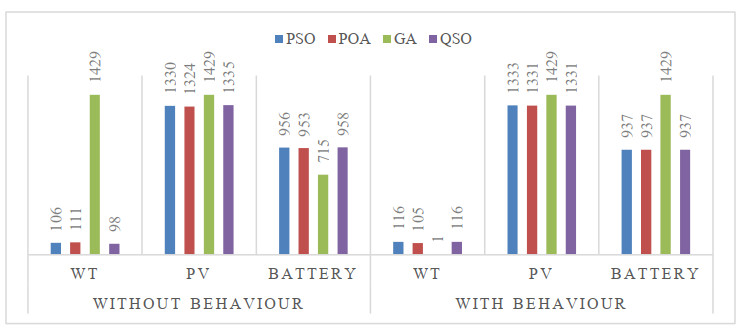
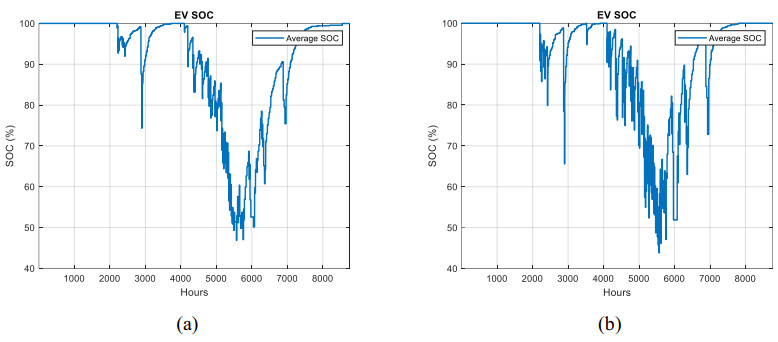
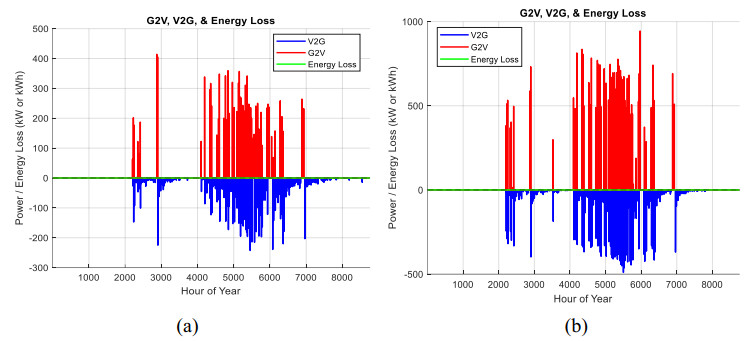
The integration of renewable energy sources (RESs) and electric vehicles (EVs) in grid-connected microgrids offers significant potential for improving energy flexibility, renewable-energy utilization, and supply reliability. However, many existing studies assume continuous EV availability or full user participation, which may overestimate the actual flexibility provided by EV fleets. To address this limitation, this study proposes a unified behavior-aware framework for a grid-connected photovoltaic–wind turbine–battery energy storage system electric vehicle (PV-WT-BESS-EV) microgrid, combining quokka swarm optimization (QSO) for optimal component sizing with a rule-based energy management system (RB-EMS). The framework incorporates EV availability, state-of-charge constraints, user willingness, mobility patterns, V2G/G2V operation, and time-of-use pricing. The system was evaluated over 8760 h using measured 2024 meteorological data and the actual hourly load profile of Al-Ramadi General Teaching Hospital, Iraq. Results showed that incorporating driver behavior reduces both V2G and G2V energy exchange by 50.88%, while battery discharge and charging increase by 1.47% and 1.48%, respectively. Grid import increases by only 0.52%, whereas exported energy decreases by 3.41%, and the cost of energy increases by 1.78%, while maintaining LPSP = 0. Optimal sizing changes from 116 WT, 1331 PV, and 937 battery units to 98 WT, 1335 PV, and 958 battery units. Statistical comparison over five independent runs showed that QSO achieves the lowest mean fitness and standard deviation, outperforming PSO, POA, and GA in convergence consistency and robustness. Sensitivity analysis further confirmed the robustness of the proposed framework under variations in EV fleet size, electricity pricing, and user behavioral composition. Increased EV penetration enhances V2G/G2V energy exchange, while tariff and behavioral variations primarily affect grid interaction and EV flexibility without compromising system reliability. Overall, the proposed framework provides a realistic and robust approach for jointly evaluating microgrid sizing and operation under practical EV behavioral constraints.
Citation: Ahmed K. Abbas, Razman Ayop, Chee Wei Tan, Yousif Al Mashhadany, Munir Ganbasha, Rozana Alik, Siti Mahfuza Saimon, Nur Faizal Kasri. Behavior-aware optimal sizing and energy management of hybrid microgrids with Vehicle-to-Grid integration via Quokka Swarm Optimization[J]. AIMS Energy, 2026, 14(5): 1217-1255. doi: 10.3934/energy.2026048
The integration of renewable energy sources (RESs) and electric vehicles (EVs) in grid-connected microgrids offers significant potential for improving energy flexibility, renewable-energy utilization, and supply reliability. However, many existing studies assume continuous EV availability or full user participation, which may overestimate the actual flexibility provided by EV fleets. To address this limitation, this study proposes a unified behavior-aware framework for a grid-connected photovoltaic–wind turbine–battery energy storage system electric vehicle (PV-WT-BESS-EV) microgrid, combining quokka swarm optimization (QSO) for optimal component sizing with a rule-based energy management system (RB-EMS). The framework incorporates EV availability, state-of-charge constraints, user willingness, mobility patterns, V2G/G2V operation, and time-of-use pricing. The system was evaluated over 8760 h using measured 2024 meteorological data and the actual hourly load profile of Al-Ramadi General Teaching Hospital, Iraq. Results showed that incorporating driver behavior reduces both V2G and G2V energy exchange by 50.88%, while battery discharge and charging increase by 1.47% and 1.48%, respectively. Grid import increases by only 0.52%, whereas exported energy decreases by 3.41%, and the cost of energy increases by 1.78%, while maintaining LPSP = 0. Optimal sizing changes from 116 WT, 1331 PV, and 937 battery units to 98 WT, 1335 PV, and 958 battery units. Statistical comparison over five independent runs showed that QSO achieves the lowest mean fitness and standard deviation, outperforming PSO, POA, and GA in convergence consistency and robustness. Sensitivity analysis further confirmed the robustness of the proposed framework under variations in EV fleet size, electricity pricing, and user behavioral composition. Increased EV penetration enhances V2G/G2V energy exchange, while tariff and behavioral variations primarily affect grid interaction and EV flexibility without compromising system reliability. Overall, the proposed framework provides a realistic and robust approach for jointly evaluating microgrid sizing and operation under practical EV behavioral constraints.

| [1] |
Shi F, Liao X, Shen L, et al. (2022) Exploring the spatiotemporal impacts of urban form on CO2 emissions: Evidence and implications from 256 Chinese cities. Environ Impact Assess Rev 96: 106850. https://doi.org/10.1016/j.eiar.2022.106850 doi: 10.1016/j.eiar.2022.106850

|
| [2] |
Maleki A, Nazari MA, Pourfayaz F (2020) Harmony search optimization for optimum sizing of hybrid solar schemes based on battery storage unit. Energy Rep 6: 102–111. https://doi.org/10.1016/j.egyr.2020.03.014 doi: 10.1016/j.egyr.2020.03.014
|
| [3] |
Azim Mohseni N, Bayati N, Ebel T (2024) Energy management strategies of hybrid electric vehicles: A comparative review. IET Smart Grid 7: 191–220. https://doi.org/10.1049/stg2.12133 doi: 10.1049/stg2.12133
|
| [4] |
Shami TM, El-Saleh AA, Alswaisti M, et al. (2022) Particle swarm optimization: A comprehensive survey. IEEE Access 10: 10031–10061. https://doi.org/10.1109/ACCESS.2022.3142859 doi: 10.1109/ACCESS.2022.3142859
|
| [5] | Holland JH (1975) Adaptation in natural and artificial systems. In: University of Michigan Press, 29–41. Available from: https://mitpress.mit.edu/9780262082136/adaptation-in-natural-and-artificial-systems/. |
| [6] |
Trojovský P, Dehghani M (2022) Pelican optimization algorithm: A novel nature-inspired algorithm for engineering applications. Sensors 22: 855. https://doi.org/10.3390/s22030855 doi: 10.3390/s22030855
|
| [7] |
Prakash K, Ali M, Siddique MNI, et al. (2022) Bi-level planning and scheduling of electric vehicle charging stations for peak shaving and congestion management in low voltage distribution networks. Comput Electr Eng 102: 108235. https://doi.org/10.1016/j.compeleceng.2022.108235 doi: 10.1016/j.compeleceng.2022.108235
|
| [8] |
Guru N, Patnaik S, Nayak MR, et al. (2024) Optimal battery energy management for a photovoltaic and EV based residential consumer. 2024 IEEE Int Conf Smart Power Control Renew Energy 2024: 1–6. https://doi.org/10.1109/ICSPCRE62303.2024.10675287 doi: 10.1109/ICSPCRE62303.2024.10675287
|
| [9] |
Hannan MA, Mollik MS, Al-Shetwi AQ, et al. (2022) Vehicle to grid connected technologies and charging strategies: Operation, control, issues and recommendations. J Clean Prod 339: 130587. https://doi.org/10.1016/j.jclepro.2022.130587 doi: 10.1016/j.jclepro.2022.130587
|
| [10] |
Guo C, Zhu K, Chen C, et al. (2020) Characteristics and effect laws of the large-scale electric Vehicle's charging load. ETransportation 3: 100049. https://doi.org/10.1016/j.etran.2020.100049 doi: 10.1016/j.etran.2020.100049
|
| [11] |
Amghar B, Azib T, Brahim KS (2026) Enhanced microgrid energy coordination using hybrid particle swarm optimization with bidirectional electric vehicle integration. E3S Web Conf 699: 02004. https://doi.org/10.1051/e3sconf/202669902004 doi: 10.1051/e3sconf/202669902004
|
| [12] |
El Ganaoui Mourlan O, Miliani EH, Moussadeq M, et al. (2025) Advanced energy management strategy for microgrids with integrated battery storage and renewable generation. Sci Technol Energy Transit 80: 2024111. https://doi.org/10.2516/stet/2024111 doi: 10.2516/stet/2024111
|
| [13] |
Pezzati N, Innocenti E, Berzi L, et al. (2025) Scalable energy management model for integrating V2G capabilities into renewable energy communities. World Electr Veh J 16: 450. https://doi.org/10.3390/wevj16080450 doi: 10.3390/wevj16080450
|
| [14] |
Cheng Z, Ji R, Tao H, et al. (2026) Optimizing energy scheduling in a photovoltaic-storage-charging flexible microgrid integrated with redox flow batteries using a dynamic weight slime mould algorithm. J Eng Res 14: 1820–1834. https://doi.org/10.1016/j.jer.2026.02.026 doi: 10.1016/j.jer.2026.02.026
|
| [15] |
Mohd Noor MI, Nik Ali NH, Amir Mustafa AM, et al. (2026) Evolving trends in energy management systems (EMS) research using scientometric analysis. J Kejuruter 38: 385–398. https://doi.org/10.17576/jkukm-2026-38(1)-34. doi: 10.17576/jkukm-2026-38(1)-34
|
| [16] |
Hemachandu P, Premalatha S, Arunachalam KP, et al. (2025) Energy management in photovoltaic-based electric vehicle charging systems with battery storage and vehicle-to-grid support. Energy Storage 7: e70236. https://doi.org/10.1002/est2.70236 doi: 10.1002/est2.70236
|
| [17] | Atheeswaran A, Thirumalai M, Panchyk M, et al. (2026) Integration of renewable energy with electric vehicle systems: A review of charging infrastructure, vehicle-to-grid technologies, and energy management. Energy Explor Exploit. https://doi.org/10.1177/01445987261466786 |
| [18] |
Sharifi P, Banerjee A, Feizollahi MJ (2020) Leveraging owners' flexibility in smart charge/discharge scheduling of electric vehicles to support renewable energy integration. Comput Ind Eng 149: 106762. https://doi.org/10.1016/j.cie.2020.106762 doi: 10.1016/j.cie.2020.106762
|
| [19] |
Alsharif A, Tan CW, Ayop R, et al. (2023) Impact of electric vehicle on residential power distribution considering energy management strategy and stochastic Monte Carlo algorithm. Energies 16: 1358. https://doi.org/10.3390/en16031358 doi: 10.3390/en16031358
|
| [20] | Shi R, Xu J, Zhang P, et al. (2022) V2G discharging price impact on EV user participation based on CDEP model. SSRN Electron J, 4034167. https://doi.org/10.2139/ssrn.4034167. |
| [21] |
Guven AF (2024) Integrating electric vehicles into hybrid microgrids: A stochastic approach to future-ready renewable energy solutions and management. Energy 303: 131968. https://doi.org/10.1016/j.energy.2024.131968 doi: 10.1016/j.energy.2024.131968
|
| [22] |
Jaworski J, Zheng N, Preindl M, et al. (2024) Vehicle-to-grid fleet service provision considering nonlinear battery behaviors. IEEE Trans Transp Electrif 10: 2945–2955. https://doi.org/10.1109/TTE.2023.3305235 doi: 10.1109/TTE.2023.3305235
|
| [23] |
Mohseni S, Brent AC, Burmester D (2019) A demand response-centred approach to the long-term equipment capacity planning of grid-independent micro-grids optimized by the moth-flame optimization algorithm. Energy Convers Manag 200: 112105. https://doi.org/10.1016/j.enconman.2019.112105 doi: 10.1016/j.enconman.2019.112105
|
| [24] |
Panda S, Samanta IS, Sahoo B, et al. (2025) Comprehensive framework for smart residential demand side management with electric vehicle integration and advanced optimization techniques. Sci Rep 15: 9948. https://doi.org/10.1038/s41598-025-93817-5 doi: 10.1038/s41598-025-93817-5
|
| [25] |
İnci M, Savrun MM, Çelik Ö (2022) Integrating electric vehicles as virtual power plants: A comprehensive review on vehicle-to-grid (V2G) concepts, interface topologies, marketing and future prospects. J Energy Storage 55: 105579. https://doi.org/10.1016/j.est.2022.105579 doi: 10.1016/j.est.2022.105579
|
| [26] |
Akinyele D, Amole A, Olabode E, et al. (2021) Simulation and analysis approaches to microgrid systems design: Emerging trends and sustainability framework application. Sustainability 13: 11299. https://doi.org/10.3390/su132011299 doi: 10.3390/su132011299
|
| [27] |
Al-Kayiem HH, Mohammad ST (2019) Potential of renewable energy resources with an emphasis on solar power in Iraq: An outlook. Resources 8: 42. https://doi.org/10.3390/resources8010042 doi: 10.3390/resources8010042
|
| [28] | Global Wind Atlas (2025) Wind resource data of Iraq—Al-Anbar. Available from: https://globalwindatlas.info/en/area/Iraq/Al-Anbar. |
| [29] |
Bukar AL, Tan CW, Lau KY (2019) Optimal sizing of an autonomous photovoltaic/wind/battery/diesel generator microgrid using grasshopper optimization algorithm. Sol Energy 188: 685–696. https://doi.org/10.1016/j.solener.2019.06.050 doi: 10.1016/j.solener.2019.06.050
|
| [30] |
Bhatti AR, Salam Z (2018) A rule-based energy management scheme for uninterrupted electric vehicles charging at constant price using photovoltaic-grid system. Renew Energy 125: 384–400. https://doi.org/10.1016/j.renene.2018.02.126 doi: 10.1016/j.renene.2018.02.126
|
| [31] |
Shi R, Li S, Zhang P, et al. (2020) Integration of renewable energy sources and electric vehicles in V2G network with adjustable robust optimization. Renew Energy 153: 1067–1080. https://doi.org/10.1016/j.renene.2020.02.027 doi: 10.1016/j.renene.2020.02.027
|
| [32] |
Bukar AL, Tan CW, Yiew LK, et al. (2020) A rule-based energy management scheme for long-term optimal capacity planning of grid-independent microgrid optimized by multi-objective grasshopper optimization algorithm. Energy Convers Manag 221: 113161. https://doi.org/10.1016/j.enconman.2020.113161 doi: 10.1016/j.enconman.2020.113161
|
| [33] |
Yan C, Zou Y, Wu Z, et al. (2024) Effect of various design configurations and operating conditions for optimization of a wind/solar/hydrogen/fuel cell hybrid microgrid system by a bio-inspired algorithm. Int J Hydrogen Energy 60: 378–391. https://doi.org/10.1016/j.ijhydene.2024.02.004 doi: 10.1016/j.ijhydene.2024.02.004
|
| [34] |
Kaabeche A, Ibtiouen R (2014) Techno-economic optimization of hybrid photovoltaic/wind/diesel/battery generation in a stand-alone power system. Sol Energy 103: 171–182. https://doi.org/10.1016/j.solener.2014.02.017 doi: 10.1016/j.solener.2014.02.017
|
| [35] |
Alguhi AA, Alotaibi MA (2025) Optimal operation of battery energy storage systems in microgrid-connected distribution networks for economic efficiency and grid security. Energies 18: 6335. https://doi.org/10.3390/en18236335 doi: 10.3390/en18236335
|
| [36] |
Piller S, Perrin M, Jossen A (2001) Methods for state-of-charge determination and their applications. J Power Sources 96: 113–120. https://doi.org/10.1016/S0378-7753(01)00560-2 doi: 10.1016/S0378-7753(01)00560-2
|
| [37] |
Bilal M, Alsaidan I, Alaraj M, et al. (2022) Techno-economic and environmental analysis of grid-connected electric vehicle charging station using AI-based algorithm. Mathematics 10: 924. https://doi.org/10.3390/math10060924 doi: 10.3390/math10060924
|
| [38] |
Bahrami S, Parniani M (2014) Game theoretic based charging strategy for plug-in hybrid electric vehicles. IEEE Trans Smart Grid 5: 2368–2375. https://doi.org/10.1109/TSG.2014.2317523 doi: 10.1109/TSG.2014.2317523
|
| [39] |
Sharma P, Raju S (2025) Techno-economic analysis of retired electric vehicle batteries with grid-connected hybrid energy system. Energy Convers Manag 339: 119870. https://doi.org/10.1016/j.enconman.2025.119870 doi: 10.1016/j.enconman.2025.119870
|
| [40] |
Barakat S, Ibrahim H, Elbaset AA (2020) Multi-objective optimization of grid-connected PV-wind hybrid system considering reliability, cost, and environmental aspects. Sustain Cities Soc 60: 102178. https://doi.org/10.1016/j.scs.2020.102178 doi: 10.1016/j.scs.2020.102178
|
| [41] |
Bahloul M, Daoud M, Khadem SK (2024) Optimal dispatch of battery energy storage for multi-service provision in a collocated PV power plant considering battery ageing. Energy 293: 130744. https://doi.org/10.1016/j.energy.2024.130744 doi: 10.1016/j.energy.2024.130744
|
| [42] |
Senthil Kumar GM, Guo X, Zhou S, et al. (2025) State-of-the-art review of smart energy management systems for supporting zero-emission electric vehicles with X2V and V2X interactions. Renew Sustain Energy Rev 208: 115050. https://doi.org/10.1016/j.rser.2024.115050 doi: 10.1016/j.rser.2024.115050
|
| [43] |
Helmus JR, Lees MH, Van Den Hoed R (2020) A data driven typology of electric vehicle user types and charging sessions. Transp Res Part C 115: 102637. https://doi.org/10.1016/j.trc.2020.102637 doi: 10.1016/j.trc.2020.102637
|
| [44] |
AL-Kubaisy WJ, AL-Khateeb B (2024) Quokka swarm optimization: A new nature-inspired metaheuristic optimization algorithm. J Intell Syst 33: 20240051. https://doi.org/10.1515/jisys-2024-0051 doi: 10.1515/jisys-2024-0051
|
| [45] |
Yadav RK, Bharti D, De M (2025) Optimizing resource allocation for enhanced distribution system performance using Quokka swarm optimization. Int J Comput Exp Sci Eng 11: 9380–9392. https://doi.org/10.22399/ijcesen.3874 doi: 10.22399/ijcesen.3874
|
| [46] |
Yahiaoui A, Benmansour K, Tadjine M (2016) Control, analysis and optimization of hybrid PV-Diesel-Battery systems for isolated rural city in Algeria. Sol Energy 137: 1–10. https://doi.org/10.1016/j.solener.2016.07.050 doi: 10.1016/j.solener.2016.07.050
|
| [47] |
Singh S, Chauhan P, Singh NJ (2021) Feasibility of grid-connected solar-wind hybrid system with electric vehicle charging station. J Mod Power Syst Clean Energy 9: 295–306. https://doi.org/10.35833/MPCE.2019.000081 doi: 10.35833/MPCE.2019.000081
|
| [48] |
Elbaz A, Guneser MT (2021) Multi-objective optimization method for proper configuration of grid-connected PV-wind hybrid system in terms of ecological effects, outlay, and reliability. J Electr Eng Technol 16: 771–782. https://doi.org/10.1007/s42835-020-00635-y doi: 10.1007/s42835-020-00635-y
|
| [49] |
Bandopadhyay J, Kumar P (2020) Application of hybrid multi-objective moth flame optimization technique for optimal performance of hybrid micro-grid system. Appl Soft Comput J 95: 106487. https://doi.org/10.1016/j.asoc.2020.106487 doi: 10.1016/j.asoc.2020.106487
|
| [50] |
Sadeghi D, Ahmadi SE, Amiri N, et al. (2022) Designing, optimizing and comparing distributed generation technologies as a substitute system for reducing life cycle costs, CO2 emissions, and power losses in residential buildings. Energy 253: 123947. https://doi.org/10.1016/j.energy.2022.123947 doi: 10.1016/j.energy.2022.123947
|
| [51] |
Iclodean C, Varga B, Burnete N, et al. (2017) Comparison of different battery types for electric vehicles. IOP Conf Ser Mater Sci Eng 252: 12058. https://doi.org/10.1088/1757-899X/252/1/012058 doi: 10.1088/1757-899X/252/1/012058
|
| [52] |
Sadeghi D, Naghshbandy AH, Bahramara S (2020) Optimal sizing of hybrid renewable energy systems in presence of electric vehicles using multi-objective particle swarm optimization. Energy 209: 118471. https://doi.org/10.1016/j.energy.2020.118471 doi: 10.1016/j.energy.2020.118471
|
| [53] |
Sanguesa JA, Torres-Sanz V, Garrido P, et al. (2021) A review on electric vehicles: Technologies and challenges. Smart Cities 4: 372–404. https://doi.org/10.3390/smartcities4010022 doi: 10.3390/smartcities4010022
|
| [54] |
Jamal S, Pasupuleti J, Rahmat NA, et al. (2024) Multi-objective optimal energy management of nanogrid using improved Pelican optimization algorithm. IEEE Access 12: 41954–41966. https://doi.org/10.1109/ACCESS.2024.3377250 doi: 10.1109/ACCESS.2024.3377250
|
| [55] |
Bukar AL, Tan CW (2019) A review on stand-alone photovoltaic-wind energy system with fuel cell: System optimization and energy management strategy. J Clean Prod 221: 73–88. https://doi.org/10.1016/j.jclepro.2019.02.228 doi: 10.1016/j.jclepro.2019.02.228
|
| [56] |
Alilou M, Younesi A, Siano P (2026) A sustainable approach to hybrid microgrid design: Optimal sizing and energy management. Renew Energy 256: 124078. https://doi.org/10.1016/j.renene.2025.124078 doi: 10.1016/j.renene.2025.124078
|
| [57] |
Mebrahtu F, Wekesa C, Moses P, et al. (2026) Metaheuristic-based optimal sizing of standalone PV-wind-BESS-EV hybrid renewable energy system. Energy Convers Manag X 31: 102141. https://doi.org/10.1016/j.ecmx.2026.102141 doi: 10.1016/j.ecmx.2026.102141
|
| [58] |
Shrivastav AK, Dutta S (2025) Multi-objective optimization of hybrid microgrid for energy trilemma goals using slime mould algorithm. Sci Rep 15: 29242. https://doi.org/10.1038/s41598-025-15207-1 doi: 10.1038/s41598-025-15207-1
|
Figures(18) / Tables(3)

Ahmed K. Abbas, Razman Ayop, Chee Wei Tan, Yousif Al Mashhadany, Munir Ganbasha, Rozana Alik, Siti Mahfuza Saimon, Nur Faizal Kasri. Behavior-aware optimal sizing and energy management of hybrid microgrids with Vehicle-to-Grid integration via Quokka Swarm Optimization[J]. AIMS Energy, 2026, 14(5): 1217-1255. doi: 10.3934/energy.2026048





 DownLoad: