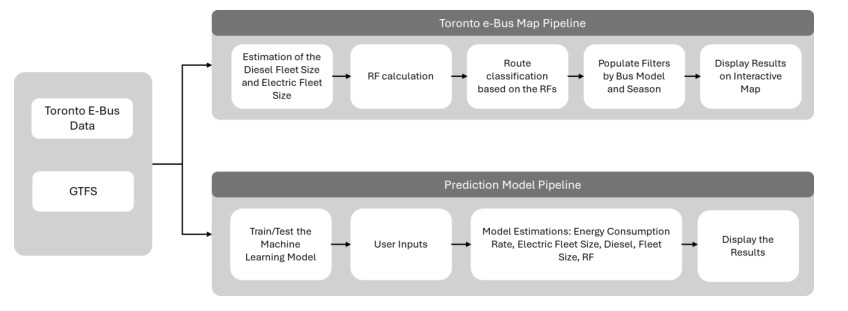
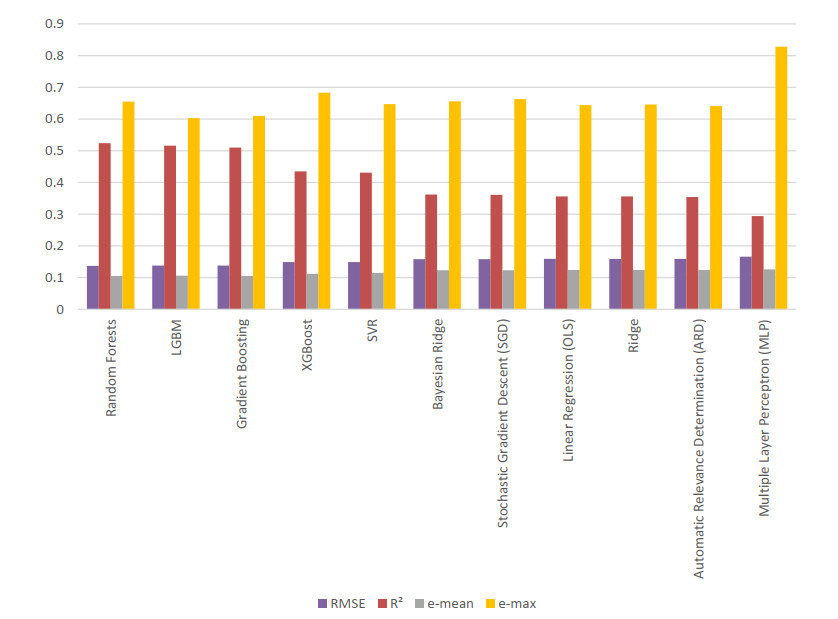
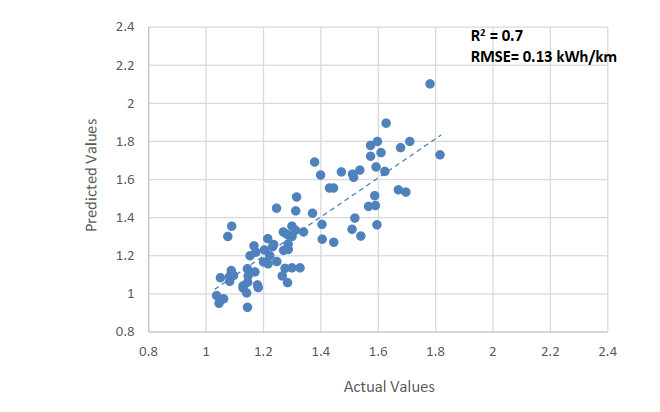
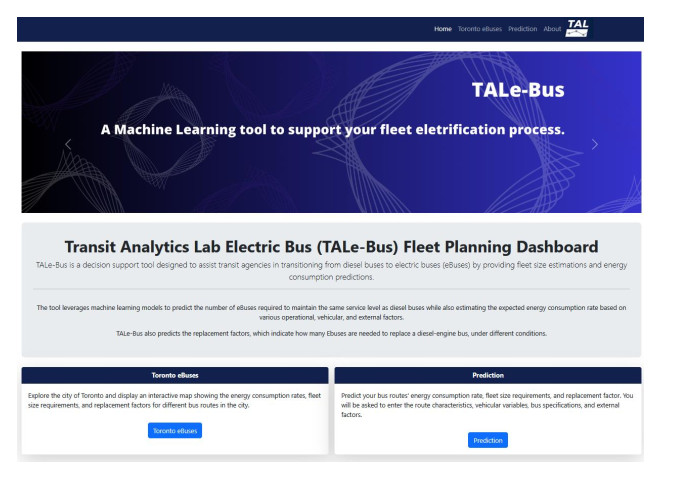
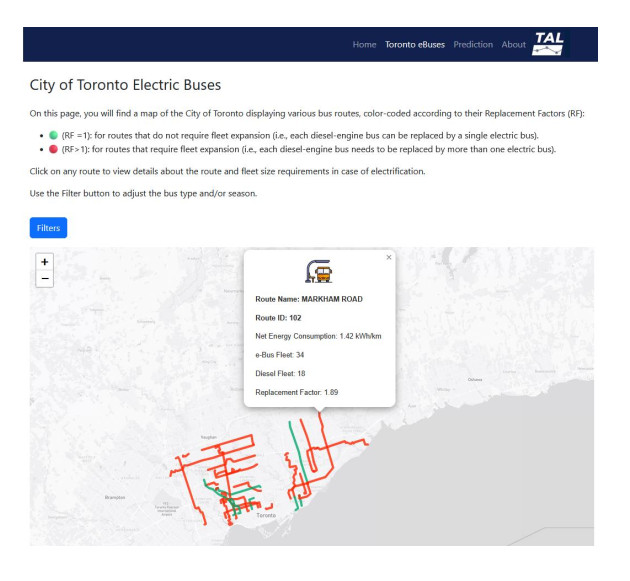
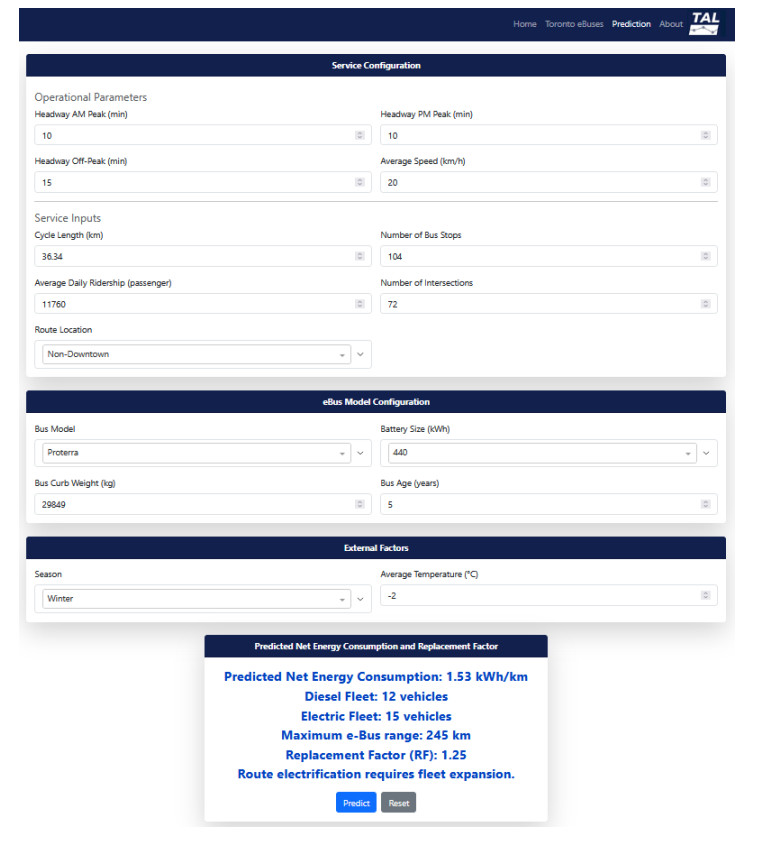
This study presents the development of the Transit Analytics Lab Electric Bus (TALe-Bus) Dashboard, an integrated decision-support tool designed to support transit agencies in planning the transition from conventional diesel buses to battery-electric buses. The dashboard combines predictive modeling, data analytics, and interactive visualization to estimate electric bus energy consumption rates, fleet size requirements, replacement factors, and maximum operational range for the case of overnight depot charging. The dashboard was built based on real-world data collected from the operations of 60 battery-electric buses on 48 routes in Toronto. The modeling workflow includes data preprocessing, feature selection, and the development and comparison of multiple statistical and machine learning energy prediction models. Tree-based modeling techniques outperformed the other techniques, demonstrating strong capability in capturing the relationships between operational, environmental, vehicle, and route characteristics and the energy consumption rate, achieving a root mean square error (RMSE) of 0.13 kWh/km. These techniques were therefore adopted as the core predictive engine of the system. The fleet-sizing module integrates traditional transit planning formulations (for diesel fleets) with electric-bus energy and range constraints to estimate both electric and diesel fleet requirements and compute the replacement factor, a key indicator reflecting the relative fleet needs for electrification. The dashboard also estimates the maximum operational bus range based on the battery capacity and real-world operating conditions, supporting reliable service planning. The system is implemented as an interactive web-based platform that provides geospatial visualization of route electrification feasibility and a scenario-based interface for customized operational analysis. By translating complex predictive analytics into a practical planning tool, the TALe-Bus Dashboard supports informed, data-driven decision-making for fleet electrification and infrastructure planning.
Citation: Kareem Othman, Diego Da Silva, Amer Shalaby, Baher Abdulhai. TALe-Bus: An interactive dashboard for electric bus fleet electrification planning[J]. AIMS Energy, 2026, 14(3): 732-759. doi: 10.3934/energy.2026030
This study presents the development of the Transit Analytics Lab Electric Bus (TALe-Bus) Dashboard, an integrated decision-support tool designed to support transit agencies in planning the transition from conventional diesel buses to battery-electric buses. The dashboard combines predictive modeling, data analytics, and interactive visualization to estimate electric bus energy consumption rates, fleet size requirements, replacement factors, and maximum operational range for the case of overnight depot charging. The dashboard was built based on real-world data collected from the operations of 60 battery-electric buses on 48 routes in Toronto. The modeling workflow includes data preprocessing, feature selection, and the development and comparison of multiple statistical and machine learning energy prediction models. Tree-based modeling techniques outperformed the other techniques, demonstrating strong capability in capturing the relationships between operational, environmental, vehicle, and route characteristics and the energy consumption rate, achieving a root mean square error (RMSE) of 0.13 kWh/km. These techniques were therefore adopted as the core predictive engine of the system. The fleet-sizing module integrates traditional transit planning formulations (for diesel fleets) with electric-bus energy and range constraints to estimate both electric and diesel fleet requirements and compute the replacement factor, a key indicator reflecting the relative fleet needs for electrification. The dashboard also estimates the maximum operational bus range based on the battery capacity and real-world operating conditions, supporting reliable service planning. The system is implemented as an interactive web-based platform that provides geospatial visualization of route electrification feasibility and a scenario-based interface for customized operational analysis. By translating complex predictive analytics into a practical planning tool, the TALe-Bus Dashboard supports informed, data-driven decision-making for fleet electrification and infrastructure planning.

| [1] | Blynn KKM (2018) Accelerating bus electrification: Enabling a sustainable transition to low carbon transportation systems (Doctoral dissertation, Massachusetts Institute of Technology). Available from: https://dspace.mit.edu/entities/publication/a079231a-22db-4fd9-92f1-3540dfd2517b. |
| [2] | Logan KG, Hastings A, Nelson JD (2022) Transportation in a net zero world: Transitioning towards low carbon public transport. Springer Nature.https://doi.org/10.1007/978-3-030-96674-4 |
| [3] |
Choma EF, Robinson LA, Nadeau KC (2024) Adopting electric school buses in the United States: Health and climate benefits. Proc Natl Acad Sci 121: e2320338121.https://doi.org/10.1073/pnas.2320338121 doi: 10.1073/pnas.2320338121

|
| [4] |
Saini H (2024) Environmental benefits of transition to electric school buses. Int J Multidiscip Res Growth Eval 5: 7-12.https://doi.org/10.54660/.IJMRGE.2024.5.6.07-12 doi: 10.54660/.IJMRGE.2024.5.6.07-12
|
| [5] |
Bursey V, Kalisa E (2025) Health, economic, and environmental impacts of electric school bus adoption: A scoping review. Sci Total Environ 988: 179843.https://doi.org/10.1016/j.scitotenv.2025.179843 doi: 10.1016/j.scitotenv.2025.179843
|
| [6] |
Avenali A, Catalano G, Giagnorio M, et al. (2024) Factors influencing the adoption of zero-emission buses: A review-based framework. Renewable Sustainable Energy Rev 197: 114388.https://doi.org/10.1016/j.rser.2024.114388 doi: 10.1016/j.rser.2024.114388
|
| [7] |
Deliali A, Chhan D, Oliver J, et al. (2021) Transitioning to zero-emission bus fleets: State of practice of implementations in the United States. Transp Rev 41: 164-191.https://doi.org/10.1080/01441647.2020.1800132 doi: 10.1080/01441647.2020.1800132
|
| [8] |
Othman K, Da Silva D, Shalaby A, et al. (2025) Interpretable machine learning models for predicting Ebus battery consumption rates in cold climates with and without diesel auxiliary heating. Green Energy and Intell Transp 4: 100250.https://doi.org/10.1016/j.geits.2024.100250 doi: 10.1016/j.geits.2024.100250
|
| [9] |
Alanazi F (2023) Electric vehicles: Benefits, challenges, and potential solutions for widespread adaptation. Appl Sci 13: 6016.https://doi.org/10.3390/app13106016 doi: 10.3390/app13106016
|
| [10] | Sclar R, Gorguinpour C, Castellanos S, et al. (2019) Barriers to adopting electric buses. Available from: https://www.sustainable-bus.com/wp-content/uploads/2019/05/barriers-to-adopting-electric-buses.pdf. |
| [11] |
Zhou B, Wu Y, Zhou B, et al. (2016) Real-world performance of battery electric buses and their life-cycle benefits with respect to energy consumption and carbon dioxide emissions. Energy 96: 603-613.https://doi.org/10.1016/j.energy.2015.12.041 doi: 10.1016/j.energy.2015.12.041
|
| [12] | Ekblom V (2024) Comprehensive sustainability in urban transport: The interconnected impacts of electrifying Stockholm's bus fleet. Available from: https://www.diva-portal.org/smash/get/diva2: 1910276/FULLTEXT01.pdf. |
| [13] |
Othman K, Hamed S, Da Silva D, et al. (2024). Decision support tools for effective bus fleet electrification: Replacement factors and fleet size prediction. Transp Res Interdiscip Perspect 28: 101267.https://doi.org/10.1016/j.trip.2024.101267 doi: 10.1016/j.trip.2024.101267
|
| [14] |
Apribowo CH, Sarjiya S, Hadi SP, et al. (2022) Optimal planning of battery energy storage systems by considering battery degradation due to ambient temperature: A review, challenges, and new perspective. Batteries 8: 290.https://doi.org/10.3390/batteries8120290 doi: 10.3390/batteries8120290
|
| [15] |
Rahman T, Alharbi T (2024) Exploring lithium-ion battery degradation: A concise review of critical factors, impacts, data-driven degradation estimation techniques, and sustainable directions for energy storage systems. Batteries 10: 220.https://doi.org/10.3390/batteries10070220 doi: 10.3390/batteries10070220
|
| [16] |
Lipu MS, Mamun AA, Ansari S, et al. (2022) Battery management, key technologies, methods, issues, and future trends of electric vehicles: A pathway toward achieving sustainable development goals. Batteries 8: 119.https://doi.org/10.3390/batteries8090119 doi: 10.3390/batteries8090119
|
| [17] |
Rogge M, Van der Hurk E, Larsen A, et al. (2018) Electric bus fleet size and mix problem with optimization of charging infrastructure. Appl Energy 211: 282-295.https://doi.org/10.1016/j.apenergy.2017.11.051 doi: 10.1016/j.apenergy.2017.11.051
|
| [18] |
Gairola P, Nezamuddin N (2023) Design of battery electric bus system considering waiting time limitations. Transp Res Rec: J Transp Res Board 2677: 1415-1430.https://doi.org/10.1177/03611981221113321 doi: 10.1177/03611981221113321
|
| [19] |
Li JQ (2016) Battery-electric transit bus developments and operations: A review. Int J Sustainable Transp 10: 157-169.https://doi.org/10.1080/15568318.2013.872737 doi: 10.1080/15568318.2013.872737
|
| [20] |
Pencheva V, Asenov A, Georgiev A, et al. (2026) An integrated model for the electrification of urban bus fleets in public transport systems. Eng Proc 121: 28.https://doi.org/10.3390/engproc2025121028 doi: 10.3390/engproc2025121028
|
| [21] |
Topić J, Soldo J, Maletić F, et al. (2020) Virtual simulation of electric bus fleets for city bus transport electrification planning. Energies 13: 3410.https://doi.org/10.3390/en13133410 doi: 10.3390/en13133410
|
| [22] |
Booysen MJ, Abraham CJ, Pretorius BG (2025) A system-of-systems framework for planning the electrification of paratransit. Energy Strategy Rev 62: 101892.https://doi.org/10.1016/j.esr.2025.101892 doi: 10.1016/j.esr.2025.101892
|
| [23] |
Heide L, Guo S, Göhlich D (2025) From simulation to implementation: A systems model for electric bus fleet deployment in metropolitan areas. World Electric Vehicle Journal 16: 378.https://doi.org/10.3390/wevj16070378 doi: 10.3390/wevj16070378
|
| [24] |
Sennefelder RM, Martín-Clemente R, González-Carvajal R (2023) Energy consumption prediction of electric city buses using multiple linear regression. Energies 16: 4365.https://doi.org/10.3390/en16114365 doi: 10.3390/en16114365
|
| [25] |
Li P, Zhang Y, Zhang K, et al. (2021). The effects of dynamic traffic conditions, route characteristics and environmental conditions on trip-based electricity consumption prediction of electric bus. Energy 218: 119437.https://doi.org/10.1016/j.energy.2020.119437 doi: 10.1016/j.energy.2020.119437
|
| [26] |
Dong C, Xiong Z, Li N, et al. (2025) A real-time prediction framework for energy consumption of electric buses using integrated machine learning algorithms. Transp Res Part E: Logistics Trans Rev 194: 103884.https://doi.org/10.1016/j.tre.2024.103884 doi: 10.1016/j.tre.2024.103884
|
| [27] |
Morlock F, Rolle B, Bauer M, et al. (2019) Forecasts of electric vehicle energy consumption based on characteristic speed profiles and real-time traffic data. IEEE Trans Veh Technol 69: 1404-1418.https://doi.org/10.1109/TVT.2019.2957536 doi: 10.1109/TVT.2019.2957536
|
| [28] |
Ekici YE, Akdağ O, Aydin AA, et al. (2023) A novel energy consumption prediction model of electric buses using real-time big data from route, environment, and vehicle parameters. IEEE Access 11: 104305-104322.https://doi.org/10.1109/ACCESS.2023.3316362 doi: 10.1109/ACCESS.2023.3316362
|
| [29] |
Nan S, Tu R, Li T, et al. (2022) From driving behavior to energy consumption: A novel method to predict the energy consumption of electric bus. Energy 261: 125188.https://doi.org/10.1016/j.energy.2022.125188 doi: 10.1016/j.energy.2022.125188
|
| [30] | Beckers CJ, Besselink IJ, Frints JJ, et al. (2019) Energy consumption prediction for electric city buses. In 13th ITS European Congress: Fulfilling its promises. Available from: https://pure.tue.nl/ws/files/127995147/postprint_2019_04_11_Energy_Consumption_Prediction_for_Electric_City_Buses_CJJBeckers_IJMBesselink_JJMFrints_and_HNijmijer.pdf. |
| [31] |
Abdelwahed A, van den Berg PL, Brandt T, et al. (2020) Evaluating and optimizing opportunity fast-charging schedules in transit battery electric bus networks. Trans Sci 54: 1439-1731.https://doi.org/10.1287/trsc.2020.0982 doi: 10.1287/trsc.2020.0982
|
| [32] |
Lajunen A (2018) Lifecycle costs and charging requirements of electric buses with different charging methods. J Cleaner Prod 172: 56-67.https://doi.org/10.1016/j.jclepro.2017.10.066 doi: 10.1016/j.jclepro.2017.10.066
|
| [33] |
Hasan MM, Avramis N, Ranta M, et al. (2021) Multi-objective energy management and charging strategy for electric bus fleets in cities using various ECO strategies. Sustainability 13: 7865.https://doi.org/10.3390/su13147865 doi: 10.3390/su13147865
|
| [34] | Hasan MM, Ranta M, El Baghdadi M, et al. (2020, November 18). Charging management strategy using ECO-charging for electric bus fleets in cities. In 2020 IEEE Vehicle Power and Propulsion Conference (VPPC), 1-8.https://doi.org/10.1109/VPPC49601.2020.9330970 |
| [35] |
Zeng B, Wu W, Ma C (2023) Electric bus scheduling and charging infrastructure planning considering bus replacement strategies at charging stations. IEEE Access 11: 125328-125345.https://doi.org/10.1109/ACCESS.2023.3330369 doi: 10.1109/ACCESS.2023.3330369
|
| [36] |
Houbbadi A, Trigui R, Pelissier S, et al. (2019). Optimal scheduling to manage an electric bus fleet overnight charging. Energies 12: 2727.https://doi.org/10.3390/en12142727 doi: 10.3390/en12142727
|
| [37] |
Wang Y, Liao F, Lu C (2022). Integrated optimization of charger deployment and fleet scheduling for battery electric buses. Transp Res Part D: Transp Environ 109: 103382.https://doi.org/10.1016/j.trd.2022.103382 doi: 10.1016/j.trd.2022.103382
|
| [38] |
Zhou GJ, Xie DF, Zhao XM, et al. (2020). Collaborative optimization of vehicle and charging scheduling for a bus fleet mixed with electric and traditional buses. IEEE Access 8: 8056-8072.https://doi.org/10.1109/ACCESS.2020.2964391 doi: 10.1109/ACCESS.2020.2964391
|
| [39] |
Wang J, Kang L, Liu Y (2020). Optimal scheduling for electric bus fleets based on dynamic programming approach by considering battery capacity fade. Renewable Sustainable Energy Rev 130: 109978.https://doi.org/10.1016/j.rser.2020.109978 doi: 10.1016/j.rser.2020.109978
|
| [40] | Çölbay K, Engin O (2025). Simulation-based analysis of bus scheduling problem for mixed fleets: Effects of flexibility strategies on delay performance. In 2025 9th International Artificial Intelligence and Data Processing Symposium (IDAP), 1-6.https://doi.org/10.1109/IDAP68205.2025.11222375 |
| [41] | Kharouf M (2022) A novel MILP model for the decarbonization of transit bus system considering emissions reduction targets and distributed energy resources. Doctoral dissertation, University of British Columbia. Available from: https://open.library.ubc.ca/soa/cIRcle/collections/ubctheses/24/items/1.0415784. |
| [42] | Federico S, Miraftabzadeh SM, Longo M, et al. (2025) Bus fleet electrification: A comprehensive review of charging systems, operations, planning and sustainability. SSRN, Preprint.https://doi.org/10.2139/ssrn.5929724 |
| [43] |
Akaber P, Hughes T, Sobolev S (2021) MILP-based customer-oriented e-fleet charging scheduling platform. IET Smart Grid 4: 215-223.https://doi.org/10.1049/stg2.12034 doi: 10.1049/stg2.12034
|
| [44] |
Chiu CC, Huang H, Chen CF (2024) A simulation-based optimization approach for the recharging scheduling problem of electric buses. Transp Res Part E: Logistics Transp Rev 192: 103835.https://doi.org/10.1016/j.tre.2024.103835 doi: 10.1016/j.tre.2024.103835
|
| [45] |
Chen Y, Zhang Y, Sun R (2021) Data-driven estimation of energy consumption for electric bus under real-world driving conditions. Transp Res Part D: Transp Environ, 98: 102969.https://doi.org/10.1016/j.trd.2021.102969 doi: 10.1016/j.trd.2021.102969
|
| [46] |
Zhang Z, Wang S, Ye B, et al. (2025). A feature prediction-based method for energy consumption prediction of electric buses. Energy 314: 134345.https://doi.org/10.1016/j.energy.2024.134345 doi: 10.1016/j.energy.2024.134345
|
| [47] |
Li P, Zhang Y, Zhang Y, et al. (2021) Prediction of electric bus energy consumption with stochastic speed profile generation modelling and data-driven method based on real-world big data. Appl Energy 298: 117204.https://doi.org/10.1016/j.apenergy.2021.117204 doi: 10.1016/j.apenergy.2021.117204
|
| [48] |
Jiang J, Yu Y, Min H, et al. (2023) Trip-level energy consumption prediction model for electric bus combining Markov-based speed profile generation and Gaussian process regression. Energy 263: 125866.https://doi.org/10.1016/j.energy.2022.125866 doi: 10.1016/j.energy.2022.125866
|
| [49] |
Pamuła T, Pamuła D (2022) Prediction of electric buses energy consumption from trip parameters using deep learning. Energies 15: 1747.https://doi.org/10.3390/en15051747 doi: 10.3390/en15051747
|
| [50] |
Zhao L, Ke H, Huo W (2023) A frequency item mining-based energy consumption prediction method for electric bus. Energy 263: 125915.https://doi.org/10.1016/j.energy.2022.125915 doi: 10.1016/j.energy.2022.125915
|
| [51] |
Zhang Z, Ye B, Wang S, et al. (2024) Analysis and estimation of energy consumption of electric buses using real-world data. Transp Res Part D: Transp Environ 126: 104017.https://doi.org/10.1016/j.trd.2023.104017 doi: 10.1016/j.trd.2023.104017
|
| [52] |
Fang Y, Yang WH, Ihara Y, et al. (2025) Developing a simple electricity consumption prediction formula for the pre-introduction prediction for electric buses. World Electr Veh J 16: 67.https://doi.org/10.3390/wevj16020067 doi: 10.3390/wevj16020067
|
| [53] |
Lyu A, Zhang H, Zhang Y, et al. (2025) A study on energy consumption analysis and prediction of electric bus at intersections considering driving behavior. Sci Rep 15: 44755.https://doi.org/10.1038/s41598-025-28835-4 doi: 10.1038/s41598-025-28835-4
|
| [54] |
Dong C, Xiong Z, Zhang C, et al. (2025) A transformer-based approach for deep feature extraction and energy consumption prediction of electric buses based on driving distances. Appl Energy 380: 123941.https://doi.org/10.1016/j.apenergy.2024.123941 doi: 10.1016/j.apenergy.2024.123941
|
| [55] |
Ma Y, Ye B, Wang S, et al. (2025) Accurate prediction of energy consumption of electric buses based on traffic condition, vehicle status, driving behaviour and environmental condition. IEEE Trans Transp Electrification 4: 9778-9792.https://doi.org/10.1109/TTE.2025.3556033 doi: 10.1109/TTE.2025.3556033
|
| [56] |
Zhao J, He J, Wang J, et al. (2025) Energy consumption prediction for electric buses based on traction modeling and LightGBM. World Electr Veh J 16: 159.https://doi.org/10.3390/wevj16030159 doi: 10.3390/wevj16030159
|
| [57] |
Kang Y, Wei J, Liu Z, et al. (2025). An energy consumption prediction model for electric buses based on extreme gradient boosting fusion algorithm. Int J Green Energy 22: 2504-2517.https://doi.org/10.1080/15435075.2025.2464155 doi: 10.1080/15435075.2025.2464155
|
| [58] |
Wang Z, Xu G, Sun R, et al. (2025) Online energy consumption forecast for battery electric buses using a learning-free algebraic method. Sci Rep 15: 1931.https://doi.org/10.1038/s41598-024-82432-5 doi: 10.1038/s41598-024-82432-5
|
| [59] |
Vehviläinen M, Lavikka R, Rantala S, et al. (2022) Setting up and operating electric city buses in harsh winter conditions. Appl Sci 12: 2762.https://doi.org/10.3390/app12062762 doi: 10.3390/app12062762
|
| [60] |
Tian X, Wang B, Wang Z, et al. (2025). Unraveling energy demand in battery electric bus operations through an explainable machine learning approach using real-world cold-climate data. Energy, 139256.https://doi.org/10.1016/j.energy.2025.139256 doi: 10.1016/j.energy.2025.139256
|
| [61] |
Pettinen R, Anttila J, Muona T, et al. (2023) Testing method for electric bus auxiliary heater emissions. Energies 16: 3578.https://doi.org/10.3390/en16083578 doi: 10.3390/en16083578
|
| [62] | Vuchic VR (2005) Urban transit: Operations, planning, and economics. John Wiley & Sons. Available from: https://www.wiley.com/en-us/shop/general-introductory-civil-engineering-construction/urban-transit-operations-planning-and-economics-p-9780471632658. |
Figures(8) / Tables(2)

Kareem Othman, Diego Da Silva, Amer Shalaby, Baher Abdulhai. TALe-Bus: An interactive dashboard for electric bus fleet electrification planning[J]. AIMS Energy, 2026, 14(3): 732-759. doi: 10.3934/energy.2026030





 DownLoad: