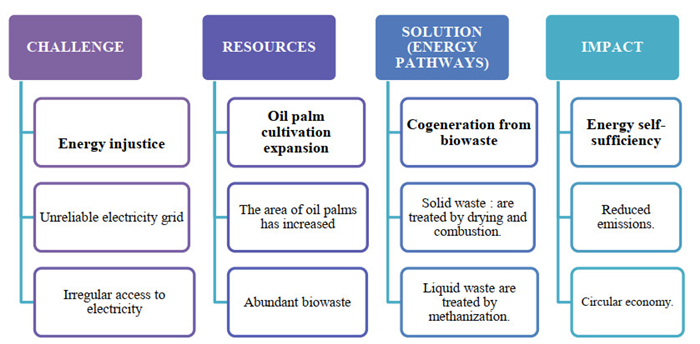
This contribution explores the potential of valorizing oil palm biowaste for improving sustainable energy access in the villages of Ngwéi, Cameroon. This mixed-methods approach includes a critical literature review and questionnaire surveys with 336 households, which represent 20% of the total household population across all 29 villages in the Municipality. It also includes focus group discussions with 139 participants from 6 selected villages: Seppe, Song-Ndong, Ndjock-Loumbe, Bitoutouk, Bomb, and Makek. The data was processed statistically using SPSS 20.0 and Excel 2019, and spatial analysis was performed using ArcGIS 10.2.2 to assess the local energy situation, evaluate the usable biomass from oil palm farms, measure the recoverable energy potential, and estimate the greenhouse gas emissions that could be avoided. The findings show that Ngwéi is a rural area dealing with energy insecurity. Despite being near two three-phase power lines (225 and 90 kV) that lead to the capital, Ngwéi struggles with electrification. Only 21 out of 29 localities are connected to a largely ineffective grid, and 95.6% of households mainly rely on kerosene lamps for lighting. With its palm oil production area, which includes 4012 hectares of palm groves producing 94,474.6 tons of fruit bunches per year, the Municipality could potentially generate about 207,593.603 MWh of energy yearly from palm oil waste, which totals 74,635 tons. Solid waste combustion could theoretically provide 199,946.14 MWh per year, while processing liquid waste through methanization could theoretically produce an estimated 7,647.463 MWh annually. Under the reference scenario of uncontrolled decomposition, the quantity of waste considered corresponds to a theoretical emission burden of approximately 22,187.39 t CO2e per year. This value is not a net life-cycle estimate of avoided emissions. Thus, recovering 90% of waste poses both environmental and economic challenges. The originality of the study lies in the territorial bioenergetic quantification, coupled with socio-spatial analyses of energy injustice a circular economy and support sustainable energies in Ngwéi and beyond.
Citation: Vadel Eneckdem Tsopgni, Guy Donald Abassombe, Mesmin Tchindjang. Assessment of oil palm waste valorization potential for sustainable electrification and energy justice in Ngwéi municipality (Littoral-Cameroon)[J]. Clean Technologies and Recycling, 2026, 6(3): 342-369. doi: 10.3934/ctr.2026014
This contribution explores the potential of valorizing oil palm biowaste for improving sustainable energy access in the villages of Ngwéi, Cameroon. This mixed-methods approach includes a critical literature review and questionnaire surveys with 336 households, which represent 20% of the total household population across all 29 villages in the Municipality. It also includes focus group discussions with 139 participants from 6 selected villages: Seppe, Song-Ndong, Ndjock-Loumbe, Bitoutouk, Bomb, and Makek. The data was processed statistically using SPSS 20.0 and Excel 2019, and spatial analysis was performed using ArcGIS 10.2.2 to assess the local energy situation, evaluate the usable biomass from oil palm farms, measure the recoverable energy potential, and estimate the greenhouse gas emissions that could be avoided. The findings show that Ngwéi is a rural area dealing with energy insecurity. Despite being near two three-phase power lines (225 and 90 kV) that lead to the capital, Ngwéi struggles with electrification. Only 21 out of 29 localities are connected to a largely ineffective grid, and 95.6% of households mainly rely on kerosene lamps for lighting. With its palm oil production area, which includes 4012 hectares of palm groves producing 94,474.6 tons of fruit bunches per year, the Municipality could potentially generate about 207,593.603 MWh of energy yearly from palm oil waste, which totals 74,635 tons. Solid waste combustion could theoretically provide 199,946.14 MWh per year, while processing liquid waste through methanization could theoretically produce an estimated 7,647.463 MWh annually. Under the reference scenario of uncontrolled decomposition, the quantity of waste considered corresponds to a theoretical emission burden of approximately 22,187.39 t CO2e per year. This value is not a net life-cycle estimate of avoided emissions. Thus, recovering 90% of waste poses both environmental and economic challenges. The originality of the study lies in the territorial bioenergetic quantification, coupled with socio-spatial analyses of energy injustice a circular economy and support sustainable energies in Ngwéi and beyond.

| [1] |
IEA (International Energy Agency) (2002) Energy and Poverty, World Energy Outlook 2002. Chapter 13, Paris. Available from: https://www.oecd.org/content/dam/oecd/en/publications/reports/2002/09/world-energy-outlook-2002_g1gh2c86/weo-2002-en.pdf |
| [2] |
Atta KL, Gogbe T, Tano K (2013) L'impact de l'électrification en milieu rural dans la région de l'AGNEBY, Université Félix Houphouët Boigny d'Abidjan, European Sci J 9: 105–125. https://doi.org/10.19044/esj.2013.v9n35p doi: 10.19044/esj.2013.v9n35p
|
| [3] |
Masse R, Vasse D, Sow M (2004) L'électrification et lutte contre la pauvreté, In: Accès à l'Energie et lutte contre la pauvreté. Energie-Francophonie 63, 75p. |
| [4] |
Eneckdem TV, Feumba RA, Tsomo O, et al. (2021) Contribution of cartography to the optimization of the evaluation of wind energy potential in the Republic of Cameroon: Case of Bitchoua Highlands. Geogr Environ Earth Sci Int 25: 53–66. https://doi.org/10.9734/jgeesi/2021/v25i430284 doi: 10.9734/jgeesi/2021/v25i430284
|
| [5] |
Eneckdem TV, Feumba RA, Tchuikoua LB (2022) Estimation du potentiel de production électrique par combustion et digestion anaérobie des déchets organiques à Bitchoua (Cameroun) en vue du développement de l'électrification rurale. EID 86 : 39–46. https://doi.org/10.46298/eid.2022.9035 doi: 10.46298/eid.2022.9035
|
| [6] |
Dabat M-H, Blin J, Rivier M (2010) Affronter le défi énergétique et alimentaire au Burkina Faso. Innovation et Développement Durable dans l'Agriculture et l'Agro-alimentaire hal-00525066: 14. Available from: https://agritrop.cirad.fr/557702/1/document_557702.pdf |
| [7] |
Groupe de la Banque Mondiale (2025) L'accès à l'énergie s'est amélioré, mais un soutien financier international reste nécessaire pour stimuler les progrès et réduire les disparités. Communiqué de presse. Available from: https://www.banquemondiale.org/fr/news/press-release/2025/06/25/energy-access-has-improved-yet-international-financial-support-still-needed-to-boost-progress-and-address-disparities |
| [8] |
Africa-EU Energy Partnership (2025) Entretiens Afrique-UE sur l'énergie (PAEE)—Faire progresser l'électrification rurale en Afrique: Diffuser les bonnes pratiques réglementaires pour accélérer le développement de l'électrification hors réseau. Non classifié(e). Available from: https://africa-eu-energy-partnership.org/fr/faire-progresser-lelectrification-rurale-en-afrique-diffuser-les-bonnes-pratiques-reglementaires-pour-accelerer-le-developpement-de-lelectrification-hors-reseau/# |
| [9] |
Groupe de la Banque Mondiale (2025) Le Cameroun en route vers un accès à l'électricité abordable, fiable et universel. Available from: https://www.banquemondiale.org/fr/news/feature/2025/01/16/cameroon-journey-toward-affordable-reliable-and-universal-electricity-access-for-all |
| [10] |
Djuikom M (2019) Énergies durables pour le développement rural en Afrique subsaharienne: Approche interdisciplinaire et défi organisationnel. VDM Verlag, 632 p. Available from: https://www.amazon.fr/Energies-durables-d%C3%A9veloppement-Afrique subsaharienne/dp/3639608291 |
| [11] |
Abassombe GD, Tchindjang M, Eneckdem TV (2023) The Oil Palm Sector in the Climate Crisis: Resilience and Social Justice in the Municipality of Ngwéi (Littoral-Cameroon), In: Perkins P. E. (ed.), Climate justice and participatory research building climate-resilient commons, University of Calgary, 71–99. https://doi.org/10.1515/9781773854090-006 |
| [12] |
Eneckdem TV (2025) Changement climatique et transition énergétique au Cameroun: Changer le pansement et penser le changement. Thèse de Doctorat, Université de Yaoundé I, 557 p. |
| [13] |
Sovacool BK, Dworkin MH (2014) Global Energy Justice: Problems, Principles, and Practices. Cambridge University Press, 22 p. https://doi.org/10.1017/CBO9781107323605 |
| [14] |
Jenkins KEH, McCauley D, Heffron R, et al. (2016) Energy justice: A conceptual review. Energy Res Soc Sci 11: 174–182. https://doi.org/10.1016/j.erss.2015.10.004 doi: 10.1016/j.erss.2015.10.004
|
| [15] |
Sovacool BK, Heffron RJ, McCauley D, et al. (2016) Energy decisions reframed as justice and ethical concerns. Nat Energy 1: 160224. https://doi.org/10.1038/nenergy.2016.24 doi: 10.1038/nenergy.2016.24
|
| [16] |
Mboua PS (2022) La contribution de l'énergie solaire au développement local dans la Municipality de Ngwei (Département de la Sanaga-Maritime), Mémoire de Master en sociologie, Université de Yaoundé 1,147 p. Available from: https://dicames.online/jspui/handle/20.500.12177/10003 |
| [17] |
Ngnikam E, Tanawa E (2004) Gestion durable des déchets et de l'assainissement urbain: Comment aller plus loin dans le cas du Cameroun. Presses Universitaires de Yaoundé: 123. Available from: https://www.pseau.org/outils/ouvrages/pseau_gestion_durable_dechets_assainissement.pdf |
| [18] |
Vernier J (2017) L'énergie des déchets. In: Vernier J. (ed.) Les énergies renouvelables, Collection Que sais-je? Presses Universitaire de France, pp. 96–111. https://doi.org/10.3917/puf.verni.2017.01 |
| [19] |
Bhattacharya SC, Shrestha RM, Ngamkajornvivat S (1989) Potential of biomass residue availability: The case of Thailand. Energy Source 11: 201–216. https://doi.org/10.1080/00908318908908954 doi: 10.1080/00908318908908954
|
| [20] |
Jingura RM, Matengaifa R (2008) The potential for energy production from crop residues in Zimbabwe. Biomass Bioenerg 32: 1287–1297. https://doi.org/10.1016/j.biombioe.2008.03.007 doi: 10.1016/j.biombioe.2008.03.007
|
| [21] |
Gregg JS, Smith SJ (2010) Global and regional potential for bioenergy from agricultural and forestry residue biomass. Mitig Adapt Strat Global Chang 15: 241–262. https://doi.org/10.1007/s11027-010-9215-4 doi: 10.1007/s11027-010-9215-4
|
| [22] |
FAO (2014) Crop Residues and Livestock Residues: User manual, BEFS rapid appraisal, Natural resources module. Agricultural residues component. Rome: FAO. Available from: https://openknowledge.fao.org/server/api/core/bitstreams/92505eb3-ff37-441d-935e-2c7214ef6ae5/content |
| [23] |
Dominic D, Baidurah S (2025) A review of biological processing technologies for palm oil mill waste treatment and simultaneous bioenergy production at laboratory scale, pilot scale and industrial scale applications with technoeconomic analysis. Environ Chall 19: 100914. https://doi.org/10.1016/j.ecmx.2025.100914 doi: 10.1016/j.ecmx.2025.100914
|
| [24] |
Feenstra M, Özerol G (2021) Energy justice as a search light for gender-energy nexus: Towards a conceptual framework. Renew Sust Energ Rev 138: 110668. https://doi.org/10.1016/j.rser.2020.110668 doi: 10.1016/j.rser.2020.110668
|
| [25] |
Falcone PM, Errichiello G (2025) Energy Justice in the 21st century: Policy interventions and advocacy for a fair energy transition, AIMS Environ Sci 12: 594–614. https://doi.org/10.3934/environsci.2025027 doi: 10.3934/environsci.2025027
|
| [26] |
National Institute of Cartography (NIC) (2014) Délimitation administrative et frontalière du Cameroun. Yaoundé, Cameroun. Dataset. |
| [27] |
Romer P (1986) Increasing returns and long run growth. J Polit Econ 94: 1002–1037. https://doi.org/10.1086/261420 doi: 10.1086/261420
|
| [28] |
Bureau Central des Recensements et des Études de Population (2005) 3e Recensement Général de la Population et de l'Habitat (3e RGPH). Résultats définitifs publiés en 2010, Cameroun. Dataset. |
| [29] |
Abassombe GD (2026) Exploitation du palmier à huile, mutations socio-environnementales et justice climatique dans la Municipality de Ngwéi (Littoral-Cameroun). Thèse de doctorat, Université de Yaoundé I, 612 p. |
| [30] |
Tailliez B, Siaka CM, Bonny CP, et al. (1993) Oil palm bunch ripening and harvesting criteria at Palmindustrie (Ivory Coast). Oléagineux 4: 169–178. Available from: https://agritrop.cirad.fr/392913/ |
| [31] |
Kaniapan S, Hassan S, Ya H, et al. (2021) The utilisation of palm oil and oil palm residues and the related challenges as a sustainable alternative in biofuel, bioenergy, and transportation sector: A review. Sustainability 13: 3110. https://doi.org/10.3390/su13063110 doi: 10.3390/su13063110
|
| [32] |
Rex TL, Denny KS (2013) Systematic approach for synthesis of integrated palm oil processing complex. Ind Eng Chem Res 52: 10206–10220. https://doi.org/10.1021/ie302926q doi: 10.1021/ie302926q
|
| [33] |
Onochie UP, Itoje HJ, Itabor N, et al. (2015) Calorific Value of Palm Oil Residues for Energy Utilisation. Int J Eng Innov Res 4: 664–667. Available from: https://www.researchgate.net/publication/303685597_Calorific_Value_of_Palm_Oil_Residues_for_Energy_Utilisation |
| [34] |
Abdulrazik A, Elsholkami M, Elkamel A, et al. (2017) Multi-products productions from Malaysian oil palm empty fruit bunch (EFB): Analyzing economic potentials from the optimal biomass supply chain. J Clean Prod 168: 131–148. https://doi.org/10.1016/j.jclepro.2017.08.088 doi: 10.1016/j.jclepro.2017.08.088
|
| [35] |
McCauley DA, Heffron RJ, Stephan H, et al. (2013) Advancing energy justice: The triumvirate of tenets. Int Energy Law Rev 32: 107–110. Available from: https://www.storre.stir.ac.uk/bitstream/1893/18349/1/IELR%202013.pdf |
| [36] |
Awoh ET, Kiplagat J, Kimutai K, et al. (2023) Current trends in palm oil waste management: A comparative review of Cameroon and Malaysia. Heliyon 9: e21410. https://doi.org/10.1016/j.heliyon.2023.e21410 doi: 10.1016/j.heliyon.2023.e21410
|
| [37] |
Sarwani MK, Fawzi M, Osman SA, et al. (2019) Bio-methane from Palm Oil Mill Effluent (POME): Transportation fuel potential in Malaysia. J Adv Res Fluid Mechan Therm Sci 63: 11. Available from: https://www.akademiabaru.com/doc/ARFMTSV63_N1_P1_11.pdf |
| [38] |
Barra C, Falcone PM (2024) Does institutional quality matter for bioeconomy performance? Insights from Italian regions. Econ Chang Restruct 57: 250. https://doi.org/10.1007/s10644-024-09834-3 doi: 10.1007/s10644-024-09834-3
|
| [39] |
Barra C, Falcone PM (2025) Institutional factors and environmental performance: Insights from global economies. Econ Syst: 101364. https://doi.org/10.1016/j.ecosys.2025.101364 doi: 10.1016/j.ecosys.2025.101364
|
| [40] |
Lacey-Barnacle M, Robison R, Foulds C (2020) Energy justice in the developing world: A review of theoretical frameworks, key research themes and policy implications. Energy Sustain Develop 55: 122–138. https://doi.org/10.1016/j.esd.2020.01.010 doi: 10.1016/j.esd.2020.01.010
|
| [41] |
Sodri A, Septriana FE (2022) Biogas power generation from Palm Oil Mill Effluent (POME): Techno-economic and environmental impact evaluation. Energies 15: 7265. https://doi.org/10.3390/en15197265 doi: 10.3390/en15197265
|
| [42] |
Kan KW, Chan YJ, Tiong TJ, et al. (2024) Maximizing biogas yield from Palm Oil Mill Effluent (POME) through advanced simulation and optimisation techniques on an industrial scale. Chem Eng Sci 285: 119644. https://doi.org/10.1016/j.ces.2023.119644 doi: 10.1016/j.ces.2023.119644
|
| [43] |
Tlijani M (2016) Contribution à la caractérisation thermo physique de matériaux bio isolants: Valorisation des déchets de bois de palmier, Thèse de Doctorat, Université Paris Est – Créteil, 185 p. https://theses.hal.science/tel-01618318/file/TH2016PESC1157.pdf |
| [44] |
Fytili D, Zabaniotou A (2017) Social acceptance of bioenergy in the context of climate change and sustainability—A review. Curr Opin Green Sustain Chem 8: 5–9. https://doi.org/10.1016/j.cogsc.2017.07.006 doi: 10.1016/j.cogsc.2017.07.006
|
| [45] |
Avelino F, Wittmayer JM (2015) Shifting power relations in sustainability transitions: A multi-actor perspective. J Environ Pol Plan 18: 628–649. https://doi.org/10.1080/1523908X.2015.1112259 doi: 10.1080/1523908X.2015.1112259
|
| [46] |
Franqueville A (1987) Une Afrique entre le village et la ville: les migrations dans le sud du Cameroun. IRD Editions, 646 p. https://books.google.cm/books/about/Une_Afrique_entre_le_village_et_la_ville.html?id = TA1wvMA-u5QC & redir_esc = y |
| [47] |
Ngosong F, Anyanwu CN, Eze IS (2024) An assessment of the renewable energy potential of oil palm residues: A case study of CDC plantation, Cameroon. Heliyon 10: e32410. https://doi.org/10.1016/j.heliyon.2024.e32410 doi: 10.1016/j.heliyon.2024.e32410
|
| [48] |
Goh KC, Kurniawan TA, AlSultan GA, et al. (2025) Innovative circular bioeconomy and decarbonization approaches in palm oil waste management: A review. Process Saf Environ Protect 195: 106746. https://doi.org/10.1016/j.psep.2024.12.127 doi: 10.1016/j.psep.2024.12.127
|
| [49] |
Rendón-Camargo D, Boom-Cárcamo E, Buelvas-Gutiérrez L, et al. (2026) Utilization of oil palm residual biomass within the framework of industrial symbiosis: A systematic review of the economic sectors involved in its valorization. Biomass 6: 10. https://doi.org/10.3390/biomass6010010 doi: 10.3390/biomass6010010
|
| [50] |
Damgaard C, McCauley D, Long J (2017) Assessing the energy justice implications of bioenergy development in Nepal. Energy Sustain Soc 7: 8. https://doi.org/10.1186/s13705-017-0111-6 doi: 10.1186/s13705-017-0111-6
|
| [51] |
Tucho GT (2019) The impacts of policy on energy justice in developing countries. In: Bombaerts G., Jenkins K., Sanusi Y. A., Guoyu M. (eds.), Energy Justice Across Borders, Springer, Cham, 137–154. https://doi.org/10.1007/978-3-030-24021-9_7 |
| [52] |
Syufina N, Baidurah S, Shimose S, et al. (2025) Solid biomass fuel production using palm oil mill effluent and empty fruit bunch via environmental recycling system (ERS) technology. Malays J Microbiol 21: 531. https://doi.org/10.21161/mjm.240805 doi: 10.21161/mjm.240805
|
Figures(9) / Tables(8)
Vadel Eneckdem Tsopgni, Guy Donald Abassombe, Mesmin Tchindjang. Assessment of oil palm waste valorization potential for sustainable electrification and energy justice in Ngwéi municipality (Littoral-Cameroon)[J]. Clean Technologies and Recycling, 2026, 6(3): 342-369. doi: 10.3934/ctr.2026014

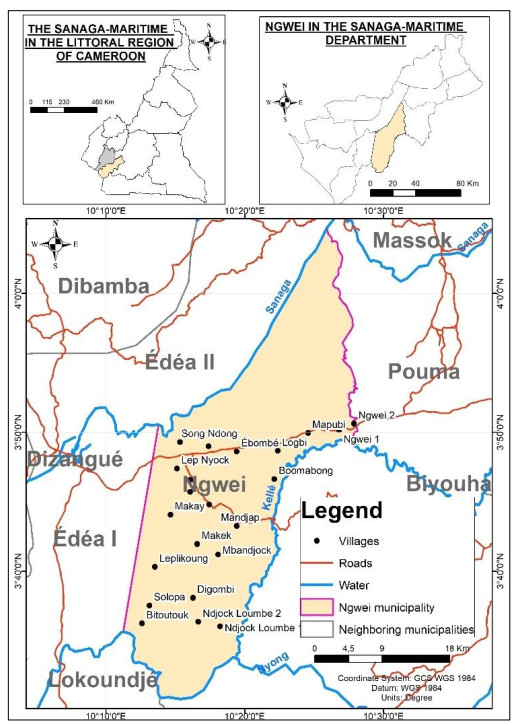
Location of the study area: the Municipality of Ngwéi
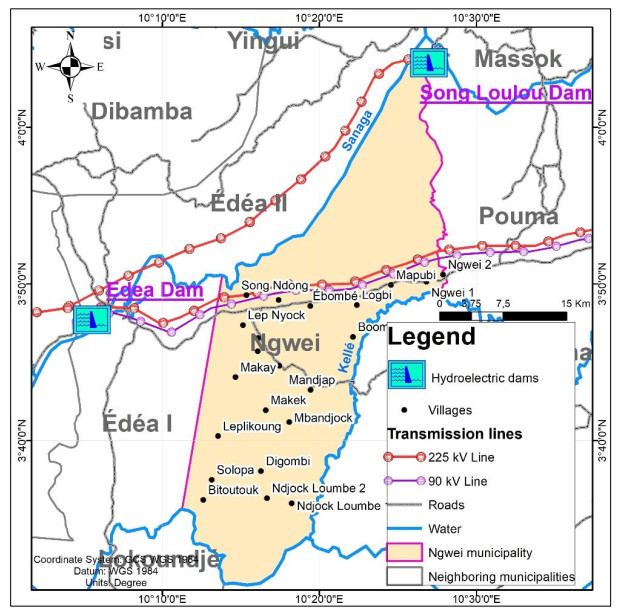
Ngwéi, a municipality at the crossroads of two hydroelectric developments
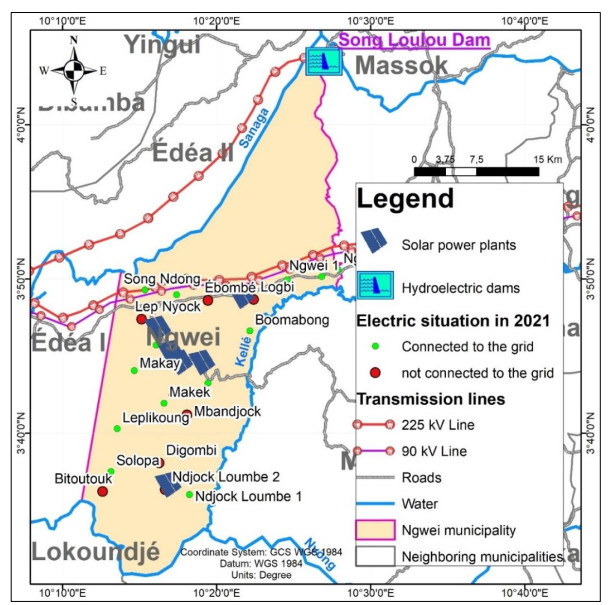
The electricity situation in the localities of Ngwei
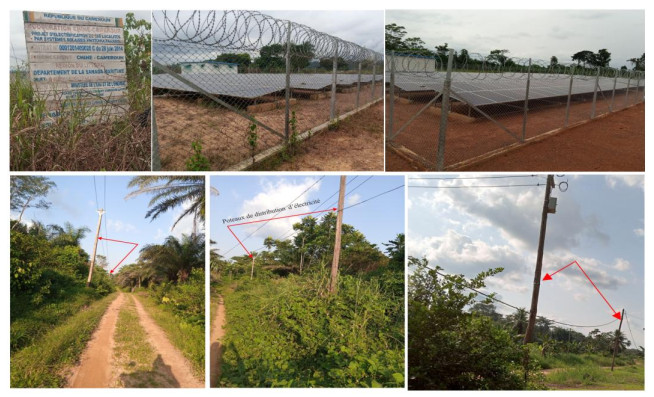
Overview of solar installations and electricity distribution network in the Municipality of Ngwéi. Photo credit, December 2019. The first three images (above) illustrate some solar installation sites in Ndjock-Loumbe and Logbii Ngwéi. Below, a view of the electricity distribution system using wooden supports
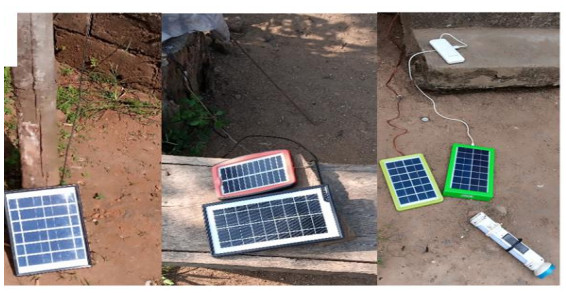
A view of some household solar kits in the Municipality of Ngwéi. Photo credit, March. 2021. The board shows some types of solar panels for household use found in the Municipality
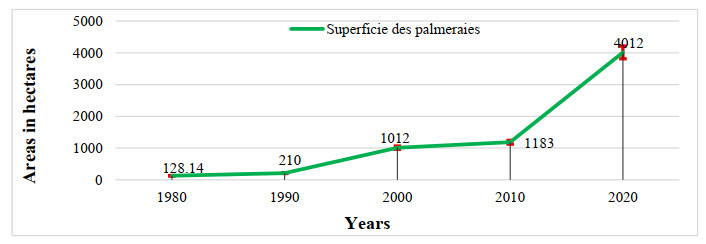
Evolution of palm grove areas in the Municipality of Ngwéi
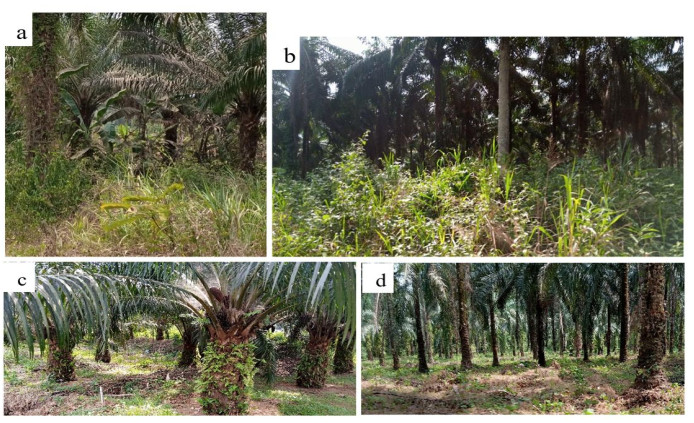
Characteristic features of peasant palm groves (a and b) and those of investors (c and d) in the Municipality of Ngwéi. Photo credit: March, 2021
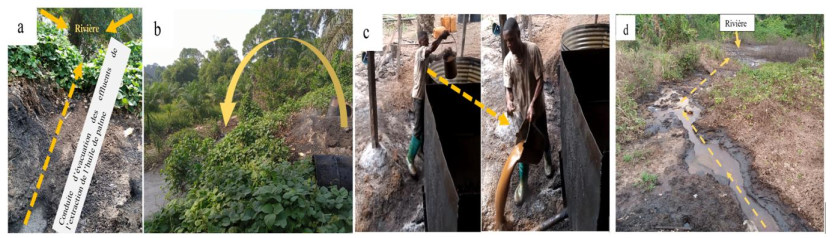
Illegal disposal of sludge and effluents from oil mills into rivers in Ngwéi. Photo credit, December 2019 and March 2021. From left to right, these images illustrate the dumping of palm oil extraction waste into rivers in the villages of Etouha, Dingombi, and Logbii. All the extraction sites pictured are located near water sources. In photo (c), the process of emptying the palm nut cooking vats into ditches that lead directly to the river, which is shown in photo (d) in the village of Ndjock-Loumbe




 DownLoad: