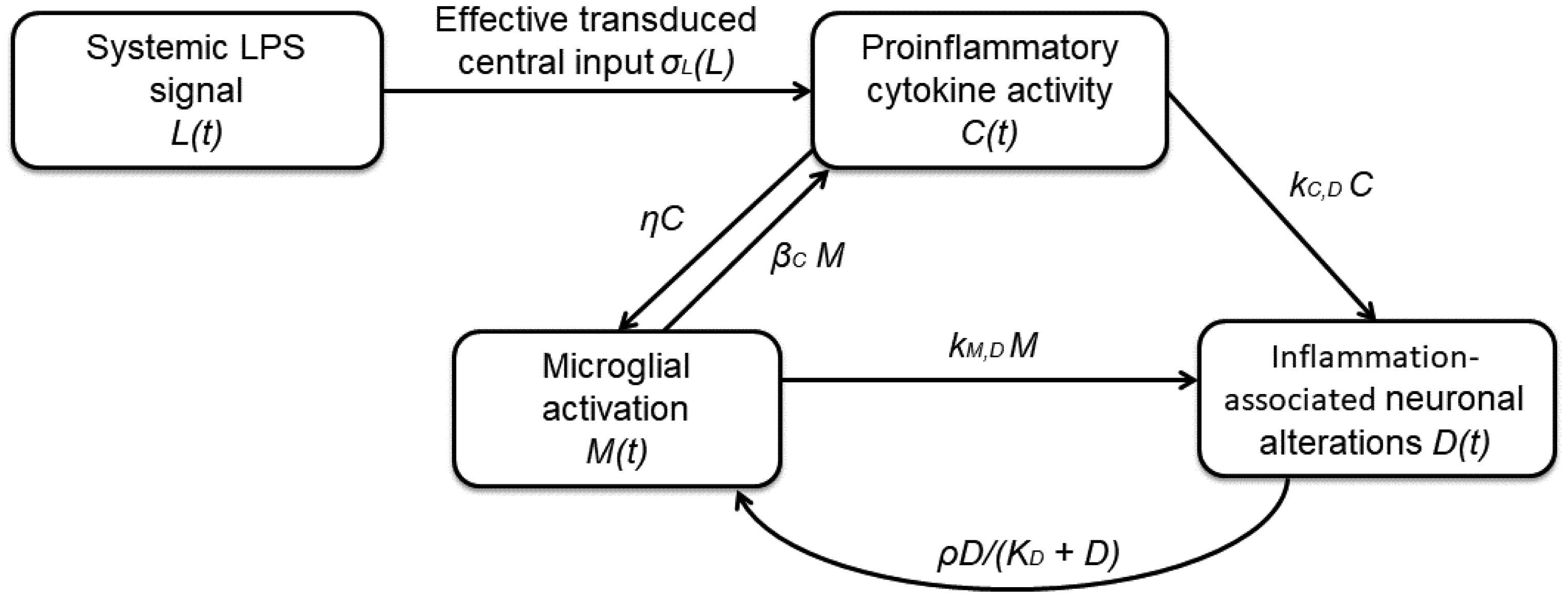
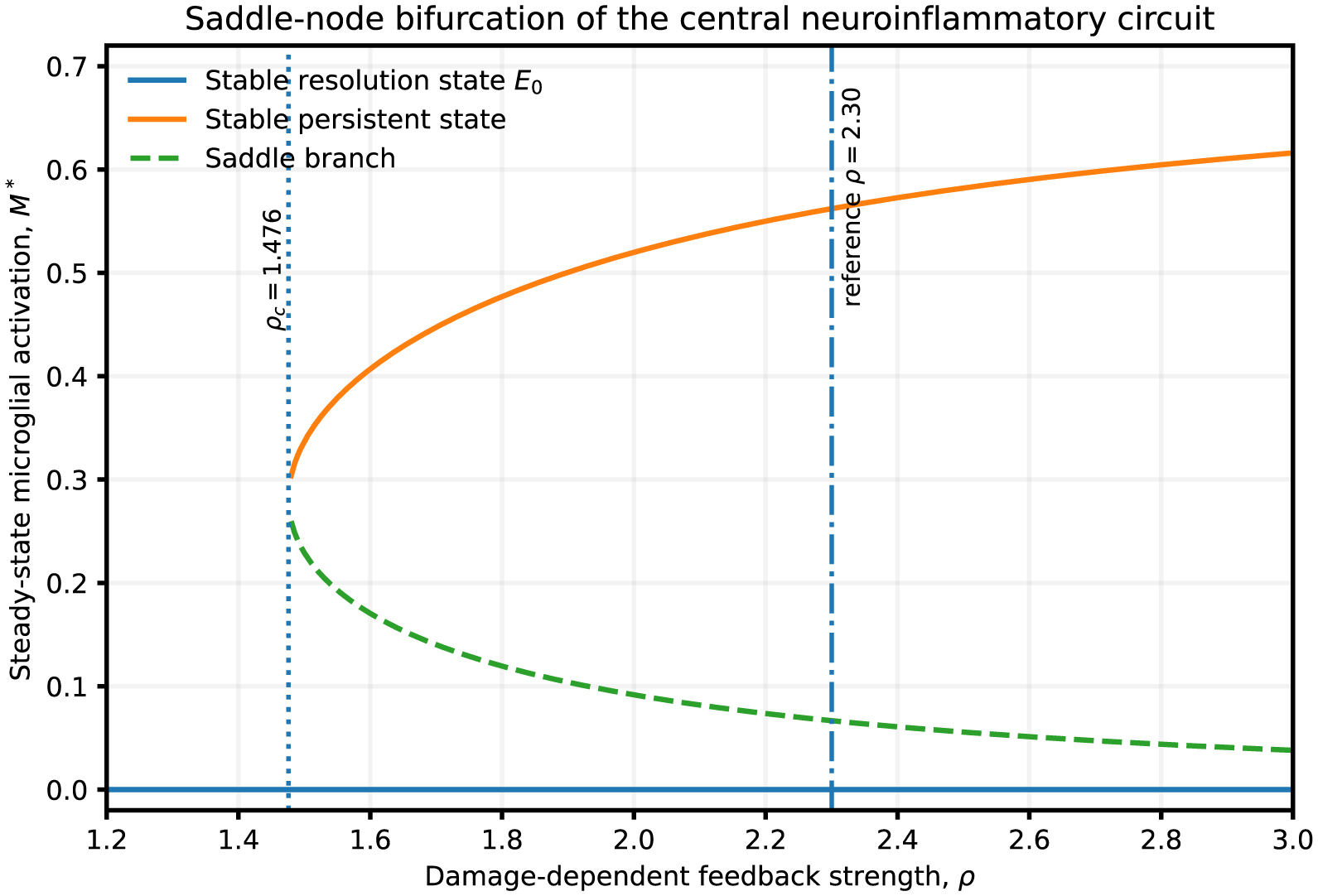
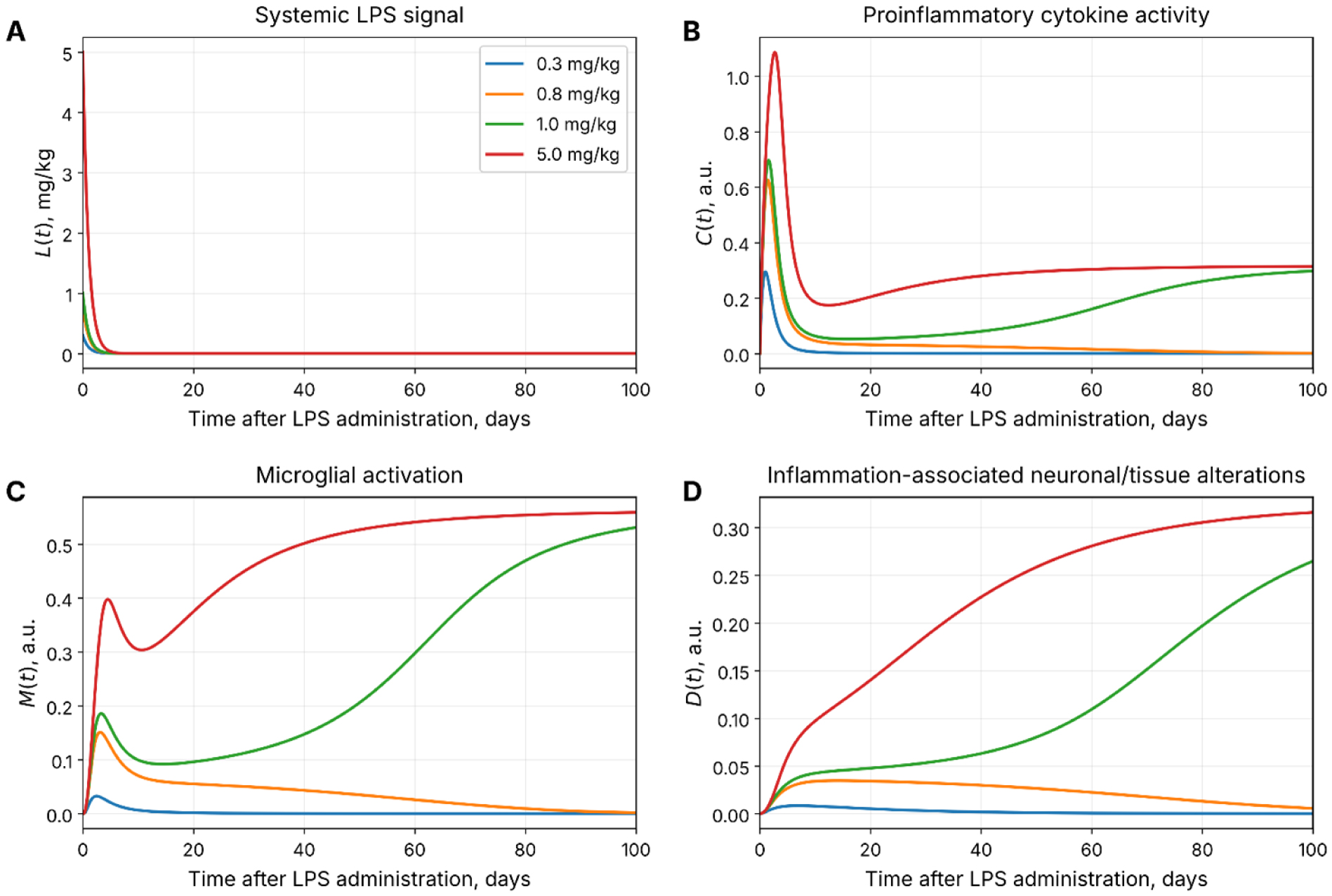
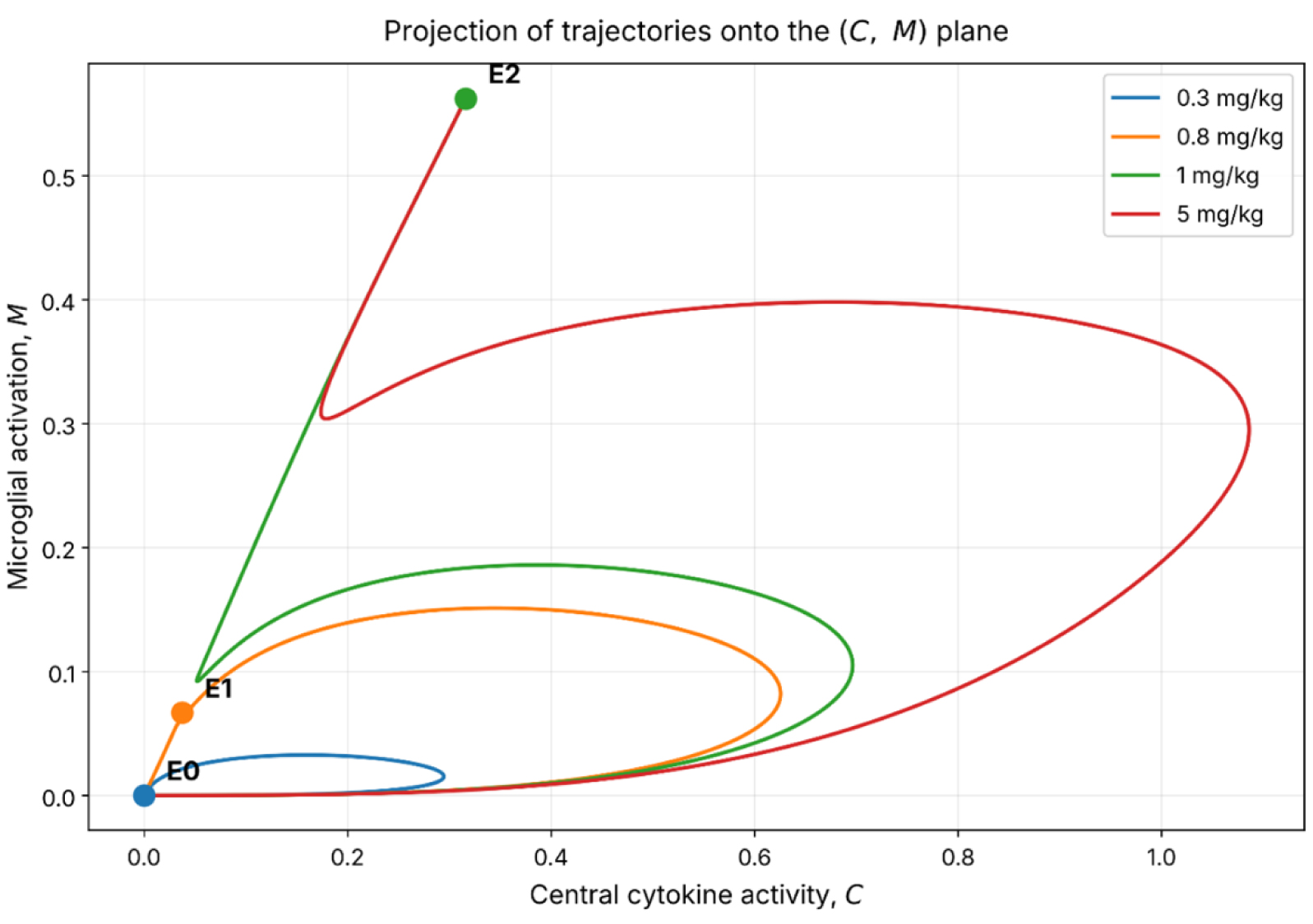
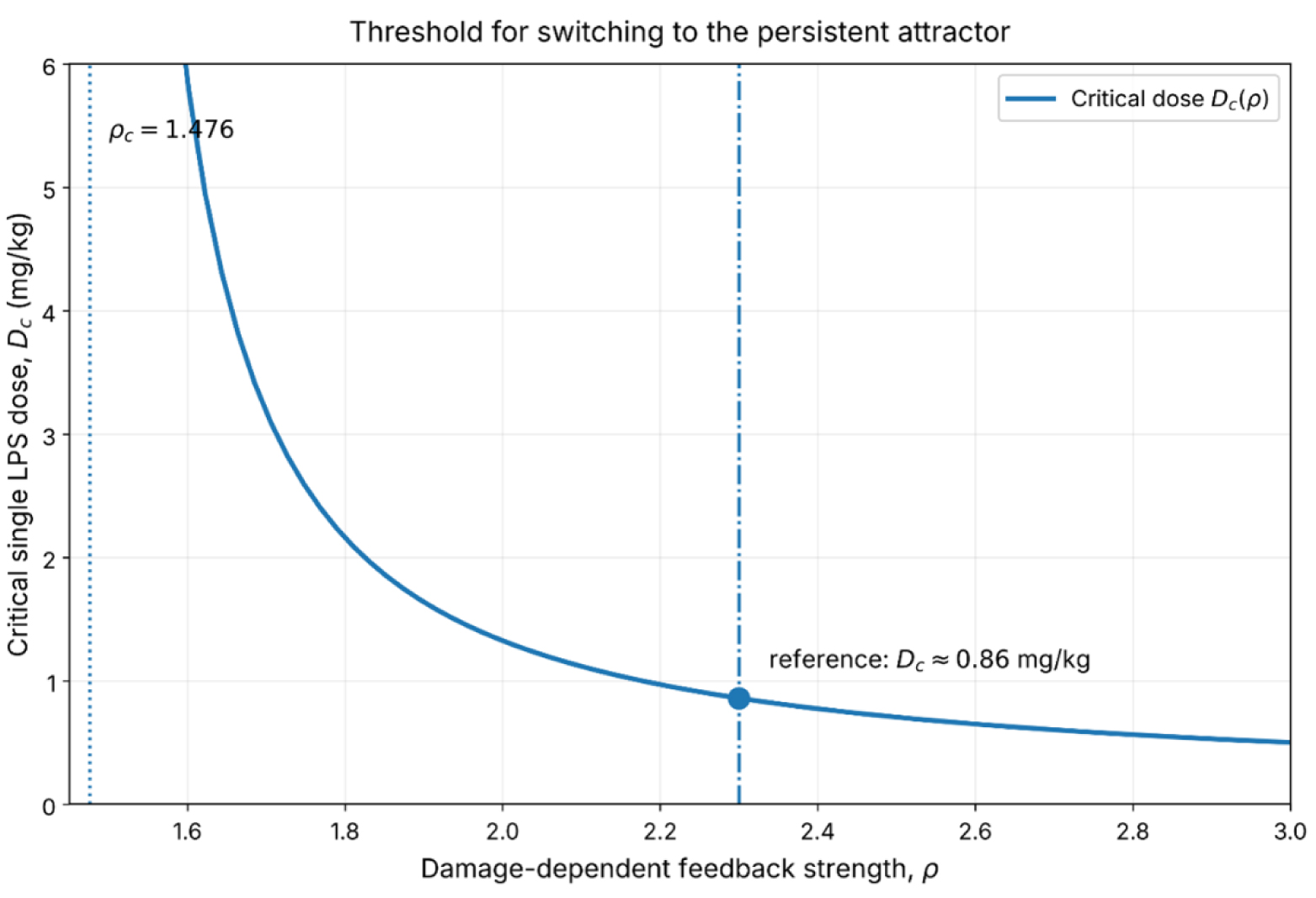
Systemic administration of lipopolysaccharide (LPS) is widely used to model neuroinflammation, yet it remains unclear how a transient systemic inflammatory challenge can lead either to resolution or to sustained central inflammatory activity. We developed a phenomenological ordinary differential equation (ODE) model of LPS-induced neuroinflammation in rodents comprising four dynamic variables: the systemic LPS signal, central proinflammatory cytokine activity, microglial activation, and the severity of inflammation-associated neuronal and tissue alterations. Peripheral cytokine signaling and blood–brain barrier-mediated communication were not represented as separate state variables; instead, their combined initiating effect was coarse-grained into a transient LPS-dependent input to the central cytokine response. Importantly, all model parameters were fixed, and the LPS dose entered the model solely through the initial condition. Analysis of equilibria, local stability, bifurcations, and basins of attraction showed that with sufficiently strong damage-dependent feedback, the system exhibits bistability between a stable resolution state and a stable persistent neuroinflammatory state, with an intermediate saddle equilibrium coexisting with them. For the reference parameter set, two positive equilibria (i.e., a saddle and a stable persistent state) emerged through a saddle-node bifurcation at the critical damage-dependent feedback coefficient ρc = 1.476. The switching threshold between resolving and persistent outcomes was Dc ≈ 0.86 mg/kg LPS. Near this threshold, trajectories exhibited markedly prolonged transients before resolution, whereas suprathreshold doses converged to the persistent attractor. Under global parameter variation, bistability was preserved in 94.9% of the parameter sets examined, and a separate analysis of the Hill coefficient showed that bistability persisted over n = 1.6–2.4, although the numerical dose threshold shifted substantially. Thus, dose-dependent outcomes arise from the intrinsic nonlinear dynamics of a fixed-parameter ODE system. The model provides a dynamical-systems framework for interpreting resolution, prolonged near-threshold responses, and persistent neuroinflammatory states following a transient systemic LPS challenge.
Citation: Ekaterina Kukushkina, Elena Lebedeva, Dmitry Traktirov, Marina Karpenko. An ODE model of LPS-induced neuroinflammation with bistability and dose-dependent switching[J]. AIMS Biophysics, 2026, 13(4): 482-500. doi: 10.3934/biophy.2026024
Systemic administration of lipopolysaccharide (LPS) is widely used to model neuroinflammation, yet it remains unclear how a transient systemic inflammatory challenge can lead either to resolution or to sustained central inflammatory activity. We developed a phenomenological ordinary differential equation (ODE) model of LPS-induced neuroinflammation in rodents comprising four dynamic variables: the systemic LPS signal, central proinflammatory cytokine activity, microglial activation, and the severity of inflammation-associated neuronal and tissue alterations. Peripheral cytokine signaling and blood–brain barrier-mediated communication were not represented as separate state variables; instead, their combined initiating effect was coarse-grained into a transient LPS-dependent input to the central cytokine response. Importantly, all model parameters were fixed, and the LPS dose entered the model solely through the initial condition. Analysis of equilibria, local stability, bifurcations, and basins of attraction showed that with sufficiently strong damage-dependent feedback, the system exhibits bistability between a stable resolution state and a stable persistent neuroinflammatory state, with an intermediate saddle equilibrium coexisting with them. For the reference parameter set, two positive equilibria (i.e., a saddle and a stable persistent state) emerged through a saddle-node bifurcation at the critical damage-dependent feedback coefficient ρc = 1.476. The switching threshold between resolving and persistent outcomes was Dc ≈ 0.86 mg/kg LPS. Near this threshold, trajectories exhibited markedly prolonged transients before resolution, whereas suprathreshold doses converged to the persistent attractor. Under global parameter variation, bistability was preserved in 94.9% of the parameter sets examined, and a separate analysis of the Hill coefficient showed that bistability persisted over n = 1.6–2.4, although the numerical dose threshold shifted substantially. Thus, dose-dependent outcomes arise from the intrinsic nonlinear dynamics of a fixed-parameter ODE system. The model provides a dynamical-systems framework for interpreting resolution, prolonged near-threshold responses, and persistent neuroinflammatory states following a transient systemic LPS challenge.
lipopolysaccharide
ordinary differential equation
central nervous system
blood-brain barrier
tumor necrosis factor α
interleukin
nuclear factor κB

The authors declare no conflicts of interest.
The study concept and design were jointly developed by all authors. EK and DT performed the study and analyses. EK and EL prepared the original draft of the manuscript. MK supervised the project and contributed to manuscript review and editing. All authors reviewed and approved the final version.
The numerical results presented in this study were generated using Python 3.12, SciPy 1.16, and Matplotlib 3.10. The source code required to reproduce the model equations, equilibria, bifurcation point, critical-dose analysis, and sensitivity analyses is available from the corresponding author upon reasonable request.
| [1] |
Skelly DT, Hennessy E, Dansereau MA, et al. (2013) A systematic analysis of the peripheral and CNS effects of systemic LPS, IL-1β, TNF-α and IL-6 challenges in C57BL/6 mice. Plos One 8: e69123. https://doi.org/10.1371/journal.pone.0069123 
|
| [2] |
Qin L, Wu X, Block ML, et al. (2007) Systemic LPS causes chronic neuroinflammation and progressive neurodegeneration. Glia 55: 453-462. https://doi.org/10.1002/glia.20467
|
| [3] |
Reynolds A, Rubin J, Clermont G, et al. (2006) A reduced mathematical model of the acute inflammatory response: I. Derivation of model and analysis of anti-inflammation. J Theor Biol 242: 220-236. https://doi.org/10.1016/j.jtbi.2006.02.016
|
| [4] |
Vaughan LE, Ranganathan PR, Kumar RG, et al. (2018) A mathematical model of neuroinflammation in severe clinical traumatic brain injury. J Neuroinflamm 15: 345. https://doi.org/10.1186/s12974-018-1384-1
|
| [5] |
Colonna M, Butovsky O (2017) Microglia function in the central nervous system during health and neurodegeneration. Annu Rev Immunol 35: 441-468. https://doi.org/10.1146/annurev-immunol-051116-052358
|
| [6] |
Ransohoff RM, Perry VH (2009) Microglial physiology: unique stimuli, specialized responses. Annu Rev Immunol 27: 119-145. https://doi.org/10.1146/annurev.immunol.021908.132528
|
| [7] |
Hoogland IC, Houbolt C, van Westerloo DJ, et al. (2015) Systemic inflammation and microglial activation: systematic review of animal experiments. J Neuroinflamm 12: 114. https://doi.org/10.1186/s12974-015-0332-6
|
| [8] |
Sun Y, Koyama Y, Shimada S (2022) Inflammation from peripheral organs to the brain: how does systemic inflammation cause neuroinflammation?. Front Aging Neurosci 14: 903455. https://doi.org/10.3389/fnagi.2022.903455
|
| [9] |
Peng X, Luo Z, He S, et al. (2021) Blood-brain barrier disruption by lipopolysaccharide and sepsis-associated encephalopathy. Front Cell Infect Microbiol 11: 768108. https://doi.org/10.3389/fcimb.2021.768108
|
| [10] |
Zhao J, Bi W, Xiao S, et al. (2019) Neuroinflammation induced by lipopolysaccharide causes cognitive impairment in mice. Sci Rep 9: 5790. https://doi.org/10.1038/s41598-019-42286-8
|
| [11] |
Kim HJ, Kim H, Lee JH, et al. (2023) Toll-like receptor 4 (TLR4): new insight immune and aging. Immun Ageing 20: 67. https://doi.org/10.1186/s12979-023-00383-3
|
| [12] |
Nürnberger F, Ott D, Claßen R, et al. (2022) Systemic lipopolysaccharide challenge induces inflammatory changes in rat dorsal root ganglia: an ex vivo study. Int J Mol Sci 23: 13124. https://doi.org/10.3390/ijms232113124
|
| [13] |
Gao HM, Zhou H, Zhang F, et al. (2011) HMGB1 acts on microglia Mac1 to mediate chronic neuroinflammation that drives progressive neurodegeneration. J Neurosci 31: 1081-1092. https://doi.org/10.1523/JNEUROSCI.3732-10.2011
|
| [14] |
Zhou R, Chen SH, Zhao Z, et al. (2023) Complement C3 enhances LPS-elicited neuroinflammation and neurodegeneration via the Mac1/NOX2 pathway. Mol Neurobiol 60: 5167-5183. https://doi.org/10.1007/s12035-023-03393-w
|
| [15] | Suleiman Khoury Z, Sohail F, Wang J, et al. (2024) Neuroinflammation: a critical factor in neurodegenerative disorders. Cureus 16: e62310. https://doi.org/10.7759/cureus.62310 |
| [16] |
Jang J, Hong A, Chung Y, et al. (2022) Interleukin-4 aggravates LPS-induced striatal neurodegeneration in vivo via oxidative stress and polarization of microglia/macrophages. Int J Mol Sci 23: 571. https://doi.org/10.3390/ijms23010571
|
| [17] |
Jung H, Lee D, You H, et al. (2023) LPS induces microglial activation and GABAergic synaptic deficits in the hippocampus accompanied by prolonged cognitive impairment. Sci Rep 13: 6547. https://doi.org/10.1038/s41598-023-32798-9
|
| [18] |
Batulin D, Lagzi F, Vezzani A, et al. (2022) A mathematical model of neuroimmune interactions in epileptogenesis for discovering treatment strategies. iScience 25: 104343. https://doi.org/10.1016/j.isci.2022.104343
|
| [19] |
da Silva AAF, Fiadeiro MB, Bernardino LI, et al. (2024) Lipopolysaccharide-induced animal models for neuroinflammation: an overview. J Neuroimmunol 387: 578273. https://doi.org/10.1016/j.jneuroim.2023.578273
|
| [20] |
Maystrenko V, Ivleva I, Krytskaya D, et al. (2021) Changes in activity of µ- and m-calpains and signs of neuroinflammation in the hippocampus and striatum of rats after single intraperitoneal injection of subseptic dose of endotoxin. Metab Brain Dis 36: 1917-1928. https://doi.org/10.1007/s11011-021-00755-y
|
| [21] |
Quan N, Stern EL, Whiteside MB, et al. (1999) Induction of pro-inflammatory cytokine mRNAs in the brain after peripheral injection of subseptic doses of lipopolysaccharide in the rat. J Neuroimmunol 93: 72-80. https://doi.org/10.1016/S0165-5728(98)00193-3
|
| [22] |
Brandi E, Torres-Garcia L, Svanbergsson A, et al. (2022) Brain region-specific microglial and astrocytic activation in response to systemic lipopolysaccharides exposure. Front Aging Neurosci 14: 910988. https://doi.org/10.3389/fnagi.2022.910988
|
| [23] |
Lima M N, Barbosa-Silva M C, Maron-Gutierrez T (2022) Microglial priming in infections and its risk to neurodegenerative diseases. Front Cell Neurosci 16: 878987. https://doi.org/10.3389/fncel.2022.878987
|
| [24] |
Pamplona F A, Vitória G, Sudo F K, et al. (2022) Age-linked suppression of lipoxin A4 associates with cognitive deficits in mice and humans. Transl Psychiatry 12: 439. https://doi.org/10.1038/s41398-022-02208-1
|
| [25] |
Furube E, Kawai S, Inagaki H, et al. (2018) Brain region-dependent heterogeneity and dose-dependent difference in transient microglia population increase during lipopolysaccharide-induced inflammation. Sci Rep 8: 2203. https://doi.org/10.1038/s41598-018-20643-3
|
| [26] |
Bossù P, Cutuli D, Palladino I, et al. (2012) A single intraperitoneal injection of endotoxin in rats induces long-lasting modifications in behavior and brain protein levels of TNF-α and IL-18. J Neuroinflamm 9: 101. https://doi.org/10.1186/1742-2094-9-101
|
| [27] |
Rezaei S, Banasr M, Prevot TD, et al. (2025) Brain-derived neurotrophic factor prevents LPS-induced dysregulation of GABAergic interneuron markers in mouse hippocampus. Front Cell Neurosci 19: 1675003. https://doi.org/10.3389/fncel.2025.1675003
|
| [28] |
He Q, Qi Q, Ibeanu GC, et al. (2024) B355252 suppresses LPS-induced neuroinflammation in the mouse brain. Brain Sci 14: 467. https://doi.org/10.3390/brainsci14050467
|
 biophy-13-04-024-s001.pdf |
 |
Figures(5) / Tables(3)

Ekaterina Kukushkina, Elena Lebedeva, Dmitry Traktirov, Marina Karpenko. An ODE model of LPS-induced neuroinflammation with bistability and dose-dependent switching[J]. AIMS Biophysics, 2026, 13(4): 482-500. doi: 10.3934/biophy.2026024




 DownLoad: