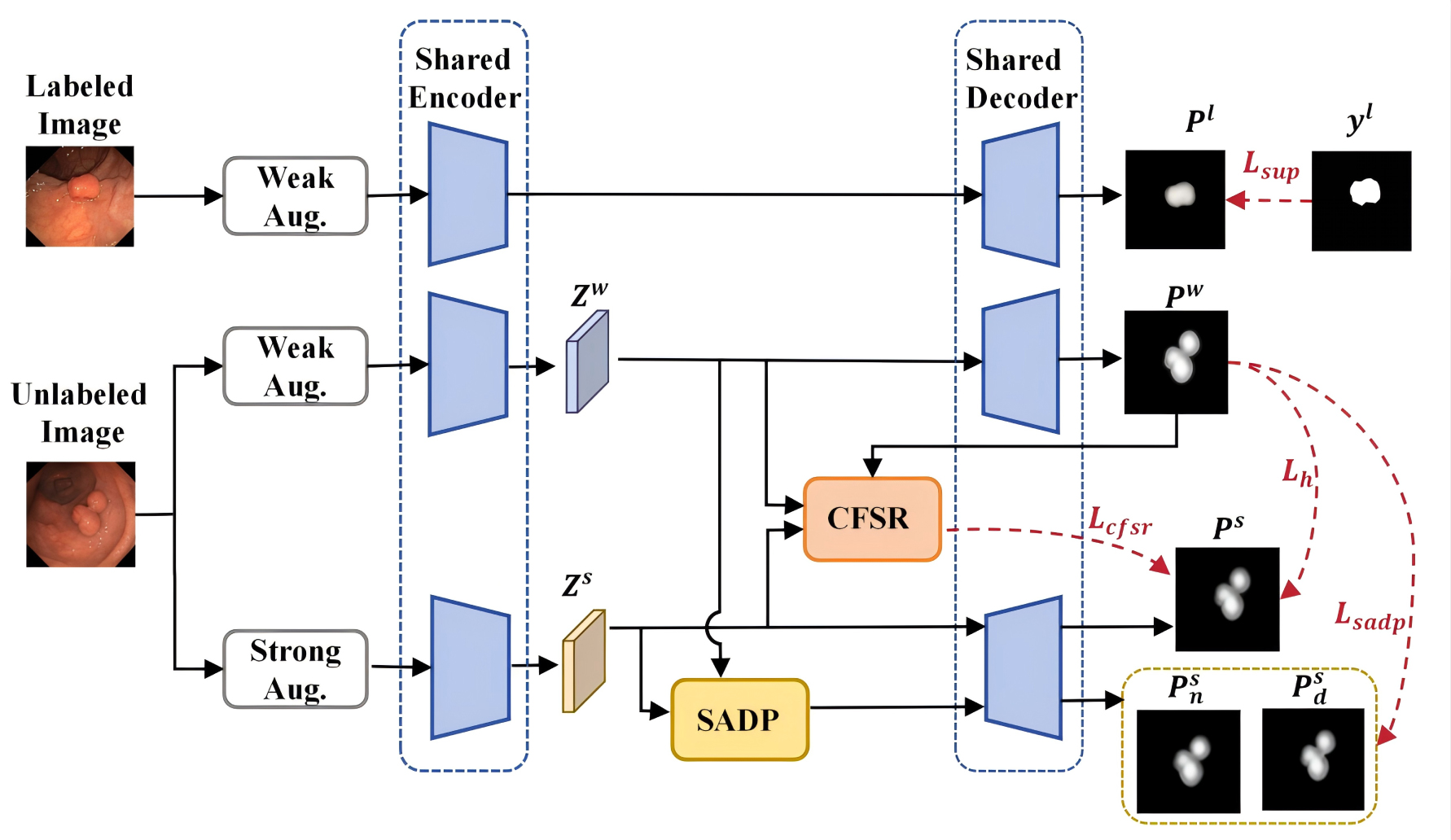
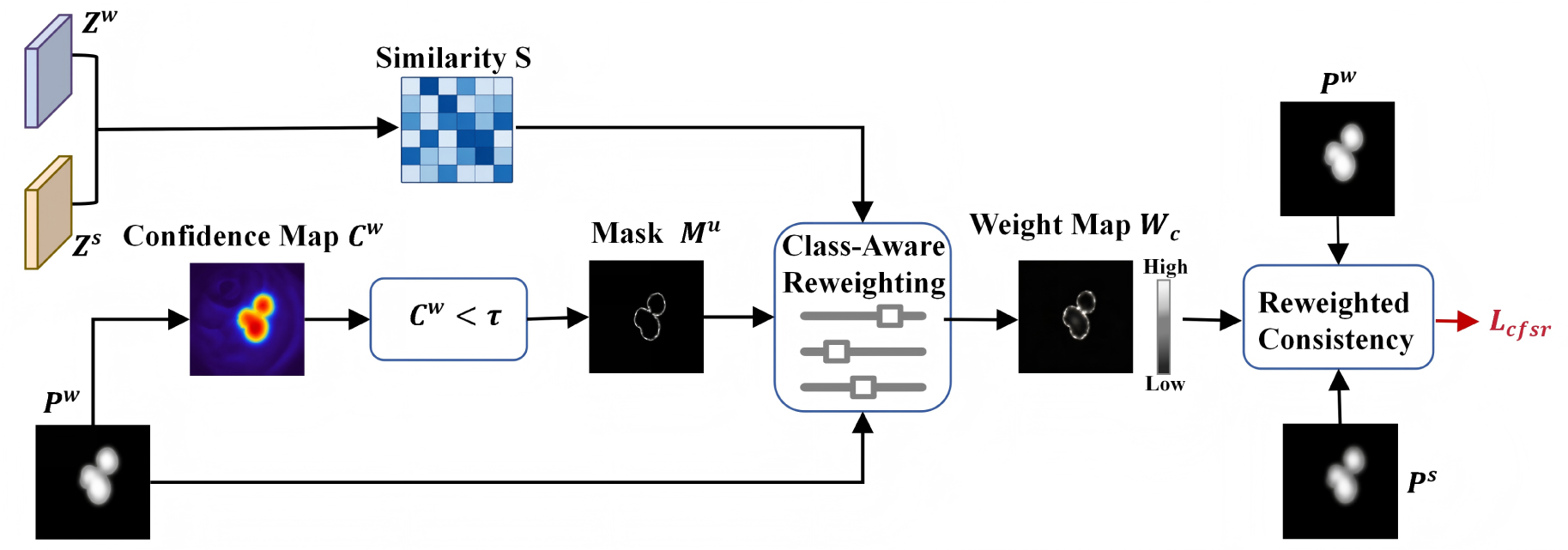
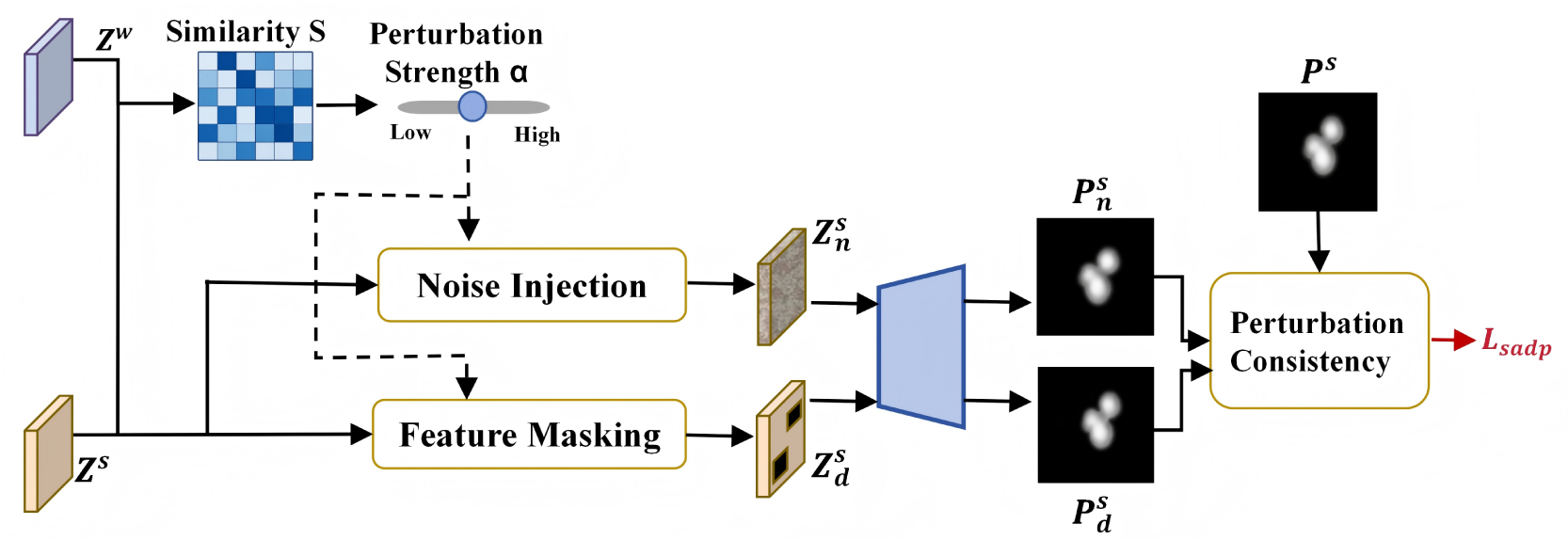
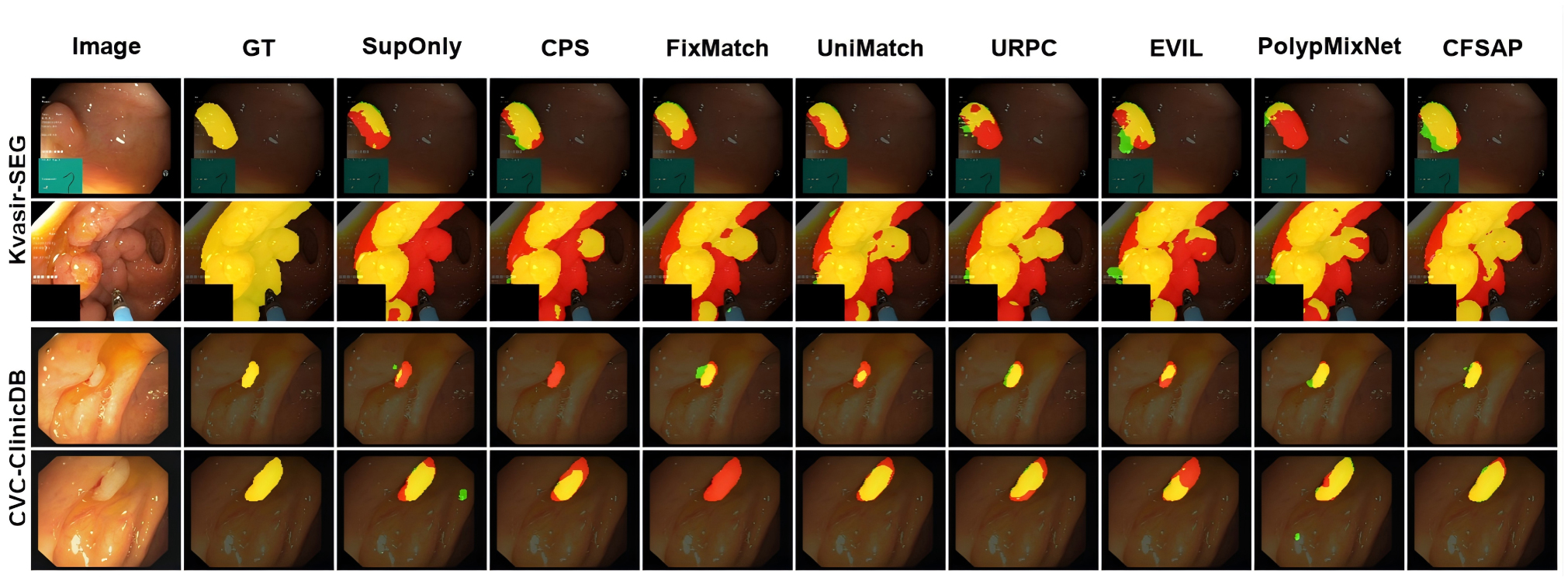
Pixel-level annotation of colonoscopy images is costly and requires substantial expert effort, motivating the development of semi-supervised methods for polyp segmentation. A common weak-to-strong consistency strategy restricts supervision to high-confidence predictions, which can leave useful information in uncertain regions insufficiently exploited. Moreover, feature perturbations are often applied with a uniform strength across samples, without explicitly accounting for differences in representation stability. We have presented CFSAP, a semi-supervised polyp segmentation framework that addresses these limitations through cross-view similarity-guided reweighting and stability-aware feature perturbation. The proposed cross-view feature similarity reweighting (CFSR) strategy measures spatial feature similarity between weakly and strongly augmented views and constructs class-conditional weights for consistency learning in low-confidence regions. The stability-aware dynamic perturbation (SADP) strategy estimates sample-level representation stability from cross-view similarity and accordingly adjusts the magnitudes of feature noise injection and spatial masking. CFSAP was evaluated on the Kvasir-SEG and CVC-ClinicDB datasets under labeled-data ratios of 1/4, 1/8, and 1/16. It achieved the highest Dice and intersection over union (IoU) scores among all compared methods across the six experimental settings. Compared with the strongest competing method in each setting, CFSAP improved Dice by 0.30–1.38 percentage points on Kvasir-SEG and by 0.47–1.29 percentage points on CVC-ClinicDB. Ablation results further confirmed the complementary contributions of the two components and showed that stability-aware perturbation assignment consistently outperformed fixed and randomly assigned perturbation strengths.
Citation: Yujun Niu, Yunqing Cong, Yalei Yin, Wanshu Fan. Cross-view feature similarity reweighting and stability-aware dynamic perturbation for semi-supervised polyp segmentation[J]. AIMS Bioengineering, 2026, 13(4): 453-482. doi: 10.3934/bioeng.2026022
Pixel-level annotation of colonoscopy images is costly and requires substantial expert effort, motivating the development of semi-supervised methods for polyp segmentation. A common weak-to-strong consistency strategy restricts supervision to high-confidence predictions, which can leave useful information in uncertain regions insufficiently exploited. Moreover, feature perturbations are often applied with a uniform strength across samples, without explicitly accounting for differences in representation stability. We have presented CFSAP, a semi-supervised polyp segmentation framework that addresses these limitations through cross-view similarity-guided reweighting and stability-aware feature perturbation. The proposed cross-view feature similarity reweighting (CFSR) strategy measures spatial feature similarity between weakly and strongly augmented views and constructs class-conditional weights for consistency learning in low-confidence regions. The stability-aware dynamic perturbation (SADP) strategy estimates sample-level representation stability from cross-view similarity and accordingly adjusts the magnitudes of feature noise injection and spatial masking. CFSAP was evaluated on the Kvasir-SEG and CVC-ClinicDB datasets under labeled-data ratios of 1/4, 1/8, and 1/16. It achieved the highest Dice and intersection over union (IoU) scores among all compared methods across the six experimental settings. Compared with the strongest competing method in each setting, CFSAP improved Dice by 0.30–1.38 percentage points on Kvasir-SEG and by 0.47–1.29 percentage points on CVC-ClinicDB. Ablation results further confirmed the complementary contributions of the two components and showed that stability-aware perturbation assignment consistently outperformed fixed and randomly assigned perturbation strengths.

| [1] | Bray F, Laversanne M, Sung H, et al. (2024) Global cancer statistics 2022: GLOBOCAN estimates of incidence and mortality worldwide for 36 cancers in 185 countries. CA Cancer J Clin 74: 229-263. https://doi.org/10.3322/caac.21834 |
| [2] |
Corley DA, Jensen CD, Marks AR, et al. (2014) Adenoma detection rate and risk of colorectal cancer and death. N Engl J Med 370: 1298-1306. https://doi.org/10.1056/NEJMoa1309086 
|
| [3] |
Qayoom A, Xie J, Ali H (2025) Polyp segmentation in medical imaging: challenges, approaches and future directions. Artif Intell Rev 58: 169. https://doi.org/10.1007/s10462-025-11173-2
|
| [4] |
Long J, Shelhamer E, Darrell T (2015) Fully convolutional networks for semantic segmentation. 2015 IEEE Conference on Computer Vision and Pattern Recognition (CVPR) . IEEE 3431-3440. https://doi.org/10.1109/CVPR.2015.7298965
|
| [5] | Ronneberger O, Fischer P, Brox T (2015) U-Net: convolutional networks for biomedical image segmentation. Medical Image Computing and Computer-Assisted Intervention – MICCAI 2015 . Springer 234-241. https://doi.org/10.1007/978-3-319-24574-4_28 |
| [6] |
Chen LC, Zhu Y, Papandreou G, et al. (2018) Encoder-decoder with atrous separable convolution for semantic image segmentation. Computer Vision – ECCV 2018 . Springer 833-851. https://doi.org/10.1007/978-3-030-01234-2_49
|
| [7] |
Huang Z, Xie F, Qing W, et al. (2024) MGF-net: multi-channel group fusion enhancing boundary attention for polyp segmentation. Med Phys 51: 407-418. https://doi.org/10.1002/mp.16584
|
| [8] |
Liu Y, Shen X, Lyu Y (2024) MCA-Net: multi-cascade attention network for polyp segmentation. Multimed Tools Appl 83: 33713-33730. https://doi.org/10.1007/s11042-023-16805-9
|
| [9] |
Jiang L, Hui Y, Fei Y, et al. (2024) Improving polyp segmentation with boundary-assisted guidance and cross-scale interaction fusion transformer network. Processes 12: 1030. https://doi.org/10.3390/pr12051030
|
| [10] |
Yue G, Li Y, Jiang W, et al. (2024) Boundary refinement network for colorectal polyp segmentation in colonoscopy images. IEEE Signal Process Lett 31: 954-958. https://doi.org/10.1109/LSP.2024.3378106
|
| [11] |
Huang X, Wang L, Jiang S, et al. (2024) DHAFormer: dual-channel hybrid attention network with transformer for polyp segmentation. PLoS One 19: e0306596. https://doi.org/10.1371/journal.pone.0306596
|
| [12] |
Wang Z, Liu Z, Yu J, et al. (2024) Multi-scale nested UNet with transformer for colorectal polyp segmentation. J Appl Clin Med Phys 25: e14351. https://doi.org/10.1002/acm2.14351
|
| [13] |
Ran L, Li Y, Liang G, et al. (2025) Pseudo labeling methods for semi-supervised semantic segmentation: a review and future perspectives. IEEE Trans Circuits Syst Video Technol 35: 3054-3080. https://doi.org/10.1109/TCSVT.2024.3508768
|
| [14] |
Souly N, Spampinato C, Shah M (2017) Semi supervised semantic segmentation using generative adversarial network. 2017 IEEE International Conference on Computer Vision (ICCV) . IEEE 5689-5697. https://doi.org/10.1109/ICCV.2017.606
|
| [15] | Hung WC, Tsai YH, Liou YT, et al. (2018) Adversarial learning for semi-supervised semantic segmentation. Proceedings of the British Machine Vision Conference . MVA Press 65. |
| [16] | Sohn K, Berthelot D, Carlini N, et al. (2020) FixMatch: simplifying semi-supervised learning with consistency and confidence. Adv Neural Inf Process Syst 33: 596-608. |
| [17] |
Yang L, Qi L, Feng L, et al. (2023) Revisiting weak-to-strong consistency in semi-supervised semantic segmentation. 2023 IEEE/CVF Conference on Computer Vision and Pattern Recognition (CVPR) . IEEE 7236-7246. https://doi.org/10.1109/CVPR52729.2023.00699
|
| [18] |
Yuan J, Liu Y, Shen C, et al. (2021) A simple baseline for semi-supervised semantic segmentation with strong data augmentation. 2021 IEEE/CVF International Conference on Computer Vision (ICCV) . IEEE 8209-8218. https://doi.org/10.1109/ICCV48922.2021.00812
|
| [19] |
Xie S, Wang H, Niu Z, et al. (2026) S2Match: revisiting weak-to-strong consistency from a semantic similarity perspective for semi-supervised medical image segmentation. IEEE J Biomed Health Inform 30: 5325-5338. https://doi.org/10.1109/JBHI.2025.3639673
|
| [20] | Yin J, Chen Y, Zheng Z, et al. (2025) Uncertainty-participation context consistency learning for semi-supervised semantic segmentation. ICASSP 2025 – 2025 IEEE International Conference on Acoustics, Speech and Signal Processing (ICASSP) . IEEE 1-5. https://doi.org/10.1109/ICASSP49660.2025.10889133 |
| [21] |
Li S, He Y, Zhang W, et al. (2023) CFCG: semi-supervised semantic segmentation via cross-fusion and contour guidance supervision. 2023 IEEE/CVF International Conference on Computer Vision (ICCV) . IEEE 16302-16312. https://doi.org/10.1109/ICCV51070.2023.01498
|
| [22] | Wu Z, Cui J (2024) Image-feature weak-to-strong consistency: an enhanced paradigm for semi-supervised learning. Computer Vision – ECCV 2024 . Springer 372-388. https://doi.org/10.1007/978-3-031-72633-0_21 |
| [23] |
Jia X, Shen Y, Yang J, et al. (2024) PolypMixNet: enhancing semi-supervised polyp segmentation with polyp-aware augmentation. Comput Biol Med 170: 108006. https://doi.org/10.1016/j.compbiomed.2024.108006
|
| [24] |
Guo P, Liu G, Liu H (2024) SemiPolypSeg: leveraging cross-pseudo supervision and contrastive learning for semi-supervised polyp segmentation. Appl Sci 14: 7852. https://doi.org/10.3390/app14177852
|
| [25] |
Wang A, Ma H, Bai L, et al. (2025) PedSemiSeg: pedagogy-inspired semi-supervised polyp segmentation. Comput Med Imaging Graph 124: 102591. https://doi.org/10.1016/j.compmedimag.2025.102591
|
| [26] |
Li Y, Zhu Z, Zhang Y, et al. (2025) Boost the inference with co-training: a depth-guided mutual learning framework for semi-supervised medical polyp segmentation. 2025 IEEE/CVF Conference on Computer Vision and Pattern Recognition (CVPR) . IEEE 10394-10403. https://doi.org/10.1109/CVPR52734.2025.00972
|
| [27] |
Chen J, Zhang H, Gong M, et al. (2024) Collaborative compensative transformer network for salient object detection. Pattern Recognit 154: 110600. https://doi.org/10.1016/j.patcog.2024.110600
|
| [28] |
Xu T, Jiang J, Cai L, et al. (2025) Salient object detection with non-local feature enhancement and edge reconstruction. Sci Rep 15: 397. https://doi.org/10.1038/s41598-024-84680-x
|
| [29] | Lee DH (2013) Pseudo-label: the simple and efficient semi-supervised learning method for deep neural networks. ICML 2013 Workshop on Challenges in Representation Learning . ICML 1-6. |
| [30] |
Chen X, Yuan Y, Zeng G, et al. (2021) Semi-supervised semantic segmentation with cross pseudo supervision. 2021 IEEE/CVF Conference on Computer Vision and Pattern Recognition (CVPR) . IEEE 2613-2622. https://doi.org/10.1109/CVPR46437.2021.00264
|
| [31] | Tarvainen A, Valpola H (2017) Mean teachers are better role models: Weight-averaged consistency targets improve semi-supervised deep learning results. Adv Neural Inf Process Syst 30: 1195-1204. |
| [32] |
Ouali Y, Hudelot C, Tami M (2020) Semi-supervised semantic segmentation with cross-consistency training. 2020 IEEE/CVF Conference on Computer Vision and Pattern Recognition (CVPR) . IEEE 12671-12681. https://doi.org/10.1109/CVPR42600.2020.01269
|
| [33] |
Luo X, Wang G, Liao W, et al. (2022) Semi-supervised medical image segmentation via uncertainty rectified pyramid consistency. Med Image Anal 80: 102517. https://doi.org/10.1016/j.media.2022.102517
|
| [34] |
Chen Y, Yang Z, Shen C, et al. (2024) Evidence-based uncertainty-aware semi-supervised medical image segmentation. Comput Biol Med 170: 108004. https://doi.org/10.1016/j.compbiomed.2024.108004
|
| [35] |
Tang Y, Wang S, Qu Y, et al. (2023) Consistency and adversarial semi-supervised learning for medical image segmentation. Comput Biol Med 161: 107018. https://doi.org/10.1016/j.compbiomed.2023.107018
|
| [36] |
Wang Y, Wang H, Shen Y, et al. (2022) Semi-supervised semantic segmentation using unreliable pseudo-labels. 2022 IEEE/CVF Conference on Computer Vision and Pattern Recognition (CVPR) . IEEE 4238-4247. https://doi.org/10.1109/CVPR52688.2022.00421
|
| [37] |
Huang S, Ge Y, Liu D, et al. (2025) Rethinking copy-paste for consistency learning in medical image segmentation. IEEE Trans Image Process 34: 1060-1074. https://doi.org/10.1109/TIP.2025.3536208
|
| [38] |
Bai Y, Chen D, Li Q, et al. (2023) Bidirectional copy-paste for semi-supervised medical image segmentation. 2023 IEEE/CVF Conference on Computer Vision and Pattern Recognition (CVPR) . IEEE 11514-11524. https://doi.org/10.1109/CVPR52729.2023.01108
|
| [39] |
Yin J, Chen T, Pei G, et al. (2025) Semi-supervised semantic segmentation with multi-constraint consistency learning. IEEE Trans Multimedia 27: 6449-6461. https://doi.org/10.1109/TMM.2025.3586111
|
| [40] |
Yin J, Yan S, Chen T, et al. (2024) Class probability space regularization for semi-supervised semantic segmentation. Comput Vis Image Underst 249: 104146. https://doi.org/10.1016/j.cviu.2024.104146
|
| [41] |
Sun B, Yang Y, Zhang L, et al. (2024) CorrMatch: label propagation via correlation matching for semi-supervised semantic segmentation. 2024 IEEE/CVF Conference on Computer Vision and Pattern Recognition (CVPR) . IEEE 3097-3107. https://doi.org/10.1109/CVPR52733.2024.00299
|
| [42] |
Mai H, Sun R, Zhang T, et al. (2024) RankMatch: exploring the better consistency regularization for semi-supervised semantic segmentation. 2024 IEEE/CVF Conference on Computer Vision and Pattern Recognition (CVPR) . IEEE 3391-3401.
|
| [43] |
Assefa M, Naseer M, Ganapathi II, et al. (2025) DyCON: dynamic uncertainty-aware consistency and contrastive learning for semi-supervised medical image segmentation. 2025 IEEE/CVF Conference on Computer Vision and Pattern Recognition (CVPR) . IEEE 30850-30860. https://doi.org/10.1109/CVPR52734.2025.02873
|
| [44] |
Wang X, Bai H, Yu L, et al. (2024) Towards the uncharted: density-descending feature perturbation for semi-supervised semantic segmentation. 2024 IEEE/CVF Conference on Computer Vision and Pattern Recognition (CVPR) . IEEE 3303-3312.
|
| [45] |
Yang Y, Wang T, Li S (2026) Attention inverted feature perturbation for semi-supervised medical image segmentation. Discov Comput 29: 16. https://doi.org/10.1007/s10791-025-09896-5
|
| [46] |
Jha D, Smedsrud PH, Riegler MA, et al. (2020) Kvasir-SEG: a segmented polyp dataset. MultiMedia Modeling . Springer 451-462. https://doi.org/10.1007/978-3-030-37734-2_37
|
| [47] |
Bernal J, Sanchez FJ, Fernandez-Esparrach G, et al. (2015) WM-DOVA maps for accurate polyp highlighting in colonoscopy: validation vs. saliency maps from physicians. Comput Med Imaging Graph 43: 99-111. https://doi.org/10.1016/j.compmedimag.2015.02.007
|
| [48] |
Kong X, Ren Z, Zhu H, et al. (2025) Semi-CLMT: a semi-supervised framework for medical image segmentation. IEEE Trans Emerg Top Comput Intell 9: 3938-3950. https://doi.org/10.1109/TETCI.2025.3554787
|
| [49] |
He K, Zhang X, Ren S, et al. (2016) Deep residual learning for image recognition. 2016 IEEE Conference on Computer Vision and Pattern Recognition (CVPR) . IEEE 770-778. https://doi.org/10.1109/CVPR.2016.90
|
Figures(4) / Tables(7)

Yujun Niu, Yunqing Cong, Yalei Yin, Wanshu Fan. Cross-view feature similarity reweighting and stability-aware dynamic perturbation for semi-supervised polyp segmentation[J]. AIMS Bioengineering, 2026, 13(4): 453-482. doi: 10.3934/bioeng.2026022




 DownLoad: