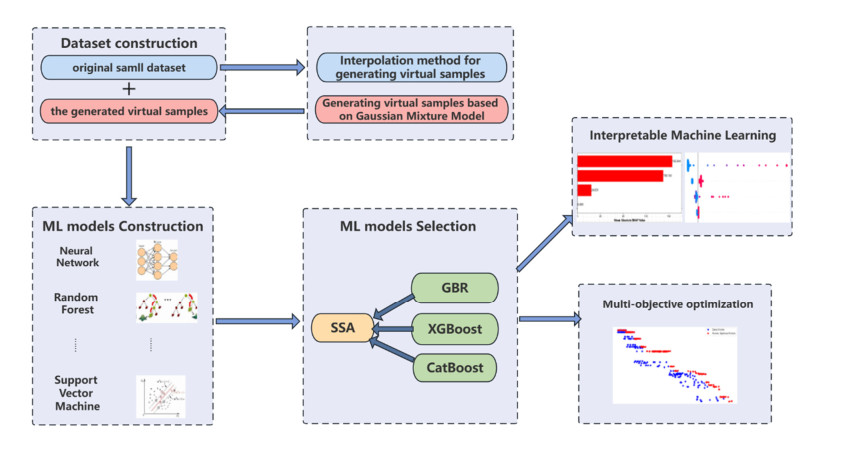
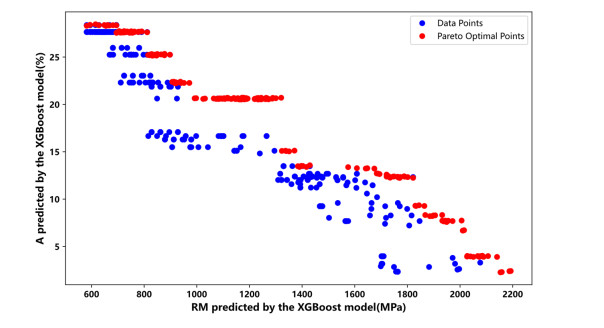
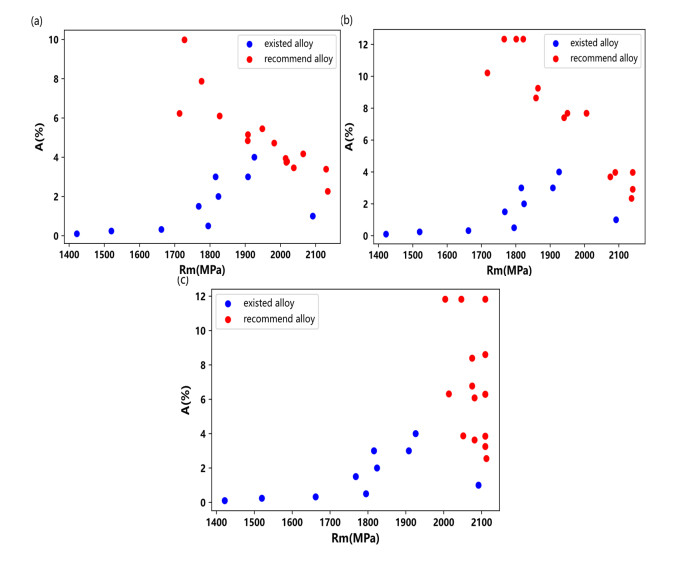
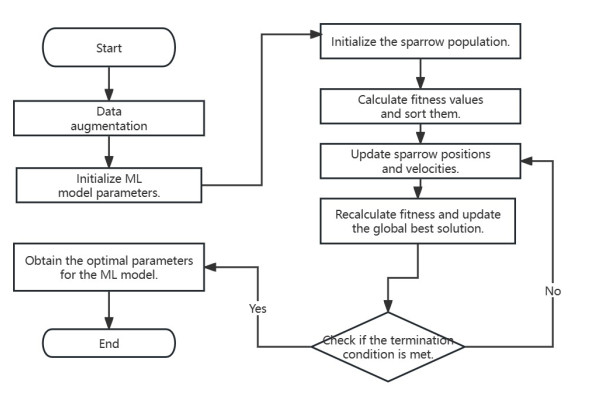
In this article, a machine learning strategy is designed to improve both the tensile strength and the elongation of a medium-entropy alloy using multi-objective optimization. In order to overcome the problem of small data sets, the linear interpolation method and Gaussian mixture model (GMM) sample generation method are integrated to augment the data. Based on the enhanced data set, the machine learning model is optimized by the sparrow search algorithm (SSA), and the multi-objective particle swarm optimization (MOPSO) algorithm is used to search the alloy process parameters with high tensile strength and elongation. Finally, 15 process parameter combinations superior to existing alloys are presented, among which three combinations, as predicted by gradient boosting regression (GBR), achieve a tensile strength exceeding 2000 MPa and an elongation of about 11%, significantly outperforming existing alloys.
Citation: Lihong Zhao, Yuyang Zhu, Cun Chen. Machine learning-enabled multi-objective optimization design of process parameters for a medium-entropy alloy[J]. Big Data and Information Analytics, 2026, 10: 189-214. doi: 10.3934/bdia.2026010
In this article, a machine learning strategy is designed to improve both the tensile strength and the elongation of a medium-entropy alloy using multi-objective optimization. In order to overcome the problem of small data sets, the linear interpolation method and Gaussian mixture model (GMM) sample generation method are integrated to augment the data. Based on the enhanced data set, the machine learning model is optimized by the sparrow search algorithm (SSA), and the multi-objective particle swarm optimization (MOPSO) algorithm is used to search the alloy process parameters with high tensile strength and elongation. Finally, 15 process parameter combinations superior to existing alloys are presented, among which three combinations, as predicted by gradient boosting regression (GBR), achieve a tensile strength exceeding 2000 MPa and an elongation of about 11%, significantly outperforming existing alloys.

| [1] | Lundberg SM, Lee SI, (2017) A unified approach to interpreting model predictions. Adv Neural Inf Proces Syst 2017: 30. |
| [2] |
Rao Z, Tung PY, Xie R, Wei Y, Zhang H, Ferrari A, et al., (2022) Machine learning—enabled high-entropy alloy discovery. Science 378: 78-85. https://doi.org/10.1126/science.abo4940 doi: 10.1126/science.abo4940

|
| [3] |
Sutojo T, Rustad S, Akrom M, Syukur A, Shidik GF, Dipojono HK, (2023) A machine learning approach for corrosion small datasets. NPJ Mater Degrad 7: 18. https://doi.org/10.1038/s41529-023-00336-7 doi: 10.1038/s41529-023-00336-7
|
| [4] |
Jiang L, Wang C, Fu H, Shen J, Zhang Z, Xie J, (2022) Discovery of aluminum alloys with ultra-strength and high-toughness via a property-oriented design strategy. J Mater Sci Technol 98: 33-43. https://doi.org/10.1016/j.jmst.2021.05.011 doi: 10.1016/j.jmst.2021.05.011
|
| [5] |
Li H, Yuan R, Liang H, Wang WY, Li J, Wang J, (2022) Towards high entropy alloy with enhanced strength and ductility using domain knowledge constrained active learning. Mater Des 223: 11118. https://doi.org/10.1016/j.matdes.2022.111186 doi: 10.1016/j.matdes.2022.111186
|
| [6] |
Zhang Y, Wen C, Wang C, Antonov S, Xue D, Bai Y, et al., (2020) Phase prediction in high entropy alloys with a rational selection of materials descriptors and machine learning models. Acta Mate 185: 528-539. https://doi.org/10.1016/j.actamat.2019.11.067 doi: 10.1016/j.actamat.2019.11.067
|
| [7] |
Ritchie RO, (2011) The conflicts between strength and toughness. Nat Mate 10: 817-822. https://doi.org/10.1038/nmat3115 doi: 10.1038/nmat3115
|
| [8] |
Lu K, (2014) Making strong nanomaterials ductile with gradients. Science 345: 1455-1456. https://doi.org/10.1126/science.1255940 doi: 10.1126/science.1255940
|
| [9] |
Zhang H, Fu H, Shen Y, Xie J, (2022) Rapid design of secondary deformation-aging parameters for ultra-low Co content Cu-Ni-Co-Si-X alloy via Bayesian optimization machine learning. Int J Miner Metall Mater 29: 1197-1205. https://doi.org/10.1007/s12613-022-2479-3 doi: 10.1007/s12613-022-2479-3
|
| [10] | Li C, Xue Y, Hua M, Cao T, Ma L, Wang L, (2016) Microstructure and mechanical properties of AlxSi0.2CrFeCoNiCu1-x high-entropy alloys. Mate Des 90: 601-609. https://doi.org/10.1016/j.matdes.2015.11.013 |
| [11] | Luo LY, Chen SN, Liu Y, Ji G, Chen HD, Jia YJ, et al., (2022) Microstructure and mechanical properties of lightweight AlxCrNbTiV (x = 0.2, 0.5, 0.8) refractory high entropy alloys. Int J Refract Met Hard Mater 104: 105784. https://doi.org/10.1016/j.ijrmhm.2022.105784 |
| [12] | Kondapalli VAS, Suresh K, Ramakrishna M, Narasaiah N, Srinivasarao B, (2023) Effect of Cu content on the microstructure and mechanical properties of FeNiMnCuxAl0.1Ti0.1 (x = 0.5, 1.0 and 1.5) high entropy alloy system. J Alloys Compd 940: 168819. https://doi.org/10.1016/j.jallcom.2023.168819 |
| [13] |
Wang R, Yan Z, He J, Fan W, Li Y, Hu Y, et al., (2023) Microstructural evolution and mechanical properties of 6Cr13 martensitic stainless steel subjected to cold rolling and heat treatments. Mater Charact 203: 113070. https://doi.org/10.1038/s41524-021-00609-2 doi: 10.1038/s41524-021-00609-2
|
| [14] |
Li H, Wang J, Xu Q, Dai L, Liao W, Yuan R, et al., (2023) High-strength medium-entropy alloy designed by precipitation-strengthening mechanism via machine learning. Mate Sci Eng A 882: 145443. https://doi.org/10.1016/j.msea.2023.145443 doi: 10.1016/j.msea.2023.145443
|
| [15] |
Sun Y, Lu Z, Liu X, Du Q, Xie H, Lv J, et al., (2021) Prediction of Ti-Zr-Nb-Ta high-entropy alloys with desirable hardness by combining machine learning and experimental data. Appl Phys Lett 119: 20. https://doi.org/10.1063/5.0065303 doi: 10.1063/5.0065303
|
| [16] | Qiao L, Lai Z, Liu Y, Bao A, Zhu J, (2021) Modelling and prediction of hardness in multi-component alloys: A combined machine learning, first principles and experimental study. J Alloys Compd 853: 156959. https://www.sci-hub.vg/10.1016/j.jallcom.2020.156959 |
| [17] |
Yang C, Ren C, Jia Y, Wang G, Li M, Lu W, (2022) A machine learning-based alloy design system to facilitate the rational design of high entropy alloys with enhanced hardness. Acta Mater 222: 117431. https://doi.org/10.1016/j.actamat.2021.117431 doi: 10.1016/j.actamat.2021.117431
|
| [18] |
Feng X, Wang Z, Jiang L, Zhao F, Zhang Z, (2023) Simultaneous enhancement in mechanical and corrosion properties of Al-Mg-Si alloys using machine learning. J Mater Sci Technol 167: 1-13. https://doi.org/10.1016/j.jmst.2023.04.072 doi: 10.1016/j.jmst.2023.04.072
|
| [19] |
Zhang Y, Wen C, Wang C, Antonov S, Xue D, Bai Y, et al., (2020) Phase prediction in high entropy alloys with a rational selection of materials descriptors and machine learning models. Acta Mater 185: 528-539. https://doi.org/10.1016/j.actamat.2019.11.067 doi: 10.1016/j.actamat.2019.11.067
|
| [20] |
Li Z, Nash WT, O'Brien SP, Qiu Y, Gupta RK, Birbilis N, (2022) CardiGAN: A generative adversarial network model for design and discovery of multi principal element alloys. J Mater Sci Technol 125: 81-96. https://doi.org/10.1016/j.jmst.2022.03.008 doi: 10.1016/j.jmst.2022.03.008
|
| [21] |
Guo Q, Xu X, Pei X, Duan Z, Liaw PK, Hou H, et al., (2023) Predict the phase formation of high-entropy alloys by compositions. J Mater Res Technol 22: 3331-3339. https://doi.org/10.1016/j.jmrt.2022.12.143 doi: 10.1016/j.jmrt.2022.12.143
|
| [22] |
Xue D, Balachandran PV, Yuan R, Hu T, Qian X, Dougherty ER, et al., (2016) Accelerated search for BaTiO3-based piezoelectrics with vertical morphotropic phase boundary using Bayesian learning. Proc Natl Acad Sci 113: 13301-13306. https://doi.org/10.1073/pnas.1607412113 doi: 10.1073/pnas.1607412113
|
| [23] |
Zhang Y, Wen C, Wang C, Antonov S, Xue D, Bai Y, et al., (2020) Phase prediction in high entropy alloys with a rational selection of materials descriptors and machine learning models. Acta Mate 185: 528-539. https://doi.org/10.1016/j.actamat.2019.11.067 doi: 10.1016/j.actamat.2019.11.067
|
| [24] |
Ramprasad R, Batra R, Pilania G, Mannodi-Kanakkithodi A, Kim C, (2017) Machine learning in materials informatics: Recent applications and prospects. NPJ Comput Mater 3: 54. https://doi.org/10.1038/s41524-017-0056-5 doi: 10.1038/s41524-017-0056-5
|
| [25] |
Ramakrishna S, Zhang TY, Lu WC, Qian Q, Low JSC, Yune JHR, et al., (2019) Materials informatics. J Intell Manuf 30: 2307-2326. https://doi.org/10.1007/s10845-018-1392-0 doi: 10.1007/s10845-018-1392-0
|
| [26] |
Rickman JM, Lookman T, Kalinin SV, (2019) Materials informatics: From the atomic-level to the continuum. Acta Mater 168: 473-510. https://doi.org/10.1016/j.actamat.2019.01.051 doi: 10.1016/j.actamat.2019.01.051
|
| [27] |
Li X, Zheng M, Yang X, Chen P, Ding W, (2022) A property-oriented design strategy of high-strength ductile RAFM steels based on machine learning. Mater Sci Eng A 840: 142891. https://doi.org/10.1016/j.msea.2022.142891 doi: 10.1016/j.msea.2022.142891
|
| [28] |
Jiang L, Zhang Z, Hu H, He X, Fu H, Xie J, (2023) A rapid and effective method for alloy materials design via sample data transfer machine learning. NPJ Comput Mater 9: 26. https://doi.org/10.1038/s41524-023-00979-9 doi: 10.1038/s41524-023-00979-9
|
| [29] |
Kim Y, Kim Y, Yang C, Park K, Gu GX, Ryu S, (2021) Deep learning framework for material design space exploration using active transfer learning and data augmentation. NPJ Comput Mater 7: 140. https://doi.org/10.1038/s41524-021-00609-2 doi: 10.1038/s41524-021-00609-2
|
| [30] |
Dempster A, Laird N, Rubin D, (1977) Maximum likelihood from incomplete data via the EM algorithm. J R Stat Soc B Stat Methodol 39: 1-38. https://doi.org/10.1111/j.2517-6161.1977.tb01600.x doi: 10.1111/j.2517-6161.1977.tb01600.x
|
| [31] |
Xue J, Shen B, (2020) A novel swarm intelligence optimization approach: Sparrow search algorithm. Syst Sci Control Eng 8: 22c34. https://doi.org/10.1080/21642583.2019.1708830 doi: 10.1080/21642583.2019.1708830
|
| [32] |
bin Mohd Zain MZ, Kanesan J, Chuah JH, Dhanapal S, Kendall G, (2018) A multi-objective particle swarm optimization algorithm based on dynamic boundary search for constrained optimization. Appl Soft Comput 70: 680-700. https://doi.org/10.1016/j.asoc.2018.06.022 doi: 10.1016/j.asoc.2018.06.022
|
| [33] |
Li G, Wang W, Zhang W, Wang Z, Tu H, You W, (2021) Grid search based multi-population particle swarm optimization algorithm for multimodal multi-objective optimization. Swarm Evol Comput 62: 100843. https://doi.org/10.1016/j.swevo.2021.100843 doi: 10.1016/j.swevo.2021.100843
|
| [34] | Coello CC, Lechuga MS, (2002) MOPSO: A proposal for multiple objective particle swarm optimization. In Proceedings of the 2002 Congress on Evolutionary Computation, 1051-1056. https://doi.org/10.1109/CEC.2002.1004388 |
Figures(11) / Tables(11)

Lihong Zhao, Yuyang Zhu, Cun Chen. Machine learning-enabled multi-objective optimization design of process parameters for a medium-entropy alloy[J]. Big Data and Information Analytics, 2026, 10: 189-214. doi: 10.3934/bdia.2026010






 DownLoad: