This study addresses a gap that developed-market ESG research has largely left open: whether the act of disclosing sustainability information as distinct from the underlying quality of ESG performance itself is associated with accounting-based financial resilience in an emerging market. We constructed a hand-collected, weighted ESG disclosure index for 48 non-financial firms listed on the Pakistan Stock Exchange (2016–2025), a period spanning Pakistan's transition from voluntary to progressively formalized sustainability-reporting requirements (Code of Corporate Governance 2019/2022; SECP ESG Disclosure Guidelines 2024; revised guidelines issued December 2025 with phased mandatory adoption by 2029). This regulatory trajectory, together with Pakistan's concentrated, family-dominated ownership structure, provides institutional variation largely absent from the developed-market samples that dominate the existing literature, where ESG disclosure and ESG performance are frequently conflated. Financial resilience was operationalized through backward-looking rolling standard deviation and conditional downside standard deviation of return on assets (ROA). Using firm-fixed-effects panel models, we found weak, specification-sensitive evidence of a negative association between ESG disclosure and general earnings volatility (β = −0.0254, conventional p = 0.085; wild-cluster bootstrap, p = 0.092); the governance pillar has the largest point estimate (−0.0242, p = 0.041), though formal coefficient-equality tests do not establish it as statistically stronger than the environmental or social pillars. The association with conditional downside ROA dispersion is not statistically significant (β = −0.0198, p = 0.167), and industry (p > 0.40) and crisis (p > 0.30) interaction terms are likewise insignificant. A randomization-based placebo test (p = 0.13) and an unbalanced-panel check both attenuated the baseline result, indicating that the evidence should be read as suggestive rather than conclusive. Taken together, the findings show that in an emerging market with an evolving regulatory framework, ESG disclosure exhibits a fragile, not robust, negative association with earnings fluctuations. This study contributes to the green finance literature by (ⅰ) isolating disclosure from performance, (ⅱ) offering one of the few firm-level, decade-long tests of accounting-based (rather than market-based) ESG–risk associations in South Asia, and (ⅲ) documenting how that association behaves under a genuine regulatory-transition setting.
Citation: Attique Ur Rehman, Athar Iqbal. ESG disclosure and accounting-based financial resilience: Evidence from earnings volatility and conditional downside ROA dispersion in Pakistan[J]. Innovation Economics, 2026, 1(2): 205-235. doi: 10.3934/InnoEcon2026011
This study addresses a gap that developed-market ESG research has largely left open: whether the act of disclosing sustainability information as distinct from the underlying quality of ESG performance itself is associated with accounting-based financial resilience in an emerging market. We constructed a hand-collected, weighted ESG disclosure index for 48 non-financial firms listed on the Pakistan Stock Exchange (2016–2025), a period spanning Pakistan's transition from voluntary to progressively formalized sustainability-reporting requirements (Code of Corporate Governance 2019/2022; SECP ESG Disclosure Guidelines 2024; revised guidelines issued December 2025 with phased mandatory adoption by 2029). This regulatory trajectory, together with Pakistan's concentrated, family-dominated ownership structure, provides institutional variation largely absent from the developed-market samples that dominate the existing literature, where ESG disclosure and ESG performance are frequently conflated. Financial resilience was operationalized through backward-looking rolling standard deviation and conditional downside standard deviation of return on assets (ROA). Using firm-fixed-effects panel models, we found weak, specification-sensitive evidence of a negative association between ESG disclosure and general earnings volatility (β = −0.0254, conventional p = 0.085; wild-cluster bootstrap, p = 0.092); the governance pillar has the largest point estimate (−0.0242, p = 0.041), though formal coefficient-equality tests do not establish it as statistically stronger than the environmental or social pillars. The association with conditional downside ROA dispersion is not statistically significant (β = −0.0198, p = 0.167), and industry (p > 0.40) and crisis (p > 0.30) interaction terms are likewise insignificant. A randomization-based placebo test (p = 0.13) and an unbalanced-panel check both attenuated the baseline result, indicating that the evidence should be read as suggestive rather than conclusive. Taken together, the findings show that in an emerging market with an evolving regulatory framework, ESG disclosure exhibits a fragile, not robust, negative association with earnings fluctuations. This study contributes to the green finance literature by (ⅰ) isolating disclosure from performance, (ⅱ) offering one of the few firm-level, decade-long tests of accounting-based (rather than market-based) ESG–risk associations in South Asia, and (ⅲ) documenting how that association behaves under a genuine regulatory-transition setting.

| [1] |
Aguilera RV, Aragón-Correa JA, Marano V, et al. (2021) The corporate governance of environmental sustainability: A review and proposal for more integrated research. J Manag 47: 1468–1497. https://doi.org/10.1177/0149206321991212 doi: 10.1177/0149206321991212
|
| [2] |
Albuquerque R, Koskinen Y, Zhang C (2019) Corporate social responsibility and firm risk: Theory and empirical evidence. Manag Sci 65: 4451–4469. https://doi.org/10.1287/mnsc.2018.3043 doi: 10.1287/mnsc.2018.3043
|
| [3] |
Ali S, Khan A, Shaique M, et al. (2025) The impact of Shariah compliance on risk disclosure practices of non-financial firms in Pakistan. Humanit Soc Sci Commun 12: 1–13. https://doi.org/10.1057/s41599-025-06284-8 doi: 10.1057/s41599-025-06284-8
|
| [4] |
Amel-Zadeh A, Serafeim G (2018) Why and how investors use ESG information: Evidence from a global survey. Financ Anal J 74: 87–103. https://doi.org/10.2469/faj.v74.n3.2 doi: 10.2469/faj.v74.n3.2
|
| [5] |
Bauer R, Hann D (2010) Corporate environmental management and credit risk. SSRN Electron J. https://doi.org/10.2139/ssrn.1660470 |
| [6] |
Bhat BA, Makkar MK, Gupta N (2024) Corporate governance for sustainability: Connecting environmental, social and economic goals. Sustain Dev 32: 2754–2765. https://doi.org/10.1002/sd.2779 doi: 10.1002/sd.2779
|
| [7] |
Bolton P, Després M, Pereira da Silva LA, et al. (2020) The green swan: Central banking and financial stability in the age of climate change. Bank for International Settlements. Available from: https://www.bis.org/publ/othp31.pdf |
| [8] |
Cameron AC, Gelbach JB, Miller DL (2008) Bootstrap-based improvements for inference with clustered errors. Rev Econ Stat 90: 414–427. https://doi.org/10.1162/rest.90.3.414 doi: 10.1162/rest.90.3.414
|
| [9] |
Chava S (2014) Environmental externalities and cost of capital. Manag Sci 60: 2223–2247. https://doi.org/10.1287/mnsc.2013.1863 doi: 10.1287/mnsc.2013.1863
|
| [10] |
Christensen HB, Serafeim G, Sikochi A (2021) Why is corporate virtue in the eye of the beholder? The case of ESG ratings. Account Rev 97: 147–175. https://doi.org/10.2308/TAR-2019-0506 doi: 10.2308/TAR-2019-0506
|
| [11] |
Connelly BL, Certo ST, Ireland RD, et al. (2011) Signaling theory: A review and assessment. J Manag 37: 39–67. https://doi.org/10.1177/0149206310388419 doi: 10.1177/0149206310388419
|
| [12] |
Deegan C (2002) The legitimising effect of social and environmental disclosures: a theoretical foundation. Account Audit Account J 15: 282–311. https://doi.org/10.1108/09513570210435852 doi: 10.1108/09513570210435852
|
| [13] |
Dhaliwal DS, Li OZ, Tsang A, et al. (2011) Voluntary nonfinancial disclosure and the cost of equity capital: The initiation of corporate social responsibility reporting. Account Rev 86: 59–100. https://doi.org/10.2308/accr.00000005 doi: 10.2308/accr.00000005
|
| [14] |
Eccles RG, Ioannou I, Serafeim G (2014) The impact of corporate sustainability on organizational processes and performance. Manag Sci 60: 2835–2857. https://doi.org/10.1287/mnsc.2014.1984 doi: 10.1287/mnsc.2014.1984
|
| [15] |
El Ghoul S, Guedhami O, Kwok CC, et al. (2011) Does corporate social responsibility affect the cost of capital? J Bank Financ 35: 2388–2406. https://doi.org/10.1016/j.jbankfin.2011.02.007 doi: 10.1016/j.jbankfin.2011.02.007
|
| [16] |
Estrada J (2002) Systematic risk in emerging markets: The D-CAPM. Emerg Mark Rev 3: 365–379. https://doi.org/10.1016/S1566-0141(02)00042-0 doi: 10.1016/S1566-0141(02)00042-0
|
| [17] |
Flammer C (2015) Does corporate social responsibility lead to superior financial performance? A regression discontinuity approach. Manag Sci 61: 2549–2568. https://doi.org/10.1287/mnsc.2014.2038 doi: 10.1287/mnsc.2014.2038
|
| [18] |
Frankel R, Litov L (2009) Earnings persistence. J Account Econ 47: 182–190. https://doi.org/10.1016/j.jacceco.2008.11.008 doi: 10.1016/j.jacceco.2008.11.008
|
| [19] |
Freeman RE, Dmytriyev SD, Phillips RA (2021) Stakeholder theory and the resource-based view of the firm. J Manag 47: 1757–1770. https://doi.org/10.1177/0149206321993576 doi: 10.1177/0149206321993576
|
| [20] |
García-Sánchez IM, Hussain N, Martínez-Ferrero J, et al. (2020) Impact of disclosure and assurance quality of corporate sustainability reports on access to finance. Corp Soc Responsib Environ Manag 27: 393–409. https://doi.org/10.1002/csr.1969 doi: 10.1002/csr.1969
|
| [21] |
Gillan SL, Koch A, Starks LT (2021) Firms and social responsibility: A review of ESG and CSR research in corporate finance. J Corp Financ 66: 101889. https://doi.org/10.1016/j.jcorpfin.2021.101889 doi: 10.1016/j.jcorpfin.2021.101889
|
| [22] |
Grewal J, Hauptmann C, Serafeim G (2020) Material sustainability information and stock price informativeness. J Bus Ethics 171: 513–544. https://doi.org/10.1007/s10551-020-04451-2 doi: 10.1007/s10551-020-04451-2
|
| [23] |
Haque F, Ntim CG (2018) Environmental policy, sustainable development, governance mechanisms and environmental performance. Bus Strateg Environ 27: 415–435. https://doi.org/10.1002/bse.2007 doi: 10.1002/bse.2007
|
| [24] |
Jamali D, Lund-Thomsen P, Jeppesen S (2015) SMEs and CSR in developing countries. Bus Soc 56: 11–22. https://doi.org/10.1177/0007650315571258 doi: 10.1177/0007650315571258
|
| [25] |
Javeed SA, Latief R, Jiang T, et al. (2021) How environmental regulations and corporate social responsibility affect the firm innovation with the moderating role of chief executive officer (CEO) power and ownership concentration? J Clean Prod 308: 127212. https://doi.org/10.1016/j.jclepro.2021.127212 doi: 10.1016/j.jclepro.2021.127212
|
| [26] |
Khan M, Serafeim G, Yoon A (2016) Corporate sustainability: First evidence on materiality. Account Rev 91: 1697–1724. https://doi.org/10.2308/accr-51383 doi: 10.2308/accr-51383
|
| [27] |
Kim Y, Li H, Li S (2014) Corporate social responsibility and stock price crash risk. J Bank Financ 43: 1–13. https://doi.org/10.1016/j.jbankfin.2014.02.013 doi: 10.1016/j.jbankfin.2014.02.013
|
| [28] |
Leuz C, Wysocki PD (2016) The economics of disclosure and financial reporting regulation: Evidence and suggestions for future research. J Account Res 54: 525–622. https://doi.org/10.1111/1475-679X.12115 doi: 10.1111/1475-679X.12115
|
| [29] |
Lins KV, Servaes H, Tamayo A (2017) Social capital, trust, and firm performance: The value of corporate social responsibility during the financial crisis. J Financ 72: 1785–1824. https://doi.org/10.1111/jofi.12505 doi: 10.1111/jofi.12505
|
| [30] |
Marquis C, Qian C (2014) Corporate social responsibility reporting in China: Symbol or substance? Organ Sci 25: 127–148. https://doi.org/10.1287/orsc.2013.0837 doi: 10.1287/orsc.2013.0837
|
| [31] |
Masud MAK, Nurunnabi M, Bae SM (2018) The effects of corporate governance on environmental sustainability reporting: Empirical evidence from South Asian countries. Asian J Sustain Soc Responsib 3: 1–26. https://doi.org/10.1186/s41180-018-0019-x doi: 10.1186/s41180-018-0019-x
|
| [32] |
Naz M, Ayub H (2017) Impact of risk-related disclosure on the risk-taking behavior of commercial banks in Pakistan. J Indep Stud Res Manag Soc Sci Econ, 15. https://doi.org/10.31384/jisrmsse/2017.15.2.9 |
| [33] |
Petersen MA (2009) Estimating standard errors in finance panel data sets: Comparing approaches. Rev Financ Stud 22: 435–480. https://doi.org/10.1093/rfs/hhn053 doi: 10.1093/rfs/hhn053
|
| [34] |
Securities and Exchange Commission of Pakistan (SECP), Code of Corporate Governance. SECP, 2022. Available from: https://www.secp.gov.pk/ |
| [35] |
Securities and Exchange Commission of Pakistan (SECP), ESG Disclosure Guidelines for Listed Companies. SECP, 2024. Available from: https://www.secp.com.pk/ |
| [36] |
Securities and Exchange Commission of Pakistan (SECP), Revised ESG Disclosure Guidelines for Listed Companies. SECP, 2025. Available from: https://www.secp.com.pk/ |
| [37] |
Serafeim G (2020) Public sentiment and the price of corporate sustainability. Financ Anal J 76: 26–46. https://doi.org/10.1080/0015198X.2020.1723390 doi: 10.1080/0015198X.2020.1723390
|
| [38] |
Spence M (1973) Job market signaling. Q J Econ 87: 355–374. https://doi.org/10.2307/1882010 doi: 10.2307/1882010
|
| [39] |
Suchman MC (1995) Managing legitimacy: Strategic and institutional approaches. Acad Manag Rev 20: 571–610. https://doi.org/10.5465/amr.1995.9508080331 doi: 10.5465/amr.1995.9508080331
|
| [40] |
Tauseef S, Khurshid AA (2025) ESG disclosure, ranking and firm's characteristics: Evidence from Pakistan. South Asian J Bus Stud 14: 268–290. https://doi.org/10.1108/SAJBS-03-2024-0110 doi: 10.1108/SAJBS-03-2024-0110
|
| [41] |
Zhang C, Zhang S, Zhou Z, et al. (2025) Merging economic aspirations with sustainability: ESG and the evolution of the corporate development paradigm in China. Sustainability 17: 9108. https://doi.org/10.3390/su17209108 doi: 10.3390/su17209108
|
| [42] |
Zhou R, Lou J, He B (2025) Greening corporate environmental, social, and governance performance: The impact of China's carbon emissions trading pilot policy on listed companies. Sustainability 17: 963. https://doi.org/10.3390/su17030963 doi: 10.3390/su17030963
|
Figures(1) / Tables(10)
Attique Ur Rehman, Athar Iqbal. ESG disclosure and accounting-based financial resilience: Evidence from earnings volatility and conditional downside ROA dispersion in Pakistan[J]. Innovation Economics, 2026, 1(2): 205-235. doi: 10.3934/InnoEcon2026011

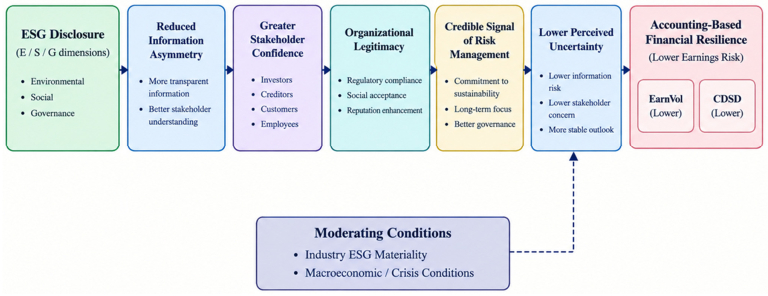
Integrated theoretical framework. Note: Arrows depict the theorized sequence discussed in Section 2.1.1 and are not empirically tested in this study



 DownLoad: