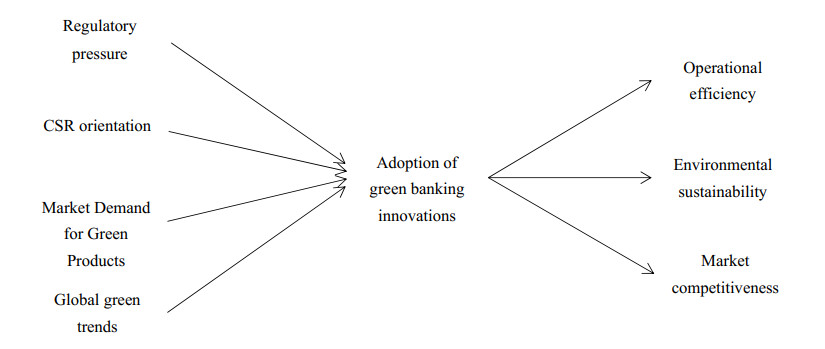
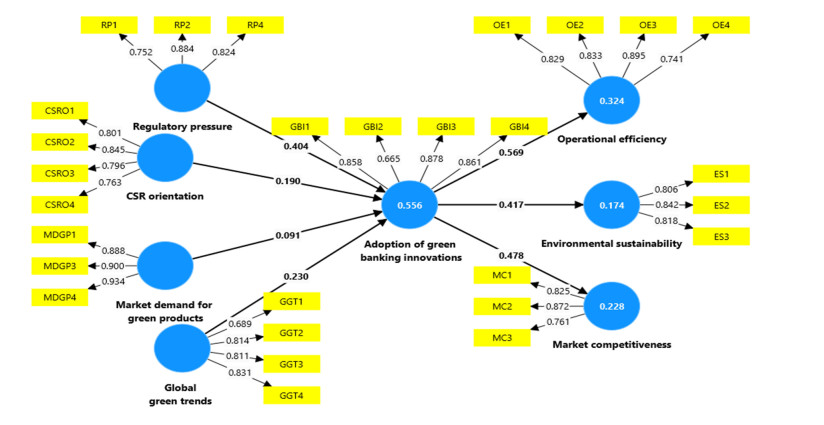
The shift toward environmentally sustainable finance has placed increased pressure on banks, especially in emerging economies, to align operations with global climate goals. Jordan's banking sector faces unique institutional, regulatory, and societal expectations, creating a timely need to investigate the mechanisms driving and resulting from the adoption of green banking. This study empirically investigates the drivers and outcomes of adopting green banking innovations within Jordan's financial institutions. Focused on key factors such as regulatory pressure, corporate social responsibility (CSR) orientation, operational efficiency, global green trends, and market demand for green products, the research examines how these elements influence the integration and effectiveness of green banking practices. Data were collected from senior executives and managers across various banks in Jordan, with 217 validated responses utilized for analysis. Smart partial least squares software for hypothesis testing was applied. The findings reveal that regulatory pressures, CSR orientation, and global green trends significantly promote the adoption of green banking innovations. Furthermore, the results demonstrate that green banking practices significantly enhance operational efficiency and contribute to environmental sustainability. The study underscores the importance of a strategic commitment to environmental principles in the banking sector, emphasizing how such commitments facilitate operational improvements and support broader sustainability goals. This research contributes to an understanding of how banks in emerging economies, like Jordanian banks, can adopt sustainable practices and enjoy financial and environmental benefits. The study implications are that regulators and banks must enhance their green policies and practices to ensure sustainability in the financial sector.
Citation: Ayman Abdalmajeed Alsmadi, Khaled Saleh Al-Omoush. Adoption of green banking innovations: Drivers and outcomes[J]. Green Finance, 2025, 7(4): 584-609. doi: 10.3934/GF.2025022
The shift toward environmentally sustainable finance has placed increased pressure on banks, especially in emerging economies, to align operations with global climate goals. Jordan's banking sector faces unique institutional, regulatory, and societal expectations, creating a timely need to investigate the mechanisms driving and resulting from the adoption of green banking. This study empirically investigates the drivers and outcomes of adopting green banking innovations within Jordan's financial institutions. Focused on key factors such as regulatory pressure, corporate social responsibility (CSR) orientation, operational efficiency, global green trends, and market demand for green products, the research examines how these elements influence the integration and effectiveness of green banking practices. Data were collected from senior executives and managers across various banks in Jordan, with 217 validated responses utilized for analysis. Smart partial least squares software for hypothesis testing was applied. The findings reveal that regulatory pressures, CSR orientation, and global green trends significantly promote the adoption of green banking innovations. Furthermore, the results demonstrate that green banking practices significantly enhance operational efficiency and contribute to environmental sustainability. The study underscores the importance of a strategic commitment to environmental principles in the banking sector, emphasizing how such commitments facilitate operational improvements and support broader sustainability goals. This research contributes to an understanding of how banks in emerging economies, like Jordanian banks, can adopt sustainable practices and enjoy financial and environmental benefits. The study implications are that regulators and banks must enhance their green policies and practices to ensure sustainability in the financial sector.

| [1] | Abu-AlSondos IA, Shehadeh M, Ajouz M, et al. (2024) The Role of Digital Transformation in Business: Opportunities Challenges and Future Directions. In: 2024 ASU International Conference in Emerging Technologies for Sustainability and Intelligent Systems (ICETSIS), 361–365, IEEE. http://dx.doi.org/10.1109/ICETSIS61505.2024.10459639 |
| [2] |
Adeniran IA, Abhulimen AO, Obiki-Osafiele AN, et al. (2024) Strategic risk management in financial institutions: Ensuring robust regulatory compliance. Financ Account Res J 6: 1582–1596. https://doi.org/10.51594/farj.v6i8.1508 doi: 10.51594/farj.v6i8.1508

|
| [3] | Al Omoush K, Lassala C, Ribeiro-Navarrete S (2023) The role of digital business transformation in frugal innovation and SMEs' resilience in emerging markets. Int J Emerg Mark. http://dx.doi.org/10.1108/IJOEM-12-2022-1937 |
| [4] |
Al-Gasaymeh A, Alsmadi AA, Alrawashdeh N, et al. (2023) Dynamic model in estimating the impact of competition on banking efficiency: Evidence form MENA countries. Calitatea 24: 385–394. https://doi.org/10.47750/QAS/24.193.44 doi: 10.47750/QAS/24.193.44
|
| [5] |
Al-Omari R, Oroud Y, Makhlouf MH, et al. (2024) The impact of profitability and asset management on firm value and the moderating role of dividend policy: Evidence from Jordan. Asian Econ Financ Rev 14: 1–11. https://doi.org/10.55493/5002.v14i1.4937 doi: 10.55493/5002.v14i1.4937
|
| [6] |
Alshehadeh AR, Elrefae G, Injadat E (2022) Influence of traditional performance indicators on economic added value: evidence from insurance companies. Corp Gov Organ Behav Rev 6: 18–27. https://doi.org/10.22495/cgobrv6i4p2 doi: 10.22495/cgobrv6i4p2
|
| [7] |
Alshukri T, Seun Ojekemi O, Öz T, et al. (2024) The Interplay of Corporate Social Responsibility, Innovation Capability, Organizational Learning, and Sustainable Value Creation: Does Stakeholder Engagement Matter? Sustainability 16: 5511. https://doi.org/10.3390/su16135511 doi: 10.3390/su16135511
|
| [8] |
Alsmadi AA, Alrawashdeh N, Al-Gasaymeh A, et al. (2023a) Adoption of blockchain technology in supply chain. Sage Open 13: 21582440231160143. https://doi.org/10.1177/21582440231160143 doi: 10.1177/21582440231160143
|
| [9] |
Alsmadi AA, Alrawashdeh N, Al-Gasaymeh A, et al. (2023b) Impact of business enablers on banking performance: A moderating role of Fintech. Banks Bank Syst 18: 14–25. https://doi.org/10.21511/bbs.18(1).2023.02 doi: 10.21511/bbs.18(1).2023.02
|
| [10] | Altenburger R (2018) Corporate social responsibility as a driver of innovation processes. Innovation Management and Corporate Social Responsibility: Social Responsibility as Competitive Advantage, Cham: Springer International Publishing, 1–12. https://doi.org/10.1007/978-3-319-93629-1_1 |
| [11] |
Alzoubi M, Alkhatib A, Alsmadi AA, et al. (2022) Bank size and capital: A trade-off between risk-taking incentives and diversification. Banks Bank Syst 17: 1. https://doi.org/10.21511/bbs.17(4).2022.01 doi: 10.21511/bbs.17(4).2022.01
|
| [12] |
Aslam W, Jawaid ST (2023) Green banking adoption practices: improving environmental, financial, and operational performance. Int J Ethics Syst 39: 820–840. https://doi.org/10.1108/IJOES-06-2022-0125 doi: 10.1108/IJOES-06-2022-0125
|
| [13] | Awan UA (2023) Impact of Electronic Invoicing on Cost Saving and Operational Efficiency in Logistics. Available from: https://www.theseus.fi/bitstream/10024/808368/2/Awan_Umer_Ali.pdf. |
| [14] | Bank B (2020) Sustainable finance policy for banks and financial institutions. Dhaka: Bangladesh Bank. |
| [15] | Bansal J, Shukla P, Tripathi PK, et al. (2024) Green Banking and SDGs: Drivers, Facilitators, and Accelerators. In: AI-Driven Decentralized Finance and the Future of Finance, 181–200. IGI Global. https://doi.org/10.4018/979-8-3693-6321-8.ch008 |
| [16] |
Bataineh AQ, Qasim D, Alhur M (2024) The impact of digital banking channels and organizational culture on operational excellence in Jordanian banking. Banks Bank Syst 19: 163–176. https://doi.org/10.21511/bbs.19(4).2024.13 doi: 10.21511/bbs.19(4).2024.13
|
| [17] | Bangladesh Bank (2023) Sustainable finance policy for banks and financial institutions. Dhaka: Sustainable Finance Department, Bangladesh Bank. Available from: https://www.bb.org.bd. |
| [18] |
Bose S, Khan HZ, Monem RM (2021) Does green banking performance pay off? Evidence from a unique regulatory setting in Bangladesh. Corp Govern Int Rev 29: 162–187. https://doi.org/10.1111/corg.12349 doi: 10.1111/corg.12349
|
| [19] |
Bose S, Khan HZ, Rashid A, et al. (2018) What drives green banking disclosure? An institutional and corporate governance perspective. Asia Paci J Manage 35: 501–527. https://doi.org/10.1007/s10490-017-9528-x doi: 10.1007/s10490-017-9528-x
|
| [20] |
Bouteraa M, Hisham R, Zainol Z (2021) Exploring determinants of customers' intention to adopt green banking: Qualitative investigation. J Sustaina Sci Manage 16: 187–203. https://doi.org/10.46754/jssm.2021.04.014 doi: 10.46754/jssm.2021.04.014
|
| [21] |
Bouteraa M, Raja Hisham RRI, Zainol Z (2023) Challenges affecting bank consumers' intention to adopt green banking technology in the UAE: A UTAUT-based mixed-methods approach. J Islamic Mark 14: 2466–2501. https://doi.org/10.1016/j.techfore.2021.120645 doi: 10.1016/j.techfore.2021.120645
|
| [22] |
Čekanavičius L, Bazytė R, Dičmonaitė A (2014) Green business: challenges and practices. Ekonomika 93: 74–88. https://doi.org/10.15388/Ekon.2014.0.3021 doi: 10.15388/Ekon.2014.0.3021
|
| [23] |
Chen X, You X, Chang V (2021) FinTech and commercial banks' performance in China: A leap forward or survival of the fittest? Technol Forecast Soc 166: 120645. https://doi.org/10.1016/j.techfore.2021.120645 doi: 10.1016/j.techfore.2021.120645
|
| [24] |
Chien F, Ngo QT, Hsu CC, et al. (2021) Assessing the mechanism of barriers towards green finance and public spending in small and medium enterprises from developed countries. Environ Sci Pollut Res 28: 60495–60510. https://doi.org/10.1007/s11356-021-14907-1 doi: 10.1007/s11356-021-14907-1
|
| [25] |
Cochran I, Pauthier A (2019) A framework for alignment with the Paris Agreement: why, what and how for financial institutions. Institute for Climate Economics: Paris, France, 56. https://doi.org/10.13140/RG.2.2.13526.13764 doi: 10.13140/RG.2.2.13526.13764
|
| [26] | David D, Venkatachalam A (2018) A comparative study on the role of public-private partnerships and green investment banks in boosting low-carbon investments. Handbook of Green Finance. Springer, Singapore, 1–28. https://doi.org/10.1007/978-981-13-0227-5 |
| [27] | D'Este L (2024) The effects of sustainable practices on customer loyalty: an analysis of the banking sector through PLS-SEM. https://doi.org/10.1007/s11356-021-14907-1 |
| [28] |
Dikken J, Kazak JK, Soebarto V, et al. (2023) Views of older people on environmental sustainability: The development of the SustainABLE-16 Questionnaire. Build Environ 242: 110514. https://doi.org/10.1016/j.buildenv.2023.110514 doi: 10.1016/j.buildenv.2023.110514
|
| [29] |
Dong S, Xu L, McIver R (2021) China's financial sector sustainability and "green finance" disclosures. Sustain Account Manage Policy J 12: 353–384. https://doi.org/10.1108/SAMPJ-10-2018-0273 doi: 10.1108/SAMPJ-10-2018-0273
|
| [30] |
Drews S, van den Bergh JC (2016) Public views on economic growth, the environment and prosperity: Results of a questionnaire survey. Global Environ Change 39: 1–14. https://doi.org/10.1016/j.gloenvcha.2016.04.001. doi: 10.1016/j.gloenvcha.2016.04.001
|
| [31] |
Du Preez R, Van Zyl LT (2015) Toward the development of a corporate social responsibility leadership questionnaire: An adaptation of the LBI-2. SA J Ind Psychol 41: 1–18. https://doi.org/10.4102/sajip.v41i1.1256 doi: 10.4102/sajip.v41i1.1256
|
| [32] |
Duarte P, Amaro S (2018) Methods for modelling reflective-formative second order constructs in PLS: An application to online travel shopping. J Hosp Tour Technol 9: 295–313. https://doi.org/10.1108/JHTT-09-2017-0092 doi: 10.1108/JHTT-09-2017-0092
|
| [33] |
Dvouletý O, Blažková I (2021) Determinants of competitiveness of the Czech SMEs: findings from the global competitiveness project. Compet Rev Int Bus J 31: 361–378. https://doi.org/10.1108/CR-01-2020-0007 doi: 10.1108/CR-01-2020-0007
|
| [34] |
Esho AOO, Iluyomade TD, Olatunde TM, et al. (2024) A comprehensive review of energy-efficient design in satellite communication systems. Int J Eng Res Updates 6: 013–025. https://doi.org/10.53430/ijeru.2024.6.2.0024 doi: 10.53430/ijeru.2024.6.2.0024
|
| [35] | Fahima KI (2023) Strategic Leadership and Competitive Advantage of Equity Bank in Kenya, Doctoral dissertation, University of Nairobi. |
| [36] |
Falcone PM, Morone P, Sica E (2018) Greening of the financial system and fuelling a sustainability transition: A discursive approach to assess landscape pressures on the Italian financial system. Technol Forecast Soc Change 127: 23–37. https://doi.org/10.1016/j.techfore.2017.05.008 doi: 10.1016/j.techfore.2017.05.008
|
| [37] |
Fornell C, Larcker DF (1981) Evaluating structural equation models with unobservable variables and measurement error. J Mark Res 18: 39–50. https://doi.org/10.1177/002224378101800104 doi: 10.1177/002224378101800104
|
| [38] |
Gangi F, Meles A, D'Angelo E, et al. (2019) Sustainable development and corporate governance in the financial system: are environmentally friendly banks less risky? Corp Soc Resp Environ Manage 26: 529–547. https://doi.org/10.1002/csr.1699 doi: 10.1002/csr.1699
|
| [39] | Gazi MAI, Al Masud A, bin Kabir S, et al. (2024) Impact of Green Banking Practices on Green CSR and Sustainability in Private Commercial Banks: The Mediating Role of Green Financing Activities. J Sustain Res 6. https://doi.org/10.20900/jsr20240072 |
| [40] | Goel A (2022) Digitization: Road Ahead for Banking Industry. Int J Res Manage 32. |
| [41] |
Gulzar R, Bhat AA, Mir AA, et al. (2024) Green banking practices and environmental performance: navigating sustainability in banks. Environ Sci Pollut Res 31: 23211–23226. https://doi.org/10.1007/s11356-024-32418-7 doi: 10.1007/s11356-024-32418-7
|
| [42] |
Hair Jr JF, Matthews LM, Matthews RL, et al. (2017) PLS-SEM or CB-SEM: updated guidelines on which method to use. Int J Multivariate Data Anal 1: 107–123. https://doi.org/10.1504/IJMDA.2017.087624 doi: 10.1504/IJMDA.2017.087624
|
| [43] |
Hair JF, Ringle CM, Sarstedt M (2011) PLS-SEM: indeed a silver bullet. J Mark Theory Pract 19: 139–151. https://doi.org/10.2753/MTP1069-6679190202 doi: 10.2753/MTP1069-6679190202
|
| [44] | Hidayat-ur-Rehman I, Hossain MN (2024) The impacts of Fintech adoption, green finance and competitiveness on banks' sustainable performance: digital transformation as moderator. Asia-Pacific J Bus Admin. https://doi.org/10.1108/APJBA-10-2023-0497 |
| [45] |
Holtbrügge D, Oberhauser M (2019) CSR orientation of future top managers in India. J Indian Bus Res 11: 162–178. https://doi.org/10.1108/JIBR-01-2018-0039 doi: 10.1108/JIBR-01-2018-0039
|
| [46] |
Hussain S, Rasheed A, Rehman SU (2024) Driving sustainable growth: exploring the link between financial innovation, green finance and sustainability performance: banking evidence. Kybernetes 53: 4678–4696. https://doi.org/10.1108/K-05-2023-0918 doi: 10.1108/K-05-2023-0918
|
| [47] |
Ibe-enwo G, Igbudu N, Garanti Z, et al. (2019) Assessing the relevance of green banking practice on bank loyalty: The mediating effect of green image and bank trust. Sustainability 11: 4651. https://doi.org/10.3390/su11174651 doi: 10.3390/su11174651
|
| [48] |
Jain A, Kansal M, Joshi M, et al. (2022) Is the Indian corporate social responsibility law working for the public sector? Public Money Manage 42: 648–657. https://doi.org/10.1080/09540962.2020.1868109 doi: 10.1080/09540962.2020.1868109
|
| [49] |
Jarah BAF, Alshehadeh AR, Al-Zaqeba MAA, et al. (2024) Review of the literature related to audit quality and integrated reporting quality in Jordanian companies. Edelweiss Appl Sci Converg Technol 8: 124–133. https://doi.org/10.55214/25768484.v8i6.2029 doi: 10.55214/25768484.v8i6.2029
|
| [50] |
Javid S, Islam MU, Rauf M (2023) The Mediation role of Customer Trust and Satisfaction on Green Banking and Customer Loyalty in toursim industry. J Tour Hosp Serv Ind Res 3: 154–172. https://doi.org/10.52461/jths.v2i2.2168 doi: 10.52461/jths.v2i2.2168
|
| [51] | Kareem HM, Aziz KA, Maelah R, et al. (2019) Organizational performance in Iraqi SMEs: Validity and reliability questionnaire. Acad Account Financ Stud J 23: 1–16. |
| [52] | kasasbeh H, Alzoubi M, Alsmadi AA, et al. (2022) The impact of COVID-19 on Amman Stock Market (ASE) performance: an ARDL approach. In: Digital Economy, Business Analytics, and Big Data Analytics Applications, 437–455. Cham: Springer International Publishing. https://doi.org/10.1007/978-3-031-05258-3_35 |
| [53] |
Khaer M, Anwar S (2022) Encouraging Sustainability and Innovation: Green Banking Practices Growing in Indonesia. EKSYAR: J Ekonomi Syari'ah Bisnis Islam 9: 173–182. https://doi.org/10.54956/eksyar.v9i2.422 doi: 10.54956/eksyar.v9i2.422
|
| [54] |
Khan HZ, Bose S, Sheehy B, et al. (2021) Green banking disclosure, firm value and the moderating role of a contextual factor: Evidence from a distinctive regulatory setting. Bus Strateg Environ 30: 3651–3670. https://doi.org/10.1002/bse.2832 doi: 10.1002/bse.2832
|
| [55] |
Khan PA, Johl SK (2019) Nexus of comprehensive green innovation, environmental management system-14001-2015 and firm performance. Cogent Bus Manage 6: 1691833. https://doi.org/10.1080/23311975.2019.1691833 doi: 10.1080/23311975.2019.1691833
|
| [56] |
Kock N (2015) Common method bias in PLS-SEM: A full collinearity assessment approach. Int J e-Collab 11: 1–10. https://doi.org/10.4018/ijec.2015100101 doi: 10.4018/ijec.2015100101
|
| [57] |
Korkmaz O (2022) Sustainability risk management: a survey of the literature. Insurance and Risk management for disruptions in social, economic and environmental systems: Decision and control allocations within new domains of risk, 207–232. https://doi.org/10.1108/978-1-80117-139-720211010 doi: 10.1108/978-1-80117-139-720211010
|
| [58] | Kulińska-Sadłocha E (2022) Environmental regulations as a framework for environmental risk management in banks. In: Environmental Risk Modelling in Banking, 23–49. Routledge. https://doi.org/10.4324/9781003310099 |
| [59] |
Kumar P, Ghodeswar BM (2015) Factors affecting consumers' green product purchase decisions. Mark Intell Plan 33: 330–347. https://doi.org/10.1108/MIP-03-2014-0068 doi: 10.1108/MIP-03-2014-0068
|
| [60] |
Lee JW (2020) Green finance and sustainable development goals: The case of China. J Asian Financ Econ Bus 7: 577–586. https://doi.org/10.13106/jafeb.2020.vol7.no7.577 doi: 10.13106/jafeb.2020.vol7.no7.577
|
| [61] |
Liao Z (2018) Institutional pressure, knowledge acquisition and a firm's environmental innovation. Bus Strateg Environ 27: 849–857. https://doi.org/10.1002/bse.2031 doi: 10.1002/bse.2031
|
| [62] | Light SE, Skinner CP (2021) Banks and climate governance. Colum L Rev 121: 1895. |
| [63] |
Lin RJ, Tan KH, Geng Y (2013) Market demand, green product innovation, and firm performance: evidence from Vietnam motorcycle industry. J Clean Prod 40: 101–107. https://doi.org/10.1016/j.jclepro.2012.01.001 doi: 10.1016/j.jclepro.2012.01.001
|
| [64] |
López-Cabrales A, Valle R, Galan JL (2011) Employment relationships as drivers of firm flexibility and learning. Pers Rev 40: 625–642. https://doi.org/10.1108/00483481111154478 doi: 10.1108/00483481111154478
|
| [65] | Mallo SF, Abdulqader DM, Abdullah RM, et al. (2024) A Review on Feasibility of Web Technology and Cloud Computing for Sustainable ES: Leveraging AI, IoT, and Security for Green Operations. J Inform Technol Inform 3. |
| [66] | Mohammed AB, Al-Rafaia R, Qasim D, et al. (2024) Exploring the Impact of Predictive Analytics on Decision Making and Efficiency in the Banking Industry. In: A. M. A. Musleh Al-Sartawi & A. I. Nour (Eds.), Artificial Intelligence and Economic Sustainability in the Era of Industrial Revolution 5.0, 61–79. Springer Nature Switzerland. https://doi.org/10.1007/978-3-031-56586-1_5 |
| [67] |
Mohd S, Kaushal VK (2018) Green finance: a step towards sustainable development. MUDRA J Financ Account 5: 59–74. https://doi.org/10.17492/mudra.v5i01.13036 doi: 10.17492/mudra.v5i01.13036
|
| [68] | Manoj S, Kumari PVP (2023) Green Banking Practices and Strategies for Sustainable. Resmilitaris 13: 380–392. |
| [69] |
Nam K, Baker J, Ahmad N, et al (2020) Dissatisfaction, disconfirmation, and distrust: An empirical examination of value co-destruction through negative electronic word-of-mouth (eWOM). Inform Syst Front 22: 113–130. https://doi.org/10.1007/s10796-018-9849-4 doi: 10.1007/s10796-018-9849-4
|
| [70] |
Nwosu NT, Babatunde SO, Ijomah T (2024) Enhancing customer experience and market penetration through advanced data analytics in the health industry. World J Adv Res Rev 22: 1157–1170. https://doi.org/10.30574/wjarr.2024.22.3.1810 doi: 10.30574/wjarr.2024.22.3.1810
|
| [71] |
Park H, Kim JD (2020) Transition towards green banking: role of financial regulators and financial institutions. Asian J Sustain Soc Responsib 5: 1–25. https://doi.org/10.1186/s41180-020-00034-3 doi: 10.1186/s41180-020-00034-3
|
| [72] |
Pavlenchyk N, Horbonos F, Pavlenchyk A, et al. (2021) Increasing the competitiveness of enterprises based on the use of marketing management tools. Agr Resour Ec Int Sci E-J 7: 77–89. https://doi.org/10.51599/are.2021.07.03.05 doi: 10.51599/are.2021.07.03.05
|
| [73] |
Prabhu GN (2021) Green Banking practices–A case study on Indian Green Banking system. International J Res Publ Rev 2: 487–493. https://doi.org/10.5281/zenodo.4680017 doi: 10.5281/zenodo.4680017
|
| [74] |
Prabhu GN, Aithal PS (2023) Quantitative ABCD Analysis of Green Banking Practices and its Impact on Using Green Banking Products. Int J Appl Eng Manage Lett 7: 28–66. https://doi.org/10.47992/ijaeml.2581.7000.0166 doi: 10.47992/ijaeml.2581.7000.0166
|
| [75] |
Probojakti W, Utami HN, Prasetya A, et al. (2024) Building Sustainable Competitive Advantage in Banking through Organizational Agility. Sustainability 16: 8327. https://doi.org/10.3390/su16198327 doi: 10.3390/su16198327
|
| [76] |
Rehman A, Ullah I, Afridi FEA, et al. (2021) Adoption of green banking practices and environmental performance in Pakistan: A demonstration of structural equation modelling. Environ Dev Sustain 1–21. https://doi.org/10.1007/s10668-020-01206-x doi: 10.1007/s10668-020-01206-x
|
| [77] |
Rodrigues M, Franco M (2023) Green innovation in small and medium-sized enterprises (smes): A qualitative approach. Sustainability 15: 4510. https://doi.org/10.3390/su15054510 doi: 10.3390/su15054510
|
| [78] |
Sachs JD, Schmidt-Traub G, Mazzucato M, et al. (2019) Six transformations to achieve the sustainable development goals. Nat Sustain 2: 805–814. https://doi.org/10.1038/s41893-019-0352-9 doi: 10.1038/s41893-019-0352-9
|
| [79] |
Sahioun A, Bataineh A, Abu-AlSondos I, et al. (2023) The impact of green marketing on consumers' attitudes: A moderating role of green product awareness. Innov Market 19: 237–253. https://doi.org/10.21511/im.19(3).2023.20 doi: 10.21511/im.19(3).2023.20
|
| [80] |
Sarfraz M, Ozturk I, Yoo S, et al. (2023) Toward a new understanding of environmental and financial performance through corporate social responsibility, green innovation, and sustainable development. Hum Soc Sci Commun 10: 1–17. https://doi.org/10.1057/s41599-023-01799-4 doi: 10.1057/s41599-023-01799-4
|
| [81] |
Sarstedt M, Ringle CM, Smith D, et al. (2014) Partial least squares structural equation modeling (PLS-SEM): A useful tool for family business researchers. J Fam Bus Strateg 5: 105–115. https://doi.org/10.1016/j.jfbs.2014.01.002 doi: 10.1016/j.jfbs.2014.01.002
|
| [82] | Sarwar G (2023) Corporate social responsibility in the banking sector: A comparative case study of CSR activities in Bangladesh and Finland. Available from: https://urn.fi/URN: NBN: fi: amk-2023051912135. |
| [83] |
Sharma R, Vasishta P, Singla A (2024) Impact of green banking awareness on green FinTech adoption: a way towards profitable and sustainable practices. Manag Financ 51: 377–394. https://doi.org/10.1108/MF-04-2024-0272 doi: 10.1108/MF-04-2024-0272
|
| [84] | Shershneva EGE, Kondyukova ES (2020) Green banking as a progressive format of financial activity in transition to sustainable economy. In: IOP conference series: Materials science and engineering, 753: 072003. IOP Publishing. https://doi.org/10.1088/1757-899X/753/7/072003 |
| [85] | Shinde AA (2021) Green Bonds an investment tool for resilient future: Helping to achieve Circular Economy business models, Master's thesis, University of Waterloo. Available from: https://uwspace.uwaterloo.ca/items/7084871a-830b-4e31-9fb6-c40f17daa9bd. |
| [86] |
Singh AK, Raza SA, Nakonieczny J, et al. (2023) Role of financial inclusion, green innovation, and energy efficiency for environmental performance? Evidence from developed and emerging economies in the lens of sustainable development. Struct Change Econ Dynam 64: 213–224. https://doi.org/10.1016/j.strueco.2022.12.008 doi: 10.1016/j.strueco.2022.12.008
|
| [87] |
Stauropoulou A, Sardianou E, Malindretos G, et al. (2023) The role of customers' awareness towards the sustainable development goals (SDGs) of banks on their behavior. Enviro Sci Pollut Res 30: 13495–13507. https://doi.org/10.1007/s11356-022-23661-w doi: 10.1007/s11356-022-23661-w
|
| [88] |
Stewart IJ, Viski A, Brewer J (2020) Combating the financing of proliferation: challenges and new tools. J Financ Crime 27: 1107–1121. https://doi.org/10.1108/JFC-06-2019-0082 doi: 10.1108/JFC-06-2019-0082
|
| [89] |
Sun H, Rabbani MR, Ahmad N, et al. (2020) CSR, co-creation and green consumer loyalty: Are green banking initiatives important? A moderated mediation approach from an emerging economy. Sustainability 12: 10688. https://doi.org/10.3390/su122410688 doi: 10.3390/su122410688
|
| [90] |
Taghizadeh-Hesary F, Yoshino N (2020) Sustainable solutions for green financing and investment in renewable energy projects. Energies 13: 788. https://doi.org/10.3390/en13040788 doi: 10.3390/en13040788
|
| [91] |
Thanasas GL (2024) Innovations in Environmental Accounting and Green Taxation: A Narrative Review. Theor Econ Lett 14: 1818–1833. https://doi.org/10.4236/tel.2024.145091 doi: 10.4236/tel.2024.145091
|
| [92] |
Vazou S, Bai Y, McLoughlin GM, et al. (2021) Self-Regulations for Educators Questionnaire (SREQ) for implementation programming. Transl Behav Med 11: 1078–1087. https://doi.org/10.1093/tbm/ibaa081 doi: 10.1093/tbm/ibaa081
|
| [93] | Verver M, Dahles H (2015) The institutionalisation of Oknha: Cambodian entrepreneurship at the interface of business and politics. J Contemp Asia 45: 48–70. https://doi.org/10.1080/00472336.2014.891147. |
| [94] |
Wang R, Mirza N, Vasbieva DG, et al. (2020) The nexus of carbon emissions, financial development, renewable energy consumption, and technological innovation: what should be the priorities in light of COP 21 Agreements? J Environ Manage 271: 111027. https://doi.org/10.1016/j.jenvman.2020.111027 doi: 10.1016/j.jenvman.2020.111027
|
| [95] |
Wahyuni R, Febriyanti B, Laila G, et al. (2024) Sustainability Based Financial Risk Management Strategies For Long Term Resilience: A Systematic Review. Indo-Fintech Intellectuals: J Econ Bus 4: 2625–2639. https://doi.org/10.54373/ifijeb.v4i5.2154 doi: 10.54373/ifijeb.v4i5.2154
|
| [96] |
Yaseen SG, Al Omoush KS (2020) Mobile crowdsourcing technology acceptance and engagement in crisis management: the case of Syrian refugees. Int J Technol Human Int 16: 1–23. https://doi.org/10.4018/IJTHI.2020070101 doi: 10.4018/IJTHI.2020070101
|
| [97] |
Zhang G (2023) Regulatory-driven corporate greenwashing: Evidence from "low-carbon city" pilot policy in China. Pac-Basin Financ J 78: 101951. https://doi.org/10.1016/j.pacfin.2022.101951 doi: 10.1016/j.pacfin.2022.101951
|
| [98] |
Zhang X, Wang Z, Zhong X, et al. (2022) Do green banking activities improve the banks' environmental performance? The mediating effect of green financing. Sustainability 14: 989. https://doi.org/10.3390/su14020989 doi: 10.3390/su14020989
|
Figures(2) / Tables(6)

Ayman Abdalmajeed Alsmadi, Khaled Saleh Al-Omoush. Adoption of green banking innovations: Drivers and outcomes[J]. Green Finance, 2025, 7(4): 584-609. doi: 10.3934/GF.2025022





 DownLoad: