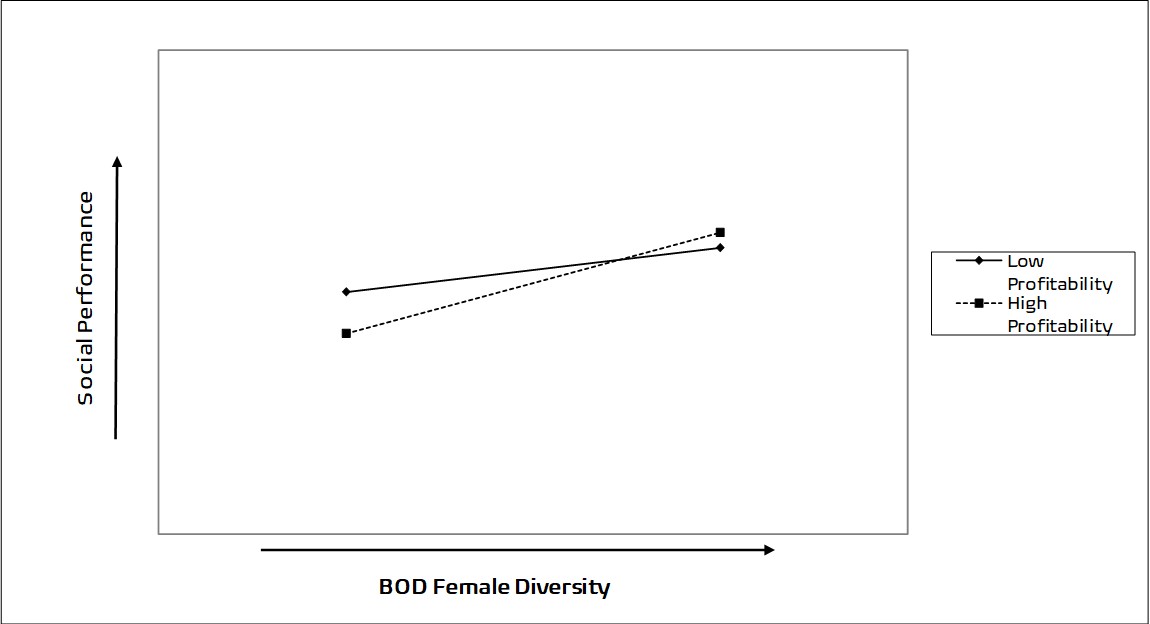
Using upper-echelon theory and the notion of managerial slack as a conceptual base, this study examines the moderating effect of profitability on the relationship of board of directors (BOD) gender diversity with social performance. This study's sample is based on a matched dataset of insurance firms using two reliable sources, namely S & P Global IQ and Refinitiv (now known as LSEG Data & Analytics). We focus on a single industry from a single country as it will allow for a reasonable performance comparison across firms. We use step-wise multiple regression models to test the hypotheses. Our findings indicate that gender-diverse boards are positively related to the social performance of firms. We find the strength of this relationship to vary according to the profitability of the firm. Study findings advance our knowledge of the corporate governance literature on this topic by bringing the notion of managerial discretion into the relationship between BOD diversity and social performance.
Citation: B. Elango. How does profitability impact the relationship between gender diversity on boards of directors and social performance?[J]. Green Finance, 2025, 7(3): 481-494. doi: 10.3934/GF.2025018
Using upper-echelon theory and the notion of managerial slack as a conceptual base, this study examines the moderating effect of profitability on the relationship of board of directors (BOD) gender diversity with social performance. This study's sample is based on a matched dataset of insurance firms using two reliable sources, namely S & P Global IQ and Refinitiv (now known as LSEG Data & Analytics). We focus on a single industry from a single country as it will allow for a reasonable performance comparison across firms. We use step-wise multiple regression models to test the hypotheses. Our findings indicate that gender-diverse boards are positively related to the social performance of firms. We find the strength of this relationship to vary according to the profitability of the firm. Study findings advance our knowledge of the corporate governance literature on this topic by bringing the notion of managerial discretion into the relationship between BOD diversity and social performance.

| [1] |
Adams RB (2016) Women on boards: The superheroes of tomorrow? Leadership Quart 27: 371–386. https://doi.org/10.1016/j.leaqua.2015.12.007 doi: 10.1016/j.leaqua.2015.12.007

|
| [2] |
Adams RB, Ferreira D (2009) Women in the boardroom and their impact on governance and performance. J Financ Econ 94: 291–309. https://doi.org/10.1016/j.jfinec.2008.10.007 doi: 10.1016/j.jfinec.2008.10.007
|
| [3] |
Adams RB, Gray S, Nowland J (2011) Does Gender Matter in the Boardroom? Evidence From the Market Reaction to Mandatory New Director Announcements. Available at SSRN. https://dx.doi.org/10.2139/ssrn.1953152 doi: 10.2139/ssrn.1953152
|
| [4] |
Bear S, Rahman N, Post C (2010) The impact of board diversity and gender composition on corporate social responsibility and firm reputation. J Bus Ethics 97: 207–221. https://doi.org/10.1007/s10551-010-0505-2 doi: 10.1007/s10551-010-0505-2
|
| [5] | Boeker W (1997) Strategic change: The influence of managerial characteristics and organizational growth. Acad Manage J 40: 152–170. https://psycnet.apa.org/doi/10.2307/257024 |
| [6] |
Boulouta I (2013) Hidden connections: The link between board gender diversity and corporate social performance. J Bus Ethics 113: 185–197. https://doi.org/10.1007/s10551-012-1293-7 doi: 10.1007/s10551-012-1293-7
|
| [7] |
Burgess Z, Tharenou P (2002) Women board directors: Characteristics of the few. J Bus Ethics 37: 39–49. https://doi.org/10.1023/A:1014726001155 doi: 10.1023/A:1014726001155
|
| [8] |
Byron K, Post C (2016) Women on boards of directors and corporate social performance: A meta-analysis. Corp Gov-Int J Bus S 24: 428–442. https://doi.org/10.1111/corg.12165 doi: 10.1111/corg.12165
|
| [9] |
Child J (1972) Organizational structure, environment and performance: The role of strategic choice. Sociology 6: 1–22. https://doi.org/10.1177/003803857200600101 doi: 10.1177/003803857200600101
|
| [10] |
Clément A, Robinot É, Trespeuch L (2025) The use of ESG scores in academic literature: a systematic literature review. J Enterp Communities 19: 92–110. https://doi.org/10.1108/JEC-10-2022-0147 doi: 10.1108/JEC-10-2022-0147
|
| [11] | Cyert RM, March JG (1963) A Behavioral Theory of the Firm. Prentice-Hall. |
| [12] |
Drempetic S, Klein C, Zwergel B (2020) The influence of firm size on the ESG score: Corporate sustainability ratings under review. J Bus Ethics 167: 333–360. https://doi.org/10.1007/s10551-019-04164-1 doi: 10.1007/s10551-019-04164-1
|
| [13] |
Dobrick J, Klein C, Zwergel B (2023) Size bias in Refinitiv ESG data. Financ Res Lett 55: 104014. https://doi.org/10.1016/j.frl.2023.104014 doi: 10.1016/j.frl.2023.104014
|
| [14] |
Donaldson T, Dunfee TW (1994) Toward a unified conception of business ethics: Integrative social contracts theory. Acad Manage Rev 19: 252–284. https://doi.org/10.2307/258705 doi: 10.2307/258705
|
| [15] | Eagly AH (1987) Sex Differences in Social Behavior: A Social-Role Interpretation. Erlbaum. |
| [16] | Eagly AH, Wood W (2012) Social role theory. In: P.A.M. Van Lange, A.W. Kruglanski, & E.T. Higgins (Eds.), Handbook of Theories of Social Psychology, 2: 458–476. SAGE Publications. https://doi.org/10.4135/9781446249222.n49 |
| [17] |
Elango B (2019) When do women reach the top spot? A multilevel study of female CEOs in emerging markets. Manage Decis 57: 2344–2357. https://doi.org/10.1108/MD-11-2017-1147 doi: 10.1108/MD-11-2017-1147
|
| [18] |
Elango B (2023) Do gender-diverse boards lead to selection of female CEOs: a study of life insurance firms in the USA. Int J Bus Gov Ethics 17: 279–292. https://doi.org/10.1504/IJBGE.2023.130090 doi: 10.1504/IJBGE.2023.130090
|
| [19] |
Endrikat J, De Villiers, C, Guenther TW, et al (2021) Board characteristics and corporate social responsibility: A meta-analytic investigation. Bus Soc 60: 2099–2135. https://doi.org/10.1177/0007650320930638 doi: 10.1177/0007650320930638
|
| [20] |
Finkelstein S, Hambric DC (1990) Top-management-team tenure and organizational outcomes: The moderating role of managerial discretion. Admin Sci Q 35: 484–503. https://doi.org/10.2307/2393314 doi: 10.2307/2393314
|
| [21] |
Galletta S, Mazzù S, Naciti V, et al. (2022) Gender diversity and sustainability performance in the banking industry. Corp Soc Resp Environ Manage 29: 161–174. https://doi.org/10.1002/csr.2191 doi: 10.1002/csr.2191
|
| [22] | Gilligan C (1982) In a Different Voice: Psychological Theory and Women's Development. Cambridge, Mass: Harvard University Press. |
| [23] | Greene WH (2018) Econometric analysis. 2018. |
| [24] |
Gutek BA, Morasch B (1982) Sex-ratios, sex-role spillover, and sexual harassment of women at work. J Soc Issues 38: 55–74. https://doi.org/10.1111/j.1540-4560.1982.tb01910.x doi: 10.1111/j.1540-4560.1982.tb01910.x
|
| [25] |
Guerrero-Villegas J, Pérez-Calero L, Hurtado-González JM, et al. (2018) Board attributes and corporate social responsibility disclosure: A meta-analysis. Sustainability 10: 4808. https://doi.org/10.3390/su10124808 doi: 10.3390/su10124808
|
| [26] | Hambrick DC (2007) Upper echelons theory: An update. Acad Manage Rev 32: 334–343. https://www.jstor.org/stable/20159303 |
| [27] | Hambrick DC, Finkelstein S (1987) Managerial discretion: A bridge between polar views of organizational outcomes. Res Organ Behav 9: 369–406. |
| [28] |
Hambrick DC, Mason PA (1984) Upper echelons: The organization as a reflection of its top managers. Acad Manage Rev 9: 193–206. https://doi.org/10.2307/258434 doi: 10.2307/258434
|
| [29] | Harjoto M, Laksmana I, Lee R (2015) Board diversity and corporate social responsibility. J Bus Ethics 132: 641–660. https://www.jstor.org/stable/24703556 |
| [30] |
Harrison JS, Bosse DA, Phillips RA (2010) Managing for stakeholders, stakeholder utility functions, and competitive advantage. Strategic Manag J 31: 58–74. https://doi.org/10.1002/smj.801 doi: 10.1002/smj.801
|
| [31] |
Hartzmark SM, Sussman AB (2019) Do investors value sustainability? A natural experiment examining ranking and fund flows. J Financ 74: 2789–2837. https://doi.org/10.1111/jofi.12841 doi: 10.1111/jofi.12841
|
| [32] |
Iannuzzi AP, Dell'Atti S, D'Apolito E, et al. (2023) Nomination committee characteristics and exposure to environmental, social and governance (ESG) controversies: Evidence from European Global Systemically Important Banks. Corp Gov-Int J Bus S 23: 1314–1338. https://doi.org/10.1108/cg-03-2022-0119 doi: 10.1108/cg-03-2022-0119
|
| [33] |
Ibrahim NA, Angelidis JP (1994) Effect of board members gender on corporate social responsiveness orientation. J Appl Bus Res 10: 35–40. https://doi.org/10.19030/jabr.v10i1.5961 doi: 10.19030/jabr.v10i1.5961
|
| [34] |
Larcker DF, Tayan B, Watts EM (2022) Seven myths of ESG. Eur Financ Manage 28: 869–882. https://doi.org/10.1111/eufm.12378 doi: 10.1111/eufm.12378
|
| [35] |
Landry EE, Bernardi RA, Bosco SM (2016) Recognition for sustained corporate social responsibility: Female directors make a difference. Corp Soc Resp Env Manag 23: 27–36. https://doi.org/10.1002/csr.1358 doi: 10.1002/csr.1358
|
| [36] |
Larrieta-Rubín de Celis I, Velasco-Balmaseda E, Fernández de Bobadilla S, et al. (2015) Does having women managers lead to increased gender equality practices in corporate social responsibility? Bus Ethics 24: 91–110. https://doi.org/10.1111/beer.12081 doi: 10.1111/beer.12081
|
| [37] |
Levy DT (1984) Variation in the Concentration-Profit Relationship across Industries. South Econ J 51: 267–273. https://doi.org/10.2307/1058338 doi: 10.2307/1058338
|
| [38] |
Liao L, Luo L, Tang Q (2015) Gender diversity, board independence, environmental committee and greenhouse gas disclosure. British Account Rev 47: 409–424. https://doi.org/10.1016/j.bar.2014.01.002 doi: 10.1016/j.bar.2014.01.002
|
| [39] | Lind EA, Tyler TR (1988) The Social Psychology of Procedural Justice. Springer Science & Business Media. |
| [40] |
Liu C (2018) Are women greener? Corporate gender diversity and environmental violations. J Corp Financ 52: 118–142. https://doi.org/10.1016/j.jcorpfin.2018.08.004 doi: 10.1016/j.jcorpfin.2018.08.004
|
| [41] |
Nerantzidis M, Tzeremes P, Koutoupis A, et al. (2022) Exploring the black box: Board gender diversity and corporate social performance. Financ Res Lett 48: 102987. https://doi.org/10.1016/j.frl.2022.102987 doi: 10.1016/j.frl.2022.102987
|
| [42] |
Nguyen THH, Ntim CG, Malagila JK (2020) Women on corporate boards and corporate financial and non-financial performance: A systematic literature review and future research agenda. Int Rev Financ Anal 71: 101554. https://doi.org/10.1016/j.irfa.2020.101554 doi: 10.1016/j.irfa.2020.101554
|
| [43] | Pfeffer J, Salancik GR (1978) The External Control of Organizations: A Resource Dependence Perspective. Harper & Row. |
| [44] | Porter ME (1980) Competitive Strategy: Techniques for Analyzing Industries and Competitors. Free Press. |
| [45] |
Setó-Pamies D (2015) The relationship between women directors and corporate social responsibility. Corp Soc Resp Env Manage 22: 334–345. https://doi.org/10.1002/csr.1352 doi: 10.1002/csr.1352
|
| [46] | Singh J, Yadav P (2013) Return on capital employed-A tool for analyzing profitability of companies. Int J Techno-Manage Res 1: 1–13. |
| [47] |
Tantalo C, Priem RL (2016) Value creation through stakeholder synergy. Strategic Manage J 37: 314–329. https://doi.org/10.1002/smj.2366 doi: 10.1002/smj.2366
|
| [48] |
Terjesen S, Couto EB, Francisco PM (2016) Does the presence of independent and female directors impact firm performance? A multi-country study. J Manage Gov 20: 447–483. https://doi.org/10.1007/s10997-014-9307-8 doi: 10.1007/s10997-014-9307-8
|
| [49] |
Velte P (2022) Meta-analyses on corporate social responsibility (CSR): A literature review. Manage Rev Q 72: 627–675. https://doi.org/10.1007/s11301-021-00211-2 doi: 10.1007/s11301-021-00211-2
|
| [50] |
Wasiuzzaman S, Wan Mohammad WM (2020) Board gender diversity and transparency of environmental, social and governance disclosure: Evidence from Malaysia. Manag Decis Econ 41: 145–156. https://doi.org/10.1002/mde.3099 doi: 10.1002/mde.3099
|
| [51] |
Wu Q, Furuoka F, Lau SC (2022) Corporate social responsibility and board gender diversity: A meta-analysis. Manage Res Rev 45: 956–983. https://doi.org/10.1108/MRR-02-2021-0136 doi: 10.1108/MRR-02-2021-0136
|
| [52] |
Xu E, Yang H, Quan JM, et al. (2015) Organizational slack and corporate social performance: Empirical evidence from China's public firms. Asia Pac J Manag 32: 181–198. https://doi.org/10.1007/s10490-014-9401-0 doi: 10.1007/s10490-014-9401-0
|
Figures(1) / Tables(2)

B. Elango. How does profitability impact the relationship between gender diversity on boards of directors and social performance?[J]. Green Finance, 2025, 7(3): 481-494. doi: 10.3934/GF.2025018





 DownLoad: