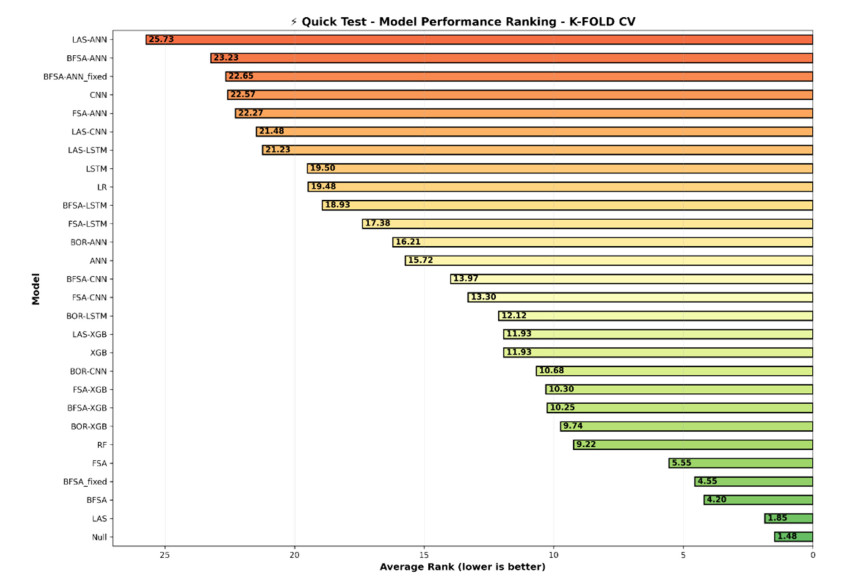
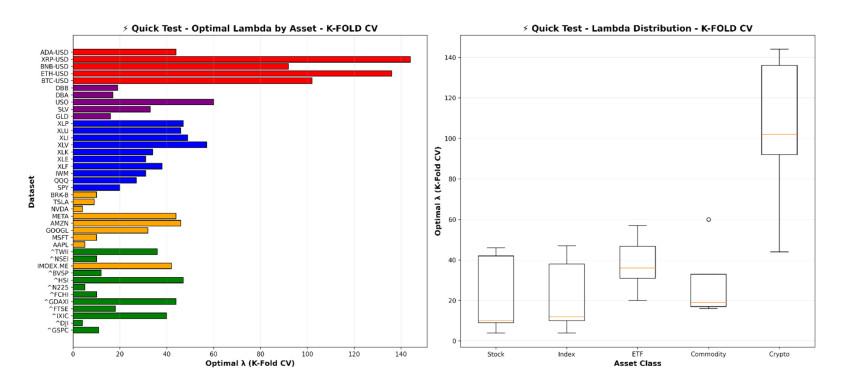
In financial forecasting, model selection has become a crucial problem because large-dimensional spaces of technical indicators need to be analyzed using meaningful signals in return series that are noisy and weakly predictive. Algorithms such as the feature selection algorithm (FSA), which apply simulated annealing to find sparse predictive subsets, have demonstrated good performance but have a methodological weakness: they habitually predict positive price changes by approximately 54% rather than a neutral 50/50 benchmark. This directional bias can distort long–short strategies, inflate hidden risk exposures, and undermine the reliability of model-driven trading systems. Although previous studies have shown the advantages of FSA in terms of sparsity and accuracy, its distributional balance in predictions has not yet been addressed, posing an unmet need in financial machine learning. To address this drawback, this paper presents the bias-corrected feature selection algorithm (BFSA), which extends the FSA loss to impose a direct penalty for deviations from a neutral benchmark of 0.5. The robustness of the penalty (λ_bias) was optimized using asset-specific five-fold chronological cross-validation, which enables BFSA to control its bias correction across varying volatility regimes and structural properties. BFSA was tested on daily Open, High, Low, Close, Volume (OHLCV) data for 40 assets tracking developed and emerging equity indices, major US-based equities, sector ETFs, commodities, and crypto markets, spanning over a decade of market history. BFSA achieved an average rank of 4.20, representing the strongest performance among all non-trivial predictive models. Only the Null model (1.48) and LASSO (1.85) obtained lower ranks, reflecting their simplicity rather than genuine predictive structure. BFSA outperformed the original FSA (5.55), all tree-based ensembles (ranks 9–12), and all deep learning hybrids (ranks 15–25), demonstrating that explicit bias control materially improves generalization in noisy financial settings. Cross-validated λ tuning improved performance in approximately 48% of assets and slightly degraded it in 52%, resulting in a near-zero net change in MSE. This indicates that the default λ_bias = 30 already has a robust general setting, while cross-validation primarily safeguards against severe hyperparameter misspecification in high-volatility assets. The wide dispersion in optimal λ values (4–135) highlights the structural heterogeneity of directional bias across asset classes. BFSA materially reduced the upward directional skew of FSA (mean prediction 0.537) and produced nearly balanced outputs (0.503), substantially improving calibration for long–short and market-neutral strategies.
Citation: David Jukl, Eva Daniela Cvik. Bias-Corrected feature selection for financial time series forecasting: a large-scale evaluation across 40 global assets[J]. Data Science in Finance and Economics, 2026, 6(3): 359-396. doi: 10.3934/DSFE.2026013
In financial forecasting, model selection has become a crucial problem because large-dimensional spaces of technical indicators need to be analyzed using meaningful signals in return series that are noisy and weakly predictive. Algorithms such as the feature selection algorithm (FSA), which apply simulated annealing to find sparse predictive subsets, have demonstrated good performance but have a methodological weakness: they habitually predict positive price changes by approximately 54% rather than a neutral 50/50 benchmark. This directional bias can distort long–short strategies, inflate hidden risk exposures, and undermine the reliability of model-driven trading systems. Although previous studies have shown the advantages of FSA in terms of sparsity and accuracy, its distributional balance in predictions has not yet been addressed, posing an unmet need in financial machine learning. To address this drawback, this paper presents the bias-corrected feature selection algorithm (BFSA), which extends the FSA loss to impose a direct penalty for deviations from a neutral benchmark of 0.5. The robustness of the penalty (λ_bias) was optimized using asset-specific five-fold chronological cross-validation, which enables BFSA to control its bias correction across varying volatility regimes and structural properties. BFSA was tested on daily Open, High, Low, Close, Volume (OHLCV) data for 40 assets tracking developed and emerging equity indices, major US-based equities, sector ETFs, commodities, and crypto markets, spanning over a decade of market history. BFSA achieved an average rank of 4.20, representing the strongest performance among all non-trivial predictive models. Only the Null model (1.48) and LASSO (1.85) obtained lower ranks, reflecting their simplicity rather than genuine predictive structure. BFSA outperformed the original FSA (5.55), all tree-based ensembles (ranks 9–12), and all deep learning hybrids (ranks 15–25), demonstrating that explicit bias control materially improves generalization in noisy financial settings. Cross-validated λ tuning improved performance in approximately 48% of assets and slightly degraded it in 52%, resulting in a near-zero net change in MSE. This indicates that the default λ_bias = 30 already has a robust general setting, while cross-validation primarily safeguards against severe hyperparameter misspecification in high-volatility assets. The wide dispersion in optimal λ values (4–135) highlights the structural heterogeneity of directional bias across asset classes. BFSA materially reduced the upward directional skew of FSA (mean prediction 0.537) and produced nearly balanced outputs (0.503), substantially improving calibration for long–short and market-neutral strategies.

| [1] |
Ahmadianfar I, Heidari AA, Noshadian S, et al. (2022) INFO: An efficient optimisation algorithm based on weighted mean of vectors. Expert Syst Appl 195: 116516. https://doi.org/10.1016/j.eswa.2022.116516 doi: 10.1016/j.eswa.2022.116516

|
| [2] |
Bloch DA (2025) A Course on Systematic Trading with RMA. SSRN Electron J. https://doi.org/10.2139/ssrn.5278107 doi: 10.2139/ssrn.5278107
|
| [3] |
Celik E, Dal D (2021) A novel simulated annealing-based optimisation approach for cluster-based task scheduling. Cluster Comput 24: 2927–2956. https://doi.org/10.1007/s10586-021-03275-7 doi: 10.1007/s10586-021-03275-7
|
| [4] | Corvers X (2025) Enhancing Trustworthiness in Algorithmic Stock Forecasting using Multi-Model Machine Learning and Historical Similarity. UHasselt Repository. http://hdl.handle.net/1942/47198 |
| [5] |
de Castro Vieira JR, Barboza F, Cajueiro D, et al. (2025) Towards Fair AI: Mitigating Bias in Credit Decisions—A Systematic Literature Review. J Risk Financ Manag 18: 228. https://doi.org/10.3390/jrfm18050228 doi: 10.3390/jrfm18050228
|
| [6] |
Elmousalami HH (2019) Artificial Intelligence and Parametric Construction Cost Estimate Modelling: State-of-the-Art Review. J Constr Eng Manag 146(1). https://doi.org/10.1061/(asce)co.1943-7862.0001678 doi: 10.1061/(asce)co.1943-7862.0001678
|
| [7] |
Gu S, Kelly B, Xiu D (2020) Empirical Asset Pricing via Machine Learning. Rev Financ Stud 33: 2223–2273. https://doi.org/10.1093/rfs/hhaa009 doi: 10.1093/rfs/hhaa009
|
| [8] |
Holzinger A, Goebel R, Fong R, et al. (2022) xxAI - Beyond Explainable Artificial Intelligence. Lect Notes Comput Sci 3–10. https://doi.org/10.1007/978-3-031-04083-2_1 doi: 10.1007/978-3-031-04083-2_1
|
| [9] |
Hort M, Chen Z, Zhang JM, et al. (2023) Bias Mitigation for Machine Learning Classifiers: A Comprehensive Survey. ACM J Responsib Comput 1: 1–52. https://doi.org/10.1145/3631326 doi: 10.1145/3631326
|
| [10] | Hyndman RJ, Athanasopoulos G (2018) Forecasting: principles and practice. OTexts. Available from: https://books.google.com.pk/books?hl=en&lr=&id=_bBhDwAAQBAJ&oi=fnd&pg=PA7&dq=Hyndman,+R.+J.,+%26+Athanasopoulos,+G.+(2021).+Forecasting:+Principles+and+practice+(3rd+ed.).+OTexts.&ots=TjkZviUQFI&sig=QjC2LnkRSn4jBvh7HQAXIWZoc9Q&redir_esc=y#v=onepage&q&f=false |
| [11] |
Ismail A, Mjlae SA, Rababa'h SY, et al. (2025) Comparative Analysis of Machine Learning Libraries for Neural Networks: A Benchmarking Study. bioRxiv. https://doi.org/10.1101/2025.02.02.635632 doi: 10.1101/2025.02.02.635632
|
| [12] |
Jukl D, Lánský J (2025) Systematic Review on Algorithmic Trading. Acta Inform Pragensia 14: 506–534. https://doi.org/10.18267/j.aip.276 doi: 10.18267/j.aip.276
|
| [13] |
Kim W, Jeon J, Jang M, et al. (2024) Developing a Dynamic Feature Selection System (DFSS) for Stock Market Prediction: Application to the Korean Industry Sectors. Appl Sci 14: 7314. https://doi.org/10.3390/app14167314 doi: 10.3390/app14167314
|
| [14] |
Makridakis S, Spiliotis E, Assimakopoulos V (2018) Statistical and Machine Learning forecasting methods: Concerns and ways forward. PLoS One 13: e0194889. https://doi.org/10.1371/journal.pone.0194889 doi: 10.1371/journal.pone.0194889
|
| [15] |
Manikandan G, Pragadeesh B, Manojkumar V, et al. (2024) Classification models combined with Boruta feature selection for heart disease prediction. Inform Med Unlocked 44: 101442. https://doi.org/10.1016/j.imu.2023.101442 doi: 10.1016/j.imu.2023.101442
|
| [16] |
Mayada C (2025) Evaluating ML models in modern portfolio diversification – a theoretical empirical approach. Int J Educ Bus Econ Res 05: 422–436. https://doi.org/10.59822/ijeber.2025.5322 doi: 10.59822/ijeber.2025.5322
|
| [17] | Murithi D (2024) Enhanced Synthetic Minority Oversampling Technique (Smote) Based Model for Enhancing Accuracy In Credit Modelling. Tharaka University Repository. http://repository.tharaka.ac.ke/xmlui/handle/1/4386 |
| [18] | Nkansah H (2017) Least squares optimisation with L1-norm regularisation. UCC Repository. https://doi.org/23105496 |
| [19] |
Pabuccu H, Barbu A (2024) Feature selection with annealing for forecasting financial time series. Financ Innov 10(1). https://doi.org/10.1186/s40854-024-00617-3 doi: 10.1186/s40854-024-00617-3
|
| [20] |
Peterson NJ, He NY (2025) An Invariant and Balanced Deep Learning Approach for Financial Risk Assessment. Front Interdiscip Appl Sci 2: 47–59. https://doi.org/10.71465/fias.v2i01.15 doi: 10.71465/fias.v2i01.15
|
| [21] |
Piles M, Bergsma R, Gianola D, et al. (2021) Feature Selection Stability and Accuracy of Prediction Models for Genomic Prediction of Residual Feed Intake in Pigs Using Machine Learning. Front Genet 12: 611506. https://doi.org/10.3389/fgene.2021.611506 doi: 10.3389/fgene.2021.611506
|
| [22] |
Pudjihartono N, Fadason T, Kempa-Liehr AW, et al. (2022) A Review of Feature Selection Methods for Machine Learning-Based Disease Risk Prediction. Front Bioinform 2: 927312. https://doi.org/10.3389/fbinf.2022.927312 doi: 10.3389/fbinf.2022.927312
|
| [23] |
Roy K, Farid DM (2024) An Adaptive Feature Selection Algorithm for Student Performance Prediction. IEEE Access 12: 75577–75598. https://doi.org/10.1109/access.2024.3406252 doi: 10.1109/access.2024.3406252
|
| [24] |
Schuetze BA, Yan VX (2023) Psychology Faculty Overestimate the Magnitude of Cohen's d Effect Sizes by Half a Standard Deviation. Collabra Psychol 9: 74020. https://doi.org/10.1525/collabra.74020 doi: 10.1525/collabra.74020
|
| [25] |
Sheng Z, Liu Q, Hu Y, Liu H (2025) A Multi-Feature Stock Index Forecasting Approach Based on LASSO Feature Selection and Non-Stationary Autoformer. Electronics 14: 2059. https://doi.org/10.3390/electronics14102059 doi: 10.3390/electronics14102059
|
| [26] | Silva M (2021) Exploring the impact of different behaviours on fairness and efficiency in MADRL. Master's thesis, Universidade do Porto. https://www.proquest.com/openview/c0e6221953281817ff880f0b965007cd/1?pq-origsite = gscholar & cbl = 2026366 & diss = y |
| [27] |
Sisk R, Sperrin M, Peek N, et al. (2023) Imputation and missing indicators for handling missing data in the development and deployment of clinical prediction models: A simulation study. Stat Methods Med Res 32: 1461–1477. https://doi.org/10.1177/09622802231165001 doi: 10.1177/09622802231165001
|
| [28] |
Taha ZY, Abdullah AA, Rashid TA (2025) Optimising feature selection with genetic algorithms: a review of methods and applications. Knowl Inf Syst 67: 9739–9778. https://doi.org/10.1007/s10115-025-02515-1 doi: 10.1007/s10115-025-02515-1
|
| [29] |
Tang A, Quan P, Niu L, Shi Y (2022) A Survey for Sparse Regularisation Based Compression Methods. Ann Data Sci 9: 695–722. https://doi.org/10.1007/s40745-022-00389-6 doi: 10.1007/s40745-022-00389-6
|
| [30] |
Wilson S (2025) Post-hoc feature-based out-of-distribution detection for real-world conditions. QUT ePrints. https://doi.org/10.5204/thesis.eprints.246678 doi: 10.5204/thesis.eprints.246678
|
| [31] |
Wongvorachan T, Bulut O, Liu JX, et al. (2024) A Comparison of Bias Mitigation Techniques for Educational Classification Tasks Using Supervised Machine Learning. Information 15: 326. https://doi.org/10.3390/info15060326 doi: 10.3390/info15060326
|
| [32] |
Zhang W, Xiao G, Gen M, et al. (2024) Enhancing multi-objective evolutionary algorithms with machine learning for scheduling problems: recent advances and survey. Front Ind Eng 2: 1337174. https://doi.org/10.3389/fieng.2024.1337174 doi: 10.3389/fieng.2024.1337174
|
| [33] |
Zhao Y, Zhang W, Liu X (2024) Grid search with a weighted error function: Hyper-parameter optimisation for financial time series forecasting. Appl Soft Comput 154: 111362. https://doi.org/10.1016/j.asoc.2024.111362 doi: 10.1016/j.asoc.2024.111362
|
 DSFE-06-03-013-s001.rar |
 |
Figures(3) / Tables(9)
David Jukl, Eva Daniela Cvik. Bias-Corrected feature selection for financial time series forecasting: a large-scale evaluation across 40 global assets[J]. Data Science in Finance and Economics, 2026, 6(3): 359-396. doi: 10.3934/DSFE.2026013





 DownLoad: