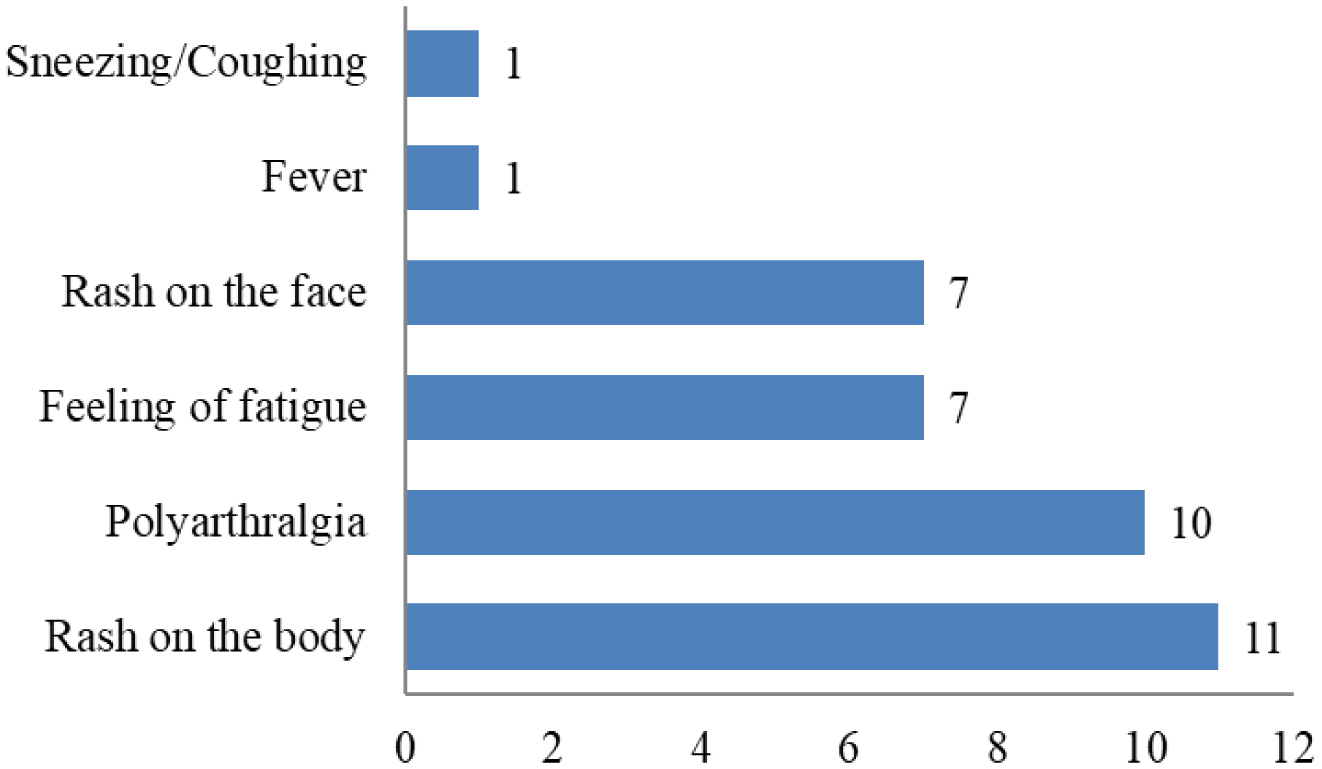
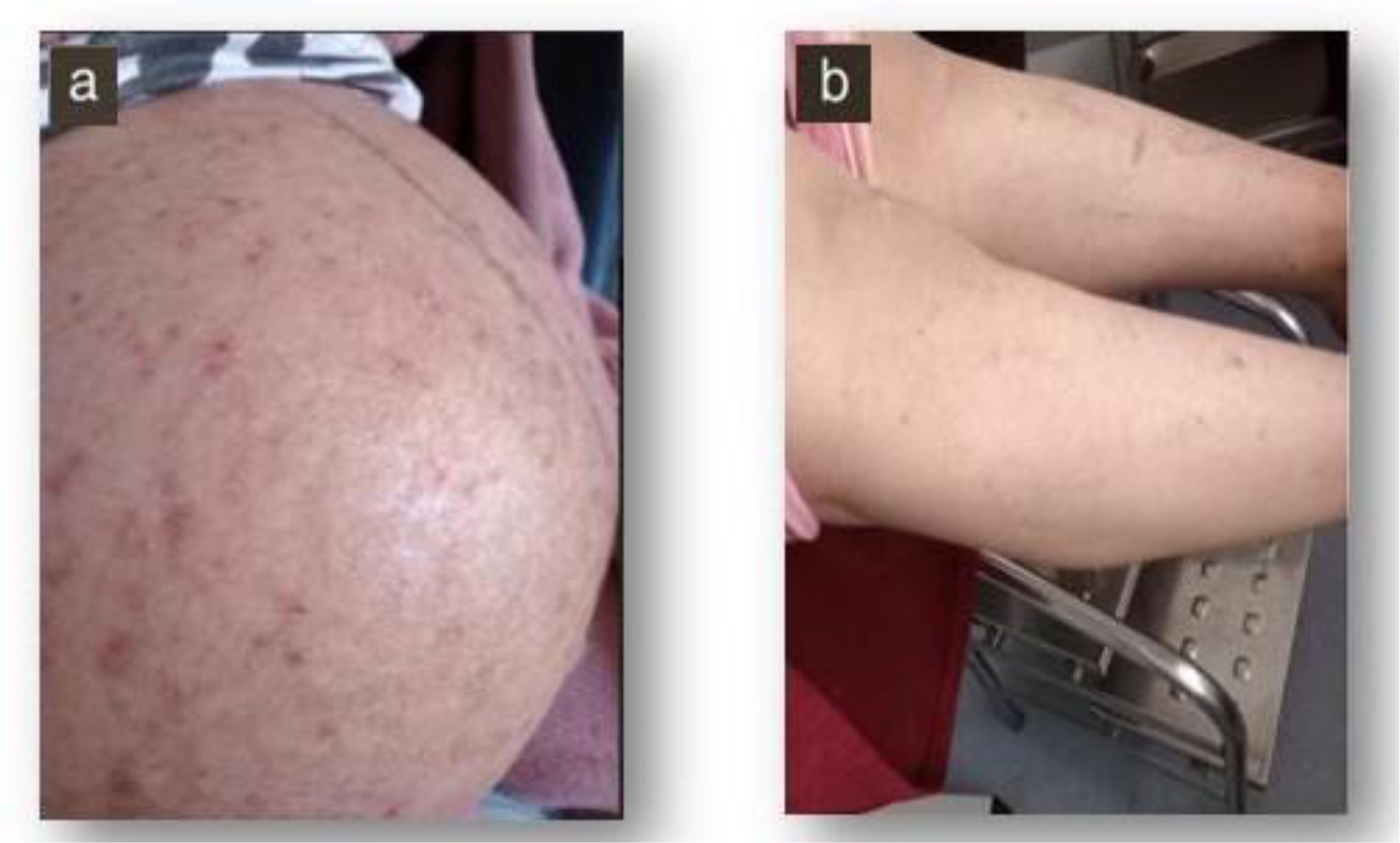
Parvovirus B19 (B19V) is a contagious virus. It is responsible for a wide range of clinical manifestations, from spontaneously resolving illness to potentially fatal and severe conditions in at risk individuals such as pregnant women. This study would enable the investigation of clinical and biological manifestations as well as adverse fetal outcomes in pregnant women with recent infection. We reported a series of 16 pregnant women with primary B19V infection. Diagnosis was clinical, serological, and molecular. Real-time PCR molecular analysis was performed on all pregnant women with recent B19V infection. Viral DNA was detected in 3 women. Mothers with recent B19V infection were symptomatic in 68.75% (11/16) of cases, and 62.5% (10/16) had developed arthralgia associated with a rash. Anemia was present in half the women with recent infection, with only one case of thrombocytopenia. Postnatal follow-up of the infected mothers showed that 13 women gave birth to healthy new borns. Two patients experienced a spontaneous abortion, and another gave birth to a premature infant. Given the complications of B19V infection, the assessment of maternal infection is important and should be considered within the framework of the fetal and maternal health policy in Morocco.
Citation: Majda Bouraddane, Karima Warda, Sara Amari, Youssef El Kamouni, Lamiae Arsalane, Karam Harou, Abderraouf Soumani, Said Zouhair. Primary parvovirus B19 infection in immunocompetent pregnancies: Clinical features and outcomes of 16 prospective cases[J]. AIMS Allergy and Immunology, 2026, 10(3): 131-142. doi: 10.3934/Allergy.2026011
Parvovirus B19 (B19V) is a contagious virus. It is responsible for a wide range of clinical manifestations, from spontaneously resolving illness to potentially fatal and severe conditions in at risk individuals such as pregnant women. This study would enable the investigation of clinical and biological manifestations as well as adverse fetal outcomes in pregnant women with recent infection. We reported a series of 16 pregnant women with primary B19V infection. Diagnosis was clinical, serological, and molecular. Real-time PCR molecular analysis was performed on all pregnant women with recent B19V infection. Viral DNA was detected in 3 women. Mothers with recent B19V infection were symptomatic in 68.75% (11/16) of cases, and 62.5% (10/16) had developed arthralgia associated with a rash. Anemia was present in half the women with recent infection, with only one case of thrombocytopenia. Postnatal follow-up of the infected mothers showed that 13 women gave birth to healthy new borns. Two patients experienced a spontaneous abortion, and another gave birth to a premature infant. Given the complications of B19V infection, the assessment of maternal infection is important and should be considered within the framework of the fetal and maternal health policy in Morocco.

| [1] |
Cotmore SF, Agbandje-McKenna M, Canuti M, et al. (2019) ICTV virus taxonomy profile: Parvoviridae. J Gen Virol 100: 367-368. https://doi.org/10.1099/jgv.0.001212 
|
| [2] |
Gigi CE, Anumba DOC (2021) Parvovirus B19 infection in pregnancy—A review. Eur J Obstet Gynecol Reprod Biol 264: 358-362. https://doi.org/10.1016/j.ejogrb.2021.07.046
|
| [3] | Zakrzewska K, Arvia R, Bua G, et al. (2023) Parvovirus B19: Insights and implication for pathogenesis, prevention and therapy. Asp Mol Med 1: 1-11. https://doi.org/10.1016/j.amolm.2023.100007 |
| [4] |
Parra D, Mekki Y, Durieu I, et al. (2014) Manifestations cliniques et biologiques de la primo-infection à Parvovirus B19 chez l'adulte immunocompétent: Étude rétrospective de 26 observations. Rev Med Interne 35: 289-296. https://doi.org/10.1016/j.revmed.2013.04.015
|
| [5] |
Bonvicini F, Bua G, Gallinella G (2017) Parvovirus B19 infection in pregnancy awareness and opportunities. Curr Opin Virol 27: 8-14. https://doi.org/10.1016/j.coviro.2017.10.003
|
| [6] |
Ornoy A, Ergaz Z (2017) Parvovirus B19 infection during pregnancy and risks to the fetus. Birth Defects Res 109: 311-323. https://doi.org/10.1002/bdra.23588
|
| [7] |
Enders M, Klingel K, Weidner A, et al. (2012) Risk of fetal hydrops and non-hydropic late intrauterine fetal death after gestational parvovirus B19 infection. J Clin Virol 49: 163-168. https://doi.org/10.1016/j.jcv.2010.07.014
|
| [8] |
Bascietto F, Liberati M, Murgano D, et al. (2018) Outcome of fetuses with congenital parvovirus B19 infection: Systematic review and meta-analysis. Ultrasound Obstet Gynecol 52: 569-576. https://doi.org/10.1002/uog.19092
|
| [9] |
Bonvicini F, Puccetti C, Salfi NCM, et al. (2011) Gestational and fetal outcomes in B19 maternal infection: A problem of diagnosis. J Clin Microbiol 49: 3514-3518. https://doi.org/10.1128/JCM.00854-11
|
| [10] |
Puccetti C, Contoli M, Bonvicini F, et al. (2012) Parvovirus B19 in pregnancy: Possible consequences of vertical transmission. Prenat Diagn 32: 897-902. https://doi.org/10.1002/pd.3930
|
| [11] |
Segata M, Chaoui R, Khalek N, et al. (2007) Fetal thrombocytopenia secondary to parvovirus infection. Am J Obstet Gynecol 196: 61.E1-61.E4. https://doi.org/10.1016/j.ajog.2006.08.041
|
| [12] |
Oiwa H, Shimada T, Hashimoto M, et al. (2011) Clinical findings in parvovirus B19 infection in 30 adult patients in Kyoto. Mod Rheumatol 21: 24-31. https://doi.org/10.3109/s10165-010-0338-y
|
| [13] |
Jensen P, Thorsen P, Jeune B, et al. (2000) An epidemic of parvovirus B19 in a population of 3596 pregnant women: A study of sociodemographic and medical risk factors. BJOG Int J Obstet Gynaecol 107: 637-643. https://doi.org/10.1111/j.1471-0528.2000.tb13306.x
|
| [14] | Van Beers-Tas M, Heidema J (2013) Review: Pathogenesis of parvovirus infections in children. Virol Mycol 2: 1-5. https://doi.org/10.4172/2161-0517.1000110 |
| [15] |
Chisaka H, Ito K, Niikura H, et al. (2006) Clinical manifestations and outcomes of parvovirus B19 infection during pregnancy in Japan. Tohoku J Exp Med 209: 277-283. https://doi.org/10.1620/tjem.209.277
|
| [16] |
Adam O, Makkawi T, Reber U, et al. (2015) The seroprevalence of parvovirus B19 infection in pregnant women in Sudan. Epidemio Infect 143: 242-248. https://doi.org/10.1017/S0950268814000600
|
| [17] | Karami A, Hoseini SL, Ramazani A, et al. (2020) Prevalence of parvovirus B19 infection by serology and PCR in pregnant women referring to obstetrics and gynecology clinic. J Natl Med Assoc 112: 91-96. https://doi.org/10.1016/j.jnma.2018.12.001 |
| [18] |
Abdelkabeer TH, Mohammed NE, Khider JS, et al. (2022) Detection of parvovirus B19 DNA in pregnant Sudanese women attending the military hospital using Nested PCR technique. Al-Kindy Coll Med J 18: 144-147. https://doi.org/10.47723/kcmj.v18i2.788
|
| [19] |
Taherkhani R, Farshadpour F, Norozi M (2022) Molecular evaluation of human parvovirus B19 infection and associated risk factors among pregnant women in Bushehr province, Southern Iran. Am J Trop Med Hyg 106: 1539-1546. https://doi.org/10.4269/ajtmh.21-1088
|
| [20] |
Servant-Delmas A, Morinet F (2016) Update of the human parvovirus B19 biology. Transfus Clin Biol 23: 5-12. https://doi.org/10.1016/j.tracli.2015.11.006
|
| [21] |
Elnifro E, Nisha AK, Almabsoot M, et al. (2009) Seroprevalence of parvovirus B19 among pregnant women in Tripoli, Libya. J Infect Dev Ctries 3: 218-220. https://doi.org/10.3855/jidc.38
|
| [22] |
Seetha D, Pillai HR, Nori SRC, et al. (2021) Molecular genetic characterization of human parvovirus B19 prevalent in Kerala State, India. Virol J 18: 96. https://doi.org/10.1186/s12985-021-01569-1
|
| [23] |
Beigi RH, Wiesenfeld HC, Landers DV, et al. (2008) High rate of severe fetal outcomes associated with maternal parvovirus B19 infection in pregnancy. Infect Dis Obstet Gynecol 2008: 524601. https://doi.org/10.1155/2008/524601
|
| [24] |
Lassen J, Jensen AKV, Bager P, et al. (2012) Parvovirus B19 infection in the first trimester of pregnancy and risk of fetal loss: A population-based case-control study. Am J Epidemiol 176: 803-807. https://doi.org/10.1093/aje/kws177
|
| [25] |
Kaşi̇Foğlu N, Us T (2016) Parvovirus B19 infections in pregnant women and neonates: Review. Turk Klin J Gynecol Obstet 26: 103-108. https://doi.org/10.5336/gynobstet.2013-38434
|
| [26] |
Riipinen A, Väisänen E, Nuutila M, et al. (2008) Parvovirus B19 infection in fetal deaths. Clin Infect Dis 47: 1519-1525. https://doi.org/10.1086/593190
|
| [27] |
Barlinn R, Trogstad L, Rollag H, et al. (2020) Parvovirus B19 DNAemia in pregnant women in relation to perinatal death: A nested case-control study within a large population-based pregnancy cohort. Acta Obstet Gynecol Scand 99: 856-864. https://doi.org/10.1111/aogs.13801
|
| [28] |
Sarfraz A, Samuelsen S, Bruu AL, et al. (2009) Maternal human parvovirus B19 infection and the risk of fetal death and low birthweight: A case–control study within 35940 pregnant women. BJOG Int J Obstet Gynaecol 116: 1492-1498. https://doi.org/10.1111/j.1471-0528.2009.02211.x
|
| [29] |
Marhamati N, Shirvani F, Azimi L, et al. (2021) Molecular detection of human parvovirus B19 in umbilical cord blood: Case study of Tehran, Iran. Gene Rep 23: 101183. https://doi.org/10.1016/j.genrep.2021.101183
|
| [30] |
De Jong EP, Walther FJ, Kroes ACM, et al. (2011) Parvovirus B19 infection in pregnancy: New insights and management. Prenat Diagn 31: 419-425. https://doi.org/10.1002/pd.2714
|
| [31] |
Lamont RF, Sobel JD, Vaisbuch E, et al. (2011) Parvovirus B19 infection in human pregnancy. BJOG Int J Obstet Gynaecol 118: 175-186. https://doi.org/10.1002/pd.2714
|
| [32] |
Miller E, Fairley CK, Cohen BJ, et al. (1998) Immediate and long term outcome of human parvovirus B19 infection in pregnancy. BJOG Int J Obstet Gynaecol 105: 174-178. https://doi.org/10.1111/j.1471-0528.1998.tb10048.x
|
| [33] |
Nagel HTC, de Haan TR, Vandenbussche FPHA, et al. (2007) Long-term outcome after fetal transfusion for hydrops associated with parvovirus B19 infection. Obstet Gynecol 109: 42-47. https://doi.org/10.1097/01.AOG.0000249611.67873.94
|
| [34] | Malm C, Fridell E, Jansson K (1993) Heart failure after parvovirus B19 infection. Orig Publ 341: 1408-1409. https://doi.org/10.1016/0140-6736(93)90973-K |
Figures(2) / Tables(2)

Majda Bouraddane, Karima Warda, Sara Amari, Youssef El Kamouni, Lamiae Arsalane, Karam Harou, Abderraouf Soumani, Said Zouhair. Primary parvovirus B19 infection in immunocompetent pregnancies: Clinical features and outcomes of 16 prospective cases[J]. AIMS Allergy and Immunology, 2026, 10(3): 131-142. doi: 10.3934/Allergy.2026011




 DownLoad: