To determine the validity of the non-invasive, novel procedure of partial urethral obstruction in adult male rats to induce bladder outlet obstruction (BOO), this study investigated the reproducibility of non-surgical induction of partial urethral obstruction to induce BOO. Effects in the rat model were compared to those of an overactive bladder (OAB) in real-world adult human males. Previous reports of BOO induction in male rats applied an invasive technique through abdominal incision and dissection of the pelvic urethra, which deviates from real-world events of BOO in men.
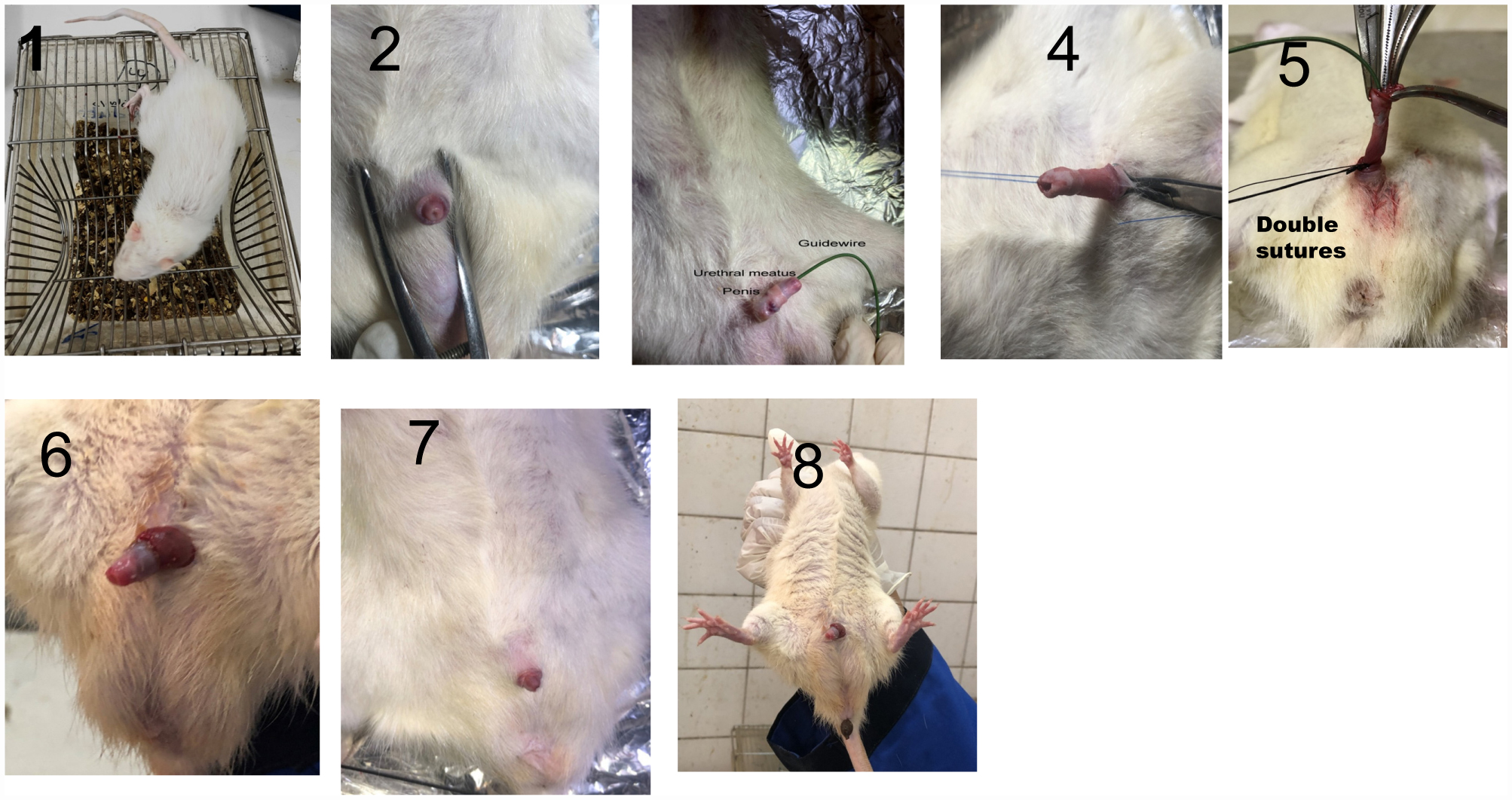
Sixteen adult male Sprague-Dawley rats (16 weeks old, 340 ± 10 g) were randomly divided into three groups: Bladder outlet obstruction group (n = 8), sham group (n = 4), and control group (n = 4). Eight rats underwent induction of BOO with the novel technique. At 8 weeks, the bladders of BOO, sham, and control groups were taken and examined histopathologically. The human study included tissue samples from three patients who had OAB secondary to neurogenic bladder dysfunction and had undergone surgical closure of vesicostomy with excision of the vesicostomy tract; tissue samples were examined histopathologically. Induction of BOO in adult male rats used a non-invasive technique that induces partial urethral occlusion via approaching the urethra at the root of the penis. The subsequent morphological and histological patterns of the male rat BOO were compared to patterns of human OAB.
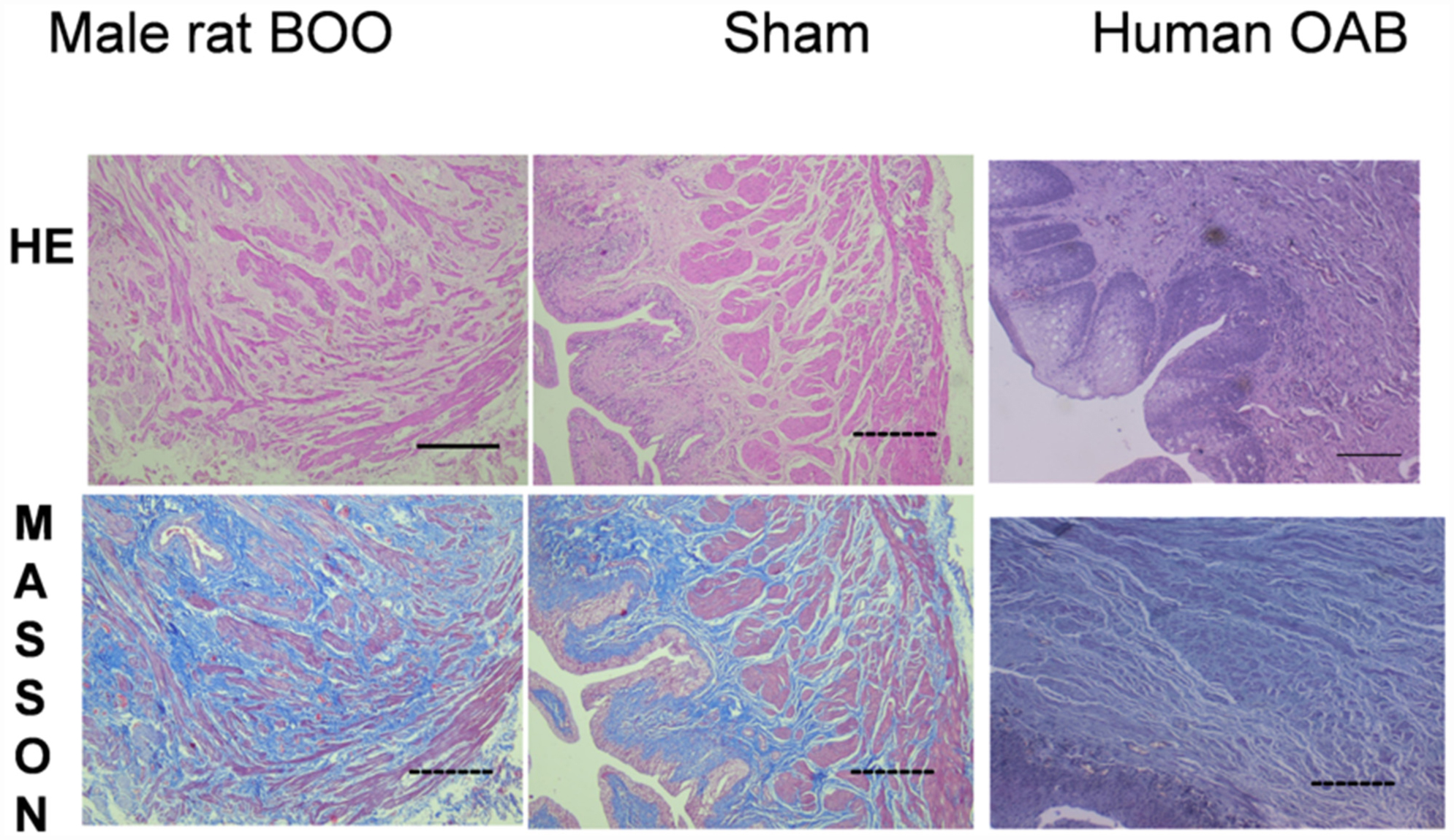
All rats survived, were active, and had no complications. Histological examination of tissue samples of the bladder wall with hematoxylin & eosin and Masson's trichrome stains showed thinner urothelium and condensation of collagen between muscle bundles. Human tissue samples showed similar cytoskeleton events.
The non-invasive technique to induce BOO in male rats proved to be safe, reproducible, and led to no complications. An increased collagen/smooth muscle ratio in the rat model was similar to that in humans. The results showed that the non-invasive procedure of BOO induction in male rats leads to identical cytoskeleton changes as in human OAB. The results indicate that this model could aid in understanding human male BOO and could be used for experimental studies of BOO in adult men.
Citation: Mohamed Wishahi, Sarah Hassan, Dina Zaki, Nabawya Kamal. Non-invasive induction of bladder outlet obstruction in adult male rat model has bladder wall events similar to overactive bladder in human adult male[J]. AIMS Medical Science, 2025, 12(4): 301-311. doi: 10.3934/medsci.2025021
To determine the validity of the non-invasive, novel procedure of partial urethral obstruction in adult male rats to induce bladder outlet obstruction (BOO), this study investigated the reproducibility of non-surgical induction of partial urethral obstruction to induce BOO. Effects in the rat model were compared to those of an overactive bladder (OAB) in real-world adult human males. Previous reports of BOO induction in male rats applied an invasive technique through abdominal incision and dissection of the pelvic urethra, which deviates from real-world events of BOO in men.
Sixteen adult male Sprague-Dawley rats (16 weeks old, 340 ± 10 g) were randomly divided into three groups: Bladder outlet obstruction group (n = 8), sham group (n = 4), and control group (n = 4). Eight rats underwent induction of BOO with the novel technique. At 8 weeks, the bladders of BOO, sham, and control groups were taken and examined histopathologically. The human study included tissue samples from three patients who had OAB secondary to neurogenic bladder dysfunction and had undergone surgical closure of vesicostomy with excision of the vesicostomy tract; tissue samples were examined histopathologically. Induction of BOO in adult male rats used a non-invasive technique that induces partial urethral occlusion via approaching the urethra at the root of the penis. The subsequent morphological and histological patterns of the male rat BOO were compared to patterns of human OAB.
All rats survived, were active, and had no complications. Histological examination of tissue samples of the bladder wall with hematoxylin & eosin and Masson's trichrome stains showed thinner urothelium and condensation of collagen between muscle bundles. Human tissue samples showed similar cytoskeleton events.
The non-invasive technique to induce BOO in male rats proved to be safe, reproducible, and led to no complications. An increased collagen/smooth muscle ratio in the rat model was similar to that in humans. The results showed that the non-invasive procedure of BOO induction in male rats leads to identical cytoskeleton changes as in human OAB. The results indicate that this model could aid in understanding human male BOO and could be used for experimental studies of BOO in adult men.
Bladder outlet obstruction
Overactive bladder
Haematoxylin and eosin

| [1] | Yokoyama O, Yusup A, Oyama N, et al. (2007) Improvement in bladder storage function by tamsulosin depends on suppression of C-fiber urethral afferent activity in rats. J Urol 177: 771-775. https://doi.org/10.1016/j.juro.2006.09.076 |
| [2] | Vale L, Cruz F, Charrua A (2024) Detrusor overactivity after partial bladder outlet obstruction is associated with high urinary adenosine triphosphate levels in female Wistar rats. Int Neurourol J 28: 34-39. https://doi.org/10.5213/inj.2346196.098 |
| [3] | Kang YJ, Jin LH, Park CS, et al. (2011) Early sequential changes in bladder function after partial bladder outlet obstruction in awake sprague-dawley rats: focus on the decompensated bladder. Korean J Urol 52: 835-841. https://doi.org/10.4111/kju.2011.52.12.835 |
| [4] | Jin LH, Andersson KE, Han JU, et al. (2011) Persistent detrusor overactivity in rats after relief of partial urethral obstruction. Am J Physiol Regul Integr Comp Physiol 301: R896-R904. https://doi.org/10.1152/ajpregu.00046.2011 |
| [5] | Dunton CL, Purves JT, Hughes FM, et al. (2021) BOO induces fibrosis and EMT in urothelial cells which can be recapitulated in vitro through elevated storage and voiding pressure cycles. Int Urol Nephrol 53: 2007-2018. https://doi.org/10.1007/s11255-021-02942-3 |
| [6] | Niemczyk G, Fus L, Czarzasta K, et al. (2020) Expression of toll-like receptors in the animal model of bladder outlet obstruction. Biomed Res Int 2020: 6632359. https://doi.org/10.1155/2020/6632359 |
| [7] | Sezginer EK, Yilmaz-Oral D, Lokman U, et al. (2019) Effects of varying degrees of partial bladder outlet obstruction on urinary bladder function of rats: a novel link to inflammation, oxidative stress and hypoxia. Low Urin Tract Symptoms 11: O193-O201. https://doi.org/10.1111/luts.12211 |
| [8] | Wishahi M, Hassan S, Kamal N, et al. (2024) Is bladder outlet obstruction rat model to induce overactive bladder (OAB) has similarity to human OAB? Research on the events in smooth muscle, collagen, interstitial cell and telocyte distribution. BMC Res Notes 17: 22. https://doi.org/10.1186/s13104-023-06681-9 |
| [9] | Melman A, Tar M, Boczko J, et al. (2005) Evaluation of two techniques of partial urethral obstruction in the male rat model of bladder outlet obstruction. Urology 66: 1127-1133. https://doi.org/10.1016/j.urology.2005.06.070 |
| [10] | Zvara P, Kliment J, Deross AL, et al. (2002) Differential expression of bladder neurotrophic factor mRNA in male and female rats after bladder outflow obstruction. J Urol 168: 2682-2688. https://doi.org/10.1016/S0022-5347(05)64244-9 |
| [11] | Takaoka EI, Kurobe M, Matsuoka K, et al. (2025) Adenosine receptor mechanisms underlying bladder dysfunction in male rats with bladder outlet obstruction. Neurourol Urodyn 44: 1370-1377. https://doi.org/10.1002/nau.70080 |
| [12] | Kitta T, Kanno Y, Chiba H, et al. (2018) Benefits and limitations of animal models in partial bladder outlet obstruction for translational research. Int J Urol 25: 36-44. https://doi.org/10.1111/iju.13471 |
| [13] | Uvelius B, Lindner P, Mattiasson A (1991) Collagen content in the rat urinary bladder following removal of an experimental infravesical outlet obstruction. Urol Int 47: 245-249. |
| [14] | Uvelius B, Andersson KE (2022) Molecular and morphological characteristics of the de-obstructed rat urinary bladder—an update. Int J Mol Sci 23: 11330. https://doi.org/10.3390/ijms231911330 |
| [15] | Huang J, Li H, Zhang Y, et al. (2023) Excitatory purinergic and cholinergic expression changed in a partial bladder outlet obstruction-induced overactive bladder rat model. Sci Rep 13: 18395. https://doi.org/10.1038/s41598-023-45014-5 |
| [16] | Buttyan R, Chen MW, Levin RM (1997) Animal models of bladder outlet obstruction and molecular insights into the basis for the development of bladder dysfunction. Eur Urol 32: 32-39. |
| [17] | Kim SO, Song SH, Ahn KY, et al. (2010) Distribution of interstitial cells of cajal in menopausal rat urinary bladder showing detrusor overactivity. Int Neurourol J 14: 48-53. https://doi.org/10.5213/inj.2010.14.1.48 |
Figures(2)

Mohamed Wishahi, Sarah Hassan, Dina Zaki, Nabawya Kamal. Non-invasive induction of bladder outlet obstruction in adult male rat model has bladder wall events similar to overactive bladder in human adult male[J]. AIMS Medical Science, 2025, 12(4): 301-311. doi: 10.3934/medsci.2025021





 DownLoad: