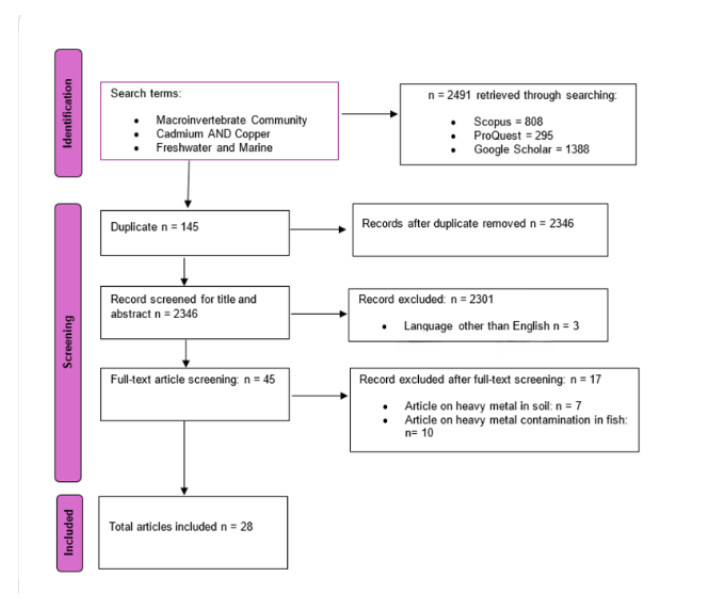
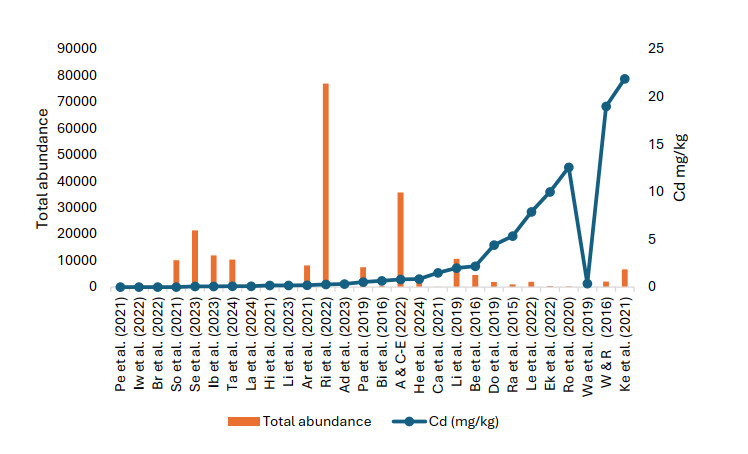
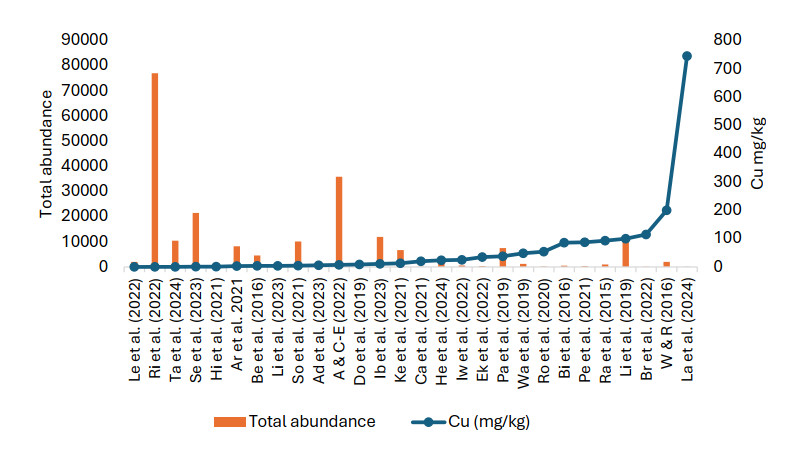
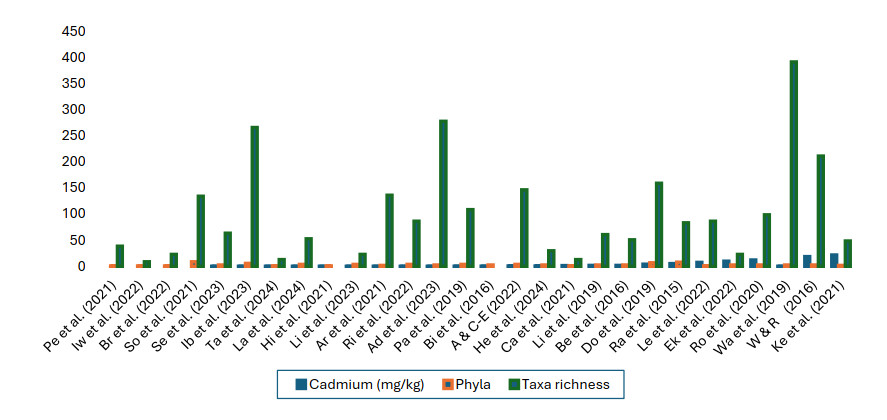
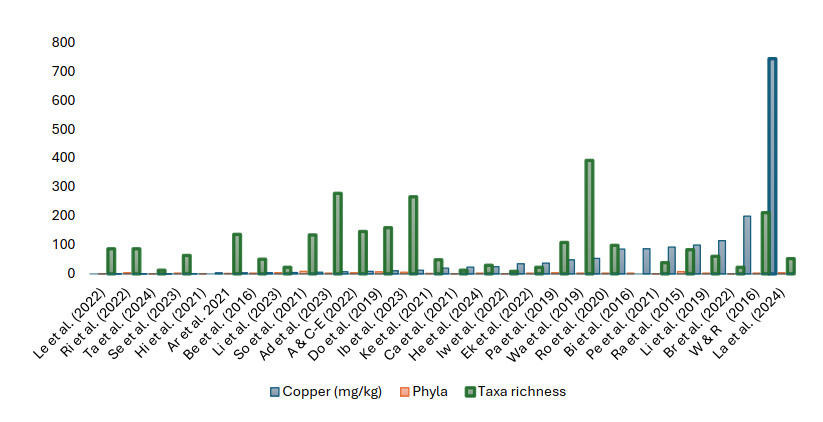
Assessing heavy metal contamination in aquatic ecosystems is crucial to understanding its effects on macroinvertebrate abundance and diversity, as these organisms serve as sensitive indicators of water quality. Among other heavy metals, cadmium and copper pose significant risks to aquatic ecosystems. We aimed to analyze the relationship of cadmium (mg/kg) and copper (mg/kg) contamination on macroinvertebrate communities using research articles published between 2014 and 2024. A total of 2,491 articles were identified from Scopus, ProQuest, and Google Scholar, and the selection process, guided by the Preferred Reporting Items for Systematic Review and Meta-analysis (PRISMA) criteria, narrowed the studies down to 28 articles that met the inclusion requirements. The studies reported cadmium concentrations ranging from 0.001 mg/kg to 21.90 mg/kg, with the highest concentration recorded in streams and the lowest in lagoon and rivers. copper levels varied from 0.001 mg/kg to 745.0 mg/kg, with the highest concentrations found in lakes, and the lowest observed in estuaries, streams, rivers, and lagoons. Findings revealed that the lowest concentrations (0.001mg/kg) of cadmium and copper corresponded with a high abundance of macroinvertebrates, reaching over 77,000 individuals. Conversely, at the highest levels of copper, macroinvertebrate abundance dropped to as low as 22, while at elevated cadmium levels in separate ecosystem, the abundance was 6707. Thus, this study highlights the possible influence of cadmium and copper contamination on the abundance, diversity, and ecological roles of macroinvertebrate communities in aquatic ecosystems.
Citation: Ella Francis Agbam, Normala Halimoon, Ferdaus Mohamat Yusuff, Wan Lutfi Wan Johari, Abdulwakil Olawale Saba. Heavy metals and the community structure of macroinvertebrate assemblages in aquatic ecosystems: a systematic review[J]. AIMS Environmental Science, 2025, 12(4): 615-652. doi: 10.3934/environsci.2025028
Assessing heavy metal contamination in aquatic ecosystems is crucial to understanding its effects on macroinvertebrate abundance and diversity, as these organisms serve as sensitive indicators of water quality. Among other heavy metals, cadmium and copper pose significant risks to aquatic ecosystems. We aimed to analyze the relationship of cadmium (mg/kg) and copper (mg/kg) contamination on macroinvertebrate communities using research articles published between 2014 and 2024. A total of 2,491 articles were identified from Scopus, ProQuest, and Google Scholar, and the selection process, guided by the Preferred Reporting Items for Systematic Review and Meta-analysis (PRISMA) criteria, narrowed the studies down to 28 articles that met the inclusion requirements. The studies reported cadmium concentrations ranging from 0.001 mg/kg to 21.90 mg/kg, with the highest concentration recorded in streams and the lowest in lagoon and rivers. copper levels varied from 0.001 mg/kg to 745.0 mg/kg, with the highest concentrations found in lakes, and the lowest observed in estuaries, streams, rivers, and lagoons. Findings revealed that the lowest concentrations (0.001mg/kg) of cadmium and copper corresponded with a high abundance of macroinvertebrates, reaching over 77,000 individuals. Conversely, at the highest levels of copper, macroinvertebrate abundance dropped to as low as 22, while at elevated cadmium levels in separate ecosystem, the abundance was 6707. Thus, this study highlights the possible influence of cadmium and copper contamination on the abundance, diversity, and ecological roles of macroinvertebrate communities in aquatic ecosystems.

| [1] |
Li A, Li J, Liu F, et al. (2024) Assessment of benthic ecological status and heavy metal contamination in an estuarine intertidal mudflat in the Northern Bohai Sea. Mar Pollut Bull 203. https://doi.org/10.1016/j.marpolbul.2024.116501 doi: 10.1016/j.marpolbul.2024.116501

|
| [2] |
Yin X, Yan G, Wang X, et al. (2024) Trends and risk assessment of heavy metals in the surface sediments of river-connected lakes: A case study of Dongting Lake. Mar Pollut Bull 209. https://doi.org/10.1016/j.marpolbul.2024.117181 doi: 10.1016/j.marpolbul.2024.117181
|
| [3] |
Tao H, Al-Hilali AA, Ahmed AM, et al. (2023) Statistical and spatial analysis for soil heavy metals over the Murray-Darling river basin in Australia. Chemosphere 317: 137914. https://doi.org/10.1016/j.chemosphere.2023.137914 doi: 10.1016/j.chemosphere.2023.137914
|
| [4] |
Qu B, Song J, Yuan H, et al. (2018) Intensive anthropogenic activities had affected Daya Bay in South China Sea since the 1980s: Evidence from heavy metal contaminations. Mar Pollut Bull 135: 318–331. https://doi.org/10.1016/j.marpolbul.2018.07.011 doi: 10.1016/j.marpolbul.2018.07.011
|
| [5] |
Su X, Ling H, Wu D, et al. (2022) Spatial–Temporal Variations, Ecological Risk Assessment, and Source Identification of Heavy Metals in the Sediments of a Shallow Eutrophic Lake, China. Toxics 10. https://doi.org/10.3390/toxics10010016 doi: 10.3390/toxics10010016
|
| [6] |
Egan A, Burge DRL, Edlund MB, et al. (2024) Distribution of water chemistry, trace metals, and Chironomidae in coastal freshwater rock pools. Freshwater Science 43: 124–139. https://doi.org/10.1086/730526 doi: 10.1086/730526
|
| [7] |
Qu X, Wu N, Tang T, et al. (2010) Effects of heavy metals on benthic macroinvertebrate communities in high mountain streams. Ann Limnol 46: 291–302. https://doi.org/10.1051/limn/2010027 doi: 10.1051/limn/2010027
|
| [8] |
Ginebreda A, Muñoz I, de Alda ML, et al. (2010) Environmental risk assessment of pharmaceuticals in rivers: Relationships between hazard indexes and aquatic macroinvertebrate diversity indexes in the Llobregat River (NE Spain). Environ Int 36: 153–162. https://doi.org/10.1016/j.envint.2009.10.003 doi: 10.1016/j.envint.2009.10.003
|
| [9] |
Cupe-Flores B, Mendes M, Phillips I, et al. (2024) Effects of diluted effluent on aquatic macroinvertebrate communities at the McClean Lake uranium operation in northern Saskatchewan. Environ Res 244. https://doi.org/10.1016/j.envres.2023.117951 doi: 10.1016/j.envres.2023.117951
|
| [10] |
Zhang A, Wang L, Zhao S, et al. (2017) Heavy metals in seawater and sediments from the northern Liaodong Bay of China: Levels, distribution and potential risks. Reg Stud Mar Sci 11: 32–42. https://doi.org/10.1016/j.rsma.2017.02.002 doi: 10.1016/j.rsma.2017.02.002
|
| [11] |
Saravanan P, Saravanan V, Rajeshkannan R, et al. (2024) Comprehensive review on toxic heavy metals in the aquatic system: sources, identification, treatment strategies, and health risk assessment. Environ Res 258: 119440. https://doi.org/10.1016/j.envres.2024.119440 doi: 10.1016/j.envres.2024.119440
|
| [12] |
Liang R, Sinclair TM, Craig PS, et al. (2024) Spatial variation in the sensitivity of freshwater macroinvertebrate assemblages to chemical stressors. Water Res 248. https://doi.org/10.1016/j.watres.2023.120854 doi: 10.1016/j.watres.2023.120854
|
| [13] |
Dong JY, Wang X, Zhang X, et al. (2023) Integrating multiple indices based on heavy metals and macrobenthos to evaluate the benthic ecological quality status of Laoshan Bay, Shandong Peninsula, China. Ecol Indic 153. https://doi.org/10.1016/j.ecolind.2023.110367 doi: 10.1016/j.ecolind.2023.110367
|
| [14] |
Zhao N, Sang C, Cao R, et al. (2025) Impacts of mining on the diversity of benthic macroinvertebrates - A case study of molybdenum mining area in Luanchuan county. Environ Pollut 364. https://doi.org/10.1016/j.envpol.2024.125335 doi: 10.1016/j.envpol.2024.125335
|
| [15] |
Dong J-Y, Zhao L, Sun X, et al. (2021) Response of macrobenthic communities to heavy metal pollution in Laoshan Bay, China: A trait-based method. Mar Pollut Bull 167: 112292. https://doi.org/10.1016/j.marpolbul.2021.112292 doi: 10.1016/j.marpolbul.2021.112292
|
| [16] |
Zhou Q, Yang N, Li Y, et al. (2020) Total concentrations and sources of heavy metal pollution in global river and lake water bodies from 1972 to 2017. Glob Ecol Conserv 22. https://doi.org/10.1016/j.gecco.2020.e00925 doi: 10.1016/j.gecco.2020.e00925
|
| [17] |
Mebane CA, Schmidt TS, Balistrieri LS (2017) Larval aquatic insect responses to cadmium and zinc in experimental streams. Environ Toxicol Chem 36: 749–762. https://doi.org/10.1002/etc.3599 doi: 10.1002/etc.3599
|
| [18] |
Souto R de MG, Corbi JJ, Jacobucci GB (2019) Aquatic insects as bioindicators of heavy metals in sediments in cerrado streams. Limnetica 38: 575–586. https://doi.org/10.23818/limn.38.33 doi: 10.23818/limn.38.33
|
| [19] | Chintada V, Vivek C, Padmaja B, et al. (2024) cadmium Toxicity Impact On Aquatic Organisms-Oxidative Stress: Implications For Human Health, Safety And Environmental Aspects-A Review. |
| [20] | Li Y, Zhou Q, Ren B, et al. (2020) Trends and Health Risks of Dissolved Heavy Metal Pollution in Global River and Lake Water from 1970 to 2017. Rev Environ Contam Toxicol Springer New York LLC, 1–24. https://doi.org/10.1007/398_2019_27 |
| [21] |
Ali H, Khan E, Ilahi I (2019) Environmental chemistry and ecotoxicology of hazardous heavy metals: Environmental persistence, toxicity, and bioaccumulation. J Chem 2019. https://doi.org/10.1155/2019/6730305 doi: 10.1155/2019/6730305
|
| [22] |
Erasmus JH, Malherbe W, Zimmermann S, et al. (2020) Metal accumulation in riverine macroinvertebrates from a platinum mining region. Sci Total Environ 703. https://doi.org/10.1016/j.scitotenv.2019.134738 doi: 10.1016/j.scitotenv.2019.134738
|
| [23] |
Frauendorf TC, Colón-Gaud C, Whiles MR, et al. (2013) Energy flow and the trophic basis of macroinvertebrate and amphibian production in a neotropical stream food web. Freshw Biol 58: 1340–1352. https://doi.org/10.1111/fwb.12131 doi: 10.1111/fwb.12131
|
| [24] |
Hu CL, Hu T, Liang L (2024) Spatial variation and potential ecological risk assessment of trace elements in the sediments of Chaohu Lake in China. J Freshw Ecol 39. https://doi.org/10.1080/02705060.2023.2294129 doi: 10.1080/02705060.2023.2294129
|
| [25] |
Wang J, Zeng X, Xu D, et al. (2020) Chemical fractions, diffusion flux and risk assessment of potentially toxic elements in sediments of Baiyangdian Lake, China. Sci Total Environ 724. https://doi.org/10.1016/j.scitotenv.2020.138046 doi: 10.1016/j.scitotenv.2020.138046
|
| [26] |
Balistrieri LS, Mebane CA, Schmidt TS (2020) Time-dependent accumulation of Cd, Co, Cu, Ni, and Zn in natural communities of mayfly and caddisfly larvae: Metal sensitivity, uptake pathways, and mixture toxicity. Sci Total Environ 732. https://doi.org/10.1016/j.scitotenv.2020.139011 doi: 10.1016/j.scitotenv.2020.139011
|
| [27] |
Piwowarska D, Kiedrzyńska E, Jaszczyszyn K (2024) A global perspective on the nature and fate of heavy metals polluting water ecosystems, and their impact and remediation. Crit Rev Environ Sci Technol 54: 1436–1458. https://doi.org/10.1080/10643389.2024.2317112 doi: 10.1080/10643389.2024.2317112
|
| [28] |
Loayza-Muro RA, Elías-Letts R, Marticorena-Ruíz JK, et al. (2010) Metal-induced shifts in benthic macroinvertebrate community composition in Andean high altitude streams. Environ Toxicol Chem 29: 2761–2768. https://doi.org/10.1002/etc.327 doi: 10.1002/etc.327
|
| [29] |
DoiH, Takagi A, Kikuchi E (2007) Stream macroinvertebrate community affected by point-source metal pollution. Int Rev Hydrobiol 92: 258–266. https://doi.org/10.1002/iroh.200610923 doi: 10.1002/iroh.200610923
|
| [30] |
Santhosh K, Kamala K, Ramasamy P, et al. (2024) Unveiling the silent threat: Heavy metal toxicity devastating impact on aquatic organisms and DNA damage. Mar Pollut Bull 200. https://doi.org/10.1016/j.marpolbul.2024.116139 doi: 10.1016/j.marpolbul.2024.116139
|
| [31] |
Costas N, Pardo I, Méndez-Fernández L, et al. (2018) Sensitivity of macroinvertebrate indicator taxa to metal gradients in mining areas in Northern Spain. Ecol Indic 93: 207–218. https://doi.org/10.1016/j.ecolind.2018.04.059 doi: 10.1016/j.ecolind.2018.04.059
|
| [32] |
Erasmus JH, Lorenz AW, Zimmermann S, et al. (2021) A diversity and functional approach to evaluate the macroinvertebrate responses to multiple stressors in a small subtropical austral river. Ecol Indic 131. https://doi.org/10.1016/j.ecolind.2021.108206 doi: 10.1016/j.ecolind.2021.108206
|
| [33] |
Clare DS, Garcia C, Bolam SG (2024) Ecosystem functioning during biodiversity loss and recovery. Oikos 2024. https://doi.org/10.1111/oik.10154 doi: 10.1111/oik.10154
|
| [34] |
Clements WH, Cadmus P, Kotalik CJ, et al. (2019) Context-Dependent Responses of Aquatic Insects to Metals and Metal Mixtures: A Quantitative Analysis Summarizing 24 Yr of Stream Mesocosm Experiments. Environ Toxicol Chem 38: 2486–2496. https://doi.org/10.1002/etc.4568 doi: 10.1002/etc.4568
|
| [35] |
Saba AO, Yasin ISM, Azmai MNA (2024) Meta-analyses indicate that dietary probiotics significantly improve growth, immune response, and disease resistance in tilapia. Aquacult Int 32: 4841–4867. https://doi.org/10.1007/s10499-024-01404-8 doi: 10.1007/s10499-024-01404-8
|
| [36] |
Chen M, Tan X, Padman R (2020) Social determinants of health in electronic health records and their impact on analysis and risk prediction: A systematic review. J Am Med Inform Assoc 27: 1764–1773. https://doi.org/10.1093/jamia/ocaa143 doi: 10.1093/jamia/ocaa143
|
| [37] |
Solà C, Burgos M, Plazuelo Á, et al. (2004) Heavy metal bioaccumulation and macroinvertebrate community changes in a Mediterranean stream affected by acid mine drainage and an accidental spill (Guadiamar River, SW Spain). Sci Total Environ 333: 109–126. https://doi.org/10.1016/j.scitotenv.2004.05.011 doi: 10.1016/j.scitotenv.2004.05.011
|
| [38] |
Bendary RE, Ibrahim SM, Goher ME, et al. (2023) Taxonomic and functional structure of macrobenthic invertebrate communities and their response to environmental variables along the subbranches of the Nile River (rayahs), Egypt. Environ Sci Pollut Res 30: 28803–28817. https://doi.org/10.1007/s11356-022-24140-z doi: 10.1007/s11356-022-24140-z
|
| [39] | Sayed SM El, Salem SG, Abdo MH, et al. (2022) Spatial distribution of heavy metals and Ecological Risk Assessment for the main sub-branches (Rayahs) sediments of Nile River, Egypt. https://doi.org/10.21203/rs.3.rs-1247777/v1 |
| [40] |
Hussain MI, Naeem M, Khan ZI, et al. (2022) Cadmium (Cd) and copper (Cu) Exposure and Bioaccumulation Arrays in Farm Ruminants: Impact of Forage Ecotypes, Ecological Sites and Body Organs. Sustainability (Switzerland) 14. https://doi.org/10.3390/su141912595 doi: 10.3390/su141912595
|
| [41] |
Affengruber L, Dobrescu A, Persad E, et al. (2022) Characteristics and recovery methods of studies falsely excluded during literature screening—a systematic review. Syst Rev 11. https://doi.org/10.1186/s13643-022-02109-w doi: 10.1186/s13643-022-02109-w
|
| [42] |
Bian B, Zhou Y, Fang B B (2016). Distribution of heavy metals and benthic macroinvertebrates: Impacts from typical inflow river sediments in the Taihu Basin, China. Ecol Indic 69: 348–359. https://doi.org/10.1016/j.ecolind.2016.04.048 doi: 10.1016/j.ecolind.2016.04.048
|
| [43] |
Perlatti F, Martins E P, de Oliveira D P, et al. (2021). Copper release from waste rocks in an abandoned mine (NE, Brazil) and its impacts on ecosystem environmental quality. Chemosphere, 262: 127843. https://doi.org/10.1016/j.chemosphere.2020.127843 doi: 10.1016/j.chemosphere.2020.127843
|
| [44] |
Bere T, Dalu T, Mwedzi T (2016). Detecting the impact of heavy metal contaminated sediment on benthic macroinvertebrate communities in tropical streams. Sci Total Environ 572: 147–156. https://doi.org/10.1016/j.scitotenv.2016.07.204 doi: 10.1016/j.scitotenv.2016.07.204
|
| [45] |
Larson J H, Lowe M R, Bailey S W, et al. (2025). Effect of copper mill waste material on benthic invertebrates and zooplankton diversity and abundance. PLoS ONE 20: e0318980. https://doi.org/10.1371/journal.pone.0318980. doi: 10.1371/journal.pone.0318980
|
| [46] |
Let M, Černý J, Nováková P, et al. (2022). Effects of Trace Metals and Municipal Wastewater on the Ephemeroptera, Plecoptera, and Trichoptera of a Stream Community. Biology 11: 648. https://doi.org/10.3390/biology11050648 doi: 10.3390/biology11050648
|
| [47] |
Iwasaki Y, Cadmus P, Ranville J, et al. (2022). Stream Mesocosm Experiments Show no Protective Effects of Calcium on Copper Toxicity to Macroinvertebrates. Environ Toxicol Chem 41: 1304–1310. https://doi.org/10.1002/etc.5308 doi: 10.1002/etc.5308
|
| [48] |
Bruno C G C, Gonçalves R C, Dos Santos A, et al. (2022). The relationship between sediment metal concentration and Odonata (Insecta) larvae assemblage structure in Cerrado streams. Limnetica 41: 27–41. https://doi.org/10.23818/limn.41.03 doi: 10.23818/limn.41.03
|
| [49] |
Namba H, Iwasaki Y, Morita K, et al. (2021). Comparing impacts of metal contamination on macroinvertebrate and fish assemblages in a northern Japanese river. Peer J 9: e10808. https://doi.org/10.7717/peerj.10808 doi: 10.7717/peerj.10808
|
| [50] |
Rico-Sánchez A E, Rodríguez-Romero A J, Sedeño-Díaz J E, et al. (2022). Aquatic macroinvertebrate assemblages in rivers influenced by mining activities. Sci Rep 12. https://doi.org/10.1038/s41598-022-06869-2 doi: 10.1038/s41598-022-06869-2
|
| [51] |
Tabassum S, Kotnala C B, Salman M, et al. (2024). The impact of heavy metal concentrations on aquatic insect populations in the Asan Wetland of Dehradun, Uttarakhand. Sci Rep 14. https://doi.org/10.1038/s41598-024-52522-5 doi: 10.1038/s41598-024-52522-5
|
| [52] |
Ekperusi O H, Ekperusi A O, Olomukoro J O (2022). Assessment of Anthropogenic Influences on the Benthic Invertebrate Community of Oghan River in Edo State, Nigeria. J Appl Sci Environ Manage 26: 1423–1431. https://doi.org/10.4314/jasem.v26i8.16 doi: 10.4314/jasem.v26i8.16
|
| [53] |
Roe R A L, Tran T K A, Schreider M J, et al. (2020). Assessment of the Effects of Sediment-Associated Metals and Metalloids on Mangrove Macroinvertebrate Assemblages. Water Air Soil Pollut 231. https://doi.org/10.1007/s11270-020-04731-7 doi: 10.1007/s11270-020-04731-7
|
| [54] |
Adesakin T A, Erhomosele E I, Ogunrinola O F, et al. (2023). Using benthic macroinvertebrates as bioindicators to evaluate the impact of anthropogenic stressors on water quality and sediment properties of a West African lagoon. Heliyon 9. https://doi.org/10.1016/j.heliyon.2023.e19508 doi: 10.1016/j.heliyon.2023.e19508
|
| [55] |
Wang X, Su P, Lin Q, et al. (2019). Distribution, assessment and coupling relationship of heavy metals and macroinvertebrates in sediments of the Weihe River Basin. Sustain Cities Soc 50: 101665. https://doi.org/10.1016/j.scs.2019.101665 doi: 10.1016/j.scs.2019.101665
|
| [56] |
Senouci N, Bemmoussat-Dekkak S, Ammouri R, et al. (2023). Water quality evaluation using benthic macroinvertebrates, physicochemical parameters and heavy metal levels in two lakes (Northwestern Algeria). Appl Ecol Environ Res 21: 5069–5090. https://doi.org/10.15666/aeer/2106_50695090 doi: 10.15666/aeer/2106_50695090
|
| [57] |
Wright I A, Ryan M M (2016). Impact of mining and industrial pollution on stream macroinvertebrates: importance of taxonomic resolution, water geochemistry and EPT indices for impact detection. Hydrobiologia 772: 103–115. https://doi.org/10.1007/s10750-016-2644-7 doi: 10.1007/s10750-016-2644-7
|
| [58] |
Keke U N, Omoigberale M O, Ezenwa I, et al. (2021). Macroinvertebrate communities and physicochemical characteristics along an anthropogenic stress gradient in a southern Nigeria stream: Implications for ecological restoration. Environ Sustain Indic 12. https://doi.org/10.1016/j.indic.2021.100157 doi: 10.1016/j.indic.2021.100157
|
| [59] |
Pastorino P, Bertoli M, Squadrone S, et al. (2019). Detection of trace elements in freshwater macrobenthic invertebrates of different functional feeding guilds: A case study in Northeast Italy. Ecohydrol Hydrobiol 19: 428–440. https://doi.org/10.1016/j.ecohyd.2019.04.006 doi: 10.1016/j.ecohyd.2019.04.006
|
| [60] |
Arimoro F O, Meme F K, Keke U N (2021). Effects of effluent discharges from a cement factory on the ecology of macroinvertebrates in an Afrotropical river. Environ Sci Pollut Res https://doi.org/10.1007/s11356-021-14514-0 doi: 10.1007/s11356-021-14514-0
|
| [61] |
Rabaoui L, El Zrelli R, Mansour M B, et al. (2015). On the relationship between the diversity and structure of benthic macroinvertebrate communities and sediment enrichment with heavy metals in Gabes Gulf, Tunisia. J Mar Biol Assoc UK 95: 233–245. https://doi.org/10.1017/S0025315414001489 doi: 10.1017/S0025315414001489
|
| [62] |
Heydari R, Rouzbahani M M, Ghatrami E R, et al. (2024). The effect of oil pollution on community structure of benthic macro invertebrates in the northwest of the Persian Gulf (Case study: Jafari creek). Global Nest J 26. https://doi.org/10.30955/gnj.005384 doi: 10.30955/gnj.005384
|
| [63] |
Ibrahim N F, Abd Hamid M, Akhir M F M, et al. (2023). Seasonal benthic species composition linked to coastal defense structures (CDS) in Kuala Nerus, Terengganu, Malaysia. PeerJ 11: e16203. https://doi.org/10.7717/peerj.16203 doi: 10.7717/peerj.16203
|
| [64] | Li D, Liang L, Dong Q, et al. 2023). Significant Dynamic Disturbance of Water Environment Quality in Urban Rivers Flowing through Industrial Areas. Water (Switzerland) 15. https://doi.org/10.3390/w15203640 |
| [65] |
Aydın G B, Çamur-Elipek B (2022). Evaluation of ecological risk analysis for benthic macroinvertebrates in paddy fields in the Meriç-Ergene River Basin (Turkish Thrace) Oceanol Hydrobiol Stud 51: 212-223. https://doi.org/10.26881/oahs-2022.2.09 doi: 10.26881/oahs-2022.2.09
|
| [66] |
V Capparelli M, Cabrera M, Rico A, et al. (2021). An Integrative Approach to Assess the Environmental Impacts of Gold Mining Contamination in the Amazon. Toxics 9: 149. https://doi.org/10.3390/toxics9070149 doi: 10.3390/toxics9070149
|
| [67] |
Donnarumma L, Appolloni L, Chianese E, et al. (2019). Environmental and Benthic Community Patterns of the Shallow Hydrothermal Area of Secca Delle Fumose (Baia, Naples, Italy). Front Mar Sci 6. https://doi.org/10.3389/fmars.2019.00685 doi: 10.3389/fmars.2019.00685
|
| [68] |
Souza F M, Gilbert E R, Brauko K M, et al. (2021). Macrobenthic community responses to multiple environmental stressors in a subtropical estuary. PeerJ 9: e12427. https://doi.org/10.7717/peerj.12427 doi: 10.7717/peerj.12427
|
| [69] |
Liu Z, Zhang C, Xin Z, et al. (2021). Comparing the Impacts of Sediment-Spiked cadmium on Chironomidae Larvae in Laboratory Bioassays and Field Microcosms and the Implications for Field Validation of Site-Specific Threshold Concentrations. Environ Toxicol Chem 40: 2450–2462. https://doi.org/10.1002/etc.5073 doi: 10.1002/etc.5073
|
| [70] |
Das S (2024) Assessment of the ecotoxicity of heavy metal contaminants on aquatic organisms: A reviewon the impact of Lead, Chromium, cadmium, Zinc and Mercury. African J Biol Sci 6: 8871–8883. https://doi.org/10.48047/AFJBS.6.5.2024.8871-8883 doi: 10.48047/AFJBS.6.5.2024.8871-8883
|
| [71] |
Shu L, Tang W, Cheng Y, et al. (2024). Heavy Metal Fate from Water into Sediment and Its Risk Assessment: A Lesson from cadmium. ACS ES & T Water 4: 1433–1442. https://doi.org/10.1021/acsestwater.3c00588 doi: 10.1021/acsestwater.3c00588
|
| [72] |
He Y, Fang H, Pan X, et al. (2023) cadmium Exposure in Aquatic Products and Health Risk Classification Assessment in Residents of Zhejiang, China. Foods 12. https://doi.org/10.3390/foods12163094 doi: 10.3390/foods12163094
|
| [73] |
Tolkou AK, Toubanaki DK, Kyzas GZ (2023) Detection of Arsenic, Chromium, cadmium, Lead, and Mercury in Fish: Effects on the Sustainable and Healthy Development of Aquatic Life and Human Consumers. Sustainability (Switzerland) 15. https://doi.org/10.3390/su152316242 doi: 10.3390/su152316242
|
| [74] | Ghosh S, Pati K, Pal P (2019) Bioaccumulation of cadmium in fish and human health risk assessment. Int J Chem Stud 7: 721–724. |
| [75] |
Nechytailo L, Danyliv S, Kuras L, et al. (2024) Dynamics of changes in cadmium levels in environmental objects and its impact on the bio-elemental composition of living organisms. Braz J Biol 84. https://doi.org/10.1590/1519-6984.271324 doi: 10.1590/1519-6984.271324
|
| [76] |
Gestin O, Lacoue-Labarthe T, Delorme N, et al. (2023) Influence of the exposure concentration of dissolved cadmium on its organotropism, toxicokinetic and fate in Gammarus fossarum. Environ Int 171. https://doi.org/10.1016/j.envint.2022.107673 doi: 10.1016/j.envint.2022.107673
|
| [77] |
Huang Y, Tang H, Jin J, et al. (2020) Effects of Waterborne cadmium Exposure on Its Internal Distribution in Meretrix meretrix and Detoxification by Metallothionein and Antioxidant Enzymes. Front Mar Sci 7. https://doi.org/10.3389/fmars.2020.00502 doi: 10.3389/fmars.2020.00502
|
| [78] |
Chutia J, Kardong D (2022) Diversity and Spatial Distribution of Freshwater Macro-Invertebrates in Poba Reserve Forest of Assam, India. Asian J Biol Life Sci 11: 117–126. https://doi.org/10.5530/ajbls.2022.11.16 doi: 10.5530/ajbls.2022.11.16
|
| [79] |
Esmel GTH, Mathieu DY, Leonard T (2023) Diversity and taxonomic structure of aquatic macroinvertebrates in a fluvio-lacustrine system in south-west Côte d'Ivoire: The case of the Soubré hydroelectric dam lake. Int J Fish Aquat Stud 11: 113–122. https://doi.org/10.22271/fish.2023.v11.i4b.2832 doi: 10.22271/fish.2023.v11.i4b.2832
|
| [80] |
Zeb M, Khan K, Younas M, et al. (2024) A review of heavy metals pollution in riverine sediment from various Asian and European countries: Distribution, sources, and environmental risk. Mar Pollut Bull 206: 116775. https://doi.org/10.1016/j.marpolbul.2024.116775 doi: 10.1016/j.marpolbul.2024.116775
|
| [81] |
Yongo E, Jin F, Mutethya E, et al. (2023) Sediment Heavy Metal Pollution Assessment in Changwang and Wuyuan Rivers in Hainan Island, China. Water (Switzerland) 15. https://doi.org/10.3390/w15081580 doi: 10.3390/w15081580
|
| [82] |
Zhang H, Reynolds M (2019) cadmium exposure in living organisms: A short review. Sci Total Environ 678: 761–767. https://doi.org/10.1016/j.scitotenv.2019.04.395 doi: 10.1016/j.scitotenv.2019.04.395
|
| [83] |
Hornberger MI (2024) A biodynamic model predicting copper and cadmium bioaccumulation in caddisflies: Linkages between field studies and laboratory exposures. PLoS One 19. https://doi.org/10.1371/journal.pone.0297801 doi: 10.1371/journal.pone.0297801
|
| [84] |
Aiki IP, Sulyman M, Shindi HA, et al. (2023) Contamination Characteristics, Source Analysis and Health Risk Assessment of Heavy Metals in Some Aquatic Insects Found in River Gashua, Yobe State Nigeria. UMYU Scientifica 2: 85–91. https://doi.org/10.56919/usci.2324.010 doi: 10.56919/usci.2324.010
|
| [85] |
Joachim S, Roussel H, Bonzom JM, et al. (2017) A long-term copper exposure in a freshwater ecosystem using lotic mesocosms: Invertebrate community responses. Environ Toxicol Chem 36: 2698–2714. https://doi.org/10.1002/etc.3822 doi: 10.1002/etc.3822
|
| [86] |
Gardham S, Chariton AA, Hosex GC (2014) Invertebrate community responses to a particulate- and dissolved-copper exposure in model freshwater ecosystems. Environ Toxicol Chem 33: 2724–2732. https://doi.org/10.1002/etc.2728 doi: 10.1002/etc.2728
|
| [87] |
Beghelli FGS, Pompêo MLM, Rosa AH, et al. (2016) Effects of copper in sediments on benthic macroinvertebrate communities in tropical reservoirs. Limnetica 35: 103–116. https://doi.org/10.23818/limn.35.09 doi: 10.23818/limn.35.09
|
| [88] |
Montz GR, Hirsch J, Rezanka R, et al. (2010) Impacts of copper on a lotic benthic invertebrate community: Response and recovery. J Freshw Ecol 25: 575–587. https://doi.org/10.1080/02705060.2010.9664407 doi: 10.1080/02705060.2010.9664407
|
| [89] |
Iwinski KJ, McQueen AD, Kinley CM, et al. (2016) Sediment Copper Concentrations, in Situ Benthic Invertebrate Abundance, and Sediment Toxicity: Comparison of Treated and Untreated Coves in a Southern Reservoir. Water Air Soil Pollut 227. https://doi.org/10.1007/s11270-016-2778-2 doi: 10.1007/s11270-016-2778-2
|
| [90] |
Banze wa Mutombo A, Atibu EK, Mbuya wa Mutombo J, et al. (2022) Contamination by heavy metals from mining activities: An ecological impact assessment of Mura and Kimpulande Rivers, Democratic Republic of the Congo. Watershed Ecol Environ 4: 148–157. https://doi.org/10.1016/j.wsee.2022.10.004 doi: 10.1016/j.wsee.2022.10.004
|
| [91] |
Arnold A, Murphy JF, Pretty JL, et al. (2021) Accumulation of trace metals in freshwater macroinvertebrates across metal contamination gradients. Environ Pollut 276. https://doi.org/10.1016/j.envpol.2021.116721 doi: 10.1016/j.envpol.2021.116721
|
| [92] |
Ndourwe Far Bolivar, Edioh Pem Frederic, Fosso Kengne Loraine Priscillia, et al. (2025) Biodiversity of Benthic Macroinvertebrates and water quality as a tool to the ecological study of three forest streams in the littoral zone (Cameroon). World Journal of Advanced Research and Reviews 25: 1722–1734. https://doi.org/10.30574/wjarr.2025.25.1.0034 doi: 10.30574/wjarr.2025.25.1.0034
|
| [93] | Banaee M (2024) Perspective Chapter: Exploring the Toxicity Effect of Heavy Metals on Aquatic Organisms – A Comprehensive Analysis. Heavy Metals in the Environment - Contamination, Risk, and Remediation, IntechOpen. https://doi.org/10.5772/intechopen.1006890 |
| [94] |
Purushottam B, Reddy RA (2024) cadmium Toxicity: Sources, Mechanisms and Human Health Implications: A Comprehensive Review. Uttar Pradesh J Zoology 45: 442–450. https://doi.org/10.56557/upjoz/2024/v45i154260 doi: 10.56557/upjoz/2024/v45i154260
|
| [95] |
Ojekunle OO, Olatoregun D, Good S, et al. (2022) Toxicological Impact of cadmium and copper Exposure in H. Exemplaris. Environ Manage Sustain Dev 11: 1. https://doi.org/10.5296/emsd.v11i2.19434 doi: 10.5296/emsd.v11i2.19434
|
| [96] | Demars BOL (2024) European freshwater macroinvertebrate richness and abundance: alternative analyses and new findings. https://doi.org/10.1101/2024.08.13.607735 |
| [97] | Wolff BA, Clements WH, Hall EK (2020) Metals alter membership but not diversity of a headwater stream microbiome. https://doi.org/10.1101/2020.04.30.071522 |
| [98] |
Kolomiytsev N, Poddubnaya N (2018) Temporal and spatial variability of environments drive the patterns of species richness along latitudinal, elevational, and depth gradients. Biol Commun 63: 189–201. https://doi.org/10.21638/spbu03.2018.305 doi: 10.21638/spbu03.2018.305
|
| [99] | Schultheis AS, Sanchez M, Hendricks AC (1997) Structural and functional responses of stream insects to copper pollution, Kluwer Academic Publishers. https://doi.org/10.1023/A: 1002909914774 |
| [100] |
Béguinot J (2018) Analysing the Role of Environmental Stresses on Species Richness and the Process of Hierarchical Structuring of Species Abundances in Marine Gastropods communities at Suva (Fiji Islands). Int J Environ Clim Chang 200–233. https://doi.org/10.9734/ijecc/2018/v8i327169 doi: 10.9734/ijecc/2018/v8i327169
|
| [101] |
Yu C, Meng K, Zhu Z, et al. (2024) Impacts of cadmium accumulation on the diversity, assembly processes, and co-occurrence patterns of archaeal communities in marine sediments. Sci Total Environ 926. https://doi.org/10.1016/j.scitotenv.2024.171936 doi: 10.1016/j.scitotenv.2024.171936
|
| [102] | Pollard AI, Yuan L (2006) Community response patterns: evaluating benthic invertebrate composition in metal-polluted streams. https://doi.org/10.1890/1051-0761(2006)016[0645: CRPEBI]2.0.CO; 2 |
| [103] |
Kodikara KAS, Hoessein T, De Silva PMCS, et al. (2023) Spatial distribution of heavy metals in surface sediments of the Kalametiya Lagoon in southern Sri Lanka: Insights into the pollution status and socio-economic interactions. J Natl Sci Found 51: 387–397. https://doi.org/10.4038/jnsfsr.v51i3.11193 doi: 10.4038/jnsfsr.v51i3.11193
|
| [104] |
Bhandari B, Shah RDT, Sharma S (2019) Status, distribution and habitat specificity of benthic macro-invertebrates: a case study in five tributaries of buddhiganga river in western Nepal. J Inst Sci Technol 23: 69–75. https://doi.org/10.3126/jist.v23i1.22198 doi: 10.3126/jist.v23i1.22198
|
| [105] |
Kurnianto AS, Baiti RN, Purnomo H (2021) Macroinvertebrates reveal water quality differences in various agricultural management. J Trop Biodivers Biotechnol 6. https://doi.org/10.22146/jtbb.61507 doi: 10.22146/jtbb.61507
|
| [106] | Zinsou Koudenoukpo C, Chikou A, Imorou Toko I, et al. (2017) Diversity of aquatic macroinvertebrates in relationship with the environmental factors of a lotic ecosystem in tropical region: the Sô river in South-East of Benin (West Africa). J Entomol Zoology Studies 5. |
| [107] |
Fergus CE, Brooks JR, Kaufmann PR, et al. (2023) Disentangling natural and anthropogenic effects on benthic macroinvertebrate assemblages in western US streams. Ecosphere 14. https://doi.org/10.1002/ecs2.4688 doi: 10.1002/ecs2.4688
|
| [108] |
Brysiewicz A, Czerniejewski P, Dabrowski J, et al. (2022) Characterisation of Benthic Macroinvertebrate Communities in Small Watercourses of the European Central Plains Ecoregion and the Effect of Different Environmental Factors. Animals 12. https://doi.org/10.3390/ani12050606 doi: 10.3390/ani12050606
|
| [109] |
Medupin C (2019) Distribution of benthic macroinvertebrate communities and assessment of water quality in a small UK river catchment. SN Appl Sci 1. https://doi.org/10.1007/s42452-019-0464-x doi: 10.1007/s42452-019-0464-x
|
| [110] |
Peters MK, Classen A, Müller J, et al. (2020) Increasing the phylogenetic coverage for understanding broad-scale diversity gradients. Oecologia 192: 629–639. https://doi.org/10.1007/s00442-020-04615-x doi: 10.1007/s00442-020-04615-x
|
| [111] |
Jezkova T, Wiens JJ (2017) What explains patterns of diversification and richness among animal phyla? American Naturalist 189: 201–212. https://doi.org/10.1086/690194 doi: 10.1086/690194
|
| [112] |
Kunwar S, Wang LQ, Chaudhary R, et al. (2021) Evolutionary diversity and species richness predict aboveground biomass better than tree size variation in local-scale tropical forest types of Nepal. For Ecol Manage 490. https://doi.org/10.1016/j.foreco.2021.119146 doi: 10.1016/j.foreco.2021.119146
|
| [113] | Alroy J (2020) On four measures of taxonomic richness. https://doi.org/10.1017/pab.2019.40 |
| [114] |
Lin HY, Wright S, Costello MJ (2023) Numbers of fish species, higher taxa, and phylogenetic similarity decrease with latitude and depth, and deep-sea assemblages are unique. PeerJ 11. https://doi.org/10.7717/peerj.16116 doi: 10.7717/peerj.16116
|
| [115] |
Le Bagousse-Pinguet Y, Soliveres S, Gross N, et al. (2019) Phylogenetic, functional, and taxonomic richness have both positive and negative effects on ecosystem multifunctionality. Proc Natl Acad Sci U S A 116: 8419–8424. https://doi.org/10.1073/pnas.1815727116 doi: 10.1073/pnas.1815727116
|
| [116] |
Harrison GT, Dunleavy HP, Vasquez-Valverde LF, et al. (2024) Arthropod diversity in shallow subterranean habitats of the Appalachian Mountains. Subterr Biol 49: 75–95. https://doi.org/10.3897/subtbiol.49.128521 doi: 10.3897/subtbiol.49.128521
|
| [117] | Burgess P, Betini G, Cholewka A, et al. (2024) Spatio-temporal determinants of arthropod biodiversity across an agro-ecosystem landscape. https://doi.org/10.22541/au.170664765.55770723/v1 |
| [118] |
Cendan L, Mijail Perez A, Cottiere S, et al. (2024) Arthropod Diversity in an Urban Forest from Miami Dade County, Florida, US. Eur J Zoology 3. https://doi.org/10.24018/ejzoo.2024.3.1.32 doi: 10.24018/ejzoo.2024.3.1.32
|
| [119] |
Cramer MD, Verboom GA (2024) Evidence that species richness begets species richness. J Biogeogr 51: 659–674. https://doi.org/10.1111/jbi.14777 doi: 10.1111/jbi.14777
|
| [120] |
Meier N, Gordon M, van Noort S, et al. (2024) Species richness estimation of the Afrotropical Darwin wasps (Hymenoptera, Ichneumonidae). PLoS One 19. https://doi.org/10.1371/journal.pone.0307404 doi: 10.1371/journal.pone.0307404
|
| [121] |
Kerr MR, Alroy J (2023) Body size and abundance are decoupled from species richness in Australian marine bivalves. Front Biogeogr 15. https://doi.org/10.21425/F5FBG58651 doi: 10.21425/F5FBG58651
|
| [122] |
Bosc C, Recoura-Massaquant R, Piffady J, et al. (2025) Linking new national active biomonitoring data with stream macroinvertebrate communities suggests large-scale effects of toxic contamination on freshwater ecosystems. Sci Total Environ 959. https://doi.org/10.1016/j.scitotenv.2024.178328 doi: 10.1016/j.scitotenv.2024.178328
|
| [123] |
Blanchette ML, Allcock R, Gonzalez J, et al. (2020) Macroinvertebrates and Microbes (Archaea, Bacteria) Offer Complementary Insights into Mine-Pit Lake Ecology. Mine Water Environ 39: 589–602. https://doi.org/10.1007/s10230-019-00647-9 doi: 10.1007/s10230-019-00647-9
|
| [124] |
Hossain MM, Jahan I, Dar MA, et al. (2025) A Review of Potentially Toxic Elements in Sediment, Water, and Aquatic Species from the River Ecosystems. Toxics 13. https://doi.org/10.3390/toxics13010026 doi: 10.3390/toxics13010026
|
| [125] |
Astorg L, Sanderson S, Côté-Gravel V, et al. (2021) Different refuge types dampen exotic invasion and enhance diversity at the whole ecosystem scale in a heterogeneous river system. Biol Invasions 23: 443–460. https://doi.org/10.1007/s10530-020-02374-7 doi: 10.1007/s10530-020-02374-7
|
| [126] | Rideout NK, Compson ZG, Monk WA, et al. (2020) Deconstructing biodiversity-ecosystem function relationships: Filtering of macroinvertebrate traits in a large river floodplain. https://doi.org/10.1101/2020.07.15.204008 |
| [127] |
Köninger J, Ballabio C, Panagos P, et al. (2023) Ecosystem type drives soil eukaryotic diversity and composition in Europe. Glob Chang Biol 29: 5706–5719. https://doi.org/10.1111/gcb.16871 doi: 10.1111/gcb.16871
|
| [128] |
Talluto L, del Campo R, Estévez E, et al. (2024) Towards (better) fluvial meta-ecosystem ecology: a research perspective. npj Biodiversity 3. https://doi.org/10.1038/s44185-023-00036-0 doi: 10.1038/s44185-023-00036-0
|
| [129] |
Ballut-Dajud GA, Herazo LCS, Fernández-Lambert G, et al. (2022) Factors Affecting Wetland Loss: A Review. Land (Basel) 11. https://doi.org/10.3390/land11030434 doi: 10.3390/land11030434
|
| [130] |
Khattra SK, Balaut A, Dogra R (2024) Advancing Sustainable Ecosystem Development. J Geogr Environ Earth Sci Int 28: 52–59. https://doi.org/10.9734/jgeesi/2024/v28i7789 doi: 10.9734/jgeesi/2024/v28i7789
|
| [131] | Beasley G, Kneale PE (2003) Investigating the influence of heavy metals on macroinvertebrate assemblages using Partial Canonical Correspondence Analysis Investigating the influence of heavy metals on macroinvertebrate assemblages using Partial Canonical Correspondence Analysis (pCCA)*. https://doi.org/10.5194/hess-7-221-2003 |
| [132] |
Zhao Q, Bai J, Gao Y, et al. (2021) Heavy metal contamination in soils from freshwater wetlands to salt marshes in the Yellow River Estuary, China. Sci Total Environ 774. https://doi.org/10.1016/j.scitotenv.2021.145072 doi: 10.1016/j.scitotenv.2021.145072
|
| [133] |
Knox AS, Paller MH, Seaman JC, et al. (2021) Removal, distribution and retention of metals in a constructed wetland over 20 years. Sci Total Environ 796. https://doi.org/10.1016/j.scitotenv.2021.149062 doi: 10.1016/j.scitotenv.2021.149062
|
| [134] |
Santoro A, Blo G, Mastrolitti S, et al. (2009) Bioaccumulation of heavy metals by aquatic macroinvertebrates along the Basento River in the South of Italy. Water Air Soil Pollut 201: 19–31. https://doi.org/10.1007/s11270-008-9923-5 doi: 10.1007/s11270-008-9923-5
|
| [135] |
Zhang L, Wu Y, Li J, et al. (2024) Hydrodynamics and dissolved organic matter components shaped the fate of dissolved heavy metals in an intensely anthropogenically disturbed estuary. Sci Total Environ 934. https://doi.org/10.1016/j.scitotenv.2024.173293 doi: 10.1016/j.scitotenv.2024.173293
|
| [136] |
Cloern JE, Jassby AD, Schraga TS, et al. (2017) Ecosystem variability along the estuarine salinity gradient: Examples from long-term study of San Francisco Bay. Limnol Oceanogr 62: S272–S291. https://doi.org/10.1002/lno.10537 doi: 10.1002/lno.10537
|
| [137] | Medeiros CRF, Costa AK da S, Lima CS da S, et al. (2016) Direcionadores ambientais da comunidade de macroinvertebrados bentônicos em um estuário hipersalino (Nordeste do Brasil). Acta Limnologica Brasiliensia 28. |
| [138] |
Goulding T, Sousa PM, Silva G, et al. (2021) Shifts in Estuarine Macroinvertebrate Communities Associated With Water Quality and Climate Change. Front Mar Sci 8. https://doi.org/10.3389/fmars.2021.698576 doi: 10.3389/fmars.2021.698576
|
| [139] |
Pérez-Ruzafa A, Dezileau L, Martínez-Sánchez MJ, et al. (2023) Long-term sediment records reveal over three thousand years of heavy metal inputs in the Mar Menor coastal lagoon (SE Spain). Sci Total Environ 902. https://doi.org/10.1016/j.scitotenv.2023.166417 doi: 10.1016/j.scitotenv.2023.166417
|
| [140] |
Purmalis O, Grinberga L, Dobkevica L, et al. (2024) Characteristics of Two Lagoons in the Coastal Area of the Baltic Sea. Limnological Review 24: 53–75. https://doi.org/10.3390/limnolrev24010004 doi: 10.3390/limnolrev24010004
|
| [141] | Boutahar L, Maanan M, Bououarour O, et al. (2024) Integrated assessment of a coastal lagoon ecological status based on benthic macroinvertebrates. https://doi.org/10.21203/rs.3.rs-3869621/v1 |
| [142] |
Onyena AP, Nwaogbe OR (2024) Assessment of water quality and heavy metal contamination in ballast water: Implications for marine ecosystems and human health. Maritime Technol Res 6. https://doi.org/10.33175/mtr.2024.270227 doi: 10.33175/mtr.2024.270227
|
| [143] |
Haka K, Shehu A, Shehu J (2024) Assessment of the Quality and Human Health Risk due to Heavy Metals Concentration in Marine Biota Species. J Ecol Eng 25: 32–45. https://doi.org/10.12911/22998993/189563 doi: 10.12911/22998993/189563
|
| [144] |
Staples DJ, Hermes R (2012) Marine biodiversity and resource management - what is the link? Aquat Ecosyst Health Manag 15: 245–252. https://doi.org/10.1080/14634988.2012.709429 doi: 10.1080/14634988.2012.709429
|
| [145] |
Irfan S, Alatawi AMM (2019) Aquatic Ecosystem and Biodiversity: A Review. Open J Ecol 09: 1–13. https://doi.org/10.4236/oje.2019.91001 doi: 10.4236/oje.2019.91001
|
| [146] |
Tadesse SA (2018) Why are marine ecosystems biologically more diversified than their equivalent terrestrial ecosystems? Int J Avian Wildlife Biol 3. https://doi.org/10.15406/ijawb.2018.03.00105 doi: 10.15406/ijawb.2018.03.00105
|
| [147] |
Kadim MK, Pasisingi N, Alinti ER, et al. (2022) Biodiversity and community assemblages of freshwater and marine macrozoobenthos in Gorontalo Waters, Indonesia. Biodiversitas 23: 637–647. https://doi.org/10.13057/biodiv/d230204 doi: 10.13057/biodiv/d230204
|
| [148] |
Moreno-Ocio I, Méndez-Fernández L, Martínez-Madrid M, et al. (2022) Developing As and Cu Tissue Residue Thresholds to Attain the Good Ecological Status of Rivers in Mining Areas. Arch Environ Contam Toxicol 82: 379–390. https://doi.org/10.1007/s00244-022-00915-w doi: 10.1007/s00244-022-00915-w
|
| [149] |
Byrne P, Reid I, Wood PJ (2013) Changes in macroinvertebrate community structure provide evidence of neutral mine drainage impacts. Environ Sci Proc Imp 15: 393–404. https://doi.org/10.1039/C2EM30447C doi: 10.1039/C2EM30447C
|
| [150] |
De Jonge M, Lofts S, Bervoets L, et al. (2014) Relating metal exposure and chemical speciation to trace metal accumulation in aquatic insects under natural field conditions. Sci Total Environ 496: 11–21. https://doi.org/10.1016/j.scitotenv.2014.07.023 doi: 10.1016/j.scitotenv.2014.07.023
|
| [151] | Alvial IE, Tapia DH, Castro MJ, et al. (2012) L'analyse des macroinvertébrés benthiques et indices biotiques pour évaluer la qualité de l'eau dans les rivières touchées par les activités minières dans le nord du Chili. Knowl Manag Aquat Ecosyst. |
| [152] |
Liu X, Zhang J, Shi W, et al. (2019) Priority pollutants in water and sediments of a river for control basing on benthic macroinvertebrate community structure. Water (Switzerland) 11. https://doi.org/10.3390/w11061267 doi: 10.3390/w11061267
|
| [153] |
Jumaat AH, Hamid SA (2023) Monitoring Heavy Metal Bioaccumulation in Rivers Using Damselflies (Insecta: Odonata, Zygoptera) as Biological Indicator. Sains Malays 52: 321–331. https://doi.org/10.17576/jsm-2023-5202-01 doi: 10.17576/jsm-2023-5202-01
|
| [154] |
Bielmyer-Fraser GK, Waters MN, Duckworth CG, et al. (2017) Assessment of metal contamination in the biota of four rivers experiencing varying degrees of human impact. Environ Monit Assess 189. https://doi.org/10.1007/s10661-016-5738-9 doi: 10.1007/s10661-016-5738-9
|
| [155] |
Farag AM, Nimick DA, Kimball BA, et al. (2007) Concentrations of metals in water, sediment, biofilm, benthic macroinvertebrates, and fish in the boulder river watershed, Montana, and the role of colloids in metal uptake. Arch Environ Contam Toxicol 52: 397–409. https://doi.org/10.1007/s00244-005-0021-z doi: 10.1007/s00244-005-0021-z
|
| [156] |
Cadmus P, Guasch H, Herdrich AT, et al. (2018) Structural and functional responses of periphyton and macroinvertebrate communities to ferric Fe, Cu, and Zn in stream mesocosms. Environ Toxicol Chem 37: 1320–1329. https://doi.org/10.1002/etc.4070 doi: 10.1002/etc.4070
|
| [157] |
Clements WH, Cadmus P, Brinkman SF (2013) Responses of aquatic insects to Cu and Zn in stream microcosms: Understanding differences between single species tests and field responses. Environ Sci Technol 47: 7506–7513. https://doi.org/10.1021/es401255h doi: 10.1021/es401255h
|
| [158] |
Zhang Y, Liu L, Cheng L, et al. (2014) Macroinvertebrate assemblages in streams and rivers of a highly developed region (Lake Taihu Basin, China). Aquat Biol 23: 15–28. https://doi.org/10.3354/ab00600 doi: 10.3354/ab00600
|
| [159] | Chiba W, Passerini MD, Tundisi JG (2011) Metal contamination in benthic macroinvertebrates in a sub-basin in the southeast of Brazil. https://doi.org/10.1590/S1519-69842011000300008 |
| [160] |
Quanz ME, Walker TR, Oakes K, et al. (2021) Effects of industrial effluent on wetland macroinvertebrate community structures near a wastewater treatment facility. Ecol Indic 127. https://doi.org/10.1016/j.ecolind.2021.107709 doi: 10.1016/j.ecolind.2021.107709
|
| [161] |
Kim HT, Kim JG (2016) Uptake of cadmium, Copper, Lead, and Zinc from Sediments by an Aquatic Macrophyte and by Terrestrial Arthropods in a Freshwater Wetland Ecosystem. Arch Environ Contam Toxicol 71: 198–209. https://doi.org/10.1007/s00244-016-0293-5 doi: 10.1007/s00244-016-0293-5
|
| [162] |
Keerthi Sri Senarathna Atapaththu (2024) Ecological Significance of Aquatic Macroinvertebrates in Headwater Streams. J Tropical Forestry Environ 13. https://doi.org/10.31357/jtfe.v13i02.6840 doi: 10.31357/jtfe.v13i02.6840
|
| [163] |
Packiam TMA, Prakasam T, Leona JB (2024) Multivariate Analysis of Macroinvertebrate Diversity and Water Quality in the Suchindram Theroor Wetland Complex. Uttar Pradesh J Zoology 45: 169–176. https://doi.org/10.56557/upjoz/2024/v45i234697 doi: 10.56557/upjoz/2024/v45i234697
|
| [164] |
Heth RLS, Bowles DE (2022) Aquatic Macroinvertebrate Community Structure along a Continuum in a Spring Dominated River, Missouri, USA. Hydrobiology 1: 518–530. https://doi.org/10.3390/hydrobiology1040031 doi: 10.3390/hydrobiology1040031
|
| [165] |
Omary RR, Lalika MCS, Nguvava M, et al. (2023) Macroinvertebrates as Bio Indicators of Water Quality in Pinyinyi River, Arusha Tanzania. J Water Resour Prot 15: 393–412. https://doi.org/10.4236/jwarp.2023.158023 doi: 10.4236/jwarp.2023.158023
|
| [166] |
Masina FM, Wasserman RJ, Wu N, et al. (2023) Macroinvertebrate diversity in relation to limnochemistry in an Austral semi–arid transboundary aquifer region pan system. Sci Total Environ 878. https://doi.org/10.1016/j.scitotenv.2023.163161 doi: 10.1016/j.scitotenv.2023.163161
|
| [167] | Cardoso PG (2021) Estuaries: Dynamics, Biodiversity, and Impacts, 1–12. https://doi.org/10.1007/978-3-319-71064-8_17-1 |
| [168] |
Poikane S, Johnson RK, Sandin L, et al. (2016) Benthic macroinvertebrates in lake ecological assessment: A review of methods, intercalibration and practical recommendations. Sci Total Environ 543: 123–134. https://doi.org/10.1016/j.scitotenv.2015.11.021 doi: 10.1016/j.scitotenv.2015.11.021
|
| [169] |
Johnston EL, Roberts DA (2009) Contaminants reduce the richness and evenness of marine communities: A review and meta-analysis. Environ Pollut 157: 1745–1752. https://doi.org/10.1016/j.envpol.2009.02.017 doi: 10.1016/j.envpol.2009.02.017
|
| [170] |
Dean AP, Nelson J, Jones AP, et al. (2025) Habitat recovery from diverted acid mine drainage pollution determined by increased biodiversity of river and estuarine benthic species. Sci Total Environ 966: 178726. https://doi.org/10.1016/j.scitotenv.2025.178726 doi: 10.1016/j.scitotenv.2025.178726
|
| [171] |
Hama Aziz KH, Mustafa FS, Omer KM, et al. (2023) Heavy metal pollution in the aquatic environment: efficient and low-cost removal approaches to eliminate their toxicity: a review. RSC Adv 13: 17595–17610. https://doi.org/10.1039/D3RA00723E doi: 10.1039/D3RA00723E
|
| [172] |
Pio JFG, Pereira T da S, Calor AR, et al. (2018) Organisation of the benthic macroinvertebrate assemblage in tropical streams of different orders in north-eastern Brazil. Ecologia Austral 28: 113–122. https://doi.org/10.25260/EA.18.28.1.0.511 doi: 10.25260/EA.18.28.1.0.511
|
| [173] |
Ferreira WR, Ligeiro R, Macedo DR, et al. (2014) Importance of environmental factors for the richness and distribution of benthic macroinvertebrates in tropical headwater streams. Freshw Sci 33: 860–871. https://doi.org/10.1086/676951 doi: 10.1086/676951
|
| [174] |
Torres-Olvera MJ, Durán-Rodríguez OY, Torres-García U, et al. (2018) Validation of an index of biological integrity based on aquatic macroinvertebrates assemblages in two subtropical basins of central Mexico. Lat Am J Aquat Res 46: 945–960. https://doi.org/10.3856/vol46-issue5-fulltext-8 doi: 10.3856/vol46-issue5-fulltext-8
|
| [175] |
Tonkin JD, Arimoro FO, Haase P (2016) Exploring stream communities in a tropical biodiversity hotspot: biodiversity, regional occupancy, niche characteristics and environmental correlates. Biodivers Conserv 25: 975–993. https://doi.org/10.1007/s10531-016-1101-2 doi: 10.1007/s10531-016-1101-2
|
| [176] |
Leszczyska J, Gowacki L, Grzybkowska M (2017) Factors shaping species richness and biodiversity of riverine macroinvertebrate assemblages at the local and regional scale. Community Ecol 18: 227–236. https://doi.org/10.1556/168.2017.18.3.1 doi: 10.1556/168.2017.18.3.1
|
| [177] | Abellán P, Ribera I (2011) Geographic location and phylogeny are the main determinants of the size of the geographical range in aquatic beetles. https://doi.org/10.1186/1471-2148-11-344 |
| [178] |
Bishop I, Boldrini A, Clymans W, et al. (2025) FreshWater Watch: Investigating the Health of Freshwater Ecosystems, from the Bottom Up. Citiz Sci 10. https://doi.org/10.5334/cstp.754 doi: 10.5334/cstp.754
|
| [179] |
M. Mwangi, B. (2021). Threats of Land Use Changes on Wetland and Water Areas of Murang'a County Kenya. Appl Ecol Environ Sci 9: 585–590. https://doi.org/10.12691/aees-9-6-2 doi: 10.12691/aees-9-6-2
|
| [180] |
Duterte JP (2025) Global Trends in Marine Biodiversity: Insights for Conservation and Sustainable Management. Int J Res Innov Soc Sci: 474–480. https://doi.org/10.47772/IJRISS.2024.814MG0040 doi: 10.47772/IJRISS.2024.814MG0040
|
| [181] |
Ferzoco IMC, Murray-Stoker KM, Hasan LS, et al. (2023) Freshwater insect communities in urban environments around the globe: a review of the state of the field. Front Ecol Evol 11. https://doi.org/10.3389/fevo.2023.1174166 doi: 10.3389/fevo.2023.1174166
|
| [182] |
Morales-Espinoza LL, Gebara RC, Longo E, et al. (2025) Microplastics in freshwater ecosystems: probabilistic environmental risk assessment and current knowledge in occurrence and ecotoxicological studies. Environ Toxicol Chem 44: 3–25. https://doi.org/10.1093/etojnl/vgae008 doi: 10.1093/etojnl/vgae008
|
| [183] |
Jyoti D, Sinha R, Faggio C (2022) Advances in biological moval efficiency can be calculated by using tethods for the sequestration of heavy metals from water bodies: A review. Environ Toxicol Pharmacol 94. https://doi.org/10.1016/j.etap.2022.103927 doi: 10.1016/j.etap.2022.103927
|
| [184] |
Syamlal CA, Sayantan D (2024) Harnessing Nature's Power to Cleanse Water Bodies through Phytoremediation of Aquatic Plants. Asian J Adv Agr Res 24: 119–132. https://doi.org/10.9734/ajaar/2024/v24i7528 doi: 10.9734/ajaar/2024/v24i7528
|
| [185] |
Gani A, Hussain A, Pathak S, et al. (2024) An empirical investigation on the elimination of heavy metals using bioremediation method for selected plant species. Phys Chem Earth 134. https://doi.org/10.1016/j.pce.2024.103568 doi: 10.1016/j.pce.2024.103568
|
| [186] |
Eram R, Singh AA, Bharti N, et al. (2023) Phytoremediation Technology for Heavy Metal Removal from the Environment. Int J Plant Environ 9: 93–101. https://doi.org/10.18811/ijpen.v9i02.01 doi: 10.18811/ijpen.v9i02.01
|
| [187] |
Sabreena, Hassan S, Bhat SA, et al. (2022) Phytoremediation of Heavy Metals: An Indispensable Contrivance in Green Remediation Technology. Plants 11. https://doi.org/10.3390/plants11091255 doi: 10.3390/plants11091255
|
| [188] |
Yadav N, Dabas V, Sharma JG (2024) Microbial and Phytoremediation of Heavy Metals from Aquatic Ecosystem: An Initiative for Sustainable Environment. J Pure Appl Microbiol 18: 823–836. https://doi.org/10.22207/JPAM.18.2.44 doi: 10.22207/JPAM.18.2.44
|
| [189] |
Tang H, Xiang G, Xiao W, et al. (2024) Microbial mediated remediation of heavy metals toxicity: mechanisms and future prospects. Front Plant Sci 15. https://doi.org/10.3389/fpls.2024.1420408 doi: 10.3389/fpls.2024.1420408
|
| [190] |
Khanzada AK, Al-Hazmi HE, Kurniawan TA, et al. (2024) Hydrochar as a bio-based adsorbent for heavy metals removal: A review of production processes, adsorption mechanisms, kinetic models, regeneration and reusability. Sci Total Environ 945. https://doi.org/10.1016/j.scitotenv.2024.173972 doi: 10.1016/j.scitotenv.2024.173972
|
| [191] |
Murtaza G, Ahmed Z, Usman M, et al. (2024) Physicochemical properties and performance of non-woody derived biochars for the sustainable removal of aquatic pollutants: A systematic review. Chemosphere 359. https://doi.org/10.1016/j.chemosphere.2024.142368 doi: 10.1016/j.chemosphere.2024.142368
|
| [192] |
Porras-Socias P, Tomasino MP, Fernandes JP, et al. (2024) Removal of metals and emergent contaminants from liquid digestates in constructed wetlands for agricultural reuse. Front Microbiol 15. https://doi.org/10.3389/fmicb.2024.1388895 doi: 10.3389/fmicb.2024.1388895
|
| [193] |
De Knegt B, Breman BC, Le Clec'h S, et al. (2024) Exploring the contribution of nature-based solutions for environmental challenges in the Netherlands. Sci Total Environ 929. https://doi.org/10.1016/j.scitotenv.2024.172186 doi: 10.1016/j.scitotenv.2024.172186
|
| [194] | Gaona Currea JA, Larrinaga López J, León Sarmiento J, et al. (2024) Ecohydrological Nature based-Solutions for Sustainable Cities: A Case Study based on Water Security and Modeling, IOP Conference Series: Earth and Environmental Science, Institute of Physics. https://doi.org/10.1088/1755-1315/1363/1/012076 |
| [195] | Yonegura VB, Domeneghini J, Silveira ALL da (2024) Nature-based Solutions (NbS) for increasing urban greening and reducing runoff flows in narrow streets. Caderno Pedagógico 21: e3373. https://doi.org/10.54033/cadpedv21n3-177 |
| [196] |
Odiete WE (2024) Novel pollution prevention process for regulating industrial wastewater for better protection of the environment and public health. Heliyon 10. https://doi.org/10.1016/j.heliyon.2024.e25308 doi: 10.1016/j.heliyon.2024.e25308
|
| [197] |
Awewomom J, Dzeble F, Takyi YD, et al. (2024) Addressing global environmental pollution using environmental control techniques: a focus on environmental policy and preventive environmental management. Discov Environ 2. https://doi.org/10.1007/s44274-024-00048-y doi: 10.1007/s44274-024-00048-y
|
Figures(9) / Tables(2)

Ella Francis Agbam, Normala Halimoon, Ferdaus Mohamat Yusuff, Wan Lutfi Wan Johari, Abdulwakil Olawale Saba. Heavy metals and the community structure of macroinvertebrate assemblages in aquatic ecosystems: a systematic review[J]. AIMS Environmental Science, 2025, 12(4): 615-652. doi: 10.3934/environsci.2025028





 DownLoad: