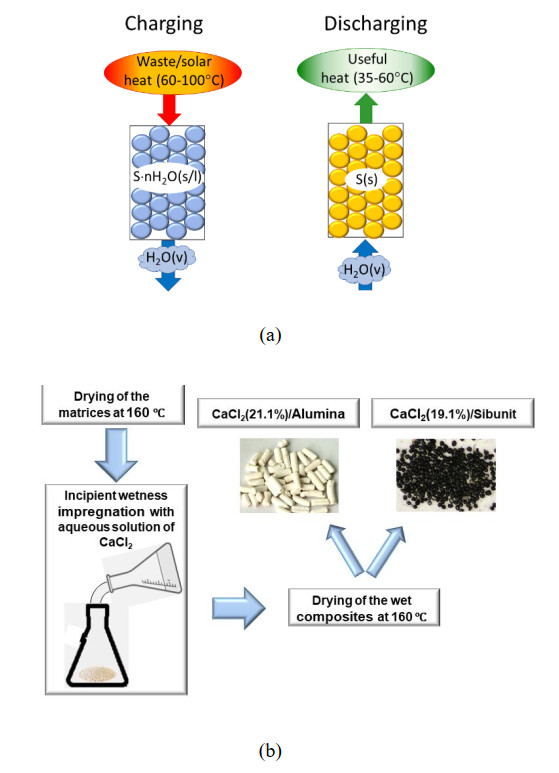
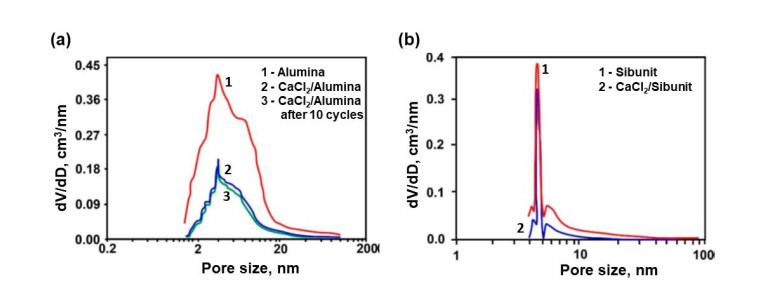
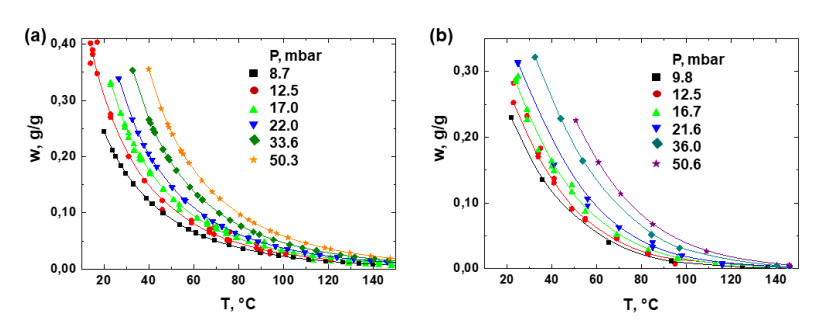
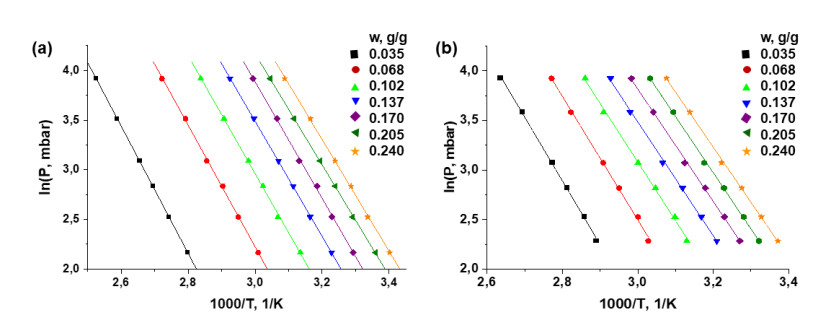
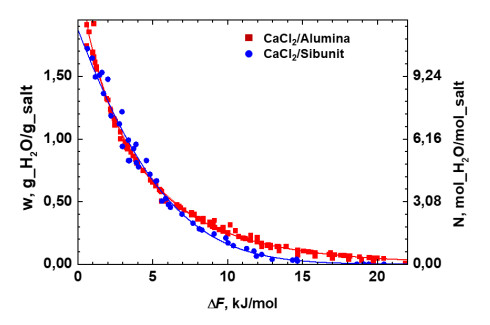
Thermochemical energy storage is an emerging technology aiming to mitigate the mismatch between heat supply and demand. Adsorption method, which belongs to the wider class of thermochemical energy storage, is a promising solution for storage of low-temperature heat (below 100 °С). Designing efficient energy storage units requires the appropriate choice of the working pair. In this article, we address the properties of composite sorbents "CaCl2 inside alumina and carbon mesopores", two commercial matrices with similar pore structure, but very different chemical nature and hydrophilicity. Despite this, water sorption equilibrium for both composites are very similar; the composites' sorption properties are influenced more by the confined salt and the matrix' porous structure than by its chemical nature. This finding provides deeper insight into the adsorption mechanisms and can guide designing new advanced composites "salt in a porous matrix" for various applications. High heat storage density (1.1–1.3 GJ/m3), low regeneration temperature (60–100 ℃), high heat release temperature (up to 60–80 ℃), good hydrothermal stability, and commercial availability of the components make the new CaCl2/Alumina composite very competitive with other materials for thermochemical energy storage.
Citation: Yuri I. Aristov, Mikhail M. Tokarev, Alexandra D. Grekova, Marina V. Solovyeva, Larisa G. Gordeeva. Composite sorbents "calcium chloride inside alumina and carbon mesopores" for thermochemical energy storage[J]. AIMS Energy, 2025, 13(4): 901-921. doi: 10.3934/energy.2025033
Thermochemical energy storage is an emerging technology aiming to mitigate the mismatch between heat supply and demand. Adsorption method, which belongs to the wider class of thermochemical energy storage, is a promising solution for storage of low-temperature heat (below 100 °С). Designing efficient energy storage units requires the appropriate choice of the working pair. In this article, we address the properties of composite sorbents "CaCl2 inside alumina and carbon mesopores", two commercial matrices with similar pore structure, but very different chemical nature and hydrophilicity. Despite this, water sorption equilibrium for both composites are very similar; the composites' sorption properties are influenced more by the confined salt and the matrix' porous structure than by its chemical nature. This finding provides deeper insight into the adsorption mechanisms and can guide designing new advanced composites "salt in a porous matrix" for various applications. High heat storage density (1.1–1.3 GJ/m3), low regeneration temperature (60–100 ℃), high heat release temperature (up to 60–80 ℃), good hydrothermal stability, and commercial availability of the components make the new CaCl2/Alumina composite very competitive with other materials for thermochemical energy storage.

| [1] | Wang R, Wang L, Wu J (2014) Adsorption refrigeration technology: Theory and application. Singapore: John Wiley & Sons, Singapore Pte. Ltd. Available from: https://www.wiley.com/en-us/Adsorption+Refrigeration+Technology%3A+Theory+and+Application-p-9781118197479. |
| [2] |
Aydin D, Casey SP, Riffat S, et al. (2015) The latest advancements on thermochemical heat storage systems. Renew Sustain Energy Rev 41: 356–367. https://doi.org/10.1016/j.rser.2014.08.054 doi: 10.1016/j.rser.2014.08.054

|
| [3] |
Deutsch M, Müller D, Aumeyr C, et al. (2016) Systematic search algorithm for potential thermochemical energy storage systems. Appl Energy 183: 113–120. https://doi.org/10.1016/j.apenergy.2016.08.142 doi: 10.1016/j.apenergy.2016.08.142
|
| [4] |
Manickam K, Mistry P, Walker G, et al. (2019) Future perspectives of thermal energy storage with metal hydrides. Int J Hydrogen Energy 44: 7738–7745. https://doi.org/10.1016/j.ijhydene.2018.12.011 doi: 10.1016/j.ijhydene.2018.12.011
|
| [5] |
Milanese C, Jensen TR, Hauback BC, et al. (2019) Complex hydrides for energy storage. Int J Hydrogen Energy 44: 7860–7874. https://doi.org/10.1016/j.ijhydene.2018.11.208 doi: 10.1016/j.ijhydene.2018.11.208
|
| [6] |
Desage L, McCabe E, Vieira AP, et al. (2023) Thermochemical batteries using metal carbonates: A review of heat storage and extraction. J Energy Storage 71: 107901. https://doi.org/10.1016/j.est.2023.107901 doi: 10.1016/j.est.2023.107901
|
| [7] |
Zhao Q, Lin J, Huang H, et al. (2021) Optimization of thermochemical energy storage systems based on hydrated salts: a review. Energy Build 244: 111035. https://doi.org/10.1016/j.enbuild.2021.111035 doi: 10.1016/j.enbuild.2021.111035
|
| [8] |
Miró L, Gasia J, Cabeza LF, (2016) Thermal energy storage (TES) for industrial waste heat (IWH) recovery: A review. Appl Energy 179, 284–301. https://doi.org/10.1016/j.apenergy.2016.06.147 doi: 10.1016/j.apenergy.2016.06.147
|
| [9] |
Formann C, Muritala IK, Pardemann R, et al. (2016) Estimating the global waste heat potential. Renew Sust Energ Rev 57: 1568–1579. https://doi.org/10.1016/j.rser.2015.12.192 doi: 10.1016/j.rser.2015.12.192
|
| [10] |
Aristov YI (2021) Adsorptive conversion of ultra-low temperature heat: Thermodynamic issues. Energy 236: 121892. https://doi.org/10.1016/j.energy.2021.121892 doi: 10.1016/j.energy.2021.121892
|
| [11] |
Henninger SK, Ernst SJ, Gordeeva L, et al. (2017) New materials for adsorption heat transformation and storage. Renew Energy 110: 59–68. https://doi.org/10.1016/j.renene.2016.08.041 doi: 10.1016/j.renene.2016.08.041
|
| [12] |
Jänchen J, Ackermann D, Weiler E (2005) Calorimetric investigation on zeolites AlPO4's and CaCl2 impregnated attapulgite for thermochemical storage of heat. Thermochim Acta 434: 37–41. https://doi.org/10.1016/j.tca.2005.01.009 doi: 10.1016/j.tca.2005.01.009
|
| [13] |
Palomba V, Vasta S, Freni A (2017) Experimental testing of AQSOA FAM Z02/water adsorption system for heat and cold storage. Appl Thermal Eng 124: 967–974. https://doi.org/10.1016/j.applthermaleng.2017.06.085 doi: 10.1016/j.applthermaleng.2017.06.085
|
| [14] |
Henninger SK, Jeremias F, Kummer H, et al. (2017) MOFs for use in adsorption heat pump processes. Eur J Inorg Chem 2012: 2625–2634. https://doi.org/10.1002/ejic.201101056 doi: 10.1002/ejic.201101056
|
| [15] |
Elsayed A, Elsayed E, Al-Dadah R, et al. (2017) Thermal energy storage using metal-organic framework materials. Appl Energy 186: 509–519. https://doi.org/10.1016/j.apenergy.2016.03.113 doi: 10.1016/j.apenergy.2016.03.113
|
| [16] |
Levitskii EA, Aristov YI, Tokarev MM, et al. (1996) "Chemical Heat Accumulators": A new approach to accumulating low potential heat. Sol Energy Mater Sol Cells 44: 219–235. https://doi.org/10.1016/0927-0248(96)00010-4 doi: 10.1016/0927-0248(96)00010-4
|
| [17] |
Gordeeva LG, Aristov YI, (2012) Composites "salt inside porous matrix" for adsorption heat transformation: a current state of the art and new trends. Int J Low Carb Tech 7: 288–302. https://doi.org/10.1093/ijlct/cts050 doi: 10.1093/ijlct/cts050
|
| [18] |
Tan B, Luo Y, Liang X, et al. (2019) Composite salt in MIL-101(Cr) with high water uptake and fast adsorption kinetics for adsorption heat pumps. Microporous Mesoporous Mater 286: 141–148. https://doi.org/10.1016/j.micromeso.2019.05.039 doi: 10.1016/j.micromeso.2019.05.039
|
| [19] | Aristov YI (2020) Nanocomposite Sorbents for Multiple Applications. Jenny Stanford Publishing. https://doi.org/10.1201/9781315156507 |
| [20] |
Ocvirk M, Ristic A, Logar NZ, et al. (2021) Synthesis of mesoporous γ-alumina support for water composite sorbents for low temperature sorption heat storage. Energies 14: 7809. https://doi.org/10.3390/en14227809 doi: 10.3390/en14227809
|
| [21] |
Glaznev I, Alekseev V, Salnikova I, et al. (2009) ARTIC-1: A new humidity buffer for showcases. Stud Conserv 54: 133–148. https://doi.org/10.1179/sic.2009.54.3.1 doi: 10.1179/sic.2009.54.3.1
|
| [22] |
Gordeeva LG, Khassin AA, Chermashentseva GK, et al. (2012) New adsorbents of methanol for the intensification of methanol synthesis. React Kinet Mech Cat 105: 391–400. https://doi.org/10.1007/s11144-011-0379-z doi: 10.1007/s11144-011-0379-z
|
| [23] |
Bu X, Wang L, Huang Y (2013) Effect of pore size on the performance of composite adsorbent. Adsorption 19: 929–935. https://doi.org/10.1007/s10450-013-9513-8 doi: 10.1007/s10450-013-9513-8
|
| [24] |
Ponomarenko IV, Glaznev IS, Gubar AV, et al. (2010) Synthesis and water sorption properties of a new composite "CaCl2 confined to SBA-15 pores". Microporou Mesoporou Mat 129: 243–250. https://doi.org/10.1016/j.micromeso.2009.09.023 doi: 10.1016/j.micromeso.2009.09.023
|
| [25] |
Zhou H, Zhang D (2022) Investigation on pH/temperature-manipulated hydrothermally reduced graphene oxide aerogel impregnated with MgCl2 hydrates for low-temperature thermochemical heat storage. Sol Energy Mater Sol Cells 241: 111740. https://doi.org/10.1016/j.solmat.2022.111740 doi: 10.1016/j.solmat.2022.111740
|
| [26] |
Ermakov YI, Surovikin VF, Plaksin GV, et al. (2087) New carbon material as support for catalysts. React Kinet Cat Lett 33: 435-440. https://doi.org/10.1007/bf02128102 doi: 10.1007/bf02128102
|
| [27] |
Jabbari-Hichri A, Bennici S, Auroux A (2017) CaCl2-containing composites as thermochemical heat storage materials. Sol Energy Mater Sol Cells 172: 177–185. https://doi.org/10.1016/j.solmat.2017.07.037 doi: 10.1016/j.solmat.2017.07.037
|
| [28] | https://www.silicagelco.com/ (last accessed 26.08.204) |
| [29] |
Zhang YN, Wang RZ, Li TX (2017) Experimental investigation on an open sorption thermal storage system for space heating. Energy 141: 2421–2433. https://doi.org/10.1016/J.Energy.2017.12.003 doi: 10.1016/J.Energy.2017.12.003
|
| [30] |
Parchovianský M, Galusek D, Švan čárek P, et al. (2014) Thermal behavior, electrical conductivity and microstructure of hot pressed Al2O3/SiC nanocomposites. Ceram Int 14: 14421–14429. https://doi.org/10.1016/j.ceramint.2014.06.038 doi: 10.1016/j.ceramint.2014.06.038
|
| [31] |
Wang K, Wu JY, Wang RZ, et al. (2006) Effective thermal conductivity of expanded graphite-CaCl2 composite adsorbent for chemical adsorption chillers. Energ Convers Manage 47: 1902–1912. https://doi.org/10.1016/j.enconman.2005.09.005 doi: 10.1016/j.enconman.2005.09.005
|
| [32] |
Pankratiev YD, Tanashev YY, Kulko EV, et al. (2006) Heat of wetting of aluminum hydroxide obtained by thermal activation of hydrargillite. Rus J Phys Chem 80: 1037–1043. https://doi.org/10.1134/S0036024406070077 doi: 10.1134/S0036024406070077
|
| [33] |
Knoezenger H, Ratnasamy P (1978) Catalytic aluminas: Surface models and characterization of surface sites. Catal Rev Sci Eng 17: 31–69. https://doi.org/10.1080/03602457808080878 doi: 10.1080/03602457808080878
|
| [34] |
Desai R, Hussain M, Ruthven DM (1992) Adsorption of water vapor on activated alumina. Ⅰ—Equilibrium behavior. Canadian J Chem Eng 70: 699–706. https://doi.org/10.1002/cjce.5450700412 doi: 10.1002/cjce.5450700412
|
| [35] |
Vradman L, Landau MV, Kantorovich D, et al. (2005) Evaluation of metal oxide phase assembling mode inside the nanotubular pores of mesostructured silica. Microporou Mesoporou Mater 79: 307–318. https://doi.org/10.1016/j.micromeso.2004.11.023 doi: 10.1016/j.micromeso.2004.11.023
|
| [36] |
Cortés FB, Chejne F, Carrasco-Marín F, et al. (2012) Water sorption on silica- and zeolite-supported hygroscopic salts for cooling system applications. Energy Convers Manag 53: 219–223. https://doi.org/10.1016/j.enconman.2011.09.001 doi: 10.1016/j.enconman.2011.09.001
|
| [37] |
Neimark A, Kheifez LI, Fenelonov VB (1981) Theory of preparation of supported catalysts. Ind Eng Chem Product Res Devel 20: 439–450. https://doi.org/10.1021/i300003a006 doi: 10.1021/i300003a006
|
| [38] |
Shkatulov A, Gordeeva LG, Girnik IS, et al. (2020) Novel adsorption method for moisture and heat recuperation in ventilation: Composites "LiCl/matrix" tailored for cold climate. Energy 201: 117595. https://doi.org/10.1016/j.energy.2020.117595 doi: 10.1016/j.energy.2020.117595
|
| [39] |
Gordeeva L, Freni A, Krieger T, et al. (2008) "Composites "Lithium Halides in Silica Gel Pores": Methanol Sorption Equilibrium". Microporous Mesoporous Mater 112: 254–261. https://doi.org/10.1016/j.micromeso.2007.09.040 doi: 10.1016/j.micromeso.2007.09.040
|
| [40] |
Solovyeva MV, Krivosheeva IV, Gordeeva LG, et al. (2023) Salt confined in MIL-101(Cr)—tailoring the composite sorbents for efficient atmospheric water harvesting. ChemSusChem 16: e202300520. https://doi.org/10.1002/cssc.202300520 doi: 10.1002/cssc.202300520
|
| [41] |
Ivanova AS (2012) Aluminium oxide and systems based on it: Properties and applications. Kinet Catal 53: 425–439. https://doi.org/10.1134/S0023158412040039 doi: 10.1134/S0023158412040039
|
| [42] |
Yong GL, Chessick JJ, Hearley FH, et al. (1954) Thermodynamics of the adsorption of water on Graphon from heats of immersion and adsorption data. J Phys Chem 58: 313–315. https://doi.org/10.1021/j150514a006 doi: 10.1021/j150514a006
|
| [43] | Vrana LM (2014) Calcium chloride. In: Kirk-Othmer Encyclopedia of Chemical Technology, John Wiley & Sons. https://doi.org/10.1002/0471238961.0301120318050904.a01.pub3 |
| [44] |
Ng KC, Buhran M, Shahzad MW, et al. (2017) A universal isotherm model to capture adsorption uptake and energy distribution of porous heterogeneous surface. Sci Rep 7: 10634. https://doi.org/10.1038/s41598-017-11156-6 doi: 10.1038/s41598-017-11156-6
|
| [45] |
Chakraborty A, Sun B (2014) An adsorption isotherm equation for multi-types adsorption with thermodynamic correctness. Appl Therm Eng 72: 190–199. https://doi.org/10.1016/j.applthermaleng.2014.04.024 doi: 10.1016/j.applthermaleng.2014.04.024
|
| [46] |
Brancato V, Frazzica A, Sapienza A, et al. (2015) Ethanol adsorption onto carbonaceous and composite adsorbents for adsorptive cooling system. Energy 84: 177–185. https://doi.org/10.1016/j.energy.2015.02.077 doi: 10.1016/j.energy.2015.02.077
|
| [47] |
Liu XY, Wang WW, Xie ST, et al. (2021) Performance characterization and application of composite adsorbent LiCl@ACFF for moisture harvesting. Sci Rep 11: 14412. https://doi.org/10.1038/s41598-021-93784-7 doi: 10.1038/s41598-021-93784-7
|
| [48] |
Frazzica A, Freni A (2017) Adsorbent working pairs for solar thermal energy storage in buildings. Renewable Energy 110: 87–94. https://doi.org/10.1016/j.renene.2016.09.047 doi: 10.1016/j.renene.2016.09.047
|
| [49] |
Dubinin MM, Astakhov VA (1971) Description of adsorption equilibrium of vapors on zeolites over wide ranges of temperatures and pressure. Adv Chem 102: 69–85. https://doi.org/10.1021/ba-1971-0102.ch044 doi: 10.1021/ba-1971-0102.ch044
|
| [50] |
Gaeini M, Rouws AL, Salari JW, et al. (2018) Characterization of microencapsulated and impregnated porous host materials based on calcium chloride for thermochemical energy storage. Appl Energy 212: 1165–1177. https://doi.org/10.1016/j.apenergy.2017.12.131 doi: 10.1016/j.apenergy.2017.12.131
|
| [51] |
Chen Z, Zhang Y, Zhang Y, et al. (2023) A study on vermiculite-based salt mixture composite materials for low-grade thermochemical adsorption heat storage. Energy 278: 127986. https://doi.org/10.1016/j.energy.2023.127986 doi: 10.1016/j.energy.2023.127986
|
| [52] |
Fu L, Wang Q, Ye R, et al. (2017) A calcium chloride hexahydrate/expanded perlite composite with good heat storage and insulation properties for building energy conservation. Renew Energy 114: 733–743. https://doi.org/10.1016/j.renene.2017.07.091 doi: 10.1016/j.renene.2017.07.091
|
| [53] |
Liu H, Nagano K, Sugiyama D, et al. (2013) Honeycomb filters made from mesoporous composite material for an open sorption thermal energy storage system to store low-temperature industrial waste heat. Int J Heat Mass Tran 65: 471–480. https://doi.org/10.1016/j.ijheatmasstransfer.2013.06.021 doi: 10.1016/j.ijheatmasstransfer.2013.06.021
|
| [54] |
Mehrabadi A, Farid M (2018) New salt hydrate composite for low-grade thermal energy storage. Energy 164: 194–203. https://doi.org/10.1016/j.energy.2018.08.192 doi: 10.1016/j.energy.2018.08.192
|
| [55] |
Alsaman AS, Ibrahim EM, Askalany A, et al. (2022) Composite material-based a clay for adsorption desalination and cooling applications. Chem Eng Res Des 188: 417–432. https://doi.org/10.1016/j.cherd.2022.09.017 doi: 10.1016/j.cherd.2022.09.017
|
| [56] | Kaerger J, Ruthven DM (1992) Diffusion in zeolites and other microporous solids. New York: John Wiley & Sons. https://doi.org/10.1002/apj.5500040311 |
| [57] |
Harned HS, Parker HW (1965) The diffusion coefficients of calcium chloride in dilute and moderately dilute solution at 25 ℃. J Am Chem Soc 77: 265. https://doi.org/10.1021/ja01607a004 doi: 10.1021/ja01607a004
|
| [58] |
Valiullin RR, Skirda VD, Stapf S, et al. (1997) Molecular exchange processes in partially filled porous glass as seen with NMR diffusometry. Phys Rev E 55: 2664–2671. https://doi.org/10.1103/PhysRevE.55.2664 doi: 10.1103/PhysRevE.55.2664
|
| [59] |
Zhang YN, Wang RZ, Li TX (2018) Thermochemical characterizations of high-stable activated alumina/LiCl composites with multistage sorption process for thermal storage. Energy 156: 240–249. https://doi.org/10.1016/j.energy.2018.05.047 doi: 10.1016/j.energy.2018.05.047
|
| [60] |
Xu SZ, Wang RZ, Wang LW, et al. (2019) Performance characterizations and thermodynamic analysis of magnesium sulfate-impregnated zeolite 13X and activated alumina composite sorbents for thermal energy storage. Energy 167: 889–901. https://doi.org/10.1016/j.energy.2018.10.200 doi: 10.1016/j.energy.2018.10.200
|
| [61] |
Pandey KM, Chaurasiya R (2017) A review on analysis and development of solar flat plate collector. Renew Sustain Energy Rev 67: 641–650. https://doi.org/10.1016/j.rser.2016.09.078 doi: 10.1016/j.rser.2016.09.078
|
| [62] |
Luberti M, Gowans R, Finn P, et al. (2022) An estimate of the ultralow waste heat available in the European Union. Energy 238: 121967. https://doi.org/10.1016/j.energy.2021.12196 doi: 10.1016/j.energy.2021.12196
|
| [63] |
Scapino L, Zondag HA, Bael JV, et al. (2017) Energy density and storage capacity cost comparison of conceptual solid and liquid sorption seasonal heat storage systems for low-temperature space heating. Renew Sustain Energy Rev 76: 1314–1331. https://doi.org/10.1016/j.rser.2017.03.101 doi: 10.1016/j.rser.2017.03.101
|
 energy-13-04-033-S001.pdf energy-13-04-033-S001.pdf |
 |
Figures(8) / Tables(3)

Yuri I. Aristov, Mikhail M. Tokarev, Alexandra D. Grekova, Marina V. Solovyeva, Larisa G. Gordeeva. Composite sorbents "calcium chloride inside alumina and carbon mesopores" for thermochemical energy storage[J]. AIMS Energy, 2025, 13(4): 901-921. doi: 10.3934/energy.2025033





 DownLoad: