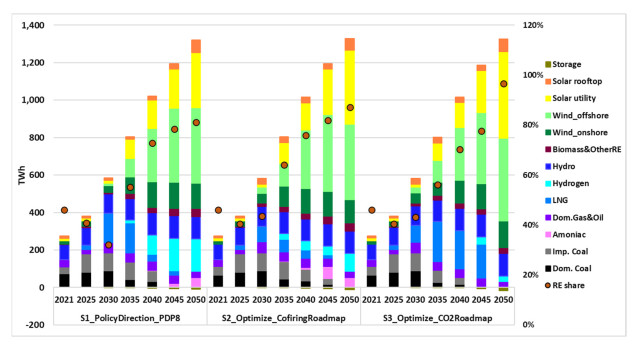
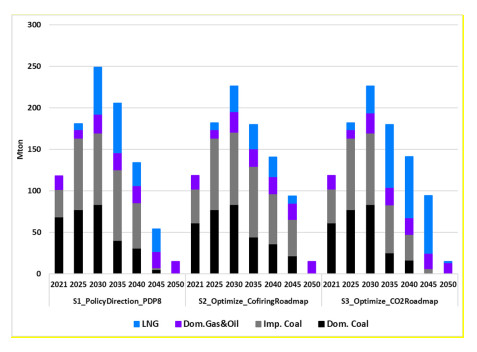
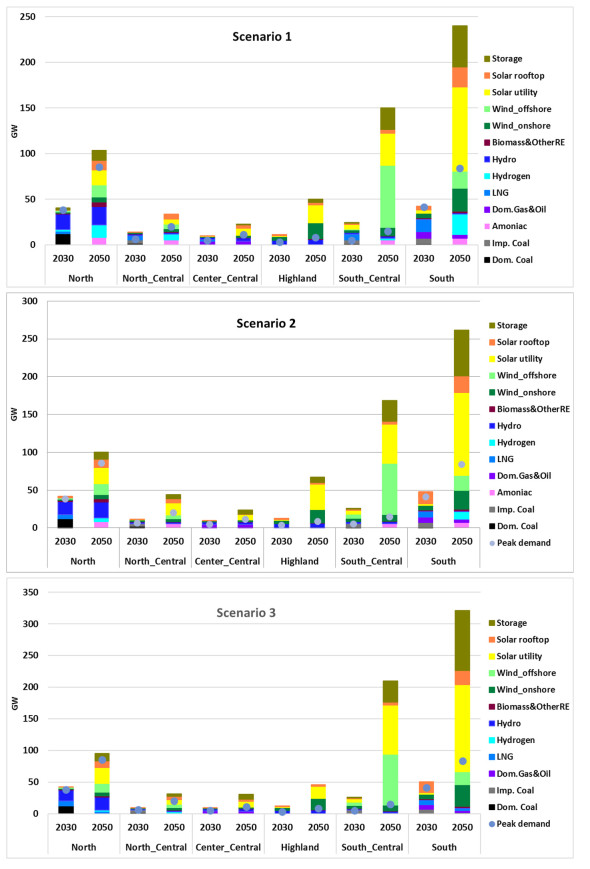
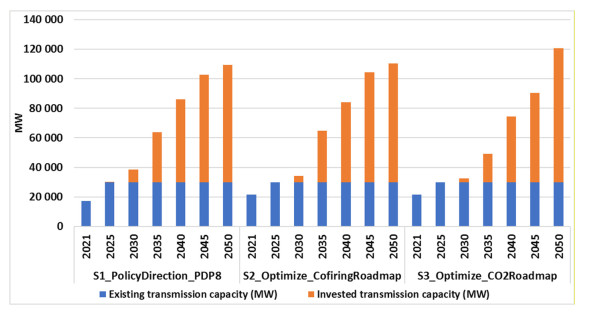
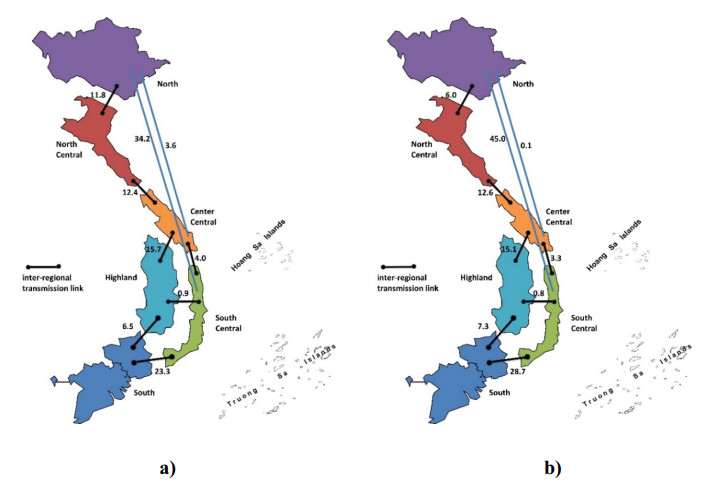
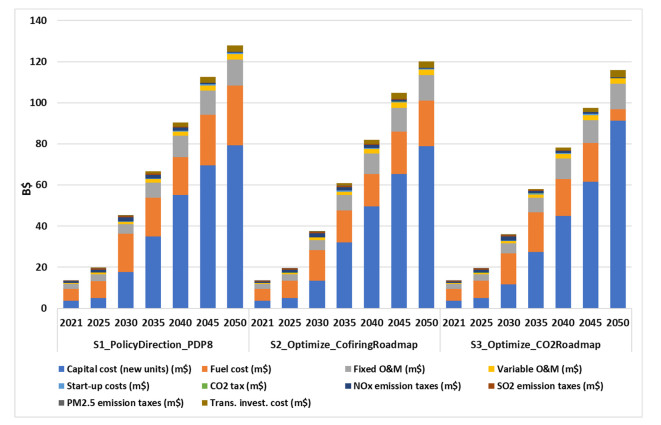
Vietnam is committed to achieving Net Zero emissions by 2050, with the power sector being central to this transition. This study investigated optimal generation expansion pathways using a unified dataset aligned with Power Development Plan Ⅷ (PDP Ⅷ). It compared two planning approaches with 3 scenarios: (1) constraining CO2 emissions directly (Scenario S3), and (2) predefining thermal plant co-firing's timeline and ratios (Scenarios S1 and S2). S1 adheres closely to PDP Ⅷ's planned thermal commitments and solar limits; S2 offers flexibility by committing only plants under construction and allowing higher solar potential. Results indicate that Scenario S3 yields the lowest total system cost while meeting the Net Zero target. The optimal strategy in S3 involves early decommissioning of thermal plants and prioritizing renewable energy and storage expansion over thermal fuel conversion. Notably, nuclear power and Carbon Capture, Utilization and Storage technology installation were not included in this optimal pathway. By 2050 under S3, renewables will contribute to 95% of energy generation, with thermal power dropping to 5%. CO2 emissions peak in 2030 in all scenarios, earlier than defined by PDP Ⅷ. The study highlights the critical need for energy storage, flexible generation, and significant high-voltage direct current transmission capacity from South Central to North Vietnam after 2030. Full utilization of ground-mounted solar potential suggests a need for expanded land allocation if available. These findings emphasize prioritizing renewable energy, storage, and transmission investment for an efficient Net Zero transition.
Citation: Van Duong Nguyen, Duy Duc Ha, Thi Hoai Thu Nguyen, Duc Huy Nguyen. Generation expansion planning toward Net Zero target considering co-firing green fuel, CCUS installation and early decommissioning in thermal power plants: A case study of Vietnam[J]. AIMS Energy, 2025, 13(3): 540-568. doi: 10.3934/energy.2025021
Vietnam is committed to achieving Net Zero emissions by 2050, with the power sector being central to this transition. This study investigated optimal generation expansion pathways using a unified dataset aligned with Power Development Plan Ⅷ (PDP Ⅷ). It compared two planning approaches with 3 scenarios: (1) constraining CO2 emissions directly (Scenario S3), and (2) predefining thermal plant co-firing's timeline and ratios (Scenarios S1 and S2). S1 adheres closely to PDP Ⅷ's planned thermal commitments and solar limits; S2 offers flexibility by committing only plants under construction and allowing higher solar potential. Results indicate that Scenario S3 yields the lowest total system cost while meeting the Net Zero target. The optimal strategy in S3 involves early decommissioning of thermal plants and prioritizing renewable energy and storage expansion over thermal fuel conversion. Notably, nuclear power and Carbon Capture, Utilization and Storage technology installation were not included in this optimal pathway. By 2050 under S3, renewables will contribute to 95% of energy generation, with thermal power dropping to 5%. CO2 emissions peak in 2030 in all scenarios, earlier than defined by PDP Ⅷ. The study highlights the critical need for energy storage, flexible generation, and significant high-voltage direct current transmission capacity from South Central to North Vietnam after 2030. Full utilization of ground-mounted solar potential suggests a need for expanded land allocation if available. These findings emphasize prioritizing renewable energy, storage, and transmission investment for an efficient Net Zero transition.

| [1] | Tracker CA (2023) CAT net zero target evaluations. Available from: https://climateactiontracker.org/global/cat-net-zero-target-evaluations/. |
| [2] | EMBER (2023) Share of electricity production from fossil fuels. Available from: https://ourworldindata.org/grapher/share-electricity-fossil-fuels. |
| [3] | GERMANWATCH (2021) Global Climate Risk Index 2021. Available from: https://www.germanwatch.org/en/19777. |
| [4] | Circular No.45/2018/TT-BCT (2018) Available from: https://chinhphu.vn/default.aspx?pageid = 27160 & docid = 195468. |
| [5] | Decision No.896/QĐ-TTg on approving National strategist on climate change by 2050. (2022) Available from: https://vanban.chinhphu.vn/?pageid = 27160 & docid = 206254. |
| [6] | Insights on planning for power system regulators (2018) Available from: https://www.irena.org/-/media/Files/IRENA/Agency/Publication/2018/Jun/IRENA_Insights_on_planning_2018.pdf. |
| [7] | California ISO (2017) 2016–2017 transmission plan. Available from: https://www.caiso.com/Documents/Board-Approved_2016-2017TransmissionPlan.pdf. |
| [8] | Dixit S, Chitnis A, Jairaj B, et al. (2014) 10 questions to ask about integrated resources planning. World Resources Institute. Available from: https://www.wri.org/research/10-questions-ask-about-integrated-resources-planning. |
| [9] | Danish Energy Agency (2015) Power markets and power sector planning in Europe-Lessons learnt for China. |
| [10] | Hawailan Electric, Maui Electric, Hawai'i Electric light (2018) Planning Hawai'i's grid for future generations: Integrated grid planning report. |
| [11] | Department of Energy Republic of South Africa (2017) IRP 2016: Introduction. |
| [12] | Law on Planning No.21/2017/QH14 (2017). Available from: https://filevbpl.mpi.gov.vn/qlvb/2022/5/5/21.2017.QH14.Law%20on%20Planning.pdf. |
| [13] | Approving the national electricity development plan for the period of 2021–2030, with a vision to 2050. (2023). Available from: https://vepg.vn/wp-content/uploads/2023/05/PDP8_full-with-annexes_EN.pdf. |
| [14] |
Béres R, Junginger M, Broek MVD (2024) Assessing the feasibility of CO2 removal strategies in achieving climate-neutral power systems: Insights from biomass, CO2 capture, and direct air capture in Europe. Adv Appl Energy 14: 100166. https://doi.org/10.1016/j.adapen.2024.100166 doi: 10.1016/j.adapen.2024.100166

|
| [15] |
Mazumdar S, Thakker D, Hayes J, et al. (2023) Towards achieving net zero by 2050 in the UK-Stakeholder perspectives in integrated urban planning. Futures 152: 103197. https://doi.org/10.1016/j.futures.2023.103197 doi: 10.1016/j.futures.2023.103197
|
| [16] |
Kat B, Şahin Ü, Teimourzadeh S, et al. (2024) A new energy-economy-environment modeling framework: Insights from decarbonization of the Turkish power Sector towards net-zero Emission targets. Energy 302: 131760. https://doi.org/10.1016/j.energy.2024.131760 doi: 10.1016/j.energy.2024.131760
|
| [17] |
Lu Y, Schandl H, Wang H, et al. (2024) China's pathway towards a net zero and circular economy: A model-based scenario analysis. Resour Conserv Recycl 204: 107514. https://doi.org/10.1016/j.resconrec.2024.107514 doi: 10.1016/j.resconrec.2024.107514
|
| [18] |
Binyet E, Hsu HW (2024) Decarbonization strategies and achieving net-zero by 2050 in Taiwan: A study of independent power grid region. Technol Forecast Soc Change 204: 123439. https://doi.org/10.1016/j.techfore.2024.123439 doi: 10.1016/j.techfore.2024.123439
|
| [19] |
Joo J, Paavola J, Van Alstine J (2023) Contested net-zero target setting in a transitioning country: The case of South Korea. Futures 147: 103114. https://doi.org/10.1016/j.futures.2023.103114 doi: 10.1016/j.futures.2023.103114
|
| [20] |
Zia A, Rana IA, Arshad HSH, et al. (2023) Monsoon flood risks in urban areas of Pakistan: A way forward for risk reduction and adaptation planning. J Environ Manage 336: 117652. https://doi.org/10.1016/j.jenvman.2023.117652 doi: 10.1016/j.jenvman.2023.117652
|
| [21] | Intergovernmental Panel on Climate Change (IPCC) (2022) Global warming of 1.5 ℃. IPCC special report on impacts of global warming of 1.5 ℃ above pre-industrial levels in context of strengthening response to climate change, sustainable development, and efforts to eradicate poverty, Cambridge University Press. https://doi.org/10.1017/9781009157940 |
| [22] | IEA (2019) Average power generation construction time (capacity weighted), 2010–2018. Available from: https://www.iea.org/data-and-statistics/charts/average-power-generation-construction-time-capacity-weighted-2010-2018. |
| [23] | EREA, DEA (2024) Viet Nam energy outlook report pathways to Net-Zero 2023. |
| [24] | EREA, DEA (2022) Data report prepared for energy outlook report 2021. Available from: http://vepg.vn/wp-content/uploads/2022/06/Vietnam-Energy-Outlook-Report-2021-English.pdf. |
| [25] | Support PDP Ⅷ about long term power generation development plan to implement net zero commitment in 2050 at COP26 conference (2022). |
| [26] |
Kies A, Schyska B, Viet DT, et al. (2017) Large-scale integration of renewable power sources into the Vietnamese power system. Energy Proc 125: 207–213. https://doi.org/10.1016/j.egypro.2017.08.188 doi: 10.1016/j.egypro.2017.08.188
|
| [27] | Viet DT, Phuong VV, Duong MQ, et al. (2018) A cost-optimal pathway to integrate renewable energy into the future Vietnamese power system. 2018 4th International Conference on Green Technology and Sustainable Development (GTSD), Ho Chi Minh City, IEEE, 144–149. https://doi.org/10.1109/GTSD.2018.8595637. |
| [28] |
Hiep DT, Hoffmann C (2020) A power development planning for Vietnam under the CO2 emission reduction targets. Energy Rep 6: 19–24 https://doi.org/10.1016/j.egyr.2019.11.036. doi: 10.1016/j.egyr.2019.11.036
|
| [29] | International Atomic Energy Agency (IAEA) (1984) Expansion planning for electrical generating systems. Available from: https://www.iaea.org/publications/1343/expansion-planning-for-electrical-generating-systems. |
| [30] | Bhuvanesh A, Kandasamy K, Subramanian K (2015) Generation expansion planning—A tutorial paper. VFSTR J STEM 01: 2455–2062. |
| [31] |
Li C, Conejo AJ, Liu P, et al. (2022) Mixed-integer linear programming models and algorithms for generation and transmission expansion planning of power systems. European J Oper Res 297: 1071–1082. https://doi.org/10.1016/j.ejor.2021.06.024 doi: 10.1016/j.ejor.2021.06.024
|
| [32] |
Paes CE, Gandelman DA, Firmo HT, et al. (2022) The power generation expansion planning in Brazil: Considering the impact of greenhouse gas emissions in an Investment Decision Model. Renewable Energy 184: 225–238. https://doi.org/10.1016/j.renene.2021.11.060 doi: 10.1016/j.renene.2021.11.060
|
| [33] | Seifi H, Sepasian MS (2011) Single-bus generation expansion planning. In: Electric Power Syst Planning, Power Systems. Springer Berlin Heidelberg, 69–88. https://doi.org/10.1007/978-3-642-17989-1_5 |
| [34] | Wu J, Qiu J, Wang X, et al. (2018) Study on medium and long-term generation expansion planning method considering the requirements of green low-carbon development. 2018 IEEE PES Asia-Pacific Power and Energy Engineering Conference (APPEEC), Kota Kinabalu, IEEE, 689–694. https://doi.org/10.1109/APPEEC.2018.8566580 |
| [35] |
Gea-Bermúdez J, Jensen IG, Münster M, et al. (2021) The role of sector coupling in the green transition: A least-cost energy system development in Northern-central Europe towards 2050. Appl Energy 289: 116685. https://doi.org/10.1016/j.apenergy.2021.116685 doi: 10.1016/j.apenergy.2021.116685
|
| [36] |
Kanugrahan SP, Hakam DF, Nugraha H (2022) Techno-economic analysis of Indonesia power generation expansion to achieve economic sustainability and net zero carbon 2050. Sustainability 14: 9038. https://doi.org/10.3390/su14159038 doi: 10.3390/su14159038
|
| [37] |
Kirkerud JG, Nagel NO, Bolkesjø TF (2021) The role of demand response in the future renewable northern European energy system. Energy 235: 121336. https://doi.org/10.1016/j.energy.2021.121336 doi: 10.1016/j.energy.2021.121336
|
| [38] |
Pombo DV, Martinez-Rico J, Marczinkowski HM (2022) Towards 100% renewable islands in 2040 via generation expansion planning: The case of São Vicente, Cape Verde. Appl Energy 315: 118869. https://doi.org/10.1016/j.apenergy.2022.118869 doi: 10.1016/j.apenergy.2022.118869
|
| [39] |
Taljegard M, Göransson L, Odenberger M, et al. (2019) Impacts of electric vehicles on the electricity generation portfolio—A Scandinavian-German case study. Appl Energy 235: 1637–1650. https://doi.org/10.1016/j.apenergy.2018.10.133 doi: 10.1016/j.apenergy.2018.10.133
|
| [40] | Ea Energy Analyses (2018) Balmorel user guide. Available from: https://www.ea-energianalyse.dk/wp-content/uploads/2020/06/Balmorel_UserGuide.pdf. |
| [41] |
Guo C, Bodur M, Papageorgiou DJ (2022) Generation expansion planning with revenue adequacy constraints. Comput Oper Res 142: 105736. https://doi.org/10.1016/j.cor.2022.105736 doi: 10.1016/j.cor.2022.105736
|
| [42] | The Government of Vietnam (2021) Resolution No. 39/2021/QH15 of the national assembly of Vietnam: Regarding the national land use planning for 2021–2030 with a vision to 2050, and the national five-year land use plan for 2021–2025. Available from: https://chinhphu.vn/default.aspx?pageid = 27160 & docid = 204566. |
| [43] | Potential solar power source (2023) Global solar atlas. Available from: https://globalsolaratlas.info/map. |
| [44] | EVN (2021) Annual report 2021. Available from: https://en.evn.com.vn/d6/news/Annual-Report-2021-6-13-2537.aspx. |
| [45] | Pfenninger S, Staffell Ⅰ Potential solar power source. Available from: https://www.renewables.ninja/. |
Figures(10) / Tables(11)

Van Duong Nguyen, Duy Duc Ha, Thi Hoai Thu Nguyen, Duc Huy Nguyen. Generation expansion planning toward Net Zero target considering co-firing green fuel, CCUS installation and early decommissioning in thermal power plants: A case study of Vietnam[J]. AIMS Energy, 2025, 13(3): 540-568. doi: 10.3934/energy.2025021





 DownLoad: