Natural processes such as mineralization, natural disasters, and geological recycling of matter result in the constant formation of nanoparticles, which are found throughout the environment. In recent years, there has been a lot of interest in nanoparticles and their applications. Because of their unique physicochemical properties, nanoparticles provide promising new avenues for the prevention and treatment of dental infections. With potential applications of nanoparticles in clinical endodontics in the near future, robust research initiatives backed by collaborations between academia and industry are critical. These nanoparticles show a number of characteristics that may improve the way endodontic infections are treated, such as increased reactivity, improved antibacterial efficacy, and the capacity to functionalize with other reactive substances.
Citation: Priyanka Bhojwani, Anuja Ikhar, Aditya Patel, Manoj Chandak, Shweta Sedani. Tiny tools, big impact: the rise of nanoparticles in endodontics[J]. AIMS Bioengineering, 2025, 12(2): 265-282. doi: 10.3934/bioeng.2025013
Natural processes such as mineralization, natural disasters, and geological recycling of matter result in the constant formation of nanoparticles, which are found throughout the environment. In recent years, there has been a lot of interest in nanoparticles and their applications. Because of their unique physicochemical properties, nanoparticles provide promising new avenues for the prevention and treatment of dental infections. With potential applications of nanoparticles in clinical endodontics in the near future, robust research initiatives backed by collaborations between academia and industry are critical. These nanoparticles show a number of characteristics that may improve the way endodontic infections are treated, such as increased reactivity, improved antibacterial efficacy, and the capacity to functionalize with other reactive substances.

| [1] |
Couvreur P (2013) Nanoparticles in drug delivery: past, present and future. Adv Drug Deliv Rev 65: 21-23. https://doi.org/10.1016/j.addr.2012.04.010 
|
| [2] |
Wong J, Zou T, Lee AHC, et al. (2021) The potential translational applications of nanoparticles in endodontics. Int J Nanomed 16: 2087-2106. https://doi.org/10.2147/IJN.S293518
|
| [3] |
Shrestha A, Kishen A (2016) Antibacterial nanoparticles in endodontics: a review. J Endod 42: 1417-1426. https://doi.org/10.1016/j.joen.2016.05.021
|
| [4] |
Yin IX, Zhang J, Zhao IS, et al. (2020) The antibacterial mechanism of silver nanoparticles and its application in dentistry. Int J Nanomed 15: 2555-2562. https://doi.org/10.2147/IJN.S246764
|
| [5] | Feynman RP, Leighton RB, Sands M (1987) Six Easy Pieces. New York: Anchor. Available from: https://www.amazon.in/Six-Easy-Pieces-Richard-Feynman/dp/0465025277 |
| [6] | Yao C, Storey D, Webster TJ (2007) Nanostructured metal coatings on polymers increase osteoblast attachment. Int J Nanomed 2: 487-492. https://doi.org/10.2147/IJN.S2.3.487 |
| [7] | Aston D (2011) Nanotechnology: the stuff of science fiction or science fact?. Sch Sci Rev 92: 71-75. |
| [8] |
Listl S, Galloway J, Mossey PA, et al. (2015) Global economic impact of dental diseases. J Dent Res 94: 1355-1361. https://doi.org/10.1177/0022034515602879
|
| [9] |
Raura N, Garg A, Arora A, et al. (2020) Nanoparticle technology and its implications in endodontics: a review. Biomater Res 24: 21. https://doi.org/10.1186/s40824-020-00198-z
|
| [10] |
Zakrzewski W, Dobrzyński M, Zawadzka-Knefel A, et al. (2021) Nanomaterials application in endodontics. Materials 14: 5296. https://doi.org/10.3390/ma14185296
|
| [11] |
Jhajharia K, Parolia A, Shetty KV, et al. (2015) Biofilm in endodontics: a review. J Int Soc Prev Comm Dent 5: 1-12. https://doi.org/10.4103/2231-0762.151956
|
| [12] |
De Jong WH, Borm PJ (2008) Drug delivery and nanoparticles: applications and hazards. Int J Nanomed 3: 133-149. https://doi.org/10.2147/IJN.S596
|
| [13] |
Wolfram J, Zhu M, Yang Y, et al. (2015) Safety of nanoparticles in medicine. Curr Drug Targets 16: 1671-1681. https://doi.org/10.2174/1389450115666140804124808
|
| [14] |
Farges J-C, Alliot-Licht B, Renard E, et al. (2015) Dental pulp defence and repair mechanisms in dental caries. Mediators Inflamm 2015: 230251. https://doi.org/10.1155/2015/230251
|
| [15] |
Yohan D, Chithrani BD (2014) Applications of nanoparticles in nanomedicine. J Biomed Nanotechnol 10: 2371-2392. https://doi.org/10.1166/jbn.2014.2015
|
| [16] |
Baetke SC, Lammers T, Kiessling F (2015) Applications of nanoparticles for diagnosis and therapy of cancer. Br J Radiol 88: 20150207. https://doi.org/10.1259/bjr.20150207
|
| [17] |
Moraes G, Zambom C, Siqueira WL (2021) Nanoparticles in dentistry: a comprehensive review. Pharmaceuticals 14: 752. https://doi.org/10.3390/ph14080752
|
| [18] | Dodwad V, Kukreja BJ Biomimetics—the new pathway for regenerating tissue. J Pharm Biomed Sci (JPBMS) 16: 1-4. |
| [19] |
Osorio R, Alfonso-Rodríguez CA, Medina-Castillo AL, et al. (2016) Bioactive polymeric nanoparticles for periodontal therapy. PLoS ONE 11: e0166217. https://doi.org/10.1371/journal.pone.0166217
|
| [20] |
Harrington GW, Natkin E (1992) Midtreatment flare-ups. Dent Clin North Am 36: 409-423. https://doi.org/10.1016/S0011-8532(22)02504-6
|
| [21] | Subramanian AK (2021) The Applications and the current status of silver nanoparticles in the field of Orthodontics. J Contemp Issues Bus Gov 27: 3620. https://doi.org/10.47750/cibg.2021.27.02.370 |
| [22] |
Rao CNR, Subrahmanyam KS, Ramakrishna Matte HSS, et al. (2010) A study of the synthetic methods and properties of graphenes. Sci Technol Adv Mater 11: 054502. https://doi.org/10.1088/1468-6996/11/5/054502
|
| [23] |
Wu Z-S, Ren W, Gao L, et al. (2009) Synthesis of graphene sheets with high electrical conductivity and good thermal stability by hydrogen arc discharge exfoliation. ACS Nano 3: 411-417. https://doi.org/10.1021/nn900020u
|
| [24] |
Ohya Y, Shiratani M, Kobayashi H, et al. (1994) Release behavior of 5-Fluorouracil from chitosan-gel nanospheres immobilizing 5-Fluorouracil coated with polysaccharides and their cell specific cytotoxicity. J Macromol Sci A 31: 629-642. https://doi.org/10.1080/10601329409349743
|
| [25] | Samiei M, Davaran S, Davari A, et al. (2014) Antibacterial efficacy of silver-crosslinked hydrogel nanocomposite versus sodium hypochlorite and chlorhexidine on Enterococcus faecalis for use in root canal infection. J Dent Res 3: 2316-2332. |
| [26] |
Wu D, Fan W, Kishen A, et al. (2014) Evaluation of the antibacterial efficacy of silver nanoparticles against Enterococcus faecalis biofilm. J Endod 40: 285-290. https://doi.org/10.1016/j.joen.2013.08.022
|
| [27] |
Kawahara K, Tsuruda K, Morishita M, et al. (2000) Antibacterial effect of silver-zeolite on oral bacteria under anaerobic conditions. Dent Mater 16: 452-455. https://doi.org/10.1016/s0109-5641(00)00050-6
|
| [28] |
Kishen A, Shi Z, Shrestha A, et al. (2008) An investigation on the antibacterial and antibiofilm efficacy of cationic nanoparticulates for root canal disinfection. J Endod 34: 1515-1520. https://doi.org/10.1016/j.joen.2008.08.035
|
| [29] |
Bhojwani P, Ikhar A, Patel A, et al. (2024) Recent advances in antimicrobial and biosynthesis properties of bioglass and nanoparticles: a narrative review. Multidisciplinary Reviews 7: 2024286. https://doi.org/10.31893/multirev.2024286
|
| [30] |
Shrestha A, Kishen A (2014) Antibacterial efficacy of photosensitizer functionalized biopolymeric nanoparticles in the presence of tissue inhibitors in root canal. J Endod 40: 566-570. https://doi.org/10.1016/j.joen.2013.09.013
|
| [31] |
Bekmukhametova A, Antony A, Halliday C, et al. (2024) Rose bengal–encapsulated chitosan nanoparticles for the photodynamic treatment of Trichophyton species. Photochem Photobiol 100: 115-128. https://doi.org/10.1111/php.13839
|
| [32] |
Shrestha A, Fong S-W, Khoo B-C, et al. (2009) Delivery of antibacterial nanoparticles into dentinal tubules using high-intensity focused ultrasound. J Endod 35: 1028-1033. https://doi.org/10.1016/j.joen.2009.04.015
|
| [33] |
Piñón-Segundo E, Ganem-Quintanar A, Alonso-Pérez V, et al. (2005) Preparation and characterization of triclosan nanoparticles for periodontal treatment. Int J Pharm 294: 217-232. https://doi.org/10.1016/j.ijpharm.2004.11.010
|
| [34] |
Corrêa JM, Mori M, Sanches HL, et al. (2015) Silver nanoparticles in dental biomaterials. Int J Biomater 2015: 485275. https://doi.org/10.1155/2015/485275
|
| [35] |
Lee MJ, Seo YB, Seo JY, et al. (2020) Development of a bioactive flowable resin composite containing a Zinc-doped phosphate-based glass. Nanomaterials 10: 2311. https://doi.org/10.3390/n
|
| [36] |
Pranno N, La Monaca G, Polimeni A, et al. (2020) Antibacterial activity against staphylococcus aureus of titanium surfaces coated with graphene nanoplatelets to prevent peri-implant diseases. an in-vitro pilot study. Int J Environ Res Public Health 17: 1568. https://doi.org/10.3390/ijerph17051568
|
| [37] |
Wu X, Ding SJ, Lin K, et al. (2017) A review on the biocompatibility and potential applications of graphene in inducing cell differentiation and tissue regeneration. J Mater Chem B 5: 3084-3102. https://doi.org/10.1039/C6TB03067J
|
| [38] |
Moradi F, Haghgoo R (2018) Evaluation of antimicrobial efficacy of nanosilver solution, sodium hypochlorite and normal saline in root canal irrigation of primary teeth. Contemp Clin Dent 9: S227-S232. https://doi.org/10.4103/ccd.ccd_95_18
|
| [39] |
Hu C, Sun J, Long C, et al. (2019) Synthesis of nano zirconium oxide and its application in dentistry. Nanotechnol Rev 8: 396-404. https://doi.org/10.1515/ntrev-2019-0035
|
| [40] |
Raura N, Garg A, Arora A, et al. (2020) Nanoparticle technology and its implications in endodontics: a review. Biomater Res 24: 21. https://doi.org/10.1186/s40824-020-00198-z
|
| [41] |
Roy AS, Parveen A, Koppalkar AR, et al. (2010) Effect of nano-Titanium dioxide with different antibiotics against methicillin-resistant staphylococcus aureus. J Biomater Nanobiotechnol 1: 37. https://doi.org/10.4236/jbnb.2010.11005
|
| [42] |
Vincent M, Duval RE, Hartemann P, et al. (2018) Contact killing and antimicrobial properties of copper. J Appl Microbiol 124: 1032-1046. https://doi.org/10.1111/jam.13681
|
| [43] |
Warnes SL, Summersgill EN, Keevil CW (2015) Inactivation of murine norovirus on a range of copper alloy surfaces is accompanied by loss of capsid integrity. Appl Environ Microb 81: 1085-1091. https://doi.org/10.1128/AEM.03280-14
|
| [44] |
Borkow G (2012) Using Copper to fight microorganisms. Curr Chem Biol 6: 93-103. https://doi.org/10.2174/187231312801254723
|
| [45] |
Bleichert P, Espírito Santo C, Hanczaruk M, et al. (2014) Inactivation of bacterial and viral biothreat agents on metallic copper surfaces. Biometals 27: 1179-1189. https://doi.org/10.1007/s10534-014-9781-0
|
| [46] |
Bukhari S, Kim D, Liu Y, et al. (2018) Novel endodontic disinfection approach using catalytic nanoparticles. J Endodont 44: 806-812. https://doi.org/10.1016/j.joen.2017.12.003
|
| [47] |
Beyth N, Houri-Haddad Y, Domb A, et al. (2015) Alternative antimicrobial approach: nano-antimicrobial materials. Evid-Based Compl Alt 2015: 246012. https://doi.org/10.1155/2015/246012
|
| [48] |
Wiatrak B, Sobierajska P, Szandruk-Bender M, et al. (2021) Nanohydroxyapatite as a biomaterial for peripheral nerve regeneration after mechanical damage—in vitro study. Int J Mol Sci 22: 4454. https://doi.org/10.3390/ijms22094454
|
| [49] |
Al-Hamdan RS, Almutairi B, Kattan HF, et al. (2020) Influence of hydroxyapatite nanospheres in dentin adhesive on the dentin bond integrity and degree of conversion: a scanning electron microscopy (SEM), Raman, Fourier transform-infrared (FTIR), and microtensile study. Polymers 12: 2948. https://doi.org/10.3390/polym12122948
|
| [50] |
Liu Y, Tjäderhane L, Breschi L, et al. (2011) Limitations in bonding to dentin and experimental strategies to prevent bond degradation. J Dent Res 90: 953-968. https://doi.org/10.1177/0022034510391799
|
| [51] |
Herman K, Wujczyk M, Dobrzynski M, et al. (2021) In vitro assessment of long-term Fluoride Ion release from nanofluorapatite. Materials 14: 3747. https://doi.org/10.3390/ma14133747
|
| [52] |
Allaker RP, Ren G (2008) Potential impact of nanotechnology on the control of infectious diseases. Trans R Soc Trop Med Hyg 102: 1-2. https://doi.org/10.1016/j.trstmh.2007.07.003
|
| [53] | Dianat O, Saedi S, Kazem M, et al. (2015) Antimicrobial activity of nanoparticle calcium hydroxide against Enterococcus faecalis: an in vitro study. Iran Endod J 10: 39-43. https://doi.org/10.22037/iej.v10i1.6379 |
| [54] |
Sireesha A, Jayasree R, Vidhya S, et al. (2017) Comparative evaluation of micron- and nano-sized intracanal medicaments on penetration and fracture resistance of root dentin—an in vitro study. Int J Biol Macromol 104: 1866-1873. https://doi.org/10.1016/j.ijbiomac.2017.05.126
|
| [55] |
Louwakul P, Saelo A, Khemaleelakul S (2017) Efficacy of calcium oxide and calcium hydroxide nanoparticles on the elimination of Enterococcus faecalis in human root dentin. Clin Oral Investig 21: 865-871. https://doi.org/10.1007/s00784-016-1836-x
|
| [56] | Zand V, Mokhtari H, Hasani A, et al. (2017) Comparison of the penetration depth of conventional and nano-particle Calcium hydroxide into dentinal tubules. Iran Endod J 12: 366-370. https://doi.org/10.22037/iej.v12i3.16421 |
| [57] |
Naseri M, Eftekhar L, Gholami F, et al. (2019) The effect of calcium hydroxide and nano–calcium hydroxide on microhardness and superficial chemical structure of root canal dentin: an ex vivo study. J Endod 45: 1148-1154. https://doi.org/10.1016/j.joen.2019.06.002
|
| [58] | Dianat O, Azadnia S, Mozayeni MA (2015) Toxicity of calcium hydroxide nanoparticles on murine fibroblast cell line. Iran Endod J 10: 49-54. https://doi.org/10.22037/iej.v10i1.7005 |
| [59] |
Sánchez-López E, Gomes D, Esteruelas G, et al. (2020) Metal-based nanoparticles as antimicrobial agents: an overview. Nanomaterials 10: 292. https://doi.org/10.3390/nano10020292
|
| [60] |
Parra-Nieto J, Del Cid MAG, de Cárcer IA, et al. (2021) Inorganic porous nanoparticles for drug delivery in antitumoral therapy. Biotechnol J 16: e2000150. https://doi.org/10.1002/biot.202000150
|
| [61] |
Zhou H, Ge J, Miao Q, et al. (2020) Biodegradable inorganic nanoparticles for cancer theranostics: insights into the degradation behavior. Bioconjug Chem 31: 315-331. https://doi.org/10.1021/acs.bioconjchem.9b00699
|
| [62] | Iqbal P, Preece JA, Mendes PM (2012) Nanotechnology: the “top-down” and “bottom-up” approaches. Supramolecular Chemistry . Wiley. Available from: https://onlinelibrary.wiley.com/doi/10.1002/9780470661345.smc195 |
| [63] | Drexler E (1987) Engines of creation: The coming era of nanotechnology. New York: Anchor. |
| [64] |
Tan W, Krishnaraj R, Desai TA (2001) Evaluation of nanostructured composite collagen–chitosan matrices for tissue engineering. Tissue Eng 7: 203-210. https://doi.org/10.1089/107632701300062831
|
| [65] |
Parolia A, Kumar H, Ramamurthy S, et al. (2020) Effectiveness of chitosan-propolis nanoparticle against Enterococcus faecalis biofilms in the root canal. BMC Oral Health 20: 1-14. https://doi.org/10.1186/s12903-020-01330-0
|
| [66] |
Zhang K, Cheng L, Imazato S, et al. (2013) Effects of dual antibacterial agents MDPB and nano-silver in primer on microcosm biofilm, cytotoxicity and dentine bond properties. J Dent 41: 464-474. https://doi.org/10.1016/j.jdent.2013.03.003
|
| [67] |
Cheng L, Zhang K, Melo MAS, et al. (2012) Anti-biofilm dentin primer with quaternary ammonium and silver nanoparticles. J Dent Res 91: 598-604. https://doi.org/10.1177/0022034512444128
|
| [68] |
Moghadas L, Shahmoradi M, Narimani T (2012) Antimicrobial activity of a new nanobased endodontic irrigation solution: in vitro study. Dent Hypotheses 3: 142. https://doi.org/10.4103/2155-8213.106838
|
| [69] |
Bruniera JFB, Silva-Sousa YTC, Lara MG, et al. (2014) Development of intracanal formulation containing silver nanoparticles. Braz Dent J 25: 302-306. https://doi.org/10.1590/0103-6440201302431
|
| [70] |
Pagonis TC, Chen J, Fontana CR, et al. (2010) Nanoparticle-based endodontic antimicrobial photodynamic therapy. J Endod 36: 322-328. https://doi.org/10.1016/j.joen.2009.10.011
|
| [71] |
Agnihotri SA, Mallikarjuna NN, Aminabhavi TM (2004) Recent advances on chitosan-based micro- and nanoparticles in drug delivery. J Control Release 100: 5-28. https://doi.org/10.1016/j.jconrel.2004.08.010
|
| [72] | Muzzarelli RA, Isolati A, Ferrero A (1974) Chitosan membranes. Ion Exch Membr 1: 193-196. |
| [73] | Machida Y, Nagai T, Abe M, et al. (1986) Use of chitosan and hydroxypropylchitosan in drug formulations to effect sustained release. Drug Des Deliv 1: 119-130. |
| [74] | Shantiaee Y, Maziar F, Dianat O, et al. (2011) Comparing microleakage in root canals obturated with nanosilver-coated gutta-percha to standard gutta-percha by two different methods. Iran Endod J 6: 140-145. https://doi.org/10.22037/iej.v6i4.1949 |
| [75] |
Araujo HC, da Silva ACG, Paião LI, et al. (2020) Antimicrobial, antibiofilm and cytotoxic effects of a colloidal nanocarrier composed by chitosan-coated iron oxide nanoparticles loaded with chlorhexidine. J Dent 101: 103453. https://doi.org/10.1016/j.jdent.2020.103453
|
| [76] |
Rabea EI, Badawy ME-T, Stevens CV, et al. (2003) Chitosan as antimicrobial agent: applications and mode of action. Biomacromolecules 4: 1457-1465. https://doi.org/10.1021/bm034130m
|
| [77] |
Upadya M, Shrestha A, Kishen A (2011) Role of efflux pump inhibitors on the antibiofilm efficacy of calcium hydroxide, chitosan nanoparticles, and light-activated disinfection. J Endod 37: 1422-1426. https://doi.org/10.1016/j.joen.2011.06.017
|
| [78] |
Jasso-Ruiz I, Velazquez-Enriquez U, Scougall-Vilchis RJ, et al. (2019) Synthesis and characterization of silver nanoparticles on orthodontic brackets: a new alternative in the prevention of white spots. Coatings 9: 480. https://doi.org/10.3390/coatings9080480
|
| [79] |
Song W, Ge S (2019) Application of antimicrobial nanoparticles in dentistry. Molecules 24: 1033. https://doi.org/10.3390/molecules24061033
|
| [80] |
Kirsch C (2007) Oral cavity cancer. Top Magn Reson Imaging 18: 269-280. https://doi.org/10.1097/RMR.0b013e3181572caa
|
| [81] |
Wanasathop A, Li SK (2018) Iontophoretic drug delivery in the oral cavity. Pharmaceutics 10: 121. https://doi.org/10.3390/pharmaceutics10030121
|
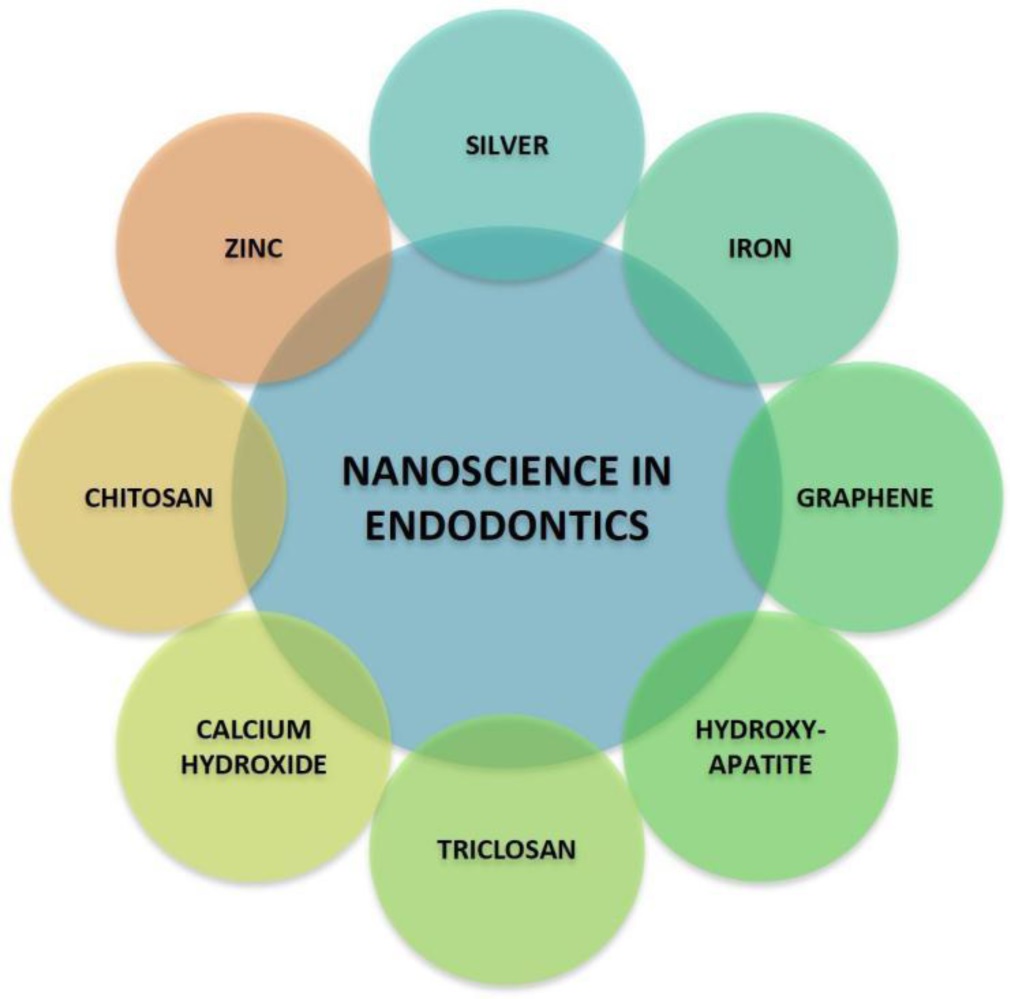
Figures(1)

Priyanka Bhojwani, Anuja Ikhar, Aditya Patel, Manoj Chandak, Shweta Sedani. Tiny tools, big impact: the rise of nanoparticles in endodontics[J]. AIMS Bioengineering, 2025, 12(2): 265-282. doi: 10.3934/bioeng.2025013




 DownLoad: