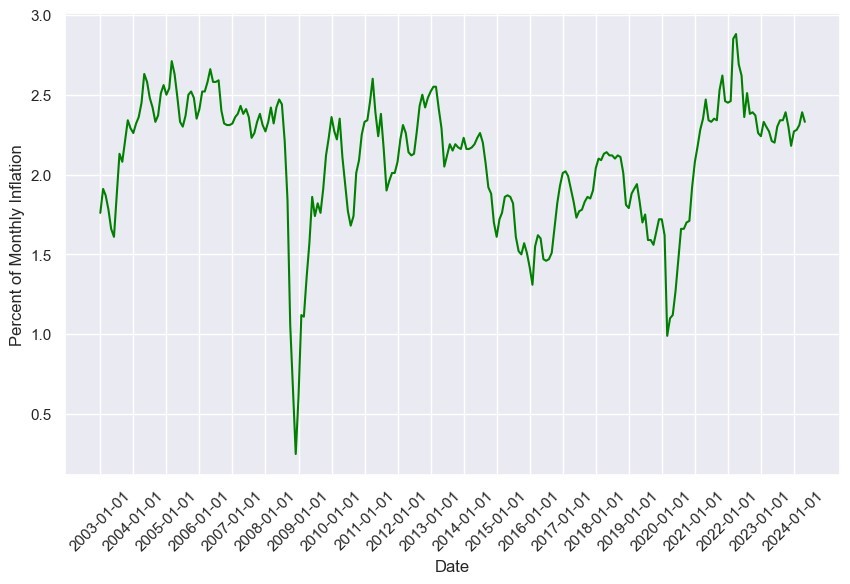
This study examined the forecasting ability of deep learning (DL) and machine learning (ML) models against benchmark traditional statistical models for the monthly inflation rates in the USA. The study compared various DL and ML models like transformers, linear regression, gradient boosting (GB), extreme gradient boosting (XGBoost), and adaptive boosting (AdaBoost) with traditional baseline time-series models like autoregressive integrated moving averages (ARIMA) and exponential smoothing (ETS) with Holt-Winters seasonal method utilizing data sourced from the Federal Reserve Bank of St. Louis. The study consistently showed that all DL and ML models outperformed the traditional approaches. In particular, the Transformer (RMSE = 0.0291, MAE = 0.0221) exhibited the lowest error rates, suggesting high forecasting accuracy for the monthly inflation data. In contrast, ARIMA (RMSE = 0.2038, MAE = 0.1895) and ETS (RMSE = 0.1619, MAE = 0.1455) models displayed higher error rates. Due to the ability of DL and ML models to process large volumes of data and identify underlying patterns, they are particularly effective for dynamic and evolving datasets. This study explored how novel DL modeling techniques could augment the accuracy and reliability of economic forecasting. The results indicate that policymakers and economists could leverage DL and ML models to gain deeper insights into inflation dynamics and implement more informed strategies to combat inflationary pressure. Hybrid methods should be further investigated in future studies to enhance economic forecasting accuracy.
Citation: Ezekiel NN Nortey, Edmund F. Agyemang, Enoch Sakyi-Yeboah, Obu-Amoah Ampomah, Louis Agyekum. AI meets economics: Can deep learning surpass machine learning and traditional statistical models in inflation time series forecasting?[J]. Data Science in Finance and Economics, 2025, 5(2): 136-155. doi: 10.3934/DSFE.2025007
This study examined the forecasting ability of deep learning (DL) and machine learning (ML) models against benchmark traditional statistical models for the monthly inflation rates in the USA. The study compared various DL and ML models like transformers, linear regression, gradient boosting (GB), extreme gradient boosting (XGBoost), and adaptive boosting (AdaBoost) with traditional baseline time-series models like autoregressive integrated moving averages (ARIMA) and exponential smoothing (ETS) with Holt-Winters seasonal method utilizing data sourced from the Federal Reserve Bank of St. Louis. The study consistently showed that all DL and ML models outperformed the traditional approaches. In particular, the Transformer (RMSE = 0.0291, MAE = 0.0221) exhibited the lowest error rates, suggesting high forecasting accuracy for the monthly inflation data. In contrast, ARIMA (RMSE = 0.2038, MAE = 0.1895) and ETS (RMSE = 0.1619, MAE = 0.1455) models displayed higher error rates. Due to the ability of DL and ML models to process large volumes of data and identify underlying patterns, they are particularly effective for dynamic and evolving datasets. This study explored how novel DL modeling techniques could augment the accuracy and reliability of economic forecasting. The results indicate that policymakers and economists could leverage DL and ML models to gain deeper insights into inflation dynamics and implement more informed strategies to combat inflationary pressure. Hybrid methods should be further investigated in future studies to enhance economic forecasting accuracy.

| [1] |
Adnan RM, Liang Z, Kuriqi A, et al. (2021) Air temperature prediction using different machine learning models. Indones J Electr Eng Comput Sci 22: 534–541. https://doi.org/10.11591/ijeecs.v22.i1.pp534-541 doi: 10.11591/ijeecs.v22.i1.pp534-541

|
| [2] |
Agyemang EF, Mensah JA, Ocran E, et al. (2023) Time series based road traffic accidents forecasting via SARIMA and Facebook Prophet model with potential changepoints. Heliyon 9: 1–18. https://doi.org/10.1016/j.heliyon.2023.e22544 doi: 10.1016/j.heliyon.2023.e22544
|
| [3] |
Alomani G, Kayid M, Abd El-Aal MF (2025) Global inflation forecasting and Uncertainty Assessment: Comparing ARIMA with advanced machine learning. J Radiat Res Appl Sci 18: 1–7. https://doi.org/10.1016/j.jrras.2025.101402 doi: 10.1016/j.jrras.2025.101402
|
| [4] |
Aras S, Lisboa PJ (2022) Explainable inflation forecasts by machine learning models. Expert Syst Appl 207: 1–19. https://doi.org/10.1016/j.eswa.2022.117982 doi: 10.1016/j.eswa.2022.117982
|
| [5] |
Araujo GS, Gaglianone WP (2023) Machine learning methods for inflation forecasting in Brazil: New contenders versus classical models. Lat Am J Cent Bank 4: 1–29. https://doi.org/10.1016/j.latcb.2023.100087 doi: 10.1016/j.latcb.2023.100087
|
| [6] |
Arora S, Rani R, Saxena N (2024) A systematic review on detection and adaptation of concept drift in streaming data using machine learning techniques. Wires Data Min Knowl 14: 1–27. https://doi.org/10.1002/widm.1536 doi: 10.1002/widm.1536
|
| [7] |
Aygun B, Gunay EK (2021) Comparison of statistical and machine learning algorithms for forecasting daily bitcoin returns. Avrupa Bilim ve Teknoloji Dergisi 21: 444–454. https://doi.org/10.31590/ejosat.822153 doi: 10.31590/ejosat.822153
|
| [8] |
Ben Bouallègue Z, Clare MC, Magnusson L, et al. (2024) The rise of data-driven weather forecasting: A first statistical assessment of machine learning–based weather forecasts in an operational-like context. B Am Meteorol Soc 105: 864–883. https://doi.org/10.1175/BAMS-D-23-0162.1 doi: 10.1175/BAMS-D-23-0162.1
|
| [9] | Bonci A, Kermenov R, Longarini L, et al. (2024) Artificial Intelligence in Manufacturing: A Lightweight Framework for Online Anomaly Detection at the Edge. Commun Ind 2024: 307–311. |
| [10] |
Busari GA, Lim DH (2021) Crude oil price prediction: A comparison between AdaBoost-LSTM and AdaBoost-GRU for improving forecasting performance. Comput Chem Eng 155: 1–9. https://doi.org/10.1016/j.compchemeng.2021.107513 doi: 10.1016/j.compchemeng.2021.107513
|
| [11] |
Cen Z, Wang J (2019) Crude oil price prediction model with long short term memory deep learning based on prior knowledge data transfer. Energy 169: 160–171. https://doi.org/10.1016/j.energy.2018.12.016 doi: 10.1016/j.energy.2018.12.016
|
| [12] | Dong J (2020) Forecasting modeling for China's inflation. Working paper. |
| [13] |
Gunnarsson ES, Isern HR, Kaloudis A, et al. (2024) Prediction of realized volatility and implied volatility indices using AI and machine learning: A review. Int Rev Financ Anal 103221: 1–20. https://doi.org/10.1016/j.irfa.2024.103221 doi: 10.1016/j.irfa.2024.103221
|
| [14] | He QQ, Pang PCI, Si YW (2019) Transfer learning for financial time series forecasting. In PRICAI 2019: Trends in Artificial Intelligence: 16th Pacific Rim International Conference on Artificial Intelligence, Springer International Publishing 1: 24–36. https://doi.org/10.1007/978-3-030-29911-8_3 |
| [15] |
Huang L, Wang J (2018) Global crude oil price prediction and synchronization based accuracy evaluation using random wavelet neural network. Energy 151: 875–888. https://doi.org/10.1016/j.energy.2018.03.099 doi: 10.1016/j.energy.2018.03.099
|
| [16] | Ingabire J, Mung'atu JK (2016) Measuring the performance of autoregressive integrated moving average and vector autoregressive models in forecasting inflation rate in Rwanda. Int J Math Phys Sci Res 4: 15–25. |
| [17] |
Jha N, Tanneru HK, Palla S, et al. (2024) Multivariate analysis and forecasting of the crude oil prices: Part Ⅰ–Classical machine learning approaches. Energy 296: 1–13. https://doi.org/10.1016/j.energy.2024.131185 doi: 10.1016/j.energy.2024.131185
|
| [18] |
Joseph A, Potjagailo G, Chakraborty C, et al. (2024) Forecasting UK inflation bottom up. Int J Forecast 40: 1521–1538. https://doi.org/10.1016/j.ijforecast.2024.01.001 doi: 10.1016/j.ijforecast.2024.01.001
|
| [19] |
Jouilil Y, Iaousse MB (2023) Comparing the accuracy of classical and machine learning methods in time series forecasting: A case study of usa inflation. Stat Optim Inform Comput 11: 1041–1050. https://doi.org/10.19139/soic-2310-5070-1767 doi: 10.19139/soic-2310-5070-1767
|
| [20] |
Kontopoulou VI, Panagopoulos AD, Kakkos I, et al. (2023) A review of ARIMA vs. machine learning approaches for time series forecasting in data driven networks. Future Internet 15: 2–31. https://doi.org/10.3390/fi15080255 doi: 10.3390/fi15080255
|
| [21] |
Maccarrone G, Morelli G, Spadaccini S (2021) GDP forecasting: Machine learning, linear or autoregression? Front Artif Intell 4: 1–19. https://doi.org/10.3389/frai.2021.757864 doi: 10.3389/frai.2021.757864
|
| [22] |
Makala D, Li Z (2021) Prediction of gold price with ARIMA and SVM. Journal of Physics: Conference Series 1767: 1–9. https://doi:10.1088/1742-6596/1767/1/012022 doi: 10.1088/1742-6596/1767/1/012022
|
| [23] |
Masini RP, Medeiros MC, Mendes EF (2023) Machine learning advances for time series forecasting. J Econ Surv 37: 76–111. https://doi.org/10.1111/joes.12429 doi: 10.1111/joes.12429
|
| [24] |
Medeiros MC, Vasconcelos GF, Veiga Á, et al. (2021) Forecasting inflation in a data-rich environment: the benefits of machine learning methods. J Bus Econ Stat 39: 98–119. https://doi.org/10.1080/07350015.2019.1637745 doi: 10.1080/07350015.2019.1637745
|
| [25] |
Nortey EN, Agbeli R, Debrah G, et al. (2024) A GARCH-MIDAS approach to modelling stock returns. Commun Stat Appl Met 31: 535–556. https://doi.org/10.29220/CSAM.2024.31.5.535 doi: 10.29220/CSAM.2024.31.5.535
|
| [26] |
Özgür Ö, Akkoç U (2022) Inflation forecasting in an emerging economy: selecting variables with machine learning algorithms. Int J Emerg Mark 17: 1889–1908. https://doi.org/10.1108/IJOEM-05-2020-0577 doi: 10.1108/IJOEM-05-2020-0577
|
| [27] |
Paranhos L (2025) Predicting inflation with recurrent neural networks. Int J Forecast 5283: 1–16. https://doi.org/10.1016/j.ijforecast.2024.07.010 doi: 10.1016/j.ijforecast.2024.07.010
|
| [28] |
Reed SB (2014) One hundred years of price change: The Consumer Price Index and the American inflation experience. Monthly Lab Rev 137: 1–32. https://doi.org/10.21916/mlr.2014.14. doi: 10.21916/mlr.2014.14
|
| [29] |
Riofrío J, Chang O, Revelo-Fuelagán EJ, et al. (2020) Forecasting the Consumer Price Index (CPI) of Ecuador: A comparative study of predictive models. Int J Adv Sci Eng Inf Technol 10: 1078–1084. https://doi.org/10.18517/ijaseit.10.3.10813 doi: 10.18517/ijaseit.10.3.10813
|
| [30] |
Sezer OB, Gudelek MU, Ozbayoglu AM (2020) Financial time series forecasting with deep learning: A systematic literature review: 2005–2019. Appl Soft Comput 90: 1–32. https://doi.org/10.1016/j.asoc.2020.106181 doi: 10.1016/j.asoc.2020.106181
|
| [31] |
Valderrama Balaguera JC (2024) Precipitation forecast estimation applying the change point method and ARIMA. Cogent Eng 11: 1–13. https://doi.org/10.1080/23311916.2024.2340191 doi: 10.1080/23311916.2024.2340191
|
| [32] |
Vaughan L, Zhang M, Gu H, et al. (2023) An exploration of challenges associated with machine learning for time series forecasting of COVID-19 community spread using wastewater-based epidemiological data. Sci Total Environ 858: 1–8. https://doi.org/10.1016/j.scitotenv.2022.159748 doi: 10.1016/j.scitotenv.2022.159748
|
| [33] |
Wang J, Qin Z, Hsu J, et al. (2024) A fusion of machine learning algorithms and traditional statistical forecasting models for analyzing American healthcare expenditure. Healthcare Anal 5: 1–10. https://doi.org/10.1016/j.health.2024.100312 doi: 10.1016/j.health.2024.100312
|
| [34] |
Westergaard G, Erden U, Mateo OA, et al. (2024) Time series forecasting utilizing automated machine learning (AutoML): A comparative analysis study on diverse datasets. Information 15: 1–20. https://doi.org/10.3390/info15010039 doi: 10.3390/info15010039
|
| [35] |
Yıldırım S, Tosun E, Çalık A, et al. (2019) Artificial intelligence techniques for the vibration, noise, and emission characteristics of a hydrogen-enriched diesel engine. Energ Source Part A 41: 2194–2206. https://doi.org/10.1080/15567036.2018.1550540 doi: 10.1080/15567036.2018.1550540
|
| [36] |
Zhang X, Qi W, Zhan Z (2021) A Study on Machine-Learning-Based Prediction for Bitcoin's Price via Using LSTM and SVR. Journal of Physics: Conference Series 1732: 1–5. https://doi.org/10.1088/1742-6596/1732/1/012027 doi: 10.1088/1742-6596/1732/1/012027
|
| [37] |
Zhao Y, Li J, Yu L (2017) A deep learning ensemble approach for crude oil price forecasting. Energy Econ 66: 9–16. https://doi.org/10.1016/j.eneco.2017.05.023 doi: 10.1016/j.eneco.2017.05.023
|



Figures(5) / Tables(6)
Ezekiel NN Nortey, Edmund F. Agyemang, Enoch Sakyi-Yeboah, Obu-Amoah Ampomah, Louis Agyekum. AI meets economics: Can deep learning surpass machine learning and traditional statistical models in inflation time series forecasting?[J]. Data Science in Finance and Economics, 2025, 5(2): 136-155. doi: 10.3934/DSFE.2025007





 DownLoad: