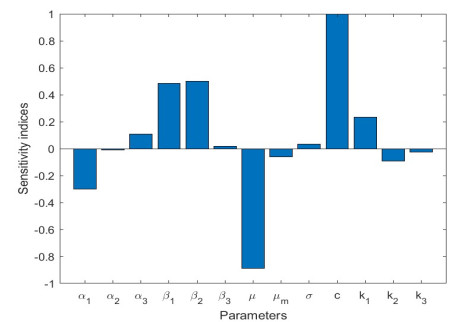
In this paper, we present a deterministic model for the population dynamics of HIV/AIDS, wherein some individuals at the severe symptomatic phase of HIV develop serious opportunistic infections (OIs) such cryptococcal, tuberculous, pneumococcal, and other bacterial meningitis due to an inappropriate treatment or lack of counseling. OIs are responsible for significant mortality and disability on individuals with HIV in many countries. Cryptococcal meningitis (CM) is among frequent OIs responsible for significant mortality and disability of individuals with HIV in limited resource settings. However, there are also cases of high mortality due to CM on HIV-uninfected individuals, but the burden of CM is more frequent in people living with HIV. We proved the global stability of the disease-free as well as the endemic equilibrium points. In addition, we performed the study of sensitivity analysis of the basic reproduction number with the parameters of the model as well as with some compartmental classes. We illustrated our theoretical results by way of numerical simulations using a projection on the HIV historical data of South Africa since 2024. Our analysis showed that a combination of ART and OI specific treatments may reduce the number of death related cases.
Citation: Mozart Umba Nsuami, Peter Joseph Witbooi. Modeling the population dynamics of HIV/AIDS with opportunistic infections at the severe stage of HIV[J]. Mathematical Biosciences and Engineering, 2025, 22(9): 2249-2268. doi: 10.3934/mbe.2025082
In this paper, we present a deterministic model for the population dynamics of HIV/AIDS, wherein some individuals at the severe symptomatic phase of HIV develop serious opportunistic infections (OIs) such cryptococcal, tuberculous, pneumococcal, and other bacterial meningitis due to an inappropriate treatment or lack of counseling. OIs are responsible for significant mortality and disability on individuals with HIV in many countries. Cryptococcal meningitis (CM) is among frequent OIs responsible for significant mortality and disability of individuals with HIV in limited resource settings. However, there are also cases of high mortality due to CM on HIV-uninfected individuals, but the burden of CM is more frequent in people living with HIV. We proved the global stability of the disease-free as well as the endemic equilibrium points. In addition, we performed the study of sensitivity analysis of the basic reproduction number with the parameters of the model as well as with some compartmental classes. We illustrated our theoretical results by way of numerical simulations using a projection on the HIV historical data of South Africa since 2024. Our analysis showed that a combination of ART and OI specific treatments may reduce the number of death related cases.

| [1] | Statistics South Africa, Mid-year Population Estimates, Statistical Release P0302, 2024. Available from: https://www.statssa.gov.za/publications/P0302/P03022024.pdf. |
| [2] |
T. B. Liu, D. S. Perlin, C. Xue, Molecular mechanisms of cryptococcal meningitis, Virulence, 3 (2012), 173–181. https://doi.org/10.4161/viru.18685 doi: 10.4161/viru.18685

|
| [3] | National Institutes of Health and Others, HIV and Opportunistic Infections, Coinfections, and Conditions, 2022. Available from: https://hivinfo.nih.gov/understanding-hiv/fact-sheets/what-opportunistic-infection. |
| [4] |
J. Shaw, N. Matin, Opportunistic infections in HIV, Medicine, 50 (2022), 294–297. https://doi.org/10.1016/j.mpmed.2022.02.010 doi: 10.1016/j.mpmed.2022.02.010
|
| [5] |
R. Rajasingham, N. P. Govender, A. Jordan, A. Loyse, A. Shroufi, D. W. Denning, et al., The global burden of HIV-associated cryptococcal infection in adults in 2020: A modelling analysis, Lancet Infect. Dis., 22 (2022), 1748–1755. https://doi.org/10.1016/S1473-3099(22)00499-6 doi: 10.1016/S1473-3099(22)00499-6
|
| [6] |
N. A. Legare, V. C. Quan, N. P. Govender, J. W. Muchiri, Lived experience of people with cryptococcal meningitis: A qualitative study, South. Afr. J. HIV Med., 25 (2024), 1560. https://doi.org/10.4102/sajhivmed.v25i1.1560 doi: 10.4102/sajhivmed.v25i1.1560
|
| [7] |
J. Rhein, K. H. Hullsiek, E. E. Evans, L. Tugume, E. Nuwagira, K. Ssebambulidde, et al., Detrimental outcomes of unmasking cryptococcal meningitis with recent ART initiation, Open Forum Infect. Dis., 25 (2018), ofy122. https://doi.org/10.1093/ofid/ofy122 doi: 10.1093/ofid/ofy122
|
| [8] |
C. L. Wang, S. Gao, X. Z. Li, M. Martcheva, Modeling syphilis and HIV coinfection: a case study in the USA, Bull. Math. Biol., 85 (2023), 20. https://doi.org/10.1007/s11538-023-01123-w doi: 10.1007/s11538-023-01123-w
|
| [9] |
M. Byamukama, M. Karuhanga, D. Kajunguri, Mathematical analysis of the role of treatment and vaccination in the management of the HIV/AIDS and pneumococcal pneumonia co‐infection, J. Math., 1 (2025), 5879698. https://doi.org/10.1155/jom/5879698 doi: 10.1155/jom/5879698
|
| [10] |
E. Britz, O. Perovic, C. von Mollendorf, A. von Gottberg, S. Iyaloo, V. Quan, et al., The epidemiology of meningitis among adults in a South African province with a high HIV prevalence, 2009–2012, PLoS One, 11 (2016), e0163036. https://doi.org/10.1371/journal.pone.0163036 doi: 10.1371/journal.pone.0163036
|
| [11] |
N. P. Govender, G. Meintjes, P. Mangena, J. Nel, S. Potgieter, D. Reddy, et al., Southern African HIV Clinicians Society guideline for the prevention, diagnosis and management of cryptococcal disease among HIV-infected persons: 2019 update, South. Afr. J. HIV Med., 20 (2019), 1–16. https://doi.org/10.4102/sajhivmed.v20i1.1030 doi: 10.4102/sajhivmed.v20i1.1030
|
| [12] |
G. J. Abiodun, N. Marcus, K. O. Okosun, P. J. Witbooi, A model for control of HIV/AIDS with parental care, Int. J. Biomath., 6 (2013), 1350006. https://doi.org/10.1142/S179352451350006X doi: 10.1142/S179352451350006X
|
| [13] | J. A. C. Hontelez, H. Goymann, Y. Berhane, P. Bhattacharjee, J. Bor, S. T. Chabata, et al., The impact of the PEPFAR funding freeze on HIV deaths and infections: a mathematical modelling study of seven countries in sub-Saharan Africa, eClinicalMedicine, 83 (2025). https://doi.org/10.1016/j.eclinm.2025.103233 |
| [14] |
O. J. Peter, A. Yusuf, M. M. Ojo, S. Kumar, N. Kumari, F. A. Oguntolu, A mathematical model analysis of meningitis with treatment and vaccination in fractional derivatives, Int. J. Appl. Comput. Math., 8 (2022), 117. https://doi.org/10.1007/s40819-022-01317-1 doi: 10.1007/s40819-022-01317-1
|
| [15] |
M. Fung, J. M. Babik, COVID-19 in immunocompromised hosts: what we know so far, Clin. Infect. Dis., 72 (2021), 340–350. https://doi.org/10.1093/cid/ciaa863 doi: 10.1093/cid/ciaa863
|
| [16] | Western Cape Department of Health in Collaboration with the National Institute for Communicable Diseases, South Africa, Risk factors for coronavirus disease 2019 (COVID-19) death in a population cohort study from the Western Cape Province, South Africa, Clin. Infect. Dis., 73 (2020), e2005–e2015. https://doi.org/10.1093/cid/ciaa1198 |
| [17] |
A. A. Khan, R. Amin, S. Ullah, W. Sumelka, M. Altanji, Numerical simulation of a Caputo fractional epidemic model for the novel coronavirus with the impact of environmental transmission, Alexandria Eng. J., 61 (2022), 5083–5095. https://doi.org/10.1016/j.aej.2021.10.008 doi: 10.1016/j.aej.2021.10.008
|
| [18] |
M. S. Abdo, K. Shah, H. A. Wahash, S. K. Panchal, On a comprehensive model of the novel coronavirus (COVID-19) under Mittag-Leffler derivative, Chaos, Solitons Fractals, 135 (2020), 109867. https://doi.org/10.1016/j.chaos.2020.109867 doi: 10.1016/j.chaos.2020.109867
|
| [19] |
N. Raza, S. Irum, S. Niazai, M. A. Ullah, M. Y. Alshahrani, A. Omame, A mathematical framework of HIV and TB co-infection dynamics, Sci. Rep., 15 (2025), 11465. https://doi.org/10.1038/s41598-025-91871-7 doi: 10.1038/s41598-025-91871-7
|
| [20] |
S. Ullah, M. Altanji, M. A. Khan, A. Alshaheri, W. Sumelka, The dynamics of HIV/AIDS model with fractal-fractional Caputo derivative, Fractals, 31 (2023), 2340015. https://doi.org/10.1142/S0218348X23400157 doi: 10.1142/S0218348X23400157
|
| [21] |
M. U. Nsuami, P. J. Witbooi, A model of HIV/AIDS population dynamics including ARV treatment and pre-exposure prophylaxis, Adv. Differ. Equations, 2018 (2018), 1–12. https://doi.org/10.1186/s13662-017-1458-x doi: 10.1186/s13662-017-1458-x
|
| [22] |
F. Nyabadza, Z. Mukandavire, S. D. Hove-Musekwa, Modelling the HIV/AIDS epidemic trends in South Africa: Insights from a simple mathematical model, Nonlinear Anal. Real World Appl., 12 (2011), 2091–2104. https://doi.org/10.1016/j.nonrwa.2010.12.024 doi: 10.1016/j.nonrwa.2010.12.024
|
| [23] |
F. Nyabadza, Z. Mukandavire, Modelling HIV/AIDS in the presence of an HIV testing and screening campaign, J. Theor. Biol., 280 (2011), 167–179. https://doi.org/10.1016/j.jtbi.2011.04.021 doi: 10.1016/j.jtbi.2011.04.021
|
| [24] |
P. van den Driessche, J. Watmough, Reproduction numbers and sub-threshold endemic equilibria for compartmental models of disease transmission, Math. Biosci., 180 (2002), 29–48. https://doi.org/10.1016/s0025-5564(02)00108-6 doi: 10.1016/s0025-5564(02)00108-6
|
| [25] |
S. Chibaya, F. Nyabadza, Mathematical modelling of the potential role of supplementary feeding for people living with HIV/AIDS, Int. J. Appl. Comput. Math., 5 (2019), 1–20. https://doi.org/10.1007/s40819-019-0660-9 doi: 10.1007/s40819-019-0660-9
|
Figures(8) / Tables(2)

Mozart Umba Nsuami, Peter Joseph Witbooi. Modeling the population dynamics of HIV/AIDS with opportunistic infections at the severe stage of HIV[J]. Mathematical Biosciences and Engineering, 2025, 22(9): 2249-2268. doi: 10.3934/mbe.2025082





 DownLoad: