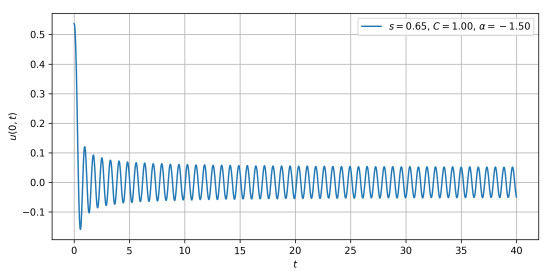
The paper first gives a rigorous proof of existence and highlights proprieties of the eigenvalues and eigenfunctions for a bounded body with peridynamical Dirichlet boundary conditions. In particular, the mechanical behavior of the body is described by mixed local and nonlocal operators where, for the latter, the regional fractional Laplacian is used. The dynamics of the1-dimensional case is thereafter analyzed. More precisely, the previous results are applied to analyze the evolutionary problem which corresponds to free oscillations of a bar taking also into account the damping effects. A peculiar numerical approach is finally proposed to solve both the eigenvalue problem and the time evolution problem. Comparisons with classical local models and super- and sub-critical behaviors are highlighted.
Citation: Federico Cluni, Vittorio Gusella, Dimitri Mugnai, Edoardo Proietti Lippi, Patrizia Pucci. Modal characteristics and evolutive response of a bar in peridynamics involving a mixed operator[J]. AIMS Mathematics, 2025, 10(4): 9435-9461. doi: 10.3934/math.2025436
The paper first gives a rigorous proof of existence and highlights proprieties of the eigenvalues and eigenfunctions for a bounded body with peridynamical Dirichlet boundary conditions. In particular, the mechanical behavior of the body is described by mixed local and nonlocal operators where, for the latter, the regional fractional Laplacian is used. The dynamics of the1-dimensional case is thereafter analyzed. More precisely, the previous results are applied to analyze the evolutionary problem which corresponds to free oscillations of a bar taking also into account the damping effects. A peculiar numerical approach is finally proposed to solve both the eigenvalue problem and the time evolution problem. Comparisons with classical local models and super- and sub-critical behaviors are highlighted.

| [1] |
G. Autuori, F. Cluni, V. Gusella, P. Pucci, Mathematical models for nonlocal elastic composite materials, Adv. Nonlinear Anal., 6 (2017), 355–382. https://doi.org/10.1515/anona-2016-0186 doi: 10.1515/anona-2016-0186

|
| [2] |
S. A. Silling, Reformulation of elasticity theory for discontinuities and long-range forces, J. Mech. Phys. Solids, 48 (2000), 175–209. https://doi.org/10.1016/S0022-5096(99)00029-0 doi: 10.1016/S0022-5096(99)00029-0
|
| [3] |
S. A. Silling, R. B. Lehoucq, Convergence of peridynamics to classical elasticity theory, J. Elasticity, 93 (2008), 13–37. https://doi.org/10.1007/s10659-008-9163-3 doi: 10.1007/s10659-008-9163-3
|
| [4] |
J. C. Bellido, J. Cueto, C. M. Corral, Bond-based peridynamics does not converge to hyperelasticity as the horizon goes to zero, J. Elasticity, 141 (2020), 273–289. https://doi.org/10.1007/s10659-020-09782-9 doi: 10.1007/s10659-020-09782-9
|
| [5] |
Y. Mikata, Analytical solutions of peristatic and peridynamic problems for a 1d infinite rod, Int. J. Solids Struct., 49 (2012), 2887–2897. https://doi.org/10.1016/j.ijsolstr.2012.02.012 doi: 10.1016/j.ijsolstr.2012.02.012
|
| [6] |
S. A. Silling, M. Zimmermann, R. Abeyaratne, Deformation of a peridynamic bar, J. Elasticity, 73 (2003), 173–190. https://doi.org/10.1023/B:ELAS.0000029931.03844.4f doi: 10.1023/B:ELAS.0000029931.03844.4f
|
| [7] |
F. Cluni, V. Gusella, D. Mugnai, E. P. Lippi, P. Pucci, A mixed operator approach to peridynamics, Math. Eng.-US, 5 (2023), 1–22. https://doi.org/10.3934/mine.2023082 doi: 10.3934/mine.2023082
|
| [8] |
J. C. Bellido, A. Ortega, A restricted nonlocal operator bridging together the Laplacian and the fractional Laplacian, Calc. Var. Partial Dif., 60 (2021). https://doi.org/10.1007/s00526-020-01896-1 doi: 10.1007/s00526-020-01896-1
|
| [9] |
H. Ren, X. Zhuang, T. Rabczuk, Dual-horizon peridynamics: A stable solution to varying horizons, Comput. Method. Appl. M., 318 (2017), 762–7821. https://doi.org/10.1016/j.cma.2016.12.031 doi: 10.1016/j.cma.2016.12.031
|
| [10] |
E. Madenci, A. Barut, M. Futch, Peridynamic differential operator and its applications, Comput. Method. Appl. M., 304 (2016), 408–451. https://doi.org/10.1016/j.cma.2016.02.028 doi: 10.1016/j.cma.2016.02.028
|
| [11] |
Z. Li, D. Huang, T. Rabczuk, Peridynamic operator method, Comput. Method. Appl. M., 411 (2023), 116047. https://doi.org/10.1016/j.cma.2023.116047 doi: 10.1016/j.cma.2023.116047
|
| [12] |
S. Liu, G. Fang, J. Liang, M. Fu, B. Wang, A new type of peridynamics: Element-based peridynamics, Comput. Method. Appl. M., 366 (2020), 113098. https://doi.org/10.1016/j.cma.2020.113098 doi: 10.1016/j.cma.2020.113098
|
| [13] |
F. V. Difonzo, L. Lopez, S. F. Pellegrino, Physics informed neural networks for learning the horizon size in bond-based peridynamic models, Comput. Method. Appl. M., 436 (2025), 117727. https://doi.org/10.1016/j.cma.2024.117727 doi: 10.1016/j.cma.2024.117727
|
| [14] |
R. Servadei, E. Valdinoci, Variational methods for non–local operators of elliptic type, Discrete Contin. Dyn. Syst., 33 (2013), 2105–2137. https://doi.org/10.3934/dcds.2013.33.2105 doi: 10.3934/dcds.2013.33.2105
|
| [15] |
P. Pucci, S. Saldi, Asymptotic stability for nonlinear damped Kirchhoff systems involving the fractional $p$–Laplacian operator, J. Differ. Equations, 263 (2017), 2375–2418. https://doi.org/10.1016/j.jde.2017.02.039 doi: 10.1016/j.jde.2017.02.039
|
| [16] |
P. Pucci, J. Serrin, Asymptotic stability for non–autonomous dissipative wave systems, Commun. Pur. Appl. Math., 49 (1996), 177–216. https://doi.org/10.1007/BF02897058 doi: 10.1007/BF02897058
|
| [17] |
W. A. Strauss, On continuity of functions with values in various Banach spaces, Pac. J. Math., 19 (1966), 543–551. https://doi.org/10.2140/pjm.1966.19.543 doi: 10.2140/pjm.1966.19.543
|
| [18] |
P. Pucci, J. Serrin, Precise damping conditions for global asymptotic stability of second order systems, Acta Math., 170 (1993), 275–307. https://doi.org/10.1007/BF02392788 doi: 10.1007/BF02392788
|
| [19] | P. Pucci, J. Serrin, Continuation and limit behavior for damped quasi–variational systems, In W. M. Ni, L. A. Peletier, and J. L. Vazquez, Eds., Degenerate Diffusions, New York: Springer-Verlag, 1993,157–173. https://doi.org/10.1007/978-1-4612-0885-3-11 |
| [20] |
Y. Huang, A. Oberman, Numerical methods for the fractional Laplacian: A finite difference-quadrature approach, SIAM J. Numer. Anal., 52 (2014), 3056–3084. https://doi.org/10.1137/140954040 doi: 10.1137/140954040
|
| [21] | J. J. More, B. S. Garbow, K. E. Hillstrom, User guide for MINPACK-1, Argonne National Laboratories, Argonne IL, 1980. |
| [22] | A. K. Chopra, Dynamics of structures, Upper Saddle River: Prentice Hall, 2012. |
Figures(9) / Tables(1)

Federico Cluni, Vittorio Gusella, Dimitri Mugnai, Edoardo Proietti Lippi, Patrizia Pucci. Modal characteristics and evolutive response of a bar in peridynamics involving a mixed operator[J]. AIMS Mathematics, 2025, 10(4): 9435-9461. doi: 10.3934/math.2025436





 DownLoad: