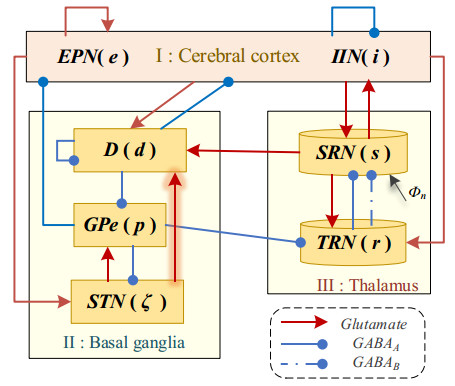
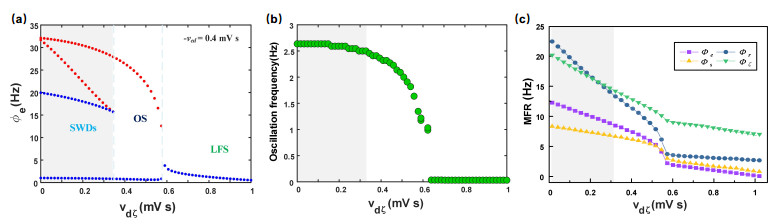
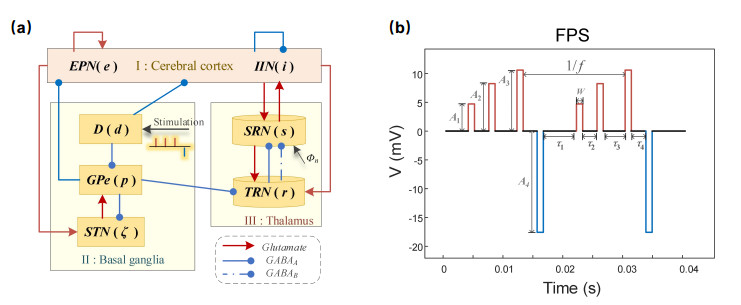
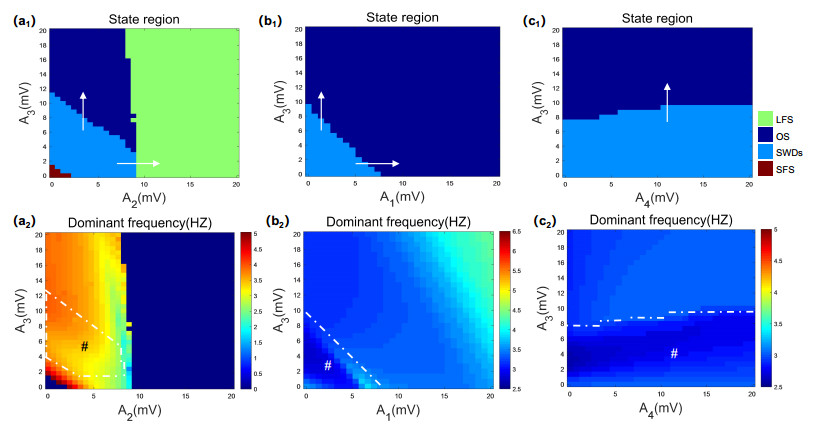
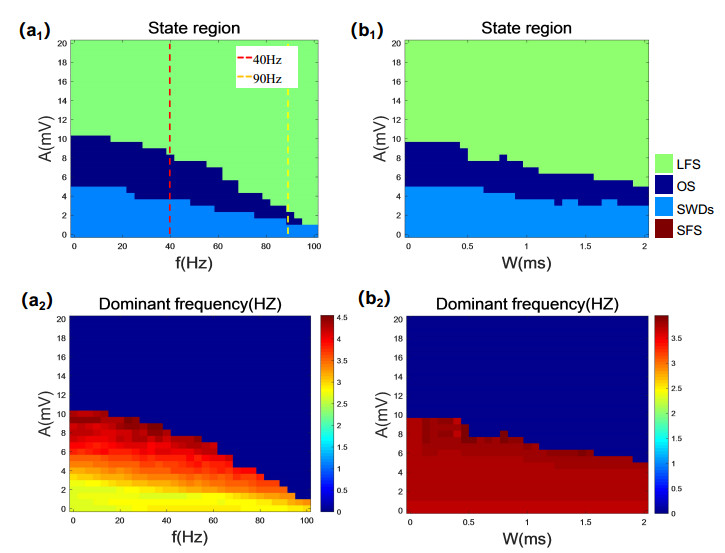
An absence seizure is a common neurological disorder primarily associated with abnormal interactions between the corticothalamic network and the basal ganglia. In order to better understand how the basal ganglia contributes to absence seizure regulation, we use an improved mean field model of the basal ganglia-corticothalamo (BGCT) by introducing a direct projection from the glutamatergic mediated subthalamic nucleus to the striatum (STN-D). The results indicate that enhancing the excitatory coupling strength of the STN-D pathway significantly suppresses spike-wave discharges (SWDs) by increasing striatal activation levels, which promotes the transition from the pathological state to either simple oscillations or low firing state. We propose a new stimulation paradigm, namely a four-phase pulse stimulation (FPS), which sequentially delivers four pulses to the striatum (D), thus targeting the cortical excitatory neurons (EPN), specific relay nuclei (SRN), STN, and D. The results indicate that FPS can successfully replace the original inputs to the D and effectively control absence seizures by adjusting the anodal pulse amplitudes ($ A_1 $, $ A_2 $, and $ A_3 $), which correspond to the excitatory inputs to the D from SRN-D, EPN-D, and SRN-D. These findings offer new insights into understanding the pathophysiology of an absence seizure and its precise therapeutic interventions.
Citation: Zhihui Wang, Yaqi Yang, Lixia Duan. Numerical simulation of novel stimulation strategies in the modulation of absence seizures based on an improved BGCT model[J]. Electronic Research Archive, 2025, 33(10): 6418-6444. doi: 10.3934/era.2025283
An absence seizure is a common neurological disorder primarily associated with abnormal interactions between the corticothalamic network and the basal ganglia. In order to better understand how the basal ganglia contributes to absence seizure regulation, we use an improved mean field model of the basal ganglia-corticothalamo (BGCT) by introducing a direct projection from the glutamatergic mediated subthalamic nucleus to the striatum (STN-D). The results indicate that enhancing the excitatory coupling strength of the STN-D pathway significantly suppresses spike-wave discharges (SWDs) by increasing striatal activation levels, which promotes the transition from the pathological state to either simple oscillations or low firing state. We propose a new stimulation paradigm, namely a four-phase pulse stimulation (FPS), which sequentially delivers four pulses to the striatum (D), thus targeting the cortical excitatory neurons (EPN), specific relay nuclei (SRN), STN, and D. The results indicate that FPS can successfully replace the original inputs to the D and effectively control absence seizures by adjusting the anodal pulse amplitudes ($ A_1 $, $ A_2 $, and $ A_3 $), which correspond to the excitatory inputs to the D from SRN-D, EPN-D, and SRN-D. These findings offer new insights into understanding the pathophysiology of an absence seizure and its precise therapeutic interventions.

| [1] |
V. Crunelli, N. Leresche, Childhood absence epilepsy: genes, channels, neurons and networks, Nat. Rev. Neurosci., 3 (2002), 371–382. https://doi.org/10.1038/nrn811 doi: 10.1038/nrn811

|
| [2] |
D. J. Thurman, E. Beghi, C. E. Begley, A. T. Berg, J. R. Buchhalter, D. Ding, et al., Standards for epidemiologic studies and surveillance of epilepsy, Epilepsia, 52 (2011), 2–26. https://doi.org/10.1111/j.1528-1167.2011.03121.x doi: 10.1111/j.1528-1167.2011.03121.x
|
| [3] |
M. Avoli, A brief history on the oscillating roles of thalamus and cortex in absence seizures, Epilepsia, 53 (2012), 779–789. https://doi.org/ 10.1111/j.1528-1167.2012.03421.x doi: 10.1111/j.1528-1167.2012.03421.x
|
| [4] |
J. A. Roberts, P. A. Robinson, Modeling absence seizure dynamics: implications for basic mechanisms and measurement of thalamocortical and corticothalamic latencies, J. Theor. Biol., 253 (2008), 189–201. https://doi.org/10.1016/j.jtbi.2008.03.005 doi: 10.1016/j.jtbi.2008.03.005
|
| [5] |
S. Rodrigues, D. Barton, R. Szalai, O. Benjamin, M. P. Richardson, J. R. Terry, Transitions to spike-wave oscillations and epileptic dynamics in a human cortico-thalamic mean-field model, J. Comput. Neurosci., 27 (2009), 507–526. https://doi.org/10.1007/s10827-009-0166-2 doi: 10.1007/s10827-009-0166-2
|
| [6] |
V. Tancredi, G. Biagini, M. D'Antuono, J. Louvel, R. Pumain, M. Avoli, Spindle-like thalamocortical synchronization in a rat brain slice preparation, J. Neurophysiol., 84 (2000), 1093–1097. https://doi.org/10.1152/jn.2000.84.2.1093 doi: 10.1152/jn.2000.84.2.1093
|
| [7] |
G. D'Arcangelo, M. D'Antuono, G. Biagini, R. Warren, V. Tancredi, M. Avoli, Thalamocortical oscillations in a genetic model of absence seizures, Eur. J. Neurosci., 16 (2002), 2383–2393. https://doi.org/10.1046/j.1460-9568.2002.02411.x doi: 10.1046/j.1460-9568.2002.02411.x
|
| [8] |
T. Arakaki, S. Mahon, S. Charpier, A. Leblois, D. Hansel, The role of striatal feedforward inhibition in the maintenance of absence seizures, J. Neurosci., 36 (2016), 9618–9632. https://doi.org/10.1523/JNEUROSCI.0208-16.2016 doi: 10.1523/JNEUROSCI.0208-16.2016
|
| [9] |
M. Chen, D. Guo, T. Wang, W. Jing, Y. Xia, P. Xu, et al., Bidirectional control of absence seizures by the basal ganglia: a computational evidence, PLoS Comput. Biol., 10 (2014), e1003495. https://doi.org/10.1371/journal.pcbi.1003495 doi: 10.1371/journal.pcbi.1003495
|
| [10] |
C. Deransart, L. Vercueil, C. Marescaux, A. Depaulis, The role of basal ganglia in the control of generalized absence seizures, Epilepsy Res., 32 (1998), 213–223. https://doi.org/10.1016/s0920-1211(98)00053-9 doi: 10.1016/s0920-1211(98)00053-9
|
| [11] |
D. Fan, Q. Wang, Improved control effect of absence seizures by autaptic connections to the subthalamic nucleus, Phys. Rev. E, 98 (2018), 052414. https://doi.org/10.1103/PhysRevE.98.052414 doi: 10.1103/PhysRevE.98.052414
|
| [12] |
B. Hu, D. Guo, Q. Wang, Control of absence seizures induced by the pathways connected to SRN in corticothalamic system, Cognit. Neurodyn., 9 (2015), 279–289. https://doi.org/10.1007/s11571-014-9321-1 doi: 10.1007/s11571-014-9321-1
|
| [13] |
B. Hu, Q. Wang, Controlling absence seizures by deep brain stimulus applied on substantia nigra pars reticulata and cortex, Chaos, Solitons Fractals, 80 (2015), 13–23. https://doi.org/10.1016/j.chaos.2015.02.014 doi: 10.1016/j.chaos.2015.02.014
|
| [14] |
C. Luo, Q. Li, Y. Xia, X. Lei, K. Xue, Z. Yao, et al., Resting state basal ganglia network in idiopathic generalized epilepsy, Hum. Brain Mapp., 33 (2012), 1279–1294. https://doi.org/10.1002/hbm.21286 doi: 10.1002/hbm.21286
|
| [15] |
J. Vuong, A. Devergnas, The role of the basal ganglia in the control of seizure, J. Neural Transm., 125 (2018), 531–545. https://doi.org/10.1007/s00702-017-1768-x doi: 10.1007/s00702-017-1768-x
|
| [16] |
A. Saunders, I. A. Oldenburg, V. K. Berezovskii, C. A. Johnson, N. D. Kingery, H. L. Elliott, et al., A direct GABAergic output from the basal ganglia to frontal cortex, Nature, 521 (2015), 85–89. https://doi.org/10.1038/nature14179 doi: 10.1038/nature14179
|
| [17] |
M. Chen, D. Guo, M. Li, T. Ma, S. Wu, J. Ma, et al., Critical roles of the direct GABAergic pallido-cortical pathway in controlling absence seizures, PLoS Comput. Biol., 11 (2015), e1004539. https://doi.org/10.1371/journal.pcbi.1004539 doi: 10.1371/journal.pcbi.1004539
|
| [18] |
M. Chen, Y. Zhu, R. Yu, Y. Hu, H. Wan, R. Zhang, et al., Insights on the role of external globus pallidus in controlling absence seizures, Neural Networks, 135 (2021), 78–90. https://doi.org/10.1016/j.neunet.2020.12.006 doi: 10.1016/j.neunet.2020.12.006
|
| [19] |
B. Hu, W. Zhou, X. Ma, Striatum is the potential target for treating absence epilepsy: a theoretical evidence, Cognit. Neurodyn., 18 (2024), 3775–3790. https://doi.org/10.1007/s11571-024-10161-6 doi: 10.1007/s11571-024-10161-6
|
| [20] |
X. Wang, L. Yin, Y. Yu, Q. Wang, Unraveling the dynamical mechanisms of motor preparation based on the heterogeneous attractor model, Chaos, Solitons Fractals, 194 (2025), 116220. https://doi.org/10.1016/j.chaos.2025.116220 doi: 10.1016/j.chaos.2025.116220
|
| [21] |
A. Saunders, K. W. Huang, B. L. Sabatini, Globus pallidus externus neurons expressing parvalbumin interconnect the subthalamic nucleus and striatal interneurons, PLoS One, 11 (2016), e0149798. https://doi.org/10.1371/journal.pone.0149798 doi: 10.1371/journal.pone.0149798
|
| [22] |
K. Kondabolu, N. M. Doig, O. Ayeko, B. Khan, A. Torres, D. Calvigioni, et al., A selective projection from the subthalamic nucleus to parvalbumin-expressing interneurons of the striatum, eNeuro, 10 (2023), ENEURO.0417–21.2023. https://doi.org/10.1523/ENEURO.0417-21.2023 doi: 10.1523/ENEURO.0417-21.2023
|
| [23] |
D. Masur, S. Shinnar, A. Cnaan, R. C. Shinnar, P. Clark, J. Wang, et al., Pretreatment cognitive deficits and treatment effects on attention in childhood absence epilepsy, Neurology, 81 (2013), 1572–1580. https://doi.org/10.1212/WNL.0b013e3182a9f3ca doi: 10.1212/WNL.0b013e3182a9f3ca
|
| [24] |
P. Kwan, A. Arzimanoglou, A. T. Berg, M. J. Brodie, W. Allen Hauser, G. Mathern, et al., Definition of drug resistant epilepsy: consensus proposal by the ad hoc Task Force of the ILAE Commission on Therapeutic Strategies, Epilepsia, 51 (2010), 1069–1077. https://doi.org/10.1111/j.1528-1167.2009.02397.x doi: 10.1111/j.1528-1167.2009.02397.x
|
| [25] |
X. Tan, H. Zhang, Y. Xie, Y. Chai, Electromagnetic radiation and electrical stimulation controls of absence seizures in a coupled reduced corticothalamic model, Electron. Res. Arch., 31 (2023), 58–74. https://doi.org/10.3934/era.2023004 doi: 10.3934/era.2023004
|
| [26] |
D. Fan, Y. Wang, J. Wu, S. Hou, Q. Wang, The preview control of a corticothalamic model with disturbance, Electron. Res. Arch., 32 (2024), 812–835. https://doi.org/10.3934/era.2024039 doi: 10.3934/era.2024039
|
| [27] |
X. Zhu, Y. Liu, S. Huang, R. Li, Y. Chai, Modulation of epileptiform discharges by heterogeneous interneurons and external stimulation strategies in the thalamocortical model, Electron. Res. Arch., 33 (2025), 2391–2411. https://doi.org/10.3934/era.2025106 doi: 10.3934/era.2025106
|
| [28] |
A. Fasano, A. Daniele, A. Albanese, Treatment of motor and non-motor features of Parkinson's disease with deep brain stimulation, Lancet Neurol., 11 (2012), 429–442. https://doi.org/10.1016/S1474-4422(12)70049-2 doi: 10.1016/S1474-4422(12)70049-2
|
| [29] |
A. L. Benabid, S. Chabardes, J. Mitrofanis, P. Pollak, Deep brain stimulation of the subthalamic nucleus for the treatment of Parkinson's disease, Lancet Neurol., 8 (2009), 67–81. https://doi.org/10.1016/S1474-4422(08)70291-6 doi: 10.1016/S1474-4422(08)70291-6
|
| [30] |
D. Fan, Y. Zheng, Z. Yang, Q. Wang, Improving control effects of absence seizures using single-pulse alternately resetting stimulation (SARS) of corticothalamic circuit, Appl. Math. Mech., 41 (2020), 1287–1302. https://doi.org/10.1007/s10483-020-2644-8 doi: 10.1007/s10483-020-2644-8
|
| [31] |
H. S. Haghighi, A. H. D. Markazi, Control of epileptic seizures by electrical stimulation: A model-based study, Biomed. Phys. Eng. Express, 7 (2021), 065009. https://doi.org/10.1088/2057-1976/ac240d doi: 10.1088/2057-1976/ac240d
|
| [32] |
B. J. Stieve, T. J. Richner, C. Krook-Magnuson, T. I. Netoff, E. Krook-Magnuson, Optimization of closed-loop electrical stimulation enables robust cerebellar-directed seizure control, Brain, 146 (2023), 91–108. https://doi.org/10.1093/brain/awac051 doi: 10.1093/brain/awac051
|
| [33] |
B. Hu, J. Zhao, Y. Ao, X. Cai, The possible role of electromagnetic induction in the regulation of absence seizures: evidence from a computational model, Nonlinear Dyn., 113 (2025), 2711–2728. https://doi.org/10.1007/s11071-024-10345-z doi: 10.1007/s11071-024-10345-z
|
| [34] |
S. Hou, D. Fan, Q. Wang, Regulating absence seizures by tri-phase delay stimulation applied to globus pallidus internal, Appl. Math. Mech., 43 (2022), 1399–1414. https://doi.org/10.1007/s10483-022-2896-7 doi: 10.1007/s10483-022-2896-7
|
| [35] |
C. He, D. Fan, W. Wang, Q. Wang, G. Baier, Network dynamics mechanisms underlying the instigation and propagation of cortical spreading depression, Neurocomputing, 649 (2025), 130733. https://doi.org/10.1016/j.neucom.2025.130733 doi: 10.1016/j.neucom.2025.130733
|
| [36] |
J. Zhao, Q. Wang, Y. Yu, A new pathway for controlling absence seizures by reducing GABA uptake from astrocytes: a dynamical perspective, Commun. Nonlinear Sci. Numer. Simul., 149 (2025), 108929. https://doi.org/10.1016/j.cnsns.2025.108929 doi: 10.1016/j.cnsns.2025.108929
|
| [37] |
J. T. Paz, M. Chavez, S. Saillet, J. M. Deniau, S. Charpier, Activity of ventral medial thalamic neurons during absence seizures and modulation of cortical paroxysms by the nigrothalamic pathway, J. Neurosci., 27 (2007), 929–941. https://doi.org/10.1523/JNEUROSCI.4677-06.2007 doi: 10.1523/JNEUROSCI.4677-06.2007
|
| [38] |
S. J. van Albada, P. A. Robinson, Mean-field modeling of the basal ganglia-thalamocortical system. I: Firing rates in healthy and parkinsonian states, J. Theor. Biol., 257 (2009), 642–663. https://doi.org/10.1016/j.jtbi.2008.12.018 doi: 10.1016/j.jtbi.2008.12.018
|
| [39] |
S. J. van Albada, R. T. Gray, P. M. Drysdale, P. A. Robinson, Mean-field modeling of the basal ganglia-thalamocortical system. II: Dynamics of parkinsonian oscillations, J. Theor. Biol., 257 (2009), 664–688. https://doi.org/10.1016/j.jtbi.2008.12.013 doi: 10.1016/j.jtbi.2008.12.013
|
| [40] |
P. A. Robinson, C. J. Rennie, D. L. Rowe, Dynamics of large-scale brain activity in normal arousal states and epileptic seizures, Phys. Rev. E, 65 (2002), 041924. https://doi.org/10.1103/PhysRevE.65.041924 doi: 10.1103/PhysRevE.65.041924
|
| [41] |
M. Breakspear, J. A. Roberts, J. R. Terry, S. Rodrigues, N. Mahant, P. A. Robinson, A unifying explanation of primary generalized seizures through nonlinear brain modeling and bifurcation analysis, Cereb. Cortex, 16 (2006), 1296–1313. https://doi.org/10.1093/cercor/bhj072 doi: 10.1093/cercor/bhj072
|
| [42] |
C. C. Chiang, C. C. Lin, M. S. Ju, D. M. Durand, High frequency stimulation can suppress globally seizures induced by 4-AP in the rat hippocampus: an acute in vivo study, Brain Stimul., 6 (2013), 180–189. https://doi.org/10.1016/j.brs.2012.04.008 doi: 10.1016/j.brs.2012.04.008
|
Figures(11) / Tables(2)
Zhihui Wang, Yaqi Yang, Lixia Duan. Numerical simulation of novel stimulation strategies in the modulation of absence seizures based on an improved BGCT model[J]. Electronic Research Archive, 2025, 33(10): 6418-6444. doi: 10.3934/era.2025283





 DownLoad: