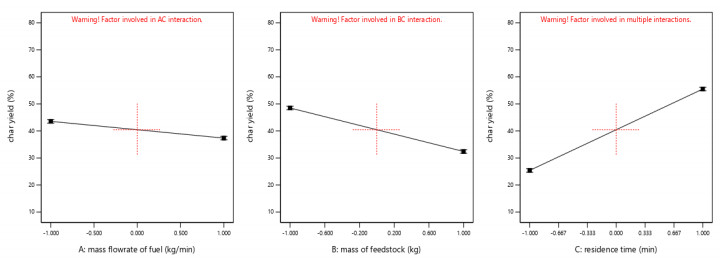
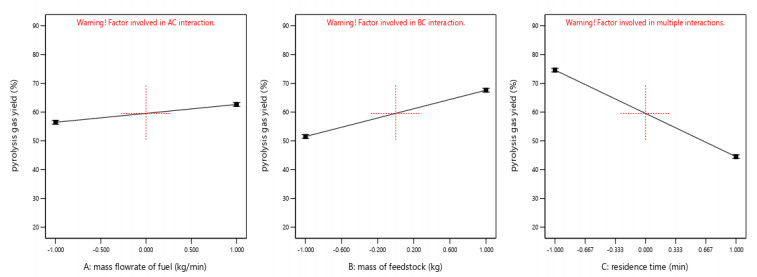
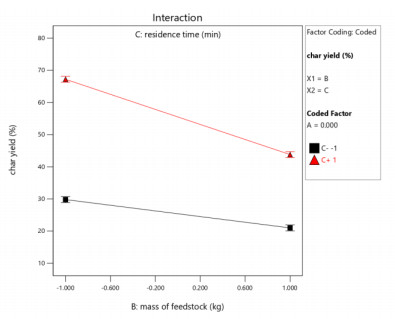
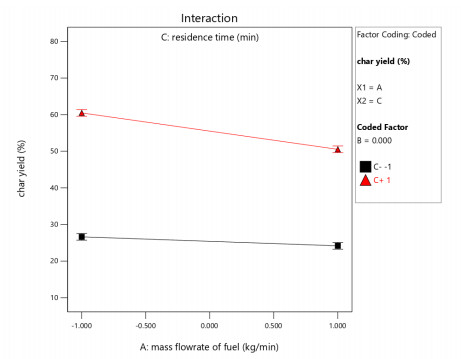
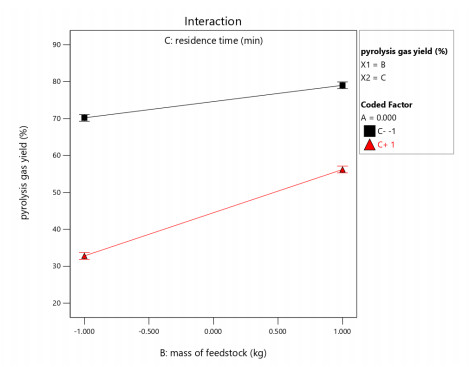
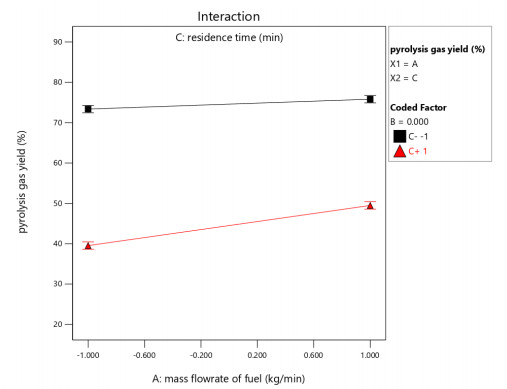
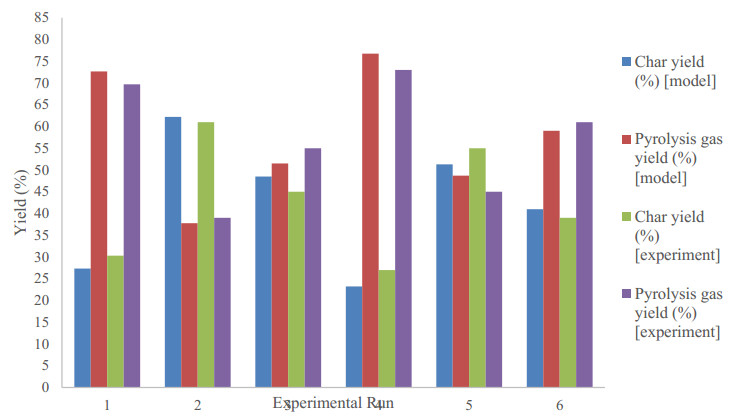
This study analyzed the effect of a slow pyrolysis process at a temperature range of 270–360 ℃ using a two-level factorial design. This pyrolysis process is limited to the process that occurs in the pyrolysis reactor, namely the decomposition process of raw materials into char and non-condensable gas. This study evaluated the effect of three process variables: fuel mass flow rate (0.006–0.008 kg/min), feedstock mass (2.5–4 kg), and residence time (120–180 min). The results showed that residence time had the most significant effect on pyrolysis products. Residence time contributes 30.1% to increasing char yield and correspondingly decreases non-condensable gas yield, indicating an inverse relationship. The feedstock mass and fuel mass flow rate show moderate effects, decreasing char yield by 16.1% and 6.2%, respectively, while inversely increasing non-condensable gas yield by the same magnitude. These findings underline the importance of residence time in determining char yield, especially in the slow pyrolysis process. This study also proves that the quantity of raw materials has an influence on char yield, although not as strong as the influence of residence time. The data revealed a clear trend, indicating how adjustments to the pyrolysis process can affect performance. With a longer residence time, it will produce a greater biochar than a non-condensable gas yield. Optimization of pyrolysis products must consider the balance between residence time, fuel heat rate, and mass of raw material load in order to obtain the optimal product as desired.
Citation: Illa Rizianiza, Ahmad Indra Siswantara, Eny Kusrini. Investigation of process parameters in the pyrolysis of sheep manure using a two-level factorial[J]. AIMS Energy, 2025, 13(4): 987-1011. doi: 10.3934/energy.2025037
This study analyzed the effect of a slow pyrolysis process at a temperature range of 270–360 ℃ using a two-level factorial design. This pyrolysis process is limited to the process that occurs in the pyrolysis reactor, namely the decomposition process of raw materials into char and non-condensable gas. This study evaluated the effect of three process variables: fuel mass flow rate (0.006–0.008 kg/min), feedstock mass (2.5–4 kg), and residence time (120–180 min). The results showed that residence time had the most significant effect on pyrolysis products. Residence time contributes 30.1% to increasing char yield and correspondingly decreases non-condensable gas yield, indicating an inverse relationship. The feedstock mass and fuel mass flow rate show moderate effects, decreasing char yield by 16.1% and 6.2%, respectively, while inversely increasing non-condensable gas yield by the same magnitude. These findings underline the importance of residence time in determining char yield, especially in the slow pyrolysis process. This study also proves that the quantity of raw materials has an influence on char yield, although not as strong as the influence of residence time. The data revealed a clear trend, indicating how adjustments to the pyrolysis process can affect performance. With a longer residence time, it will produce a greater biochar than a non-condensable gas yield. Optimization of pyrolysis products must consider the balance between residence time, fuel heat rate, and mass of raw material load in order to obtain the optimal product as desired.

| [1] | Mohajan HK (2017) Greenhouse gas emissions, global warming and climate change. Proceedings of the 15th Chittagong Conference on Mathematical Physics, Jamal Nazrul Islam Research Centre for Mathematical and Physical Sciences (JNIRCMPS), Chittagong, Bangladesh. Available from: https://www.researchgate.net/publication/315668490_Greenhouse_Gas_Emissions_Global_Warming_and_Climate_Change.. |
| [2] |
Ogunkunle O, Ahmed NA (2021) Overview of biodiesel combustion in mitigating the adverse impacts of engine emissions on the sustainable human-environment scenario. Sustainability 13: 5465. https://doi.org/10.3390/su13105465 doi: 10.3390/su13105465

|
| [3] | Omer AM (2009) Energy use and environmental impacts: A general review. J Renew Sustain Energy, 1. https://doi.org/10.1063/1.3220701 |
| [4] | Holechek JL, Geli HME, Sawalhah MN, et al. (2022) A global assessment: Can renewable energy replace fossil fuels by 2050? Sustainability, 14. https://doi.org/10.3390/su14084792 |
| [5] |
Yuping S, Shenghu S, Aviral Kumar T, et al. (2024) Impacts of renewable energy on climate risk: A global perspective for energy transition in a climate adaptation framework. Appl Energy 362: 122994. https://doi.org/10.1016/j.apenergy.2024.122994 doi: 10.1016/j.apenergy.2024.122994
|
| [6] | Khoshnevisan B, Duan N, Tsapekos P, et al. (2021) A critical review on livestock manure biorefinery technologies: Sustainability, challenges, and future perspectives. Renew Sustain Energy Rev, 135. https://doi.org/10.1016/j.rser.2020.110033 |
| [7] | Indonesia S (2022) Livestock in figures 2022. Available from: https://www.bps.go.id/en/publication/2022/06/30/4c014349ef2008bea02f4349/peternakan-dalam-angka-2022.html.. |
| [8] |
Erdogdu AE, Polat R, Ozbay G (2019) Pyrolysis of goat manure to produce bio-oil. Eng Sci Technol Int J 22: 452–457. https://doi.org/10.1016/j.jestch.2018.11.002 doi: 10.1016/j.jestch.2018.11.002
|
| [9] | Gaur AC, Mathur RS (1990) Organic manures. Soil Fertil Fertil Vol IV Nutr Manag Supply Syst Sustain Agric 1990s, 149–159. Available from: https://www.cabidigitallibrary.org/doi/full/10.5555/19850771553.. |
| [10] | Direktorat Jenderal Peternakan dan Kesehatan Hewan Kementerian Pertanian DJP dan KHK (Ed.) (2021) Statistik Peternakan dan Kesehatan Hewan 2021, Jakarta, Direktorat Jenderal Peternakan dan Kesehatan Hewan Kementerian Pertanian RI. Available from: https://pusvetma.ditjenpkh.pertanian.go.id/upload/statistik/1644549920.Buku_Statistik_2021.pdf.. |
| [11] |
Parthasarathy P, Fernandez A, Singh DK, et al. (2022) Thermogravimetric analysis of camel dung, date stone, and their blend for pyrolytic, kinetic, and thermodynamic studies. Clean Chem Eng 4: 100072. https://doi.org/10.1016/j.clce.2022.100072 doi: 10.1016/j.clce.2022.100072
|
| [12] | Escalante J, Chen W-H, Tabatabaei M, et al. (2022) Pyrolysis of lignocellulosic, algal, plastic, and other biomass wastes for biofuel production and circular bioeconomy: A review of thermogravimetric analysis (TGA) approach. Renew Sustain Energy Rev, 169. https://doi.org/10.1016/j.rser.2022.112914 |
| [13] | Brownsort PA (2009) Biomass pyrolysis processes: Performance parameters and their influence on biochar system benefits. Available from: http://hdl.handle.net/1842/3116. |
| [14] |
Carrier M, Hardie AG, Uras Ü, et al. (2012) Production of char from vacuum pyrolysis of South-African sugar cane bagasse and its characterization as activated carbon and biochar. J Anal Appl Pyrolysis 96: 24–32. https://doi.org/10.1016/j.jaap.2012.02.016 doi: 10.1016/j.jaap.2012.02.016
|
| [15] |
Yu X, Zhang C, Qiu L, et al. (2020) Anaerobic digestion of swine manure using aqueous pyrolysis liquid as an additive. Renew Energy 147: 2484–2493. https://doi.org/10.1016/j.renene.2019.10.096 doi: 10.1016/j.renene.2019.10.096
|
| [16] | Qian C, Li Q, Zhang Z, et al. (2020) Prediction of higher heating values of biochar from proximate and ultimate analysis. Fuel 265. https://doi.org/10.1016/j.fuel.2019.116925 |
| [17] | Al-Rumaihi A, Shahbaz M, McKay G, et al. (2023) Investigation of co-pyrolysis blends of camel manure, date pits and plastic waste into value added products using Aspen Plus. Fuel, 340. https://doi.org/10.1016/j.fuel.2023.127474 |
| [18] |
Atienza-Martínez M, Ábrego J, Gea G, et al. (2020) Pyrolysis of dairy cattle manure: evolution of char characteristics. J Anal Appl Pyrolysis 145: 104724. https://doi.org/10.1016/j.jaap.2019.104724 doi: 10.1016/j.jaap.2019.104724
|
| [19] |
Li L, Yao Z, You S, et al. (2019) Optimal design of negative emission hybrid renewable energy systems with biochar production. Appl Energy 243: 233–249. https://doi.org/10.1016/j.apenergy.2019.03.183 doi: 10.1016/j.apenergy.2019.03.183
|
| [20] |
Kuryntseva P, Galitskaya P, Selivanovskaya S (2022) Optimization of pyrolysis regime for chicken manure treatment and biochar production. Water Environ J 36: 270–281. https://doi.org/10.1111/wej.12764 doi: 10.1111/wej.12764
|
| [21] |
Hu X, Gholizadeh M (2019) Biomass pyrolysis: A review of the process development and challenges from initial researches up to the commercialisation stage. J Energy Chem 39: 109–143. https://doi.org/10.1016/j.jechem.2019.01.024 doi: 10.1016/j.jechem.2019.01.024
|
| [22] | Vuppaladadiyam AK, Varsha Vuppaladadiyam SS, Sikarwar VS, et al. (2023) A critical review on biomass pyrolysis: Reaction mechanisms, process modeling and potential challenges. J Energy Inst, 108. https://doi.org/10.1016/j.joei.2023.101236 |
| [23] | Al-Rumaihi A, Shahbaz M, McKay G, et al. (2022) A review of pyrolysis technologies and feedstock: A blending approach for plastic and biomass towards optimum biochar yield. Renew Sustain Energy Rev 167. https://doi.org/10.1016/j.rser.2022.112715 |
| [24] |
Ippolito JA, Cui L, Kammann C, et al. (2020) Feedstock choice, pyrolysis temperature and type influence biochar characteristics: A comprehensive meta-data analysis review. Biochar 2: 421–438. https://doi.org/10.1007/s42773-020-00067-x doi: 10.1007/s42773-020-00067-x
|
| [25] |
Pecha MB, Arbelaez JIM, Garcia-Perez M, et al. (2019) Progress in understanding the four dominant intra-particle phenomena of lignocellulose pyrolysis: Chemical reactions, heat transfer, mass transfer, and phase change. Green Chem 21: 2868–2898. https://doi.org/10.1039/C9GC00585D doi: 10.1039/C9GC00585D
|
| [26] |
Yaman S (2004) Pyrolysis of biomass to produce fuels and chemical feedstocks. Energy Convers Manag 45: 651–671. https://doi.org/10.1016/S0196-8904(03)00177-8 doi: 10.1016/S0196-8904(03)00177-8
|
| [27] |
Chen Y, Liu J, Li L, et al. (2025) Optimizing pyrolysis of herbal tea and Salvia miltiorrhiza residues for sustainable energy and product recovery. Chem Eng J 513: 162694. https://doi.org/10.1016/j.cej.2025.162694 doi: 10.1016/j.cej.2025.162694
|
| [28] |
Al-Mrayat T, Al-Hamaiedeh H, El-Hasan T, et al. (2022) Pyrolysis of domestic sewage sludge: Influence of operational conditions on the product yields using factorial design. Heliyon 8: e09418. https://doi.org/10.1016/j.heliyon.2022.e09418 doi: 10.1016/j.heliyon.2022.e09418
|
| [29] | Aliedeh MA, Aljbour SH, Al-Harahsheh AM, et al. (2021) Implementing 24-1 fractional factorial design for filing the gaps in ovat sorption studies of nitrate ions onto jordanian zeolitic tuff. J Chem Technol Metall 56: 331–341. Available from: https://journal.uctm.edu/j2021-2. |
| [30] |
Li S, Zeng Y, Qu R, et al. (2025) Insight into fast infrared-assisted and coal rank on pyrolysis kinetics and products distribution. J Anal Appl Pyrolysis 187: 106986. https://doi.org/10.1016/j.jaap.2025.106986 doi: 10.1016/j.jaap.2025.106986
|
| [31] |
Zhang Y, Li M, Liu Z, et al. (2025) Elucidating synergistic effects and environmental value enhancement in infrared-Assisted Co-Pyrolysis of coal and polyvinyl chloride. Sep Purif Technol 357: 130071. https://doi.org/10.1016/j.seppur.2024.130071 doi: 10.1016/j.seppur.2024.130071
|
| [32] |
Masyuk N, Sherin A, Snytnikov VN, et al. (2018) Effect of infrared laser radiation on gas-phase pyrolysis of ethane. J Anal Appl Pyrolysis 134: 122–129. https://doi.org/10.1016/j.jaap.2018.05.017 doi: 10.1016/j.jaap.2018.05.017
|
| [33] | Su G, Ong HC, Mohd Zulkifli NW, et al. (2022) Valorization of animal manure via pyrolysis for bioenergy: A review. J Clean Prod, 343. https://doi.org/10.1016/j.jclepro.2022.130965 |
| [34] |
Chen W-H, Lin B-J, Lin Y-Y, et al. (2021) Progress in biomass torrefaction: Principles, applications and challenges. Prog Energy Combust Sci 82: 100887. https://doi.org/10.1016/j.pecs.2020.100887 doi: 10.1016/j.pecs.2020.100887
|
| [35] | Parthasarathy P, Al-Ansari T, Mackey HR, et al. (2022) A review on prominent animal and municipal wastes as potential feedstocks for solar pyrolysis for biochar production. Fuel 316. https://doi.org/10.1016/j.fuel.2022.123378 |
| [36] |
Shahbaz M, AlNouss A, Parthasarathy P, et al. (2020) Investigation of biomass components on the slow pyrolysis products yield using Aspen Plus for techno-economic analysis. Biomass Convers Biorefinery 12: 669–681. https://doi.org/10.1007/s13399-020-01040-1 doi: 10.1007/s13399-020-01040-1
|
| [37] |
Gani A, Naruse I (2007) Effect of cellulose and lignin content on pyrolysis and combustion characteristics for several types of biomass. Renew Energy 32: 649–661. https://doi.org/10.1016/j.renene.2006.02.017 doi: 10.1016/j.renene.2006.02.017
|
| [38] |
Cao H, Xin Y, Yuan Q (2016) Prediction of biochar yield from cattle manure pyrolysis via least squares support vector machine intelligent approach. Bioresour Technol 202: 158–164. https://doi.org/10.1016/j.biortech.2015.12.024 doi: 10.1016/j.biortech.2015.12.024
|
| [39] |
Rathnayake D, Schmidt H, Leifeld J, et al. (2023) Biochar from animal manure: A critical assessment on technical feasibility, economic viability, and ecological impact. GCB Bioenergy 15: 1078–1104. https://doi.org/10.1111/gcbb.13082 doi: 10.1111/gcbb.13082
|
| [40] |
Zhu Y, Merbold L, Leitner S, et al. (2020) The effects of climate on decomposition of cattle, sheep and goat manure in Kenyan tropical pastures. Plant Soil 451: 325–343. https://doi.org/10.1007/s11104-020-04528-x doi: 10.1007/s11104-020-04528-x
|
| [41] |
Giudicianni P, Cardone G, Ragucci R (2013) Cellulose, hemicellulose and lignin slow steam pyrolysis: Thermal decomposition of biomass components mixtures. J Anal Appl Pyrolysis 100: 213–222. https://doi.org/10.1016/j.jaap.2012.12.026 doi: 10.1016/j.jaap.2012.12.026
|
| [42] | Hoyos-Sebá JJ, Arias NP, Salcedo-Mendoza J, et al. (2024) Animal manure in the context of renewable energy and value-added products: A review. Chem Eng Process—Process Intensif, 196. https://doi.org/10.1016/j.cep.2023.109660 |
| [43] |
Kirch T, Medwell PR, Birzer CH, et al. (2020) Feedstock dependence of emissions from a reverse-downdraft gasifier cookstove. Energy Sustain Dev 56: 42–50. https://doi.org/10.1016/j.esd.2020.02.008 doi: 10.1016/j.esd.2020.02.008
|
| [44] |
Rabah AA (2022) Livestock manure availability and syngas production: A case of Sudan. Energy 259: 124980. https://doi.org/10.1016/j.energy.2022.124980 doi: 10.1016/j.energy.2022.124980
|
| [45] |
Siswantara AI, Rizianiza I, Mahdi DP, et al. (2024) Investigating kinetic and thermodynamic parameters in the pyrolysis of sheep manure using thermogravimetric analysis. J Sustain Dev Energy, Water Environ Syst 12: 1–18. https://doi.org/10.13044/j.sdewes.d12.0493 doi: 10.13044/j.sdewes.d12.0493
|
| [46] | Mong GR, Chong CT, Chong WWF, et al. (2022) Progress and challenges in sustainable pyrolysis technology: Reactors, feedstocks and products. Fuel, 324. https://doi.org/10.1016/j.fuel.2022.124777 |
| [47] | Liu H, Ma J, Tong L, et al. (2018) Investigation on the potential of high efficiency for internal combustion engines. Energies, 11. https://doi.org/10.3390/en11030513 |
| [48] | Anil Kumar Sakhiya Shivangi Pathak, Virendra Kumar Vijay, Priyanka Kaushal PB (2020) Effect of process parameters on slow pyrolysis of rice straw: Product yield and energy analysis. 2020 International Conference and Utility Exhibition on Energy, Environment and Climate Change (ICUE), IEEE, 1–9. https://doi.org/10.1109/ICUE49301.2020.9306945 |
| [49] |
Mohan D, Pittman Jr CU, Steele PH (2006) Pyrolysis of wood/biomass for bio-oil: A critical review. Energy Fuels 20: 848–889. https://doi.org/10.1021/ef0502397 doi: 10.1021/ef0502397
|
| [50] |
Bridgwater AV (2012) Review of fast pyrolysis of biomass and product upgrading. Biomass Bioenergy 38: 68–94. https://doi.org/10.1016/j.biombioe.2011.01.048 doi: 10.1016/j.biombioe.2011.01.048
|
| [51] |
Talwar P, Agudelo MA, Nanda S (2025) Pyrolysis process, reactors, products, and applications: A review. Energies 18: 1–32. https://doi.org/10.3390/en18112979 doi: 10.3390/en18112979
|
| [52] |
Ahmad M, Rajapaksha AU, Lim JE, et al. (2014) Biochar as a sorbent for contaminant management in soil and water: A review. Chemosphere 99: 19–33. https://doi.org/10.1016/j.chemosphere.2013.10.071 doi: 10.1016/j.chemosphere.2013.10.071
|
| [53] | Brown R (2012) Biochar production technology. Biochar for Environmental Management, Routledge, 159–178. Available from: https://www.taylorfrancis.com/chapters/edit/10.4324/9781849770552-15/biochar-production-technology-robert-brown.. |
| [54] |
Ouerhani M, Largeau JF (2025) Thermal conversion of cellulose fiber under slow pyrolysis: Kinetics, thermodynamics and related chemical species. Bioresour Technol Rep 30: 102110. https://doi.org/10.1016/j.biteb.2025.102110 doi: 10.1016/j.biteb.2025.102110
|
| [55] | Slamani M, Jammel S, Chatelain JF (2025) Effects of wax and graphene concentrations on cutting force in drilling GFRP composites: A comprehensive study using a full factorial design of experiments. J Compos Mater, 1–19. https://doi.org/10.1177/00219983251341623 |
| [56] |
Ma M, Bai Y, Wei J, et al. (2023) Decoupling study of volatile-char interaction during coal/biomass co-gasification based on a two-stage fixed bed reactor: Insight into the role of O-containing compound species. Chem Eng Sci 265: 118262. https://doi.org/10.1016/j.ces.2022.118262 doi: 10.1016/j.ces.2022.118262
|
| [57] |
Yan M, Zhang S, Wibowo H, et al. (2020) Biochar and pyrolytic gas properties from pyrolysis of simulated municipal solid waste (SMSW) under pyrolytic gas atmosphere. Waste Dispos Sustain Energy 2: 37–46. https://doi.org/10.1007/s42768-019-00030-y doi: 10.1007/s42768-019-00030-y
|
| [58] |
Demirbaş A (2001) Biomass resource facilities and biomass conversion processing for fuels and chemicals. Energy Convers Manag 42: 1357–1378. https://doi.org/10.1016/S0196-8904(00)00137-0 doi: 10.1016/S0196-8904(00)00137-0
|
| [59] | Lehmann J, Joseph S (2009) Biochar for environmental management: science and technology. Earthscan. London, Sterl. |
| [60] |
Chen J, Lang X, Wang Y, et al. (2018) Comparative evaluation of different non-condensable gases on thermal behaviors, kinetics, high pressure properties, and product characteristics of heavy oil. Energy Convers Manag 162: 13–25. https://doi.org/10.1016/j.enconman.2018.02.029 doi: 10.1016/j.enconman.2018.02.029
|
| [61] |
Morgan TJ, Kandiyoti R (2014) Pyrolysis of coals and biomass: analysis of thermal breakdown and its products. Chem Rev 114: 1547–1607. https://doi.org/10.1021/cr400194p doi: 10.1021/cr400194p
|
| [62] |
Sandu MR, Boldor D, Macavei MG, et al. (2025) Heat and flow dynamics in biomass reactors under pyrolysis conditions: Computational insights. Renew Energy 244: 122691. https://doi.org/10.1016/j.renene.2025.122691 doi: 10.1016/j.renene.2025.122691
|
| [63] |
Abdel-Gawad EH, Saleh IH, Sedahmed GH, et al. (2024) Effect of cross-flow on heat and mass transfer rates at the outer surface of a spiral tube placed in a cylindrical container and possible application in heat exchanger/reactor design. Chem Eng Res Des 206: 251–264. https://doi.org/10.1016/j.cherd.2024.04.058 doi: 10.1016/j.cherd.2024.04.058
|
| [64] |
Kapoor R, Ghosh P, Kumar M, et al. (2020) Valorization of agricultural waste for biogas based circular economy in India: A research outlook. Bioresour Technol 304: 123036. https://doi.org/10.1016/j.biortech.2020.123036 doi: 10.1016/j.biortech.2020.123036
|
| [65] |
Khan MR (1989) A literature survey and an experimental study of coal devolatilization at mild and severe conditions: influences of heating rate, temperature, and reactor type on products yield and composition. Fuel 68: 1522–1531. https://doi.org/10.1016/0016-2361(89)90289-5 doi: 10.1016/0016-2361(89)90289-5
|
| [66] |
Li C-Z (2013) Importance of volatile–char interactions during the pyrolysis and gasification of low-rank fuels—A review. Fuel 112: 609–623. https://doi.org/10.1016/j.fuel.2013.01.031 doi: 10.1016/j.fuel.2013.01.031
|
| [67] |
Chen D, Cen K, Cao X, et al. (2021) Insight into a new phenolic-leaching pretreatment on bamboo pyrolysis: Release characteristics of pyrolytic volatiles, upgradation of three phase products, migration of elements, and energy yield. Renew Sustain Energy Rev 136: 110444. https://doi.org/10.1016/j.rser.2020.110444 doi: 10.1016/j.rser.2020.110444
|
| [68] |
Wang X, Bai S, Jin Q, et al. (2018) Soot formation during biomass pyrolysis: Effects of temperature, water-leaching, and gas-phase residence time. J Anal Appl Pyrolysis 134: 484–494. https://doi.org/10.1016/j.jaap.2018.07.015 doi: 10.1016/j.jaap.2018.07.015
|
| [69] | Varma AK, Shankar R, Mondal P (2018) A review on pyrolysis of biomass and the impacts of operating conditions on product yield, quality, and upgradation. Recent Adv Biofuels Bioenergy Util, 227–259. https://doi.org/10.1007/978-981-13-1307-3_10 |
| [70] |
Shen D, Xiao R, Gu S, et al. (2013) The overview of thermal decomposition of cellulose in lignocellulosic biomass. Cellul Convers 12: 193–226. https://doi.org/10.5772/51883 doi: 10.5772/51883
|
| [71] |
Touray N, Tsai WT, Chen HR, et al. (2014) Thermochemical and pore properties of goat-manure-derived biochars prepared from different pyrolysis temperatures. J Anal Appl Pyrolysis 109: 116–122. https://doi.org/10.1016/j.jaap.2014.07.004 doi: 10.1016/j.jaap.2014.07.004
|
| [72] |
Guo J, Zheng L, Li Z, et al. (2021) Effects of various pyrolysis conditions and feedstock compositions on the physicochemical characteristics of cow manure-derived biochar. J Clean Prod 311: 127458. https://doi.org/10.1016/j.jclepro.2021.127458 doi: 10.1016/j.jclepro.2021.127458
|
| [73] |
Newalkar G, Iisa K, D'Amico AD, et al. (2014) Effect of temperature, pressure, and residence time on pyrolysis of pine in an entrained flow reactor. Energy Fuels 28: 5144–5157. https://doi.org/10.1021/ef5009715 doi: 10.1021/ef5009715
|
| [74] |
Shen Q, Wu H (2023) Rapid pyrolysis of biochar prepared from slow and fast pyrolysis: The effects of particle residence time on char properties. Proc Combust Inst 39: 3371–3378. https://doi.org/10.1016/j.proci.2022.07.119 doi: 10.1016/j.proci.2022.07.119
|
| [75] |
Solar J, de Marco I, Caballero BM, et al. (2016) Influence of temperature and residence time in the pyrolysis of woody biomass waste in a continuous screw reactor. Biomass Bioenergy 95: 416–423. https://doi.org/10.1016/j.biombioe.2016.07.004 doi: 10.1016/j.biombioe.2016.07.004
|
| [76] |
Xu W-C, Tomita A (1989) The effects of temperature and residence time on the secondary reactions of volatiles from coal pyrolysis. Fuel Process Technol 21: 25–37. https://doi.org/10.1016/0378-3820(89)90012-X doi: 10.1016/0378-3820(89)90012-X
|
| [77] |
Hasan MM, Rasul MG, Jahirul MI, et al. (2024) Fast pyrolysis of municipal green waste in an auger reactor: Effects of residence time and particle size on the yield and characteristics of produced oil. Energies 17: 2914. https://doi.org/10.3390/en17122914 doi: 10.3390/en17122914
|
| [78] |
Tripathi M, Sahu JN, Ganesan P (2016) Effect of process parameters on production of biochar from biomass waste through pyrolysis: A review. Renew Sustain energy Rev 55: 467–481. https://doi.org/10.1016/j.rser.2015.10.122 doi: 10.1016/j.rser.2015.10.122
|
| [79] |
Kitzler H, Pfeifer C, Hofbauer H (2011) Pressurized gasification of woody biomass—Variation of parameter. Fuel Process Technol 92: 908–914. https://doi.org/10.1016/j.fuproc.2010.12.009 doi: 10.1016/j.fuproc.2010.12.009
|
| [80] |
Nyazika T, Jimenez M, Samyn F, et al. (2019) Pyrolysis modeling, sensitivity analysis, and optimization techniques for combustible materials: A review. J Fire Sci 37: 377–433. https://doi.org/10.1177/0734904119852740 doi: 10.1177/0734904119852740
|
Figures(9) / Tables(7)

Illa Rizianiza, Ahmad Indra Siswantara, Eny Kusrini. Investigation of process parameters in the pyrolysis of sheep manure using a two-level factorial[J]. AIMS Energy, 2025, 13(4): 987-1011. doi: 10.3934/energy.2025037





 DownLoad: