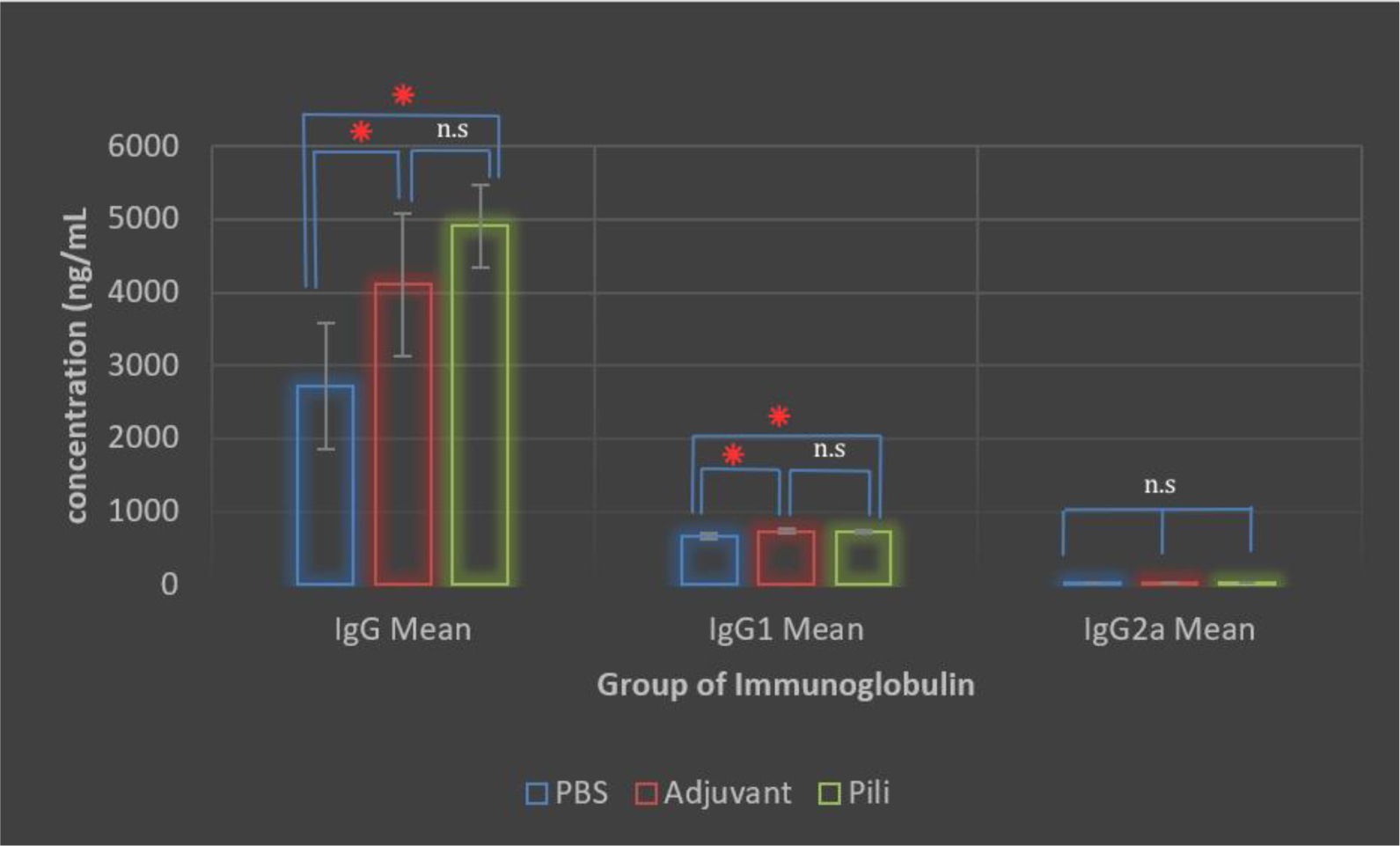
Klebsiella pneumoniae is a significant etiological agent of both community-acquired and nosocomial infections, characterized by its pronounced vulnerability to drug resistance. Preventive measures, such as vaccine research, are essential since no effective and viable vaccine currently exists. Pili, a critical virulence component in Klebsiella pneumoniae, promote bacterial adherence and have very low variability relative to other virulence factors, rendering them a viable target for vaccination. The 65.5 kDa pili protein has been recognized as a possible antigen owing to its significant antigenicity. This study sought to assess the immunogenic response by quantifying IgG, IgG1, and IgG2a levels in BALB/c mice following the delivery of the 65.5 kDa pili protein. A total of 24 mice were categorized into three groups: PBS, adjuvant, and pili. Serum concentrations of IgG, IgG1, and IgG2a were assessed via ELISA. Statistical analysis was conducted utilizing the ANOVA test with a 95% confidence interval. The data indicate that vaccination with the 65.5 kDa pili protein elicits a robust humoral immune response characterized by increased IgG and IgG1 production, suggesting a Th2-biased response, while showing no significant impact on IgG2a levels, which are typically associated with Th1-mediated immunity. In summary, the 65.5 kDa pili protein shows promise as a vaccine candidate for Klebsiella pneumoniae by inducing a strong IgG and IgG1-mediated immunological response in BALB/c mice. Future studies should use flow cytometry to assess immune cell activation, cytokine profiling for Th1/Th2 responses, and antigen-specific assays to explore T-cell activation. Research on dose optimization, adjuvant screening, immunity duration, and challenge studies with virulent Klebsiella pneumoniae is crucial. Proteomic analysis and epitope mapping can aid in refining vaccine design.
Citation: Dini Agustina, Diana Chusna Mufida, Yunita Armiyanti, M. Ali Shodikin, Enny Suswati, Muhammad Farhan Hibatulloh, Shafrizal Aufal Ikhsani, Virly Kania Mitananda, Priska Liana Lutianto. Immunogenic potential of 65.5 kDa pili protein of Klebsiella pneumoniae: Evaluation of IgG, IgG1, and IgG2a levels in BALB/c mice[J]. AIMS Allergy and Immunology, 2025, 9(3): 144-155. doi: 10.3934/Allergy.2025011
Klebsiella pneumoniae is a significant etiological agent of both community-acquired and nosocomial infections, characterized by its pronounced vulnerability to drug resistance. Preventive measures, such as vaccine research, are essential since no effective and viable vaccine currently exists. Pili, a critical virulence component in Klebsiella pneumoniae, promote bacterial adherence and have very low variability relative to other virulence factors, rendering them a viable target for vaccination. The 65.5 kDa pili protein has been recognized as a possible antigen owing to its significant antigenicity. This study sought to assess the immunogenic response by quantifying IgG, IgG1, and IgG2a levels in BALB/c mice following the delivery of the 65.5 kDa pili protein. A total of 24 mice were categorized into three groups: PBS, adjuvant, and pili. Serum concentrations of IgG, IgG1, and IgG2a were assessed via ELISA. Statistical analysis was conducted utilizing the ANOVA test with a 95% confidence interval. The data indicate that vaccination with the 65.5 kDa pili protein elicits a robust humoral immune response characterized by increased IgG and IgG1 production, suggesting a Th2-biased response, while showing no significant impact on IgG2a levels, which are typically associated with Th1-mediated immunity. In summary, the 65.5 kDa pili protein shows promise as a vaccine candidate for Klebsiella pneumoniae by inducing a strong IgG and IgG1-mediated immunological response in BALB/c mice. Future studies should use flow cytometry to assess immune cell activation, cytokine profiling for Th1/Th2 responses, and antigen-specific assays to explore T-cell activation. Research on dose optimization, adjuvant screening, immunity duration, and challenge studies with virulent Klebsiella pneumoniae is crucial. Proteomic analysis and epitope mapping can aid in refining vaccine design.

| [1] | Janakiram B, Shanthikrupa D, Naveena Lavanya Latha J (2023) Monitoring MDR evolution and transmission dynamics of MDR Klebsiella Pneumonia. J Bacteriol Mycol 10. https://doi.org/10.26420/jbacteriolmycol.2023.1203 |
| [2] |
Asha A, Karnaker VK, Rai R (2017) Characterization and antibiogram of Klebsiellae isolated from clinical samples. Int J Curr Microbiol Appl Sci 6: 386-396. https://doi.org/10.20546/ijcmas.2017.607.046 
|
| [3] | Subbarayudu S, Rao US, Ravichitra KN (2014) Isolation and antibiotic sensitivity of Klebsiella Pneumoniae from pus, sputum and urine samples. Int J Curr Microbiol App Sci 3: 115-119. |
| [4] |
Pitout JDD, Nordmann P, Poirel L (2015) Carbapenemase-producing Klebsiella Pneumoniae, a key pathogen set for global nosocomial dominance. Antimicrob Agents Chemother 59: 5873-5884. https://doi.org/10.1128/AAC.01019-15
|
| [5] |
Di Pilato V, Pollini S, Miriagou V, et al. (2024) Carbapenem-resistant Klebsiella Pneumoniae: The role of plasmids in emergence, dissemination, and evolution of a major clinical challenge. Expert Rev Anti Infect Ther 22: 25-43. https://doi.org/10.1080/14787210.2024.2305854
|
| [6] |
Yabwa KG, Ajobiewe HF, Ajobiewe JO, et al. (2020) Prevalence of Klebsiella Pneumoniae infection in adults attending national hospital, Abuja, Nigeria. Sch J Appl Med Sci 8: 1667-1672. https://doi.org/10.36347/sjams.2020.v08i07.006
|
| [7] |
Soni DP, Nerurkar DA, Gandhi DV (2019) Klebsiella Pneumoniae, an important uropathogen: Prevalence and antimicrobial susceptibility pattern. Trop J Pathol Microbiol 5: 171-176. https://doi.org/10.17511/jopm.2019.i03.10
|
| [8] | Asri NAM, Ahmad S, Mohamud R, et al. (2021) Global prevalence of nosocomial multidrug-resistant Klebsiella Pneumoniae: A systematic review and meta-analysis. Antibiotics 10: 1-19. https://doi.org/10.3390/antibiotics10121508 |
| [9] |
Assoni L, Girardello R, Converso TR, et al. (2021) Current stage in the development of Klebsiella Pneumoniae vaccines. Infect Dis Ther 10: 2157-2175. https://doi.org/10.1007/s40121-021-00533-4
|
| [10] |
Lundberg U, Senn BM, Schuler W, et al. (2013) Identification and characterization of antigens as vaccine candidates against Klebsiella Pneumoniae. Hum Vaccin Immunother 9: 497-505. https://doi.org/10.4161/hv.23225
|
| [11] |
Miller JC, Cross AS, Tennant SM, et al. (2024) Klebsiella pneumoniae lipopolysaccharide as a vaccine target and the role of antibodies in protection from disease. Vaccines 12: 8-10. https://doi.org/10.3390/vaccines12101177
|
| [12] |
Limbago BM, Rasheed JK, Anderson KF, et al. (2011) IMP-producing carbapenem-resistant Klebsiella pneumoniae in the United States. J Clin Microbiol 49: 4239-4245. https://doi.org/10.1128/JCM.05297-11
|
| [13] | Xie J, Wang H, Ma R, et al. (2025) The molybdate transport protein ModA regulates nitrate reductase activity to increase the intestinal colonization and extraintestinal dissemination of Klebsiella pneumoniae in the inflamed gut. Virulence 16. https://doi.org/10.1080/21505594.2025.2474185 |
| [14] |
Zhang F, Meng Y, Xu L, et al. (2022) KbvR mutant of Klebsiella pneumoniae affects the synthesis of type 1 fimbriae and provides protection to mice as a live attenuated vaccine. Vet Res 53: 97. https://doi.org/10.1186/s13567-022-01116-y
|
| [15] |
Liu L, Li F, Xu L, et al. (2020) Cyclic AMP-CRP modulates the cell morphology of Klebsiella pneumoniae in high-glucose environment. Front Microbiol 10: 1-13. https://doi.org/10.3389/fmicb.2019.02984
|
| [16] | Xu L, Wang M, Yuan J, et al. (2021) The KbvR regulator contributes to capsule production, outer membrane protein biosynthesis, antiphagocytosis, and virulence in Klebsiella pneumoniae. Infect Immun 89. https://doi.org/10.1128/IAI.00016-21 |
| [17] | Wang M, Tian Y, Xu L, et al. (2022) High osmotic stress increases OmpK36 expression through the regulation of KbvR to decrease the antimicrobial resistance of Klebsiella pneumoniae. Microbiol Spectr 10. https://doi.org/10.1128/spectrum.00507-22 |
| [18] | Fa'idha A, Mufida D, Febianti Z (2020) Peran protein hemaglutinin pili Streptococcus Pneumoniae 54 kDa sebagai adhesin. J Ilm Kesehat 13: 194-203. https://doi.org/10.33086/jhs.v13i2.1442 |
| [19] |
Finka R, Agustina D, Rachmawati DA, et al. (2019) The role of pili protein 38,6 kDa Klebsiella pneumoniae as a hemagglutinin and adhesin protein which serves as a virulence factor. J Agromedicine Med Sci 5: 9. https://doi.org/10.19184/ams.v5i2.9558
|
| [20] |
Agustina D, Jiwangga B, Nurdian Y, et al. (2023) Effect of exposure pili protein 65.5 kDa Klebsiella pneumoniae on interferon gamma levels. Biomol Heal Sci J 6: 64. https://doi.org/10.4103/bhsj.bhsj_32_22
|
| [21] | GeBAMini GeBAflex-tube (250 µL) gel extraction and dialysis kit handbook table (2019). |
| [22] | Greenfield EA (2019) Preparing and using adjuvants. Cold Spring Harb Protoc 2019. https://doi.org/10.1101/pdb.prot100214 |
| [23] | Greenfield EA (2020) Standard immunization of mice, rats, and hamsters. Cold Spring Harb Protoc 2020. https://doi.org/10.1101/pdb.prot100297 |
| [24] | Arifin WN, Zahiruddin WM (2017) Sample size calculation in animal studies using resource equation approach. Malaysian J Med Sci 24: 101-105. https://doi.org/10.21315/mjms2017.24.5.11 |
| [25] | IAUCCVerterbrate animal research: Anesthesia (guideline) (2023). Available from: https://animal.research.uiowa.edu/iacuc-guidelines-anesthesia |
| [26] |
Arato V, Raso MM, Gasperini G, et al. (2025) Prophylaxis and treatment against Klebsiella pneumoniae: Current insights on this emerging anti-microbial resistant global threat. Int J Mol Sci 22: 4042. https://doi.org/10.3390/ijms22084042
|
| [27] | Bayart JL, Douxfils J, Gillot C, et al. Waning of IgG, total and neutralizing antibodies 6 months post-vaccination with BNT162b2 in healthcare workers (2021). https://doi.org/10.21203/rs.3.rs-862966/v1 |
| [28] | Vaillant JAA, Sabir S, Jan A (2024) Physiology, Immune Response. Florida: StatPearls Publishing. Available from: https://www.ncbi.nlm.nih.gov/books/NBK539801/ |
| [29] |
Sarvas HO, Seppälä IJT, Tähtinen T, et al. (1983) Mouse IgG antibodies have subclass associated affinity differences. Mol Immunol 20: 239-246. https://doi.org/10.1016/0161-5890(83)90062-7
|
| [30] | Abbas A, Lichtman A, Pillai S (2022) Cellular and Molecular Immunology. Pennsylvania: Jeremy Bowes. |
| [31] |
Agustina D (2017) Deteksi immunoglobulin G dengan immunoblotting pasca imunisasi subkutan protein hemaglutinin pili Klebsiella pneumoniae 12,8 kDa pada mencit BALB/c. J Agromedicine Me Sci 3: 40-46. https://doi.org/10.19184/ams.v3i2.5069
|
| [32] |
Putra Uta DR, Mufida DC, Sutejo IR, et al. (2024) Increased levels of IL-4 in the spleen of BALB/c mice after 65.5 kDa pili protein Klebsiella pneumoniae immunization. Med Lab Technol J 10: 55-62. https://doi.org/10.31964/mltj.v10i1.575
|
| [33] | Zhang BZ, Hu D, Dou Y, et al. (2021) Identification and evaluation of recombinant outer membrane proteins as vaccine candidates against Klebsiella pneumoniae. Front Immunol 12. https://doi.org/10.3389/fimmu.2021.730116 |
| [34] | Care IA UCGuidelines for the use of adjuvants in research special emphasis on Freund's adjuvant (2017). |
| [35] |
Martiñón S, Cisneros A, Villicaña S, et al. (2019) Chemical and immunological characteristics of aluminum-based, oil-water emulsion, and bacterial-origin adjuvants. J Immunol Res 2019. https://doi.org/10.1155/2019/3974127
|
| [36] |
Dubé J yves, Mcintosh F, Zarruk JG, et al. (2020) Synthetic mycobacterial molecular patterns partially complete Freund's adjuvant. Sci Rep 10: 5874. https://doi.org/10.1038/s41598-020-62543-5
|
| [37] |
Wei S, Xu T, Chen Y, et al. (2023) Autophagy, cell death, and cytokines in K. pneumoniae infection: Therapeutic perspectives. Emerg Microbes Infect 12: 2140607. https://doi.org/10.1080/22221751.2022.2140607
|
| [38] |
Park JC, Han JW, Lee SK, et al. (2022) T helper cell pathology and recurrent pregnancy losses; Th1/Th2, Treg/Th17, and other T cell responses. Immunology of Recurrent Pregnancy Loss and Implantation Failure . New York: Academic Press 27-53. https://doi.org/10.1016/B978-0-323-90805-4.00019-5
|
| [39] |
Piccinni MP, Lombardelli L, Logiodice F, et al. (2015) T helper cell mediated-tolerance towards fetal allograft in successful pregnancy. Clin Mol Allergy 13: 9. https://doi.org/10.1186/s12948-015-0015-y
|
| [40] |
Beukema M, Gong S, Al-Jaawni K, et al. (2023) Prolonging the delivery of influenza virus vaccine improves the quantity and quality of the induced immune responses in mice. Front Immunol 14. https://doi.org/10.3389/fimmu.2023.1249902
|
| [41] |
Zissler UM, Chaker AM, Effner R, et al. (2016) Interleukin-4 and interferon-γ orchestrate an epithelial polarization in the airways. Mucosal Immunol 9: 917-926. https://doi.org/10.1038/mi.2015.110
|
| [42] |
Lazarski CA, Ford J, Katzman SD, et al. (2013) IL-4 attenuates Th1-associated chemokine expression and Th1 trafficking to inflamed tissues and limits pathogen clearance. PLoS One 8: e71949. https://doi.org/10.1371/journal.pone.0071949
|
| [43] | Sa'adah AS, Mufida DC, Dini Agustina, et al. (2024) Effect of immunization of the pili protein 65.5 kDa Klebsiella pneumoniae on IFN-Î3 levels of spleen BALB/c mice. Indones J Trop Infect Dis 12: 92-99. https://doi.org/10.20473/ijtid.v12i2.54026 |
| [44] |
Chen Z, Gou Q, Yuan Y, et al. (2024) Vaccination with a trivalent Klebsiella pneumoniae vaccine confers protection in a murine model of pneumonia. Vaccine 42: 126217. https://doi.org/10.1016/j.vaccine.2024.126217
|
| [45] |
Babu L, Uppalapati SR, Sripathy MH, et al. (2017) Evaluation of recombinant multi-epitope outer membrane protein-based Klebsiella pneumoniae subunit vaccine in mouse model. Front Microbiol 8: 258249. https://doi.org/10.3389/fmicb.2017.01805
|
| [46] |
Hussein KE, Bahey-el-din M, Sheweita SA (2018) Immunization with the outer membrane proteins OmpK17 and OmpK36 elicits protection against Klebsiella penumoniae in the murine infection model. Microb Pathog 119: 12-18. https://doi.org/10.1016/j.micpath.2018.04.004
|
| [47] |
Hou N, Zhang X, Zhao L, et al. (2013) A novel chronic stress-induced shift in the Th1 to Th2 response promotes colon cancer growth. Biochem Biophys Res Commun 439: 471-476. https://doi.org/10.1016/j.bbrc.2013.08.101
|
| [48] |
Hylander BL, Gordon CJ, Repasky EA (2019) Manipulation of ambient housing temperature to study the impact of chronic stress on immunity and cancer in mice. J Immunol 202: 631-636. https://doi.org/10.4049/jimmunol.1800621
|
| [49] |
Bucsek MJ, Qiao G, MacDonald CR, et al. (2017) β-Adrenergic signaling in mice housed at standard temperatures suppresses an effector phenotype in CD8+ T cells and undermines checkpoint inhibitor therapy. Cancer Res 77: 5639-5561. https://doi.org/10.1158/0008-5472.CAN-17-0546
|
| [50] |
Estrada LD, Ağaç D, Farrar JD (2016) Sympathetic neural signaling via the β2-adrenergic receptor suppresses T-cell receptor-mediated human and mouse CD8+ T-cell effector function. Eur J Immunol 46: 1948-1958. https://doi.org/10.1002/eji.201646395
|
| [51] | Sharkey RM, Natale A, Goldenberg DM, et al. (1991) Rapid blood clearance of immunoglobulin G2a and immunoglobulin G2b in nude mice. Cancer Res 51: 3102-3107. https://doi.org/10.1002/ijc.2910510216 |
 allergy-09-03-011-s001.pdf allergy-09-03-011-s001.pdf |
 |
Figures(1) / Tables(1)

Dini Agustina, Diana Chusna Mufida, Yunita Armiyanti, M. Ali Shodikin, Enny Suswati, Muhammad Farhan Hibatulloh, Shafrizal Aufal Ikhsani, Virly Kania Mitananda, Priska Liana Lutianto. Immunogenic potential of 65.5 kDa pili protein of Klebsiella pneumoniae: Evaluation of IgG, IgG1, and IgG2a levels in BALB/c mice[J]. AIMS Allergy and Immunology, 2025, 9(3): 144-155. doi: 10.3934/Allergy.2025011





 DownLoad: